
Harley-Davidson XLCR 1977: The Most Unusual Harley of Its Decade Became a Victim of Its Own Design

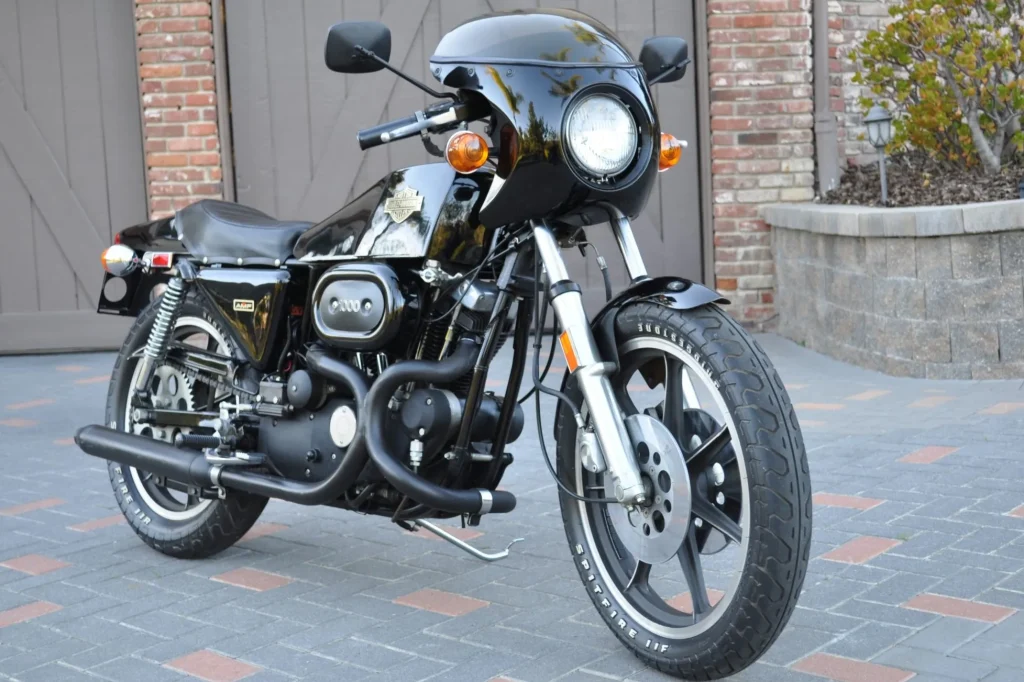
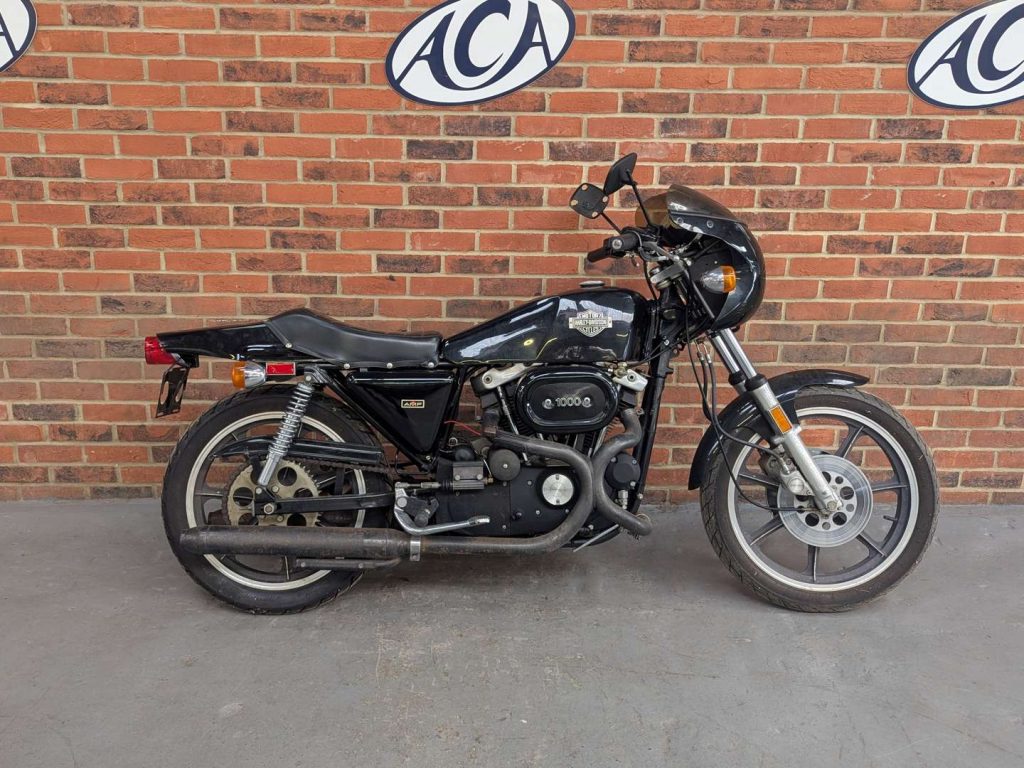
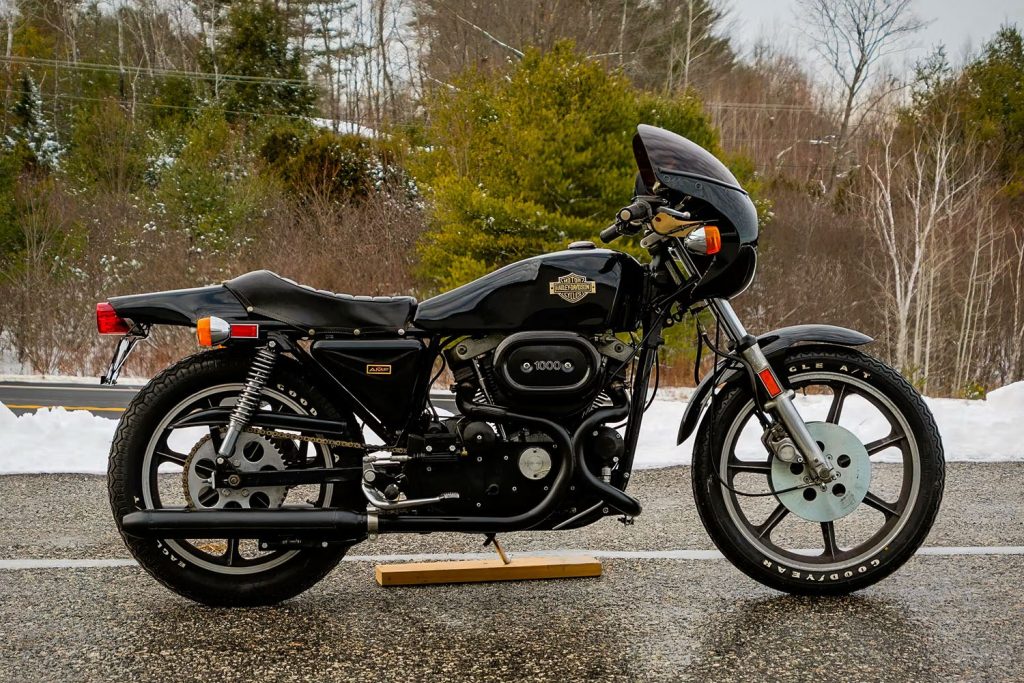
In 1977, Harley-Davidson put a motorcycle into dealerships that was almost impossible to mistake for any other Harley. Gone was the familiar shine of an American cruiser: nearly everything was black—the engine, frame, exhaust, fairing, fuel tank, and tail section. The low handlebars forced the rider forward, a small fairing wrapped around the headlight, Morris cast wheels and three disc brakes promised a very different kind of performance. Even the name left little room for interpretation: XLCR stood for XL Café Racer.
The motorcycle was certainly unusual. But its commercial failure is difficult to explain with the familiar story that Harley-Davidson had created something too advanced for the public of 1977. The market already knew perfectly well what a fast European-style road motorcycle was. BMW had the R90S, Moto Guzzi had the Le Mans, Ducati was producing the 900SS, and Japanese manufacturers were rapidly developing increasingly sophisticated performance machines.
The real problem was more interesting: the XLCR looked considerably more radical than it actually was mechanically.
And that is precisely what makes its story much more interesting than the usual tale of an unrecognized masterpiece.
Harley-Davidson in a Very Uncomfortable 1977
To understand the XLCR, it is necessary to look at the company that built it.
Harley-Davidson was then controlled by the AMF corporation, while the global market for large motorcycles was changing rapidly. Japanese manufacturers were no longer simply producing inexpensive alternatives to European motorcycles. Honda, Kawasaki, Suzuki, and Yamaha had learned how to manufacture powerful, fast, technically sophisticated machines in enormous numbers.
For Harley-Davidson, the situation was particularly uncomfortable. The company’s principal sporting road motorcycle was still the Sportster, a machine whose lineage stretched back to the 1950s.
Its 45-degree V-twin was charismatic, torquey, and unmistakably American, but competing purely on performance with the latest multi-cylinder Japanese engines was becoming increasingly difficult. Even later historical assessments by Cycle World noted that by the mid-1970s the Sportster was falling behind the rapidly rising standards established by Japanese motorcycles.
Harley needed something different.
Not necessarily an entirely new engine or a clean-sheet platform—both would have required enormous investment. There was another possibility: use the components already available in a radically different way.
This is where Willie G. Davidson entered the story.
A Motorcycle That Began Almost Like a Factory Custom
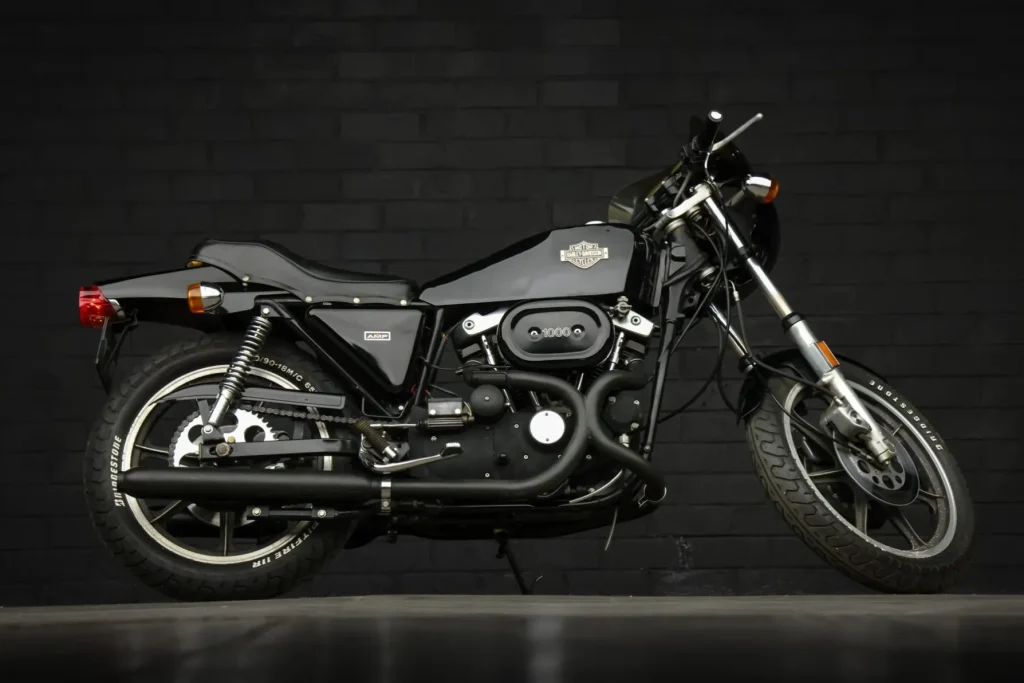
The origins of the XLCR are somewhat more complicated than the attractive corporate legend in which Willie G. simply built a motorcycle for himself, management happened to see it, and the company immediately decided to put it into production.
Willie G. Davidson certainly played the central role, but the project was developed together with engineer Bob Modero and prototype builder Jim Haubert.
Work began around 1974. The Sportster provided the foundation, but the rear section of the frame was modified with inspiration from the racing XR-750. The first prototype was completed in early 1975, followed by pre-production motorcycles and further testing.
The concept itself was relatively straightforward.
Take the sportiest Harley already in production, lower the riding position, introduce elements inspired by the American flat-track XR-750 and European café racers, eliminate almost all the chrome, and create an entirely new visual identity without developing a completely new motorcycle from scratch.
From a styling perspective, the result was remarkably successful.
And this is where the XLCR’s central contradiction begins.
It Looked Faster Than It Was
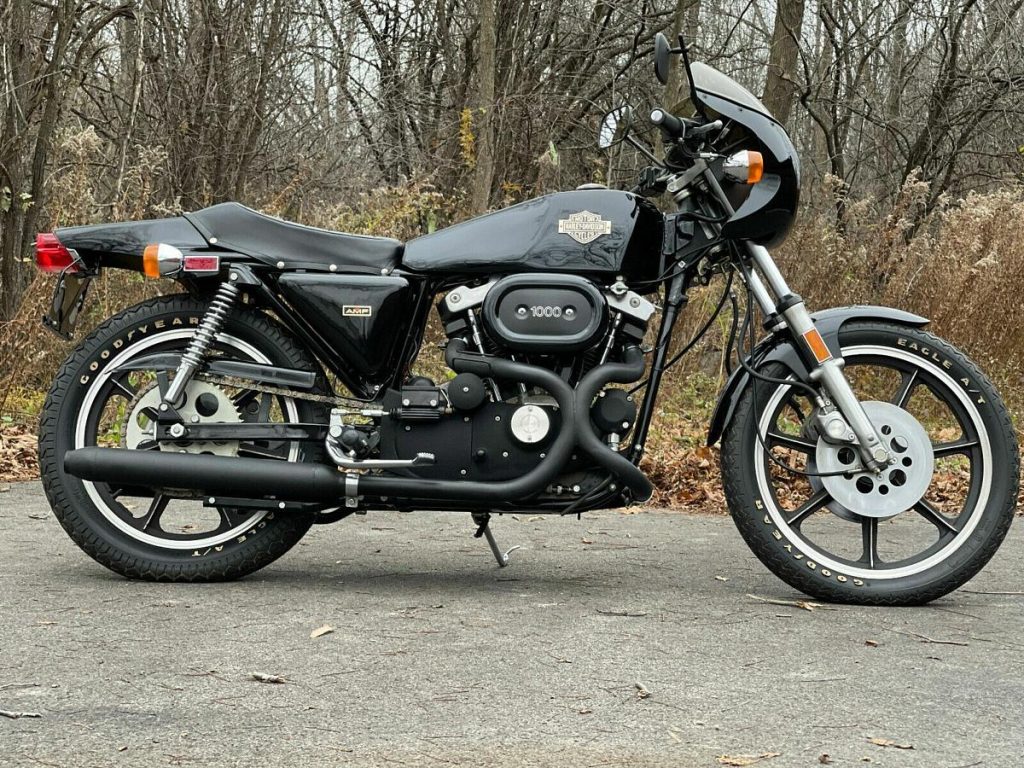
Place a conventional 1977 Sportster beside an XLCR and the latter appears to belong to another generation.
The blacked-out engine, compact front fairing, elongated fuel tank, solo seat with its distinctive tail section, seven-spoke Morris cast wheels, low handlebars, triple disc brakes, and long black exhaust system gave it a genuinely aggressive appearance.
But remove the fiberglass bodywork and the revolution becomes considerably less dramatic.
Underneath, it was still fundamentally a Sportster.
The air-cooled, 45-degree OHV V-twin displaced 997 cc. It used a 38 mm Keihin carburetor, a four-speed gearbox, and chain final drive.
Claimed output was approximately 61 hp at 6,200 rpm, although higher factory figures can also be found in period material. Later dyno testing cited by Motorcycle Classics recorded roughly 44 hp at the rear wheel. Wet weight was approximately 234 kg.
That made the XLCR a fairly heavy café racer.
Yet calling it slow would be equally misleading.
In Cycle World’s period testing, it covered the standing quarter-mile in 13.08 seconds at 99.66 mph. Harley-Davidson’s own riders recorded 12.79 seconds at another track, although the magazine quite reasonably declined to compare that figure directly with its standardized testing.
For a mid-1970s Harley-Davidson, that was serious performance.
For the entire motorcycle market of 1977, however, it was no longer enough to settle the argument.
The Engine Wasn’t Its Biggest Problem
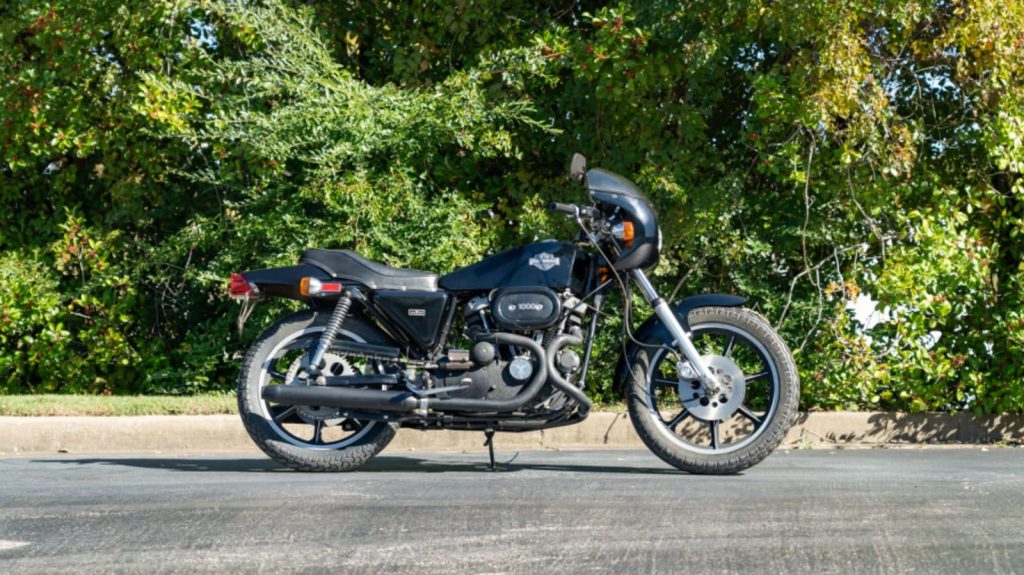
The most revealing way to understand the XLCR is not through modern collector commentary but through contemporary road tests.
Cycle World found a rather contradictory motorcycle. It held its line well through fast, sweeping corners, produced strong low-end torque, and was less cumbersome than its appearance and weight suggested.
But when ridden truly aggressively, the underlying nature of the chassis began to reveal itself.
The front end was derived from the Sportster, while the rear had been reworked with influence from the XR-750. The suspension remained relatively stiff, available travel was limited, and under extreme loads the different parts of the chassis did not always seem to work in complete harmony.
The braking system was particularly revealing.
On paper, it looked impressive: two discs at the front and one at the rear. For Harley-Davidson, this represented a significant advance.
Yet Cycle World recorded a stopping distance of approximately 201 feet—61 meters—from 60 mph. The magazine attributed much of the problem to extremely hard brake-pad material that required considerable lever pressure.
That was the essence of the XLCR.
Visually, it promised something approaching a racing Harley. Mechanically, it remained a very fast and dramatically restyled relative of the Sportster.
Harley-Davidson XLCR 1000 Specifications
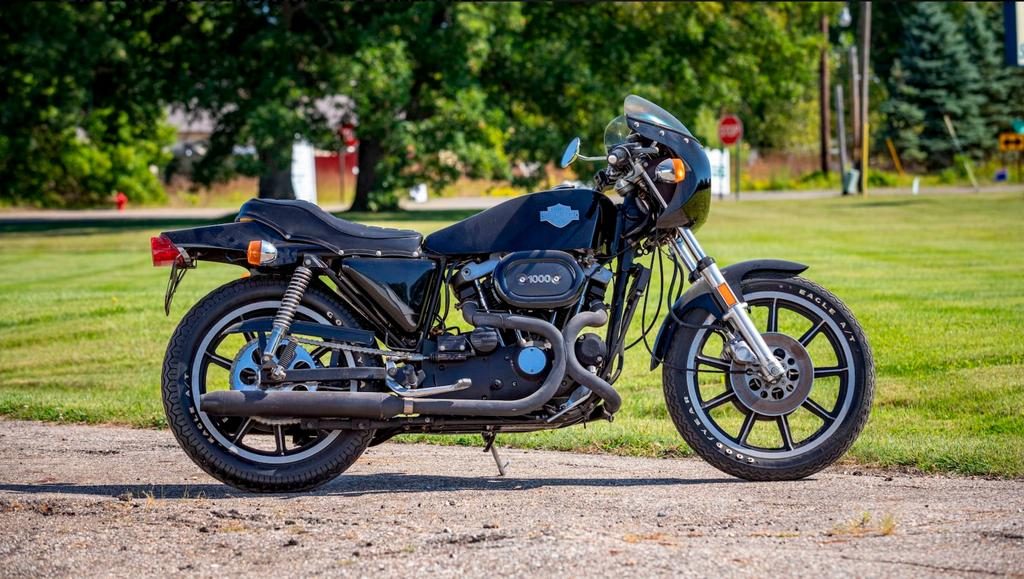
| Manufacturer | Harley-Davidson |
| Model | XLCR 1000 Café Racer |
| Production Years | 1977–1979 |
| Engine | 45° V-twin, OHV, air-cooled |
| Displacement | 997 cc |
| Bore × Stroke | 81 × 96.8 mm |
| Compression Ratio | 9:1 |
| Carburetor | 38 mm Keihin |
| Claimed Power | Approx. 61 hp at 6,200 rpm |
| Transmission | 4-speed |
| Final Drive | Chain |
| Front Wheel | 19 inches |
| Rear Wheel | 18 inches |
| Brakes | Twin front discs, single rear disc |
| Wet Weight | Approx. 234 kg |
| Fuel Capacity | Approx. 15 liters |
| Quarter Mile | 13.08 sec in Cycle World testing |
| Top Speed | Approx. 170–177 km/h (106–110 mph) in period testing |
| 1977 Price | $3,595 |
$3,595 Was Another Problem
In 1977, the XLCR cost $3,595.
That mattered.
A buyer saw a Harley that looked like a serious café racer, but if outright speed and handling were the primary objectives, the market already offered numerous formidable alternatives.
Meanwhile, the traditional Harley customer had to be convinced why he needed low handlebars, a forward-leaning riding position, a relatively stiff chassis, solo-seat styling, and almost none of the visual language for which he normally bought a motorcycle from Milwaukee.
The XLCR therefore found itself caught between two well-established groups of customers.
But even here, saying that «people didn’t understand it» oversimplifies the story.
They understood it perfectly well.
They simply did not all want to pay for it.
In fact, the initial response from the public and dealers was far from negative. When the motorcycle was first shown, interest was strong enough to convince Harley-Davidson that production was worthwhile. Contemporary Cycle World coverage in late 1976 specifically noted the positive reaction from both dealers and the public.
The difficulties came afterward—when the dramatic new Harley had to be compared with its competitors and sold for real money.
How Many XLCRs Were Actually Built?
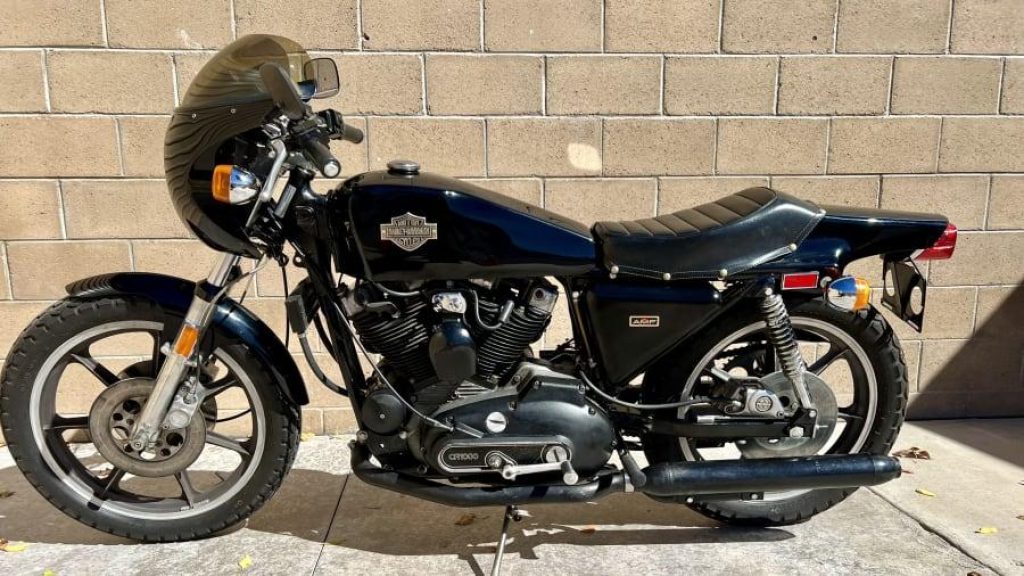
There is another interesting source of confusion surrounding the motorcycle.
Popular accounts frequently claim that approximately 3,000 XLCRs were produced. More detailed sources, however, give a lower total: 1,923 examples between 1977 and 1979, a figure cited by Motorcycle Classics.
Most were produced during the first two years, while the final motorcycles remained in the dealer network after the model’s commercial fate had effectively been decided.
For Harley-Davidson, it was a very small production run.
Yet the program was not entirely wasted.
Some of the XLCR’s engineering solutions subsequently migrated into the regular Sportster family. Cycle World later noted that the 1979 Sportster received an improved chassis that effectively developed ideas introduced with the Café Racer.
In other words, the money spent on the XLCR did not merely produce a dramatic black body kit.
Why the XLCR Occupies a Very Different Place in Harley History Today
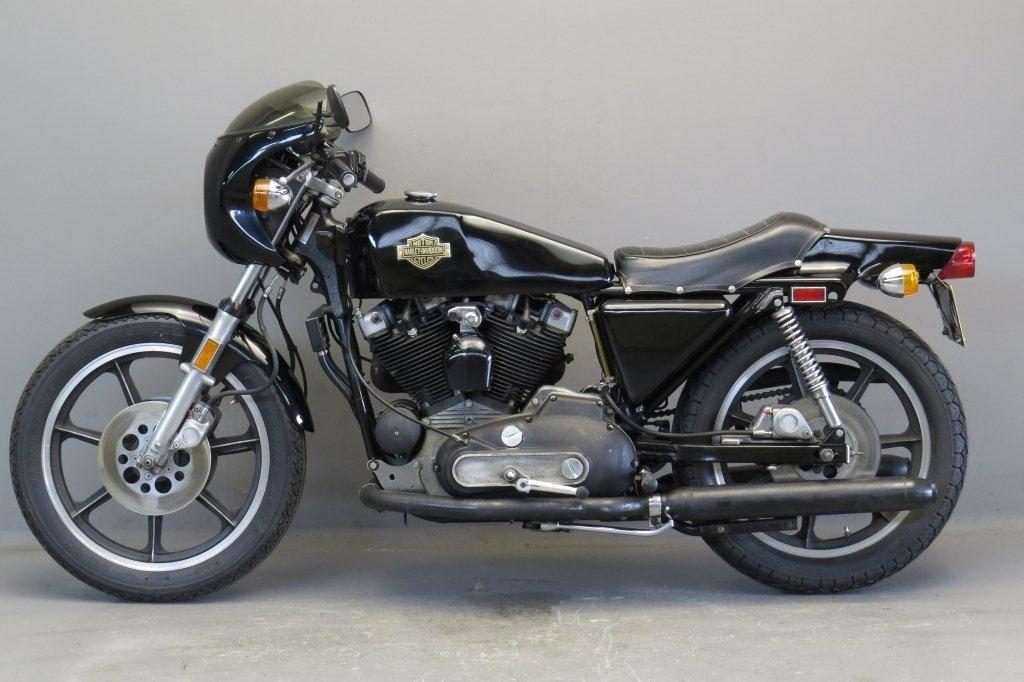
Nearly half a century later, the XLCR no longer has to compete against new Kawasakis, BMWs, or Ducatis.
And its weaknesses are no longer the primary measure of its value.
What matters today is how far Harley-Davidson allowed itself to move away from its established identity. The XLCR almost demonstratively rejected the familiar chrome-heavy American motorcycle aesthetic. Its black exhaust system, angular fuel tank, abbreviated tail, Morris wheels, and small fairing created a design that remains difficult to confuse with anything else.
There is also a revealing indication of how its creator regarded the motorcycle. Willie G. Davidson kept the first production XLCR for himself and later gave XLCRs to his sons as graduation presents.
For collectors, the combination of unusual styling, limited production, and the XLCR’s peculiar place in the AMF-era Harley-Davidson story matters far more today than its 1977 braking distances.
That is how a commercially unsuccessful model became one of the most recognizable collectible Harleys of its generation.
The XLCR Wasn’t Too Early. Its Styling Simply Made a Bigger Promise
It is tempting to end the Harley-Davidson XLCR story by describing it as a motorcycle that arrived before its time.
The problem is that 1977 was actually an excellent time to build a café racer.
BMW had already produced the R90S. Moto Guzzi had the Le Mans. Ducati was building sporting V-twins. Japanese manufacturers were rapidly raising expectations for horsepower, reliability, braking, and handling.
The world was entirely ready for a sporting road motorcycle.
The XLCR simply offered something different.
Harley-Davidson took old, deeply characteristic American mechanical hardware and attempted to make it speak the visual language of European café racers and American dirt-track racing. The result was a motorcycle whose appearance promised more than its engine, brakes, and chassis could consistently deliver.
Yet that contradiction is exactly what preserved the XLCR’s place in history.
Had Harley-Davidson simply produced another average Sportster in 1977, it would now be remembered mainly by specialists and owners. Instead, the company built a black, noisy, heavy, unmistakably different motorcycle that looked unlike almost anything else carrying the Harley-Davidson name.
It was not the best café racer of its era.
But almost fifty years later, a Harley-Davidson XLCR is still impossible to mistake for anything else.
