
Upton’s Breakthrough: How a 24-Year-Old Colonel Found a Way Through the Trenches — and Why It Still Failed

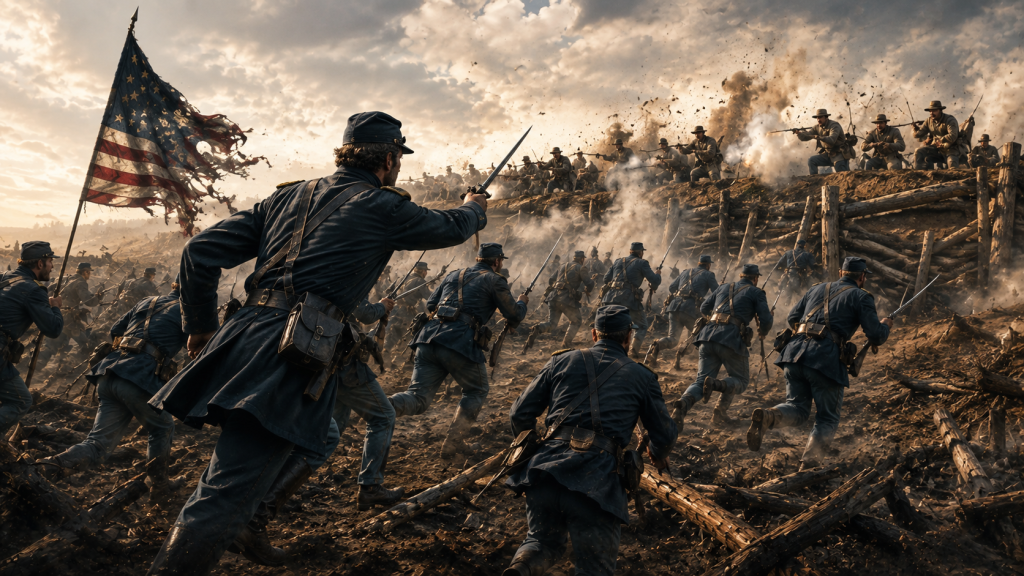
On May 10, 1864, roughly five thousand Union soldiers emerged from the woods near Spotsylvania and charged toward the Confederate trenches. About 200 yards — roughly 180 meters — of open ground separated them from the enemy. Ahead stood earthworks, artillery, and infantry capable of turning a conventional assault into a massacre within minutes. Yet Colonel Emory Upton ordered his men to do something almost unnatural for infantry under fire:
Do not stop. Do not engage in a firefight.
Within minutes, the Confederate defenses had been breached.
Union troops seized the first line of earthworks, penetrated toward the second, captured artillery pieces, and took hundreds of prisoners. The experiment devised by the 24-year-old colonel worked so well that Ulysses S. Grant almost immediately decided to repeat it on a much larger scale.
Yet by the end of the evening, Upton’s men were essentially back where they had started.
They had lost around a thousand men, the captured positions had been abandoned, and the Confederates had restored their defensive line.
At first glance, it looks like just another failed assault of the American Civil War.
In reality, something much more interesting had happened.
Upton had solved one of the problems that increasingly plagued nineteenth-century armies: how infantry could cross a killing zone and penetrate a fortified position. But almost immediately, he encountered the next problem — what to do after the defenses had been breached.
That is what makes the attack at Spotsylvania important. Not because Upton somehow invented twentieth-century assault tactics, but because it illustrates a moment when warfare was beginning to change faster than armies could change the way they fought.
The Rifle Changed. The Assault Barely Did
By the middle of the nineteenth century, European and American armies found themselves in a peculiar situation.
Infantry weapons were improving rapidly. Rifled muskets offered much greater potential range and accuracy than smoothbore weapons. Artillery was also becoming increasingly effective. At the same time, field fortifications could be constructed within hours: an earthen parapet, logs, abatis in front of the position — and an ordinary infantry line suddenly became an extremely difficult target.
The American Civil War became an enormous laboratory in which these developments collided with tactical habits inherited from an earlier age.
By 1864, the problem had become particularly obvious.
That spring, Ulysses S. Grant, now commanding all Union armies, accompanied George Meade’s Army of the Potomac into the Overland Campaign, attempting to impose a continuous series of battles on Robert E. Lee’s Army of Northern Virginia. After the horrific fighting in the Wilderness, Grant did not retreat north as some of his predecessors had done. Instead, he continued south.
The next major confrontation came at Spotsylvania Court House.
The Confederates reached the area first and began digging in.
Their defensive system developed an unusual shape. A huge salient roughly a mile deep projected forward from the main line and became known as the Mule Shoe. The salient allowed the Confederates to hold important terrain, but it also created vulnerabilities: any projection in a defensive line could potentially be attacked from several directions, while its shape complicated the movement of reserves.
On the western side of the Mule Shoe, another weakness appeared.
The woods extended relatively close to the Confederate positions.
Only about 200 yards of open ground separated the trees from the earthworks.
That was where Emory Upton looked.
The Colonel Was Only Twenty-Four
By then, Upton was anything but an inexperienced young officer.
Born in New York State in 1839 to a farming family, he briefly attended Oberlin College before entering West Point. He graduated in May 1861 — almost exactly as the Civil War was beginning.
His career then advanced at extraordinary speed.
Upton served first in artillery and later in infantry, participated in major battles in the Eastern Theater, and by 1862 had become colonel of the 121st New York Infantry. By the spring of 1864, he was not yet twenty-five years old, but he was already commanding a brigade and possessed extensive combat experience.
More importantly, he had been watching carefully what happened when infantry attacked.
The problem was not merely the firepower of the defenders.
It was also the mechanics of the assault itself.
A deployed infantry line allowed large numbers of soldiers to fire simultaneously, but it was difficult to maintain across broken terrain. Under fire, formations became disorganized. Men stopped and fired back. Officers lost control. An advancing force could gradually turn into a firing line exchanging shots with an enemy protected behind earthworks.
That was precisely what Upton wanted to avoid.
His basic idea was simple:
If the objective is to capture the fortification, the first priority is to reach it.
Not to win a firefight.
Not to force the defenders back through superior musketry.
But to move enough men across those dangerous 200 yards and physically place them inside the enemy defenses before the defenders could stop them.
To accomplish this, Upton intended to sacrifice frontage in favor of depth, speed, and concentration.
Twelve Regiments Instead of One Long Line
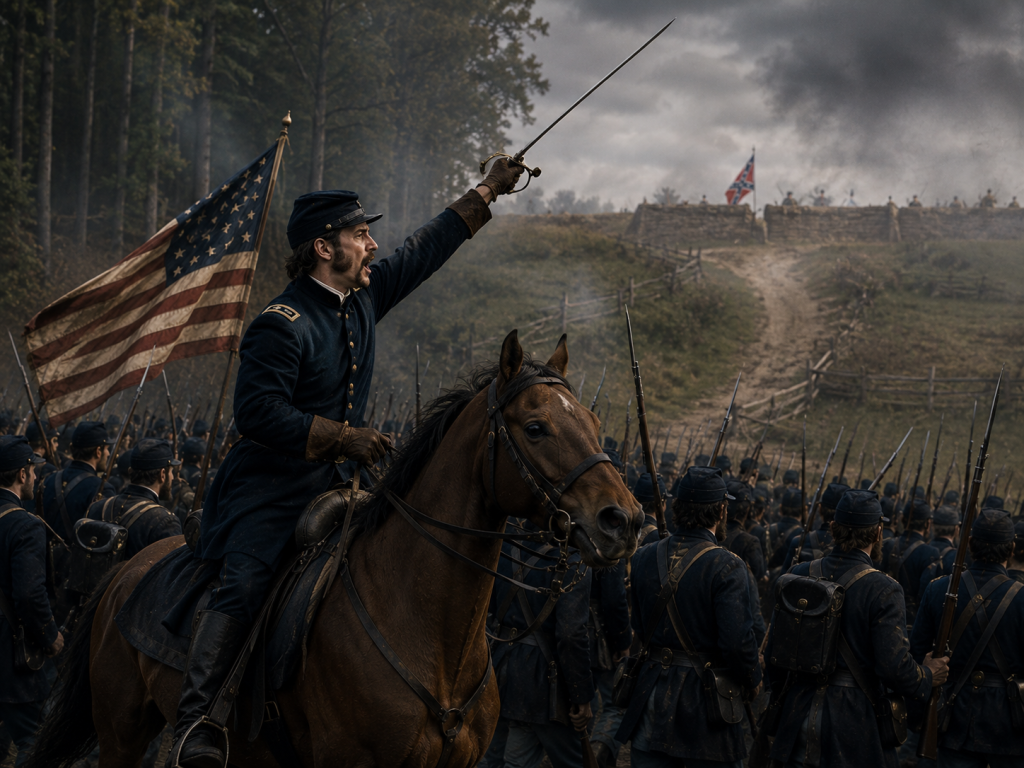
Upton was given twelve selected regiments — roughly 4,500 to 5,000 men.
He had no intention of deploying them in one enormous thin line.
His formation was completely different.
Four lines.
Three regiments in each.
The result was a deep, compact mass of infantry aimed at a relatively narrow section of the Confederate defenses.
But even more important was the fact that different elements had specific assignments.
The first line was to break through the earthworks. Once inside, units were to turn along the Confederate trenches and clear them to the right and left. The following lines would support the assault and continue forward. The final line would remain in reserve.
Upton was therefore trying to solve one of the problems that ruined many successful assaults: thousands of men might reach an enemy position at the same time and immediately turn into a disorganized crowd.
His crowd was supposed to remain a system.
There was another unusual order as well.
Contrary to a frequently repeated version of the story, Upton did not order the percussion caps removed from every musket. The first three regiments advanced with loaded weapons ready to fire. The second, third, and fourth lines, however, were indeed ordered not to cap their weapons.
The reason was intensely practical.
Upton did not want his men to stop.
Once a soldier fired his first shot, the natural response was to reload. Then fire again. Very quickly, the attacking column could become just another firing line stalled in front of the Confederate parapet.
Upton did not want a firefight.
He wanted speed.
Officers were instructed to keep repeating one command:
Forward.
Do not stop to shoot.
Do not stop for the wounded.
Reach the fortifications.
Then use the bayonet.
Two Hundred Yards
On the evening of May 10, Union artillery began preparing the attack.
At around 6:30 p.m., the guns fell silent.
Upton’s men emerged from the woods.
Facing them was the Georgia brigade of Brigadier General George Doles. The defenders spotted the advancing Federals almost immediately and opened fire.
But exactly what Upton had hoped for happened.
The Union troops did not stop.
The distance was simply too short.
The leading units crossed roughly 200 yards in about a minute. Then thousands of soldiers crashed simultaneously into a relatively narrow section of the Confederate position.
The first line went over the parapets.
Hand-to-hand fighting began.
The following regiments poured into the breach. Some units turned along the trenches while others continued deeper into the position. Four artillery pieces were captured. The attackers reached the secondary defensive line and penetrated almost to the center of the Mule Shoe.
Approximately a thousand Confederate soldiers were captured.
Only minutes earlier, Upton had faced an apparently continuous fortified line of the Army of Northern Virginia.
Now there was a large hole in it.
The tactical experiment had worked.
And that was precisely when the defeat began.
Breaking the Line Was Not Enough
There was a crucial element in Upton’s plan.
His twelve regiments were not supposed to win the battle by themselves.
They were the battering ram.
Once the breach had been created, fresh troops were supposed to move through it and transform a local tactical success into a genuine breakthrough.
Gershom Mott’s division of the II Corps was supposed to support the operation.
But one of the oldest problems in warfare intervened — poor coordination.
The timetable for the broader attack changed, but Mott was not informed in time. His division advanced earlier, around 5 p.m., came under heavy fire, and was repulsed.
When Upton launched his successful assault roughly an hour and a half later, the troops that were supposed to exploit his breakthrough had effectively already been removed from the equation.
The result was an almost perfect demonstration of the difference between two concepts:
penetrating a position and exploiting the penetration.
Upton had solved the first problem.
He no longer had enough troops to solve the second.
His men were now deep inside the Confederate defenses. They had suffered serious casualties, units had become intermixed, and the original momentum of the assault was fading.
The Confederates, meanwhile, still possessed reserves.
Lee began moving troops toward the threatened sector. Counterattacks followed. Artillery positioned farther inside the salient also began firing on the Union troops who had penetrated the line.
Now time was working against Upton.
Every minute allowed the Confederates to close the breach.
Every minute reduced the likelihood that reinforcements would arrive.
By evening it had become clear: either the Federals withdrew immediately or a significant portion of Upton’s assault force risked being cut off.
Upton ordered a retreat.
His men returned almost to their original positions.
Roughly a thousand of the approximately five thousand attackers had been lost.
If we compare the battlefield maps from before and after the attack, it might seem that almost nothing had happened.
Grant saw something entirely different.
If Five Thousand Could Do It, What Could Twenty Thousand Do?
Before Upton’s attack, there had been a fundamental question:
Could such field fortifications be broken quickly at all?
After May 10, the answer was clear.
Yes.
The problem was exploiting the result before the enemy recovered.
Grant immediately began preparing another operation. This time, instead of several thousand soldiers, the Mule Shoe would be attacked by Winfield Scott Hancock’s entire II Corps — around 20,000 men.
Early on May 12, they struck.
The initial result was spectacular.
The Confederate defenses were penetrated and thousands of soldiers were captured. The situation became so dangerous that Lee’s army briefly faced the possibility of being split apart.
But then the same fundamental problem appeared again — only on a much larger scale.
Thousands of men were trying to move through a narrow section of the front.
Formations became mixed.
Command and control deteriorated.
The Confederates brought up reserves.
The attempt to exploit the breakthrough turned into a gigantic close-range struggle around the position that entered history as the Bloody Angle.
The fighting lasted for roughly twenty hours.
This was no longer the experiment of one young colonel. It had become one of the most brutal engagements of the entire campaign.
And this is where Upton’s story becomes especially revealing.
He had found an answer to one nineteenth-century tactical problem — only to collide almost immediately with another problem that armies would struggle with for decades.
Why Upton Actually Mattered
It is tempting to give this story an excessively neat ending.
Upton can be proclaimed the inventor of assault troops.
A straight line can be drawn from Spotsylvania to the trenches of the First World War.
One can even push the argument all the way to Blitzkrieg.
But that would simplify history too much.
Upton did not invent the concentration of forces against a narrow front. Deep columns and concentrated assault formations had existed long before him. He did not create the modern tactics of small assault detachments. And the attack of 1864 was certainly not a direct ancestor of German Blitzkrieg in 1940.
His achievement was more specific.
Upton adapted an assault formation to a very particular problem — the rapid seizure of field fortifications in an environment of dramatically increased firepower.
Instead of trying to defeat the defenders with their own weapon by exchanging musket fire in front of the parapet, Upton attempted to minimize the amount of time his men spent under fire.
A narrow sector.
A concentrated mass of troops.
Depth.
Preassigned tasks.
Minimal stopping.
Immediate expansion of the breach.
This was more sophisticated than simply telling soldiers to “run faster.”
It was an attempt to break the assault into a sequence of separate tasks.
That is why historians of the U.S. Army have treated Upton’s actions as an important precursor to some later methods of attacking fortified positions. But between Spotsylvania and the First World War lay another half-century of developments in artillery, communications, weapons, logistics, and tactics.
After the War, He Turned to the Entire Army
Spotsylvania was not the end of Upton’s military career.
For his actions on May 10, he was promoted to brigadier general. He continued fighting, was wounded again, and by the end of the war received the brevet rank of major general. Upton was also one of the relatively few American officers of his generation to accumulate significant experience commanding artillery, infantry, and cavalry.
After the war, however, he became increasingly interested not merely in individual battles but in the structure of the army itself.
In 1867 he published A New System of Infantry Tactics, which was officially adopted by the U.S. Army. Upton later taught at West Point, and between 1875 and 1877 traveled extensively through Europe and Asia to study foreign military organizations.
The Prussian-German military system made a particularly strong impression on him.
Upton gradually concluded that the United States needed a more professional army, a stronger system of military education, a better-trained officer corps, and the ability to expand its regular forces rapidly in the event of a major war.
His The Military Policy of the United States was not published during his lifetime. It finally appeared in 1904, more than twenty years after his death, and became an influential contribution to American military thought in the early twentieth century.
The progression is striking.
In 1864, Upton had asked why the infantry assault no longer worked properly.
After the war, he began asking a much more uncomfortable question:
Was the army itself working properly?
The Breakthrough That Revealed the Problem of the Future
Upton’s personal story ended tragically. In 1881, at the age of 41, he died by suicide in San Francisco. His health had been deteriorating, while many of his proposals for reforming the U.S. Army remained unrealized. Much of his influence emerged only after his death.
But that is precisely why his story should not end with the attractive legend of a man who “invented the tactics of the future.”
The reality is more interesting.
On May 10, 1864, Emory Upton received roughly five thousand soldiers and a very specific task: capture a section of fortifications that would be extremely difficult to take through a conventional assault.
He abandoned the attempt to win a firefight.
He concentrated his troops on a narrow sector.
He divided the formation into several successive lines.
He determined in advance what different units were supposed to do after reaching the trenches.
And he made his soldiers cross the final 200 yards as quickly as possible.
The defenses really did collapse.
Then the attack itself collapsed — because fresh forces were not introduced in time to exploit the tactical success.
And that is what makes Spotsylvania much more important than the appealing story of a “colonel who invented assault columns.”
Upton demonstrated that a fortified front could be penetrated. At the same time, he showed that penetration by itself solved almost nothing.
Half a century later, the armies of the First World War would encounter the same problem on a vastly greater scale. Artillery would smash the first defensive line. Infantry would capture enemy trenches. Impressive breaches would appear on operational maps.
And then the attackers would discover, again and again, that the hardest part began after success.
Reserves had to be moved forward.
Artillery had to be repositioned.
Command and communications had to be restored.
Ammunition had to reach the front.
Enemy counterattacks had to be defeated.
And all of this had to happen faster than the defender could seal the breach.
In 1864, Emory Upton did not yet have the answer to that problem.
But in a few violent minutes near Spotsylvania, he demonstrated with remarkable clarity what the central problem of the next era of warfare would become.
