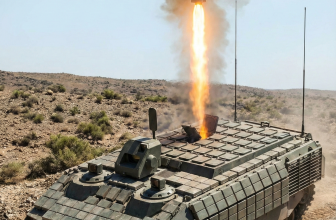
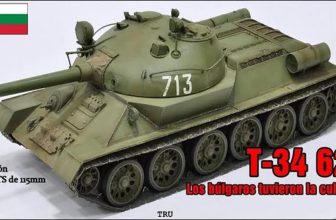
The simplest idea—to build flamethrower tanks based on the most common, lightweight models—turned out not to be very successful.
The pillboxes—which the flamethrower tanks were, in fact, intended to engage—were divided into machine-gun pillboxes, gun pillboxes, and those with mixed armament. While a flamethrower tank based on the T-26 could, in theory, be quite effective against machine-gun pillboxes, against artillery and mixed-armament pillboxes, the OT-26 (or HT-26) had virtually no chance—practically any cannon would destroy it before it could reach the flamethrower’s effective range (which was only a few dozen meters).
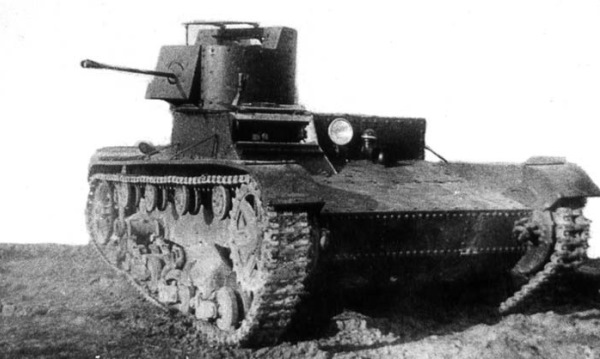
(OT/HT-26)
Therefore, it was assumed that gun emplacements and mixed-weapon emplacements would be dealt with by the air force, artillery, and engineers, while pillboxes—and especially machine-gun pillboxes—would become “legitimate targets” for light flamethrower tanks. Flamethrower tanks were built on T-26 chassis, on the chassis of small amphibious tanks, and even on the chassis of T-27 light tanks.
No one doubted the usefulness of flamethrower tanks as such—dousing a pillbox, let alone a bunker (of which there are far more), with a blazing fire mixture meant guaranteed suppression. Burning the trenches and bunkers to the ground along with the enemy infantry—now that’s just wonderful! But the enemy infantry won’t even wait for this nightmare to unfold—they’ll just take off running.
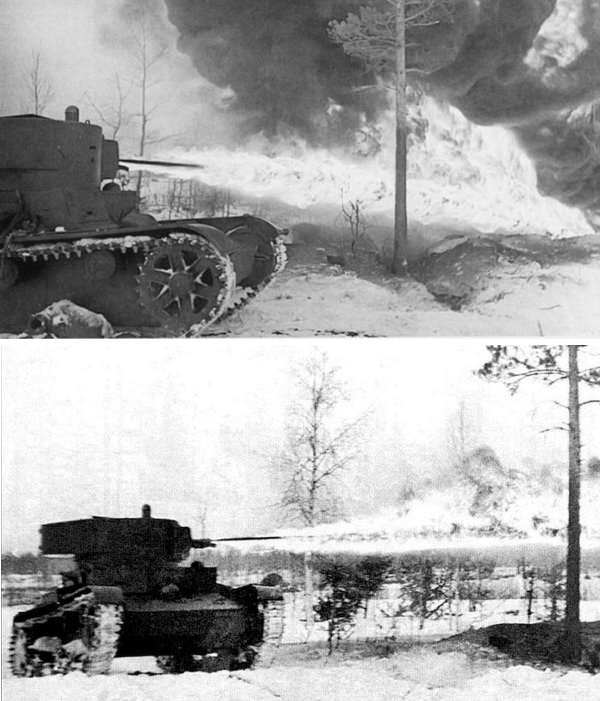
(OT/HT-130 in operation)
In addition to their flamethrower capabilities, these same tanks, equipped with the same gear, were used to lay smoke screens and contaminate the terrain with chemical agents—or, conversely, to neutralize such contamination. That is why, in fact, they were also called “chemical” tanks (HT). The pneumatic flamethrower didn’t care at all what kind of junk it was “spitting” out.
But as time went on, very soon even the machine-gun pillboxes and dugouts could, in theory, be equipped (and were equipped!) light anti-tank guns—not to mention large-caliber machine guns and anti-tank rifles. Even ordinary trenches could be heavily armed with these same weapons.
In other words, the combat effectiveness of light flamethrower tanks—specifically as flamethrowers (which is their primary function!)—was called into serious question. The most viable option for their use remained their role as “chemical” tanks. That, of course, is necessary as well. But using a tank for this purpose wasn’t exactly rational. After all, contaminating the terrain with chemical agents from fire hoses—and even more so, decontamination—is not carried out during combat, right on the battlefield. In combat, chemical agents are delivered by other “dispensers,” and soldiers simply wear gas masks. And in the rear—even the immediate rear—outside of combat situations, it is more practical to use cheaper “chemical” vehicles. And the Red Army did have such vehicles.
In short, the army needed a new, effective, FLAME-THROWING tank. At the Research Institute, they tried to solve the problem “extensively”—in a simplistic way—by “developing” “line” tanks—the basic models—at the same time. The OT-26 (or HT—whichever you prefer; both are correct) Model 33 was replaced by the OT-130 (based on the single-turret T-26 Model 33) and the OT-133, based on the T-26 Model 38 (with a conical turret).
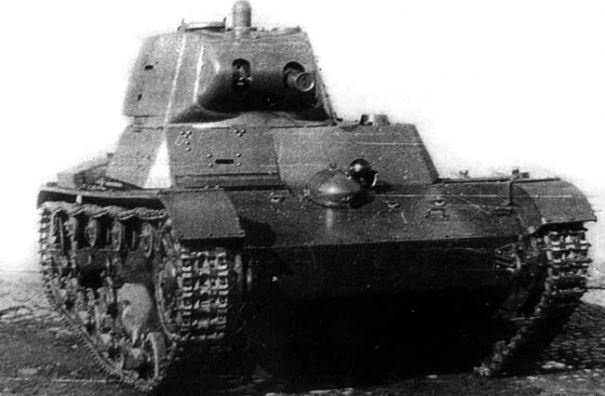
(OT-133 (HT-133), 1938 model – the “pinnacle” of flamethrower tank development based on the T-26 chassis)
Another issue is that the army was no longer entirely satisfied with the combat effectiveness of “flamethrowers” mounted on the chassis of an obsolete light tank—fewer OT-130s and OT-133s were produced than OT-26s, model 33. Most likely, the new flamethrower tanks based on the T-26 chassis were produced “out of habit” to make up for their shortage in the organizational structures of “chemical” units and subunits amid the overall growth of the Red Army’s motorized and mechanized forces.
Naturally, as soon as the opportunity arose, flamethrower tanks began to be produced on more effective chassis—the T-34 (OT-34) and even the KV (KV-8)! No one questioned the fundamental usefulness of the flamethrower, and combat experience consistently confirmed this—flamethrower tanks were also built on the T-34-85 chassis.
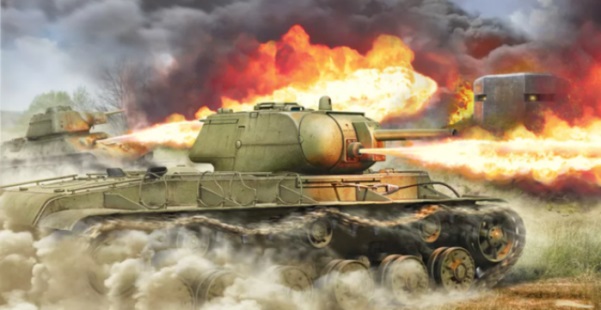
But that was much later.
In the meantime, let’s go back to 1935 in the AI, when the question arose of replacing the outdated OT-26 (Model 33) with a more advanced flamethrower tank.
The Design Bureau of the 185th Experimental Tank Plant received a contract to develop a new light flamethrower tank capable of meeting the new “challenges” on a battlefield saturated with anti-tank weapons. In fact, it had been established specifically to develop all sorts of “innovative” “tank-like” vehicles, and throughout the 1930s, it ran wild to its heart’s content, fulfilling military orders not as required, but exactly as it saw fit (““I’m an artist! This is how I see it!”), and was convenient from the developers’ perspective. Their perspective.
Moreover, the preference was still to obtain a new flamethrower tank that was as technologically similar as possible to the T-26. More specifically, one based simply on its single-turret variant from 1933.
It’s clear that when people spoke of “adapting to current battlefield conditions,” they were referring, above all, to robust armor. But how could such armor be installed on the T-26, with its underpowered engine, weak suspension, and narrow tracks?
Well, that’s exactly why we have Experimental Tank Plant No. 185—to put “original” solutions into practice, even if they aren’t very suitable for Mass-Production Tank Plant No. 174, where they were churning out standard T-26 tanks. And forget about the plant! They didn’t even care much whether these solutions were acceptable to the customer—the army. That was standard practice for Experimental Plant No. 185.
First and foremost, they decided to take a “revolutionary” approach to “saving” weight—in order to reinforce the armor, at least in certain areas. They removed the turret! They trimmed the turret base down to a minimum, turning it into an extremely low-profile cabin. As for the armament, they kept only the main weapon—the flamethrower. And a different one at that! Instead of the now-standard KS-24 pneumatic flamethrower, they installed an “exotic” high-explosive model (whose fuel mixture is “ejected” not by compressed air, but by a pyrotechnic charge that generates much higher pressure). Such flamethrowers (which are structurally very simple) were developed for the Tsarist army during World War I and were used quite successfully in 1916–1917.
Moreover, this was not a simple high-explosive flamethrower, but a more complex high-explosive flamethrower of the piston type (i.e., reusable, although it could only be “reloaded” after withdrawing from combat). To make it clearer—the pyrotechnic cartridge did not force the fuel-air mixture out of the reservoir directly into the nozzle and then toward the target (as happens in a conventional, single-use high-explosive flamethrower), but instead applied its “explosive” pressure to a special piston, which then “forced” the fuel-air mixture toward the target through that very same nozzle. As a result, it was no longer a single-use weapon. It could be quickly reloaded.
While the OT-26, armed with a standard KS-24 pneumatic launcher, could fire up to 70 one-second bursts (5 liters of fuel-air mixture in each) at a range of just 35 meters, with the equipment weighing more than half a metric ton (not even counting the weight of the turret!), now, with the equipment weighing no more than 250 kg, the vehicle could fire only four two-second bursts (the same 5 liters of fuel-air mixture in each), but at a range of 60 meters. If you hit the target well with those four shots, you’ve accomplished your combat mission. If not—it was time to reload. But they saved nearly 300 kg in weight on the armament alone! Plus, they eliminated the turret and part of the turret base…
The fuel supply was also reduced to a minimum by eliminating the second fuel tank and reverting to a single fuel tank, as was the case on the twin-turret T-26 until the end of 1932 (though it was made of lightweight “self-tightening” fiber). Moreover, the shape, “cubic capacity,” and, accordingly, the volume of the single “self-tightening” fuel tank were also reduced to “free up” space in the engine compartment and ensure optimal cooling conditions for the powerplant. Therefore, not a single drop of extra fuel was carried! It was enough for no more than a 50-km drive on the highway. On rough terrain, even less. It was calculated that for such a “fire-hazardous” tank in combat, it was sufficient to carry only enough “highly flammable” fuel to reach the designated target, strike it, and return safely. On the march, refueling would be done as needed. In essence, this was no longer a tank in the strict sense, but rather a self-propelled flamethrower!
And all this drastic weight reduction was done to strengthen armor protection and improve off-road capability. Moreover, the armor reinforcement was strictly localized. From the front, its thickness was increased to match that of the T-28 medium tank’s frontal armor—up to 30 mm. Provision was made to add an additional 10-mm plate if absolutely necessary. The rest of the armor (vertical, 15 mm thick), as well as the power train, transmission, suspension, and tracks, remained the same as on the original single-turret T-26 Model 33.
Since the plan was to eventually increase the T-26’s engine power to 100 l. s. by supercharging the engine, and in the suspension, to replace the three-leaf springs with five-leaf ones, plans were also made to reinforce the armor of the “self-propelled flamethrower” in the future—increasing the frontal armor to as much as 50 mm, without additional screens, and the 15-mm side armor was to be further protected with attached 6- or even 9-mm armor screens.
During testing, this vehicle—which is essentially a flamethrower self-propelled gun—produced mixed results. On the one hand, yes, it was capable of advancing to its EFFECTIVE firing range with its flamethrower, ignoring frontal fire from the enemy’s light anti-tank weapons. But! Its side armor remained weak (even with armor plates, totaling no more than 24 mm). Its off-road capability was not much better than that of the standard T-26—and even worse when equipped with armor plates. In other words, any anti-tank obstacles were already nearly insurmountable. The vehicle had no self-defense weapons for close combat—unless one counts the revolvers and grenades carried by the two crew members. Moreover, the “four-barreled” “bundled” flamethrower nozzle (each of the four high-explosive flamethrowers had its own!) had very limited elevation angles. Moreover, the vertical range was greater than the horizontal—so the crew had to “make up for it” by moving the tracks.
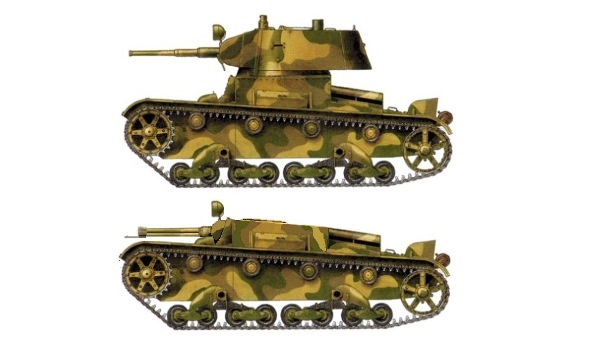
The ABTU reached a verdict: the vehicle is fully combat-ready, but not tactically autonomous. Therefore, after placing an order with Plant No. 174 for a small experimental batch of self-propelled vehicles for comprehensive army trials (fortunately, the vehicle’s design did not differ drastically from that of the standard T-26), the designers were tasked, looking ahead, with developing a more complex vehicle of a similar class, this time without such a strict and mandatory tie to the T-26 chassis. The main thing was that the technical characteristics be significantly improved.
And they were worded very strictly:
The armor provides protection against shells from the front, without exception. On the sides, it offers protection against rounds from large-caliber machine guns and anti-tank rifles.
Off-road capability—just like the T-28.
The armament should include both the more familiar PNEUMATIC flamethrower with a large supply of fuel-air mixture and a defensive machine gun mounted in a well-protected, fully rotating turret. Preferably, it should be large-caliber. Additionally, disposable high-explosive flamethrowers mounted on tracks—again, for self-defense in close combat—and devices for laying smoke screens.
That’s why the designers had to «jump through hoops.»
At first, it was perfectly clear to them that it was, in principle, impossible to build such a vehicle on the T-26 chassis. Then, sensational news emerged about Vickers’ successful development in 1935–1936 of a “small, heavily armored tank” (the “Matilda I”) with armor as thick as 60 mm!
Admittedly, this success came at the cost of weak armament—consisting of a single machine gun—and a top speed of 13 km/h!
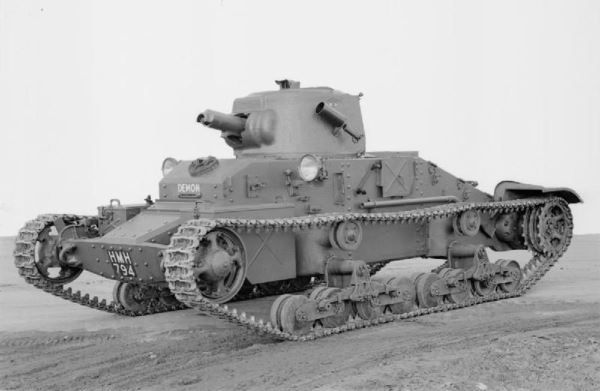
Which, of course, no longer suited our military.
But the very fact that a “small, heavily armored tank” was possible in principle really inspired everyone. We thought it over, ran the numbers, and came up with this. While retaining the well-proven and familiar suspension design of the T-26—in which the springs, already reinforced on their own, were further upgraded to five leaves instead of three—the track links and road wheels were borrowed from the T-28. The drive wheels and idler wheels were also borrowed. The length of the hull—and, consequently, the contact patch—increased, improving the flamethrower tank’s capabilities in terms of cross-country mobility and the ability to overcome anti-tank obstacles.
Well-established in industry and the military, the 131-si-power “pseudo-diesel” powerplant (a 4-cylinder KIN engine) and transmission were borrowed from the “Komintern” artillery tractor.
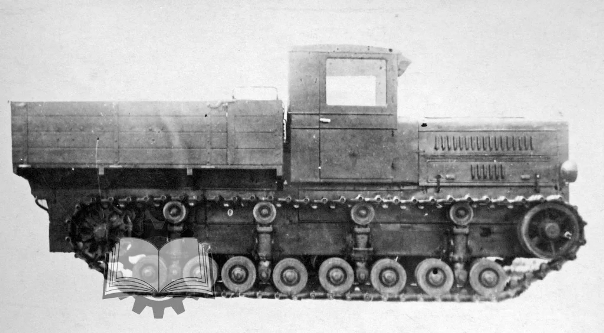
The gear ratios were revised so that the engine would operate under less stress during extreme loads, would not overheat, could run on different types of fuel, and would have an extended service life.
Of course, at the expense of speed and with the inevitable increase in fuel consumption.
However, these measures—aimed at reinforcing the suspension and increasing the power of the control system—made it possible to increase the thickness of the front armor to 60 mm and the side armor to 35 mm all at once.
The armament was mounted in a compact single-seat turret protected by 50 mm of armor all around. The main armament was a flamethrower. In addition, the secondary defensive armament consisted of a DT machine gun mounted in tandem with the flamethrower. The ABTU’s request for a large-caliber machine gun was ignored for two reasons: the thick-armored turret had been minimized in size as much as possible to reduce weight and the target area. Besides, large-caliber machine guns simply weren’t available. (And they also took into account that a decent large-caliber machine gun would not only be heavy but also take up a lot of space.) In short—they decided to settle for a standard DT in a twin-barrel configuration. After all, it’s DEFENSIVE!
Problems also arose with the turret’s circular rotation—the thick high-pressure hose that supplied the fuel-air mixture from the tank to the nozzle was not very flexible or long, so the horizontal aiming angles were limited to 45 degrees on each side. In other words, both “circular rotation” and firing toward the stern were impossible.
Since the hull was also extremely compact (especially in width—it was the same as that of the T-26), and the crew was still limited to two tankers, their duties were, so to speak, slightly redistributed.
The driver and turret gunner were fitted with bulky headset-style headphones with built-in microphones for the TPU (tank communication system), through which they could communicate with each other constantly and without interruption. What’s more, an “external subscriber” could also connect to the TPU—for this purpose, there was a simple communications outlet at the rear of the tank, along with its own reel of field cable.
In essence, duties were now assigned just as they would be in a combat aircraft—“pilot” (the mechanic-driver) and “gunner” in the turret—who constantly maintained a detailed exchange of information. And they operated just like a ground-attack or dive bomber—attacking specific pillboxes and anti-tank emplacements listed in the “flight mission,” without being distracted by any other targets or tasks unless absolutely necessary.
The problem of drastically improved cross-country mobility was solved not only by using tracks and other suspension components from the T-28, nor solely by the increased power of the engine. The fact is that both the large fuel tank and the compressed-air cylinders (since the flamethrower is pneumatically operated) were removed from the hull altogether and placed in a trailer. Initially, it was a two-wheeled trailer, but later they switched to a tracked chassis that could be rigidly coupled to the tank, thereby significantly extending the wheelbase! Moreover, the trailer’s tracks were driven directly by the tank’s drive sprockets via special chain drives! Obviously, the service life of such a combination would likely be short, but it was intended to be used exclusively under particularly extreme conditions.
By removing the fuel tank and compressed-air cylinders, the hull was equipped with an effective fire suppression system and the fuel capacity was increased. The large supply of incendiary mixture in the trailer made it possible to dispense with the high-explosive disposable flamethrowers that had been “ordered” as additional armament. The trackshelves held only spare parts boxes and smoke screen launchers (structurally similar to those installed on the T-28).
The new flamethrower tank entered testing in 1937. It was extremely slow—its maximum speed on the highway did not exceed 27 km/h. And that was EMPTY! With a full load, it could go no faster than 23 km/h. Off-road, it moved even slower. But that’s precisely what sets a flamethrower tank apart from a conventional one—it has absolutely no reason to rush. Pillboxes and bunkers aren’t going anywhere. You might as well advance on your target at a pedestrian’s pace.
On the other hand, the tractor’s pulling power allowed it to easily tow a tracked trailer and move unhurriedly toward its target, even across rough terrain. A powerful smoke screen generated by two smoke generators simultaneously concealed the vehicle’s maneuvers on the battlefield. The armor protected the tank from armor-piercing bullets from all angles and from anti-tank artillery shells from the front, as well as from the sides at sharp turning angles. Its armament allowed it to deliver sustained barrages against defensive fortifications and defend itself in close combat—fortunately, all weapons were mounted in the turret, which provided fire coverage in the forward “hemisphere.” Behind it, the heavily armored flame-thrower lead tank was to be covered by conventional light tanks and accompanying assault infantry.
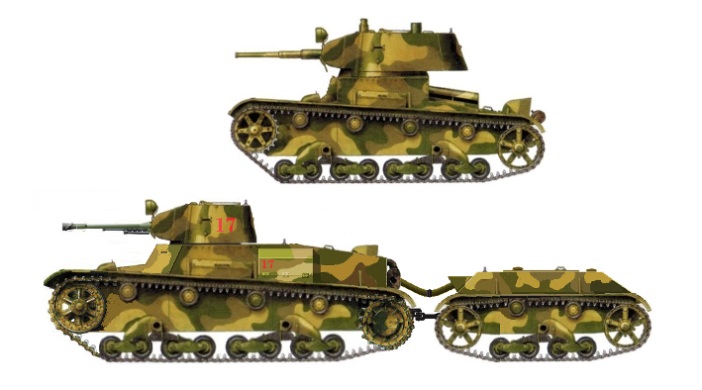
The two tank crew members, much like the crew of a combat aircraft, communicated effectively with each other and with any interested “external source.” There was no need for a separate loader or a “dedicated” commander. Any pillbox—and especially any dugout—was swiftly destroyed with certainty.
The factory field tests made a strong impression on the customer (especially when a specially modified propellant mixture was put to use, which nearly doubled the firing range!), and the non-governmental organization gladly issued an advance payment for further development and a batch of flamethrower tanks for comprehensive army trials.
The flamethrower tanks withstood those tests. Almost. However…
The trailer drive turned out to be extremely unreliable. The rigid coupling between the tank and the trailer also caused major problems. The fact that the trailer was less well-protected than the tank (it was assembled from armor plates only 15 mm thick) also led to serious problems.
Therefore, the drive system was abandoned. It was agreed that the rigid coupling would be considered strictly “optional.” It was decided to increase the thickness of the trailer’s armor in the production series to 25 mm, and to fill the high-pressure cylinders with inert nitrogen instead of air at the base, and only in the field, if necessary, “recharge” them with air from a compressor.
In addition, in case the trailer caught fire, they implemented a system to fill the entire “volume” of the trailer with nitrogen from those very cylinders, along with a mechanism for the emergency “disconnection” of the tanker and trailer carrying the flammable mixture—a very simple one—in the form of a rod that rotates a cotter pin, which “releases” a “pin” that instantly pops out, uncoupling the tank from the trailer. The high-pressure hose supplying the fuel-air mixture would rupture mechanically at the very first jolt of the tank.
The military agreed to all these design changes. Nevertheless, given its low “operational mobility,” the tank was adopted under the designation OT-138 only for service within the special, separate, flamethrower-assault tank battalions of the RGK. Including them in the structure of “chemical” tank battalions within “line” tank units was deemed unacceptable.
Not only did it make no sense, but it wasn’t even possible—the tank wasn’t a modification of a production model (even though it was essentially a «Frankenstein» assembled from production components of other vehicles). It was produced in small batches, in a “semi-artisanal” manner, by that very same 185th Experimental Plant. “You came up with the idea yourselves, so build it yourselves—at least be of some use to the army!”—this was the “parting advice” accompanying the “order” from the stern Marshal Kulik, who had replaced the executed Tukhachevsky as Chief of Armaments of the Red Army.
The army didn’t care for the OT-138. It was very slow and, despite all its «bells and whistles,» quite complicated. However, because vehicles of this type were wisely not scattered throughout regular army mechanized units (where they would certainly have met an unenviable fate), but were concentrated in just a few specialized RGK battalions, they were kept in perfect condition and operated competently.
And when the Winter War began, this had a most favorable effect. The OT-138 tanks cut through the Finnish “Mannerheim Line” like a hot knife through melted butter. And because of the infantry’s indecision, they had to do this several times—burning everything in their path. In the end, these “spectacular” breakthroughs (“with a bang!”) managed to inspire the Soviet infantry, which consolidated those breaches and advanced into open terrain. The problem of the breakthrough was resolved in literally a few weeks. Finland surrendered unconditionally even before New Year’s. Its non-participation in World War II was decided quickly and definitively—just as had been planned from the outset in the Kremlin.
For the combat successes of OT-138, the staff of the 185th Experimental Plant (where, previously, they had regarded their “flamethrower” as an “ugly duckling”) was showered with praise, awarded numerous honors, and spared from disbandment for ineffective work. What’s more! The team was reorganized into a specialized “tank research institute.” As a result, a decision was made to abandon the excessively heavy “howitzer” KV and to build these tanks as “multi-purpose heavy self-propelled guns” with a significantly lighter turret and a 107 mm gun instead of a 152 mm howitzer, and to arm some of the KV-1s with flamethrowers instead of the standard machine gun. Over time, the plan was to replace all obsolete OT-138s with these flamethrower-equipped KV-1s.
And—yes. When World War II began, the OT-138s, which were already quite worn out, in their original configuration, without the support of standard tanks, proved completely pointless and useless—there were no targets “typical” for flamethrower tanks on the battlefield in the summer of 1941 that they had to assault. Although the command did note that within units mixed with “regular” tanks, while carrying out joint missions, “collective” effectiveness increased dramatically—the enemy infantry, fearing the risk of being caught in a blazing firestorm, simply scattered, abandoning their positions—such was the psychological impact of the flamethrower tanks’ presence.
And since the OT-138 had already been deployed to several companies of the RGK’s flamethrower-assault tank battalions, in order to get the most out of them, it was decided to rearm the tanks by “removing” the trailers and replacing the flamethrower in the turret with an automatic 20 mm TNSh cannon, which also did not require a loader—a crucial factor for a single-seat turret. And on the track-mounted racks, instead of smoke-launching devices, mounting points were provided for disposable high-explosive flamethrowers—so as not to lose that very powerful “psychological effect.”
And, as it turned out, the rearmament was by no means in vain. A tank like this—one that neither anti-tank rifles nor the 37-mm “door knocker” could penetrate—proved to be very useful in supporting the infantry. A separate tank brigade of the RGK, armed with OT-138/20 tanks equipped with 20-mm TNSh cannons instead of flamethrowers, performed well in the battles on the Luzhskaya Line. It was there, in fact, that those OT-138s ended their combat service.