A Ready-Made Hull, an Uncertain Warship: Why the U.S. Navy Is Looking at the British Type 31

The U.S. Navy is once again searching for a frigate. Its previous attempt ended in an almost textbook procurement failure. The Italian FREMM was selected as the basis for the Constellation class, but the design was modified so extensively to meet American requirements that the program lost both of its supposed advantages: the maturity of an existing ship and the promise of rapid construction. Costs rose, schedules slipped, and the program was eventually canceled.
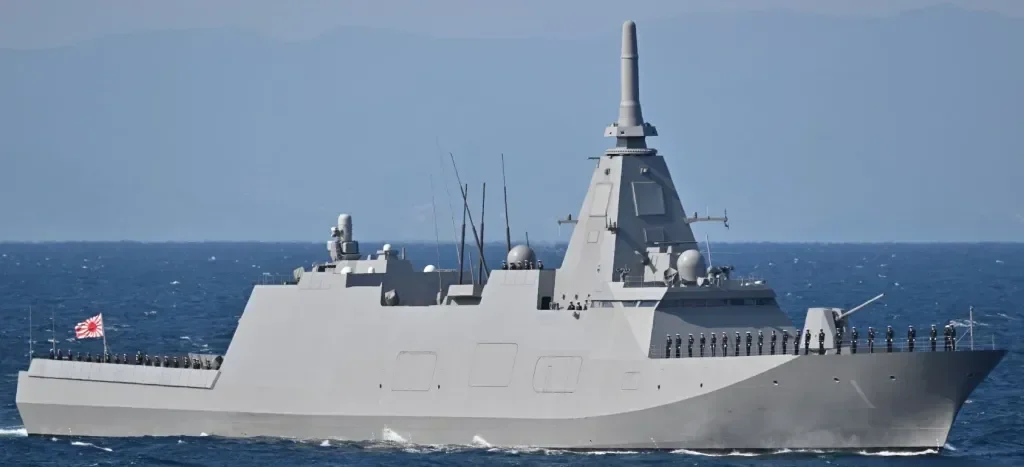
Washington is now examining foreign designs, including Japan’s Mogami class, South Korea’s Chungnam class, Turkey’s Istanbul class, and Britain’s Arrowhead 140—the platform behind the Royal Navy’s Type 31 frigates.
Babcock has already held preliminary discussions with Pentagon officials and is preparing to submit a formal expression of interest. Huntington Ingalls Industries, the largest military shipbuilder in the United States, has been mentioned as a possible American partner. The proposal remains at an early stage: no configuration has been selected, no contract has been awarded, and a joint Babcock-HII bid has not yet been formally presented.
The British candidate is interesting because of its underlying technical philosophy. Babcock is not offering the smallest or most heavily armed frigate in the competition. Its principal selling point is a large hull with considerable internal volume—a platform that could theoretically accept American radars, launchers, sonar equipment, and combat systems without requiring the Navy to develop an entirely new ship.
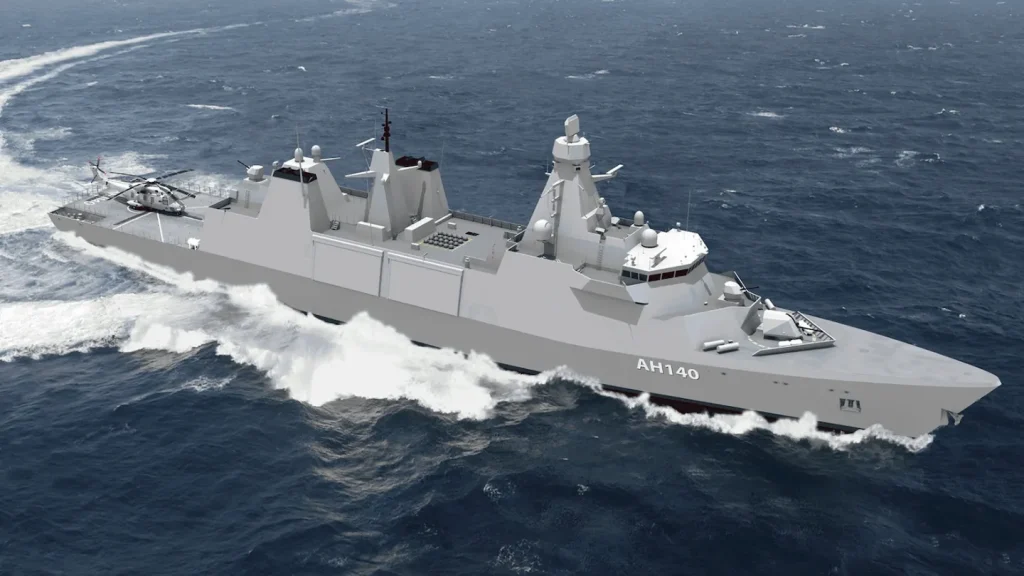
Type 31 and Arrowhead 140 Are Not Quite the Same Thing
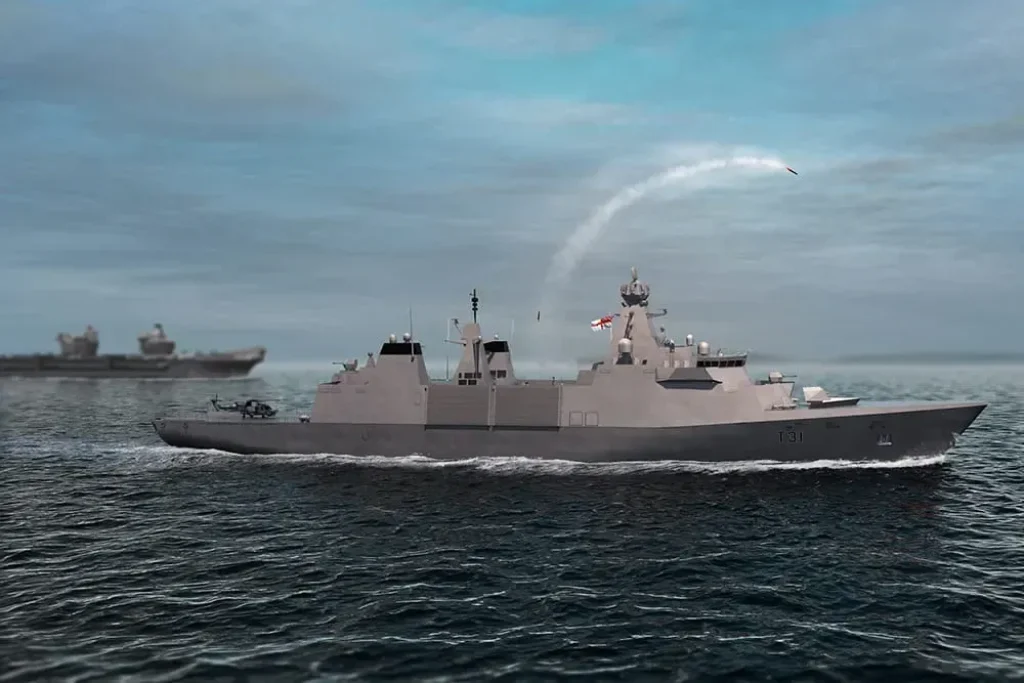
The British Type 31 is often described as a ready-made export frigate, but that is a slight oversimplification. The ship is based on Babcock’s Arrowhead 140 platform, which was itself derived from Denmark’s Iver Huitfeldt-class frigates. Type 31 is only one national configuration, developed specifically for the Royal Navy.
Arrowhead 140 is the product Babcock offers to foreign customers. Poland has used it as the basis for its Miecznik program, while Indonesia selected it for the Merah Putih class. These national variants can differ substantially in their weapons, radar systems, electronics, and even full-load displacement.
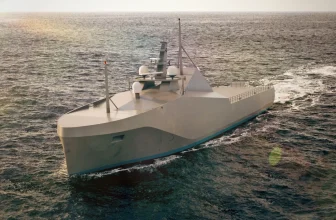
The baseline ship is approximately 139 meters long and nearly 20 meters wide, with a displacement of around 5,700 tonnes. It is no lightweight patrol frigate. In terms of size, it approaches a small destroyer. The more heavily equipped Polish version may displace approximately 7,700 tonnes.
Its size is not necessarily a disadvantage. In many respects, it is the platform’s most valuable feature. The hull provides space for additional missile launchers, sensors, supplies, boats, uncrewed vehicles, and embarked personnel. There is a hangar large enough for a Merlin helicopter and a spacious flight deck capable of receiving even a Chinook. The design also includes boat bays and adaptable mission spaces that can be configured for different operations.
Four Diesel Engines and an Emphasis on Endurance
Arrowhead 140 uses a combined diesel-and-diesel, or CODAD, propulsion arrangement. Four diesel engines drive two shafts. This configuration cannot match gas turbines in terms of power-to-weight ratio, but it is more economical and generally simpler to operate.
Maximum speed is reported to exceed 26–28 knots. That is not exceptional, but it is sufficient for convoy escort, operations with naval formations, and most independent missions. Range and endurance are more important: the design is intended to remain deployed for periods of one or two months.
The British Type 31 is expected to operate with a core crew of approximately 110–115, while accommodation is provided for around 140 personnel. Automation of the machinery, combat management, and damage-control systems helps reduce the required crew.
At the same time, spare accommodation allows the ship to embark aviation personnel, Marines, uncrewed-system operators, specialists, or additional damage-control teams.
That could be particularly valuable to the U.S. Navy. A future frigate would have to carry weapons, but it would also need to spend months operating in the Indo-Pacific, escort merchant shipping, protect sea lanes, and work far from American bases. A large hull with an economical propulsion system is better suited to these missions than a smaller warship packed tightly with weapons and electronics.
Almost the Entire Weapons Suite Can Be Replaced
The Royal Navy’s Type 31 configuration includes a 57mm Bofors Mk 3 main gun, two 40mm Bofors weapons, the Thales NS110 radar, and the TACTICOS combat management system. The ships are expected to receive Sea Ceptor surface-to-air missiles, Naval Strike Missiles, and Mk 41 vertical launch cells.
There would be little reason to transfer this exact equipment package to an American version. The U.S. Navy uses its own combat systems, data links, electronic warfare equipment, and missile families. A U.S. Arrowhead 140 would therefore likely require a radar from the SPY-6 family, an American combat management system, and Mk 41 vertical launchers.
The hull is large enough to accommodate several dozen Mk 41 cells while retaining room for future modernization. Depending on the selected configuration, these cells could carry Standard-family surface-to-air missiles, ESSM, ASROC anti-submarine weapons, and other compatible missiles. Naval Strike Missiles, already in American service, could provide an over-the-horizon anti-ship capability.
On paper, the result is highly attractive: a large hull equipped with American electronics, universal missile launchers, a full-size helicopter, and space for uncrewed systems. Such a frigate could escort convoys, hunt surface ships and submarines, provide local air defense, and perform some of the missions currently assigned to Arleigh Burke-class destroyers—at a lower operating cost.
For now, however, this configuration exists only as a possibility. Babcock has not revealed a finalized American version, while the U.S. Navy has not published a definitive equipment list for an allied-design frigate.
The Greatest Problem Lies Beneath the Surface
The baseline Type 31 was designed as a general-purpose warship. The British version lacks the full bow-mounted sonar and towed-array system required for continuous high-end anti-submarine warfare. Much of its anti-submarine capability would have to come from an embarked helicopter or external uncrewed systems.
For the Royal Navy, this division of responsibilities makes sense. Specialized submarine-hunting missions will be assigned to the more expensive and acoustically quiet Type 26 frigates. The U.S. Navy, however, needs a ship capable of escorting convoys and carrier groups in an environment where the underwater threat may be severe.
An American version would therefore almost certainly require a bow sonar, a towed array, torpedo armament, and an anti-submarine helicopter.
Installing this equipment is physically possible. Making the ship quiet enough to use it effectively is much more difficult. An anti-submarine frigate is defined not only by its sonar. Machinery noise, vibration isolation, propeller design, internal equipment mountings, and the acoustic characteristics of the hull all determine how effectively the ship can detect a submarine.
Arrowhead 140 can be fitted with sophisticated sensors, but it cannot be transformed into a specialized anti-submarine ship comparable to the Type 26 simply by replacing a few pieces of equipment.
This is where the project could begin to grow expensive. A new sonar suite would require changes to the hull, electrical systems, cooling arrangements, and combat management architecture. These changes could be followed by new requirements for acoustic performance, survivability, and electromagnetic compatibility. At some point, a supposedly ready-made platform could once again become a new warship that only resembles the original design from the outside.
The Lesson of Constellation
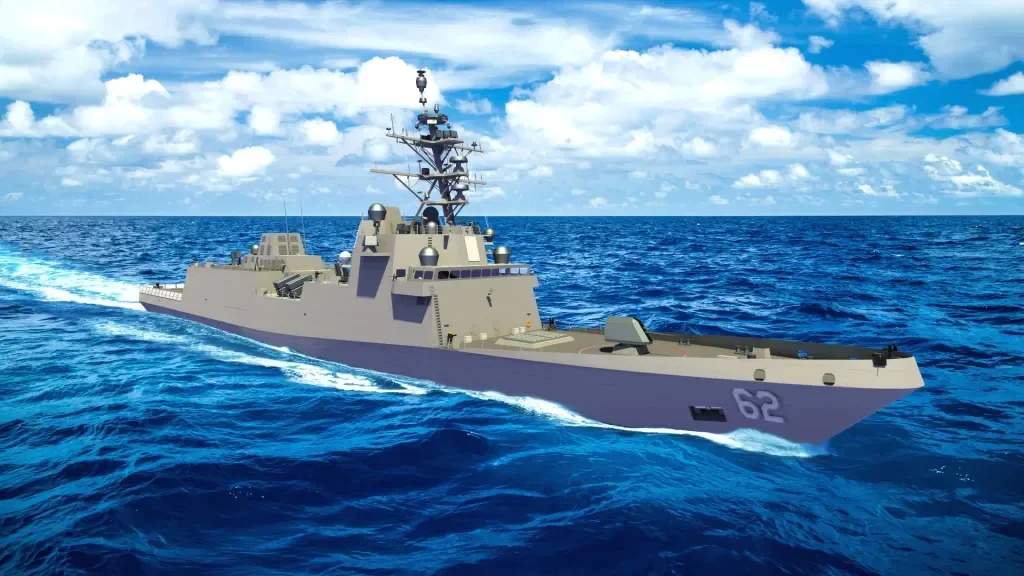
The Constellation program began with almost exactly the same idea. The U.S. Navy selected an existing FREMM design to reduce technical risk and accelerate construction. It then demanded changes to the hull, propulsion system, superstructure, electronics, armament, and survivability standards. Displacement increased, design work fell behind schedule, and construction of the lead ship began before the working drawings were complete.
By the time the scale of the problem became clear, the advantages of using a foreign design had disappeared. Washington was no longer buying an American version of FREMM. It was developing a new frigate while simultaneously trying to build it.
Arrowhead 140 can avoid the same fate only if the U.S. Navy accepts the limitations of the original platform. Installing essential American weapons and communications equipment would be reasonable. Completely redesigning the ship in an attempt to create a smaller Arleigh Burke would be a direct route toward repeating the Constellation experience.
This is the central paradox of Babcock’s proposal. A large and modular hull makes modernization easier, but it also encourages the customer to add more systems. Empty space rapidly fills with equipment, displacement rises, electrical demands increase, and more personnel are required. A relatively straightforward frigate gradually becomes an expensive major combatant.
An American Ship of British Origin
Babcock does not operate a shipyard in the United States. The most likely arrangement would therefore involve transferring design rights, documentation, and technical knowledge to an American industrial partner. Most of the ships would be built in the United States, although the first one or two could theoretically be constructed abroad.
A partnership with HII would be logical. The two companies already cooperate in submarine construction, including the production of components for nuclear-powered submarines. Babcock could remain the design authority and provide engineering support, while HII established an American production line.
This creates another interesting complication. HII is already working on the U.S. Navy’s FF(X), which is based on the Coast Guard’s Legend-class National Security Cutter. That vessel is intended to be a simpler patrol frigate that can enter production quickly. Its initial configuration is not expected to include a vertical launch system.
Arrowhead 140 offers something different: a much larger platform with greater potential for weapons and future upgrades.
Washington may therefore end up with two different answers to the same problem. FF(X) is the ship the Navy hopes to put into the water as quickly as possible. Arrowhead 140 would be a larger platform capable of evolving into a genuine multi-mission frigate. The first approach is simpler. The second offers more combat potential but carries a much greater risk of delays and redesign.
How Mature Is Type 31?
Babcock describes Arrowhead 140 as a mature, production-ready design. That is only partly true. Its lineage extends back to the operational Danish Iver Huitfeldt class, while Polish and Indonesian versions are already under construction. However, no British Type 31 has yet entered operational Royal Navy service.
The British program has also encountered delays, redesign work, and financial problems. In 2026, Babcock recorded an additional charge of approximately £140 million related to design changes and rework. The company’s total losses on the Type 31 contract have exceeded £300 million.
This does not necessarily mean that the platform is fundamentally flawed. Instead, the Type 31 experience illustrates how difficult it is to introduce a new production system, refine a warship design, and remain within a strict fixed-price contract at the same time.
An American version would face many of the same challenges, compounded by the need to transfer construction across the Atlantic, train a new workforce, and establish a domestic supply chain.
A Good Foundation, but Not a Finished Solution
Arrowhead 140 genuinely offers qualities that many competing designs lack. It is a large, seaworthy hull with long endurance, a spacious hangar, adaptable mission areas, and substantial room for future weapons. It could become a powerful American frigate equipped with Mk 41 launchers, a modern radar, anti-ship missiles, and a full aviation complex.
But Babcock is currently offering a platform, not a completed warship tailored to U.S. Navy requirements. The most difficult and expensive work would begin after the hull was selected: integrating American electronics, developing an anti-submarine warfare suite, adapting the design to U.S. standards, and transferring production to a new shipyard.
The fate of the British proposal will therefore not be decided by the number of missile cells it can carry. The central question is whether the Americans will know when to stop.
If the Pentagon accepts Arrowhead 140 as a sufficiently capable frigate and limits modifications to genuinely essential systems, the design could provide a comparatively quick way to restore frigates to the U.S. fleet.
If the Navy once again tries to turn a foreign frigate into a miniature destroyer with every capability of an Arleigh Burke, the United States may end up with a second Constellation—this time built around a British hull.
based on https://www.twz.com/sea/british-type-31-frigate-variant-offered-to-the-u-s-navy