Golden Liberty, Sabres and Kutasy: Why the Polish Nobility Declared Themselves Sarmatians

A late seventeenth-century Polish nobleman wore a sabre at his belt, with kutasy swaying beside it. No, the word is not a mistake. In old Poland, kutasy were tassels made of silk, wool or gold thread—an expensive decoration attached to clothing and belts. The word acquired its decidedly ruder modern Polish meaning much later. Back then, a fine set of kutasy was something to display rather than hide.
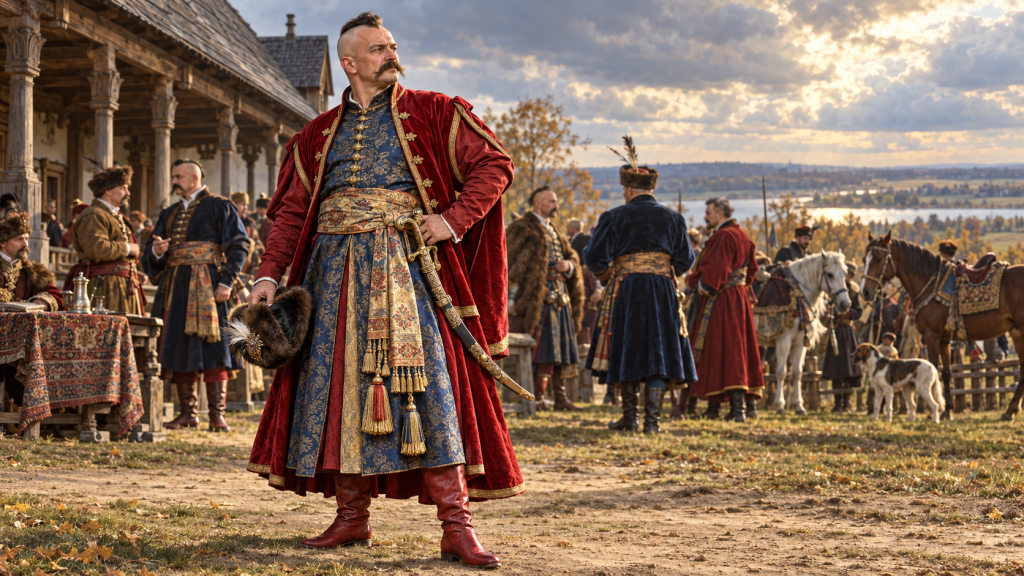
A visitor from Paris or Amsterdam would still have found plenty to stare at. Before him stood a man with a long moustache and a head shaved high at the sides, dressed in a bright żupan, an open crimson kontusz and red boots. A broad patterned sash was wrapped several times around his waist, with the hilt of a curved karabela sabre emerging from beneath it. He might easily have been mistaken for an Ottoman or Persian dignitary. Yet the man saw himself as a defender of Christian Europe against the Ottomans, a citizen of one of the freest states of his age and a descendant of the ancient warriors of the steppe. He called himself a Sarmatian—and he meant it.
The Ancestors Who Had to Be Invented
The real Sarmatians were Iranian-speaking nomads who once dominated the steppes between the Urals, the Don and the Black Sea, fought the Scythians and threatened the frontiers of the Roman Empire. There was no evidence that they had any special connection to the Polish nobility. To a person living in the sixteenth century, however, such a pedigree did not sound absurd.
Ancient geographers had used the name Sarmatia for enormous stretches of Eastern Europe. Polish Renaissance scholars took that familiar geographical label and turned it into a story of national origins. Jan Długosz wrote of the Sarmatian roots of Poles and Ruthenians. Maciej Miechowita, Marcin Bielski, Marcin Kromer and other chroniclers followed him, adding fresh details to the legend. Where evidence failed, imagination took over. The Sarmatians were connected to ancient heroes, biblical patriarchs and Noah’s son Japheth. The history of the Commonwealth could now be traced not merely to the mists of the Middle Ages, but almost to the beginnings of humanity itself.
Such exercises were common at the time. The French looked for their ancestors among Gauls and Trojans; the Swedes found theirs among the Goths. The expanding and increasingly powerful realm of the Jagiellons also needed a glorious past. The Sarmatians were ideal candidates. Ancient writers described them as freedom-loving horsemen and formidable warriors. That was precisely how people whose estate had emerged from the medieval knightly class wished to see themselves.
At first, Sarmatia meant the entire country and Sarmatians were the peoples who inhabited it. The legend helped unite Polish, Lithuanian and Ruthenian nobles who differed in language, faith and family history. This became particularly useful after the Union of Lublin in 1569: the vast Polish-Lithuanian Commonwealth needed a shared idea of itself. Before long, however, the ancient ancestors had been privatised. The Sarmatians were no longer the forefathers of everyone in the country. They belonged exclusively to the nobility.
A Separate Nation Within Its Own State
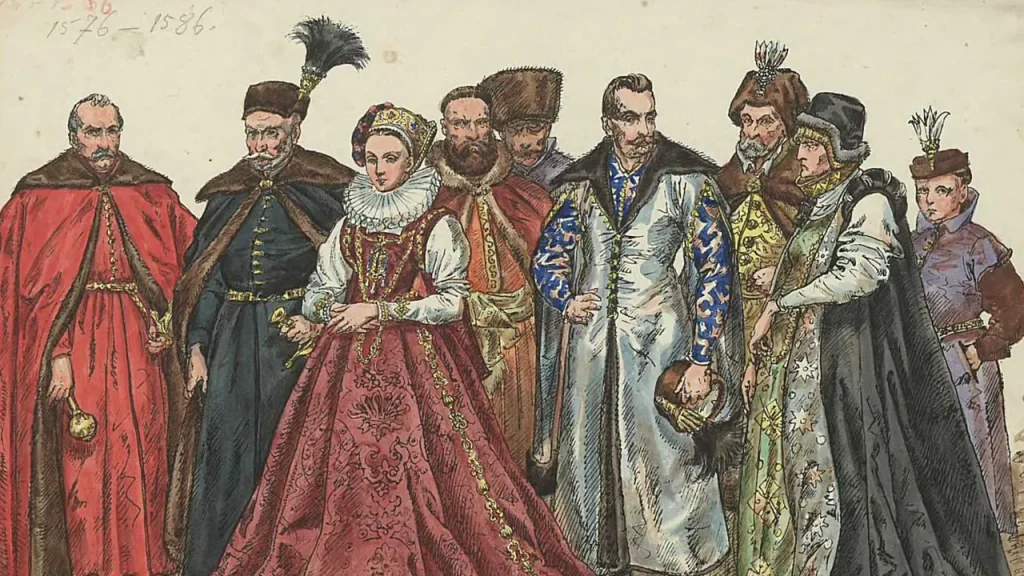
The szlachta made up roughly six to ten per cent of the Commonwealth’s population—an extraordinarily high proportion by the standards of contemporary Europe. Its ranks included mighty magnates who possessed dozens of towns and maintained private armies, prosperous landowners, modest masters of a single village and impoverished nobles who worked their own fields. In law, they all belonged to the same estate.
This gave rise to a famous principle: “A nobleman on his farm is the equal of a voivode.” A poor man with a tiny plot possessed the same noble status as the owner of an immense landed domain. The Commonwealth never developed the familiar Western European hierarchy of dukes, marquesses, counts and barons; foreign titles were long regarded as an affront to noble equality. Every nobleman was simply a pan. He could attend his local sejmik and, at least in theory, aspire even to the crown.
Money and family connections mattered enormously in practice. Impoverished nobles became dependent on magnates, served in their retinues and voted according to their wishes. Yet a magnate could not openly declare such a man a second-class noble. He still had to invite his poorer neighbour to the table, address him as an equal and seek his support. Sarmatian brotherhood was a political fiction, but it was a fiction that everyone had to take seriously.
Most of the country’s inhabitants remained outside that brotherhood. Townspeople had little influence over government, while peasants possessed scarcely any share of noble liberty. In the harshest version of the legend, the Sarmatians had conquered the native population and reduced it to dependent farmers. The conclusion was wonderfully convenient: a nobleman ruled not because he had happened to be born into a fortunate family, but because he descended from a race of conquerors.
An invented genealogy could therefore explain a very real social order. The Commonwealth was understood as the common property of the “noble nation”, rather than of all the people who lived within its borders.
A Liberty That Could Not Be Surrendered to the King
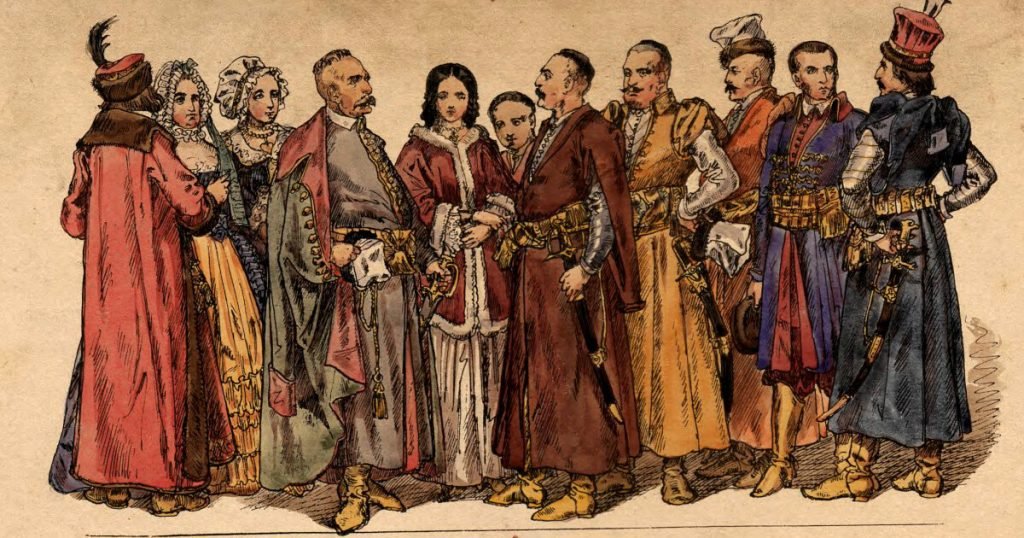
A Sarmatian’s most treasured possession was neither his estate nor his coat of arms, but his liberty. Polish writers called it Golden Liberty—aurea libertas. Behind the grand language stood political rights that noblemen in most European monarchies could only dream of.
New laws required the participation of the Sejm. After the extinction of the Jagiellonian dynasty, kings were elected, and every new monarch had to accept the Henrician Articles together with his own negotiated pledges, the pacta conventa. At local sejmiks, nobles debated taxes, courts and the instructions given to their representatives. If a king broke the established rules, they could form a confederation against him or even launch a rokosz—an armed rebellion in defence of noble liberties.
The ideal monarch did not command the country as though it were his private estate. He was expected to govern alongside its citizens and remain subject to the law. “It is not the king but the law that rules” sounded almost like a profession of faith. While French kings were strengthening absolute monarchy, the citizens of the noble republic saw powerful kingship not as a cure, but as the beginning of slavery.
The liberum veto grew from the same fear. Decisions of the Sejm were supposed to be unanimous: a free citizen should not be forced to obey a majority if he believed its decision threatened the common good. The principle could work while participants genuinely sought consensus. By the seventeenth and eighteenth centuries, however, the right of a single deputy to break up a session had become a remarkably convenient weapon. Magnate factions exploited it, followed by neighbouring powers that preferred the Commonwealth to remain without taxes, reforms or an effective army.
Golden Liberty contained the central contradiction of the Sarmatian world. A nobleman felt deeply humiliated when the king threatened his rights, yet barely noticed the lack of freedom endured by those who worked his land. He defended equality within his own estate. He feared tyranny when it was directed at him.
Why the Defender of Europe Dressed Like an Easterner
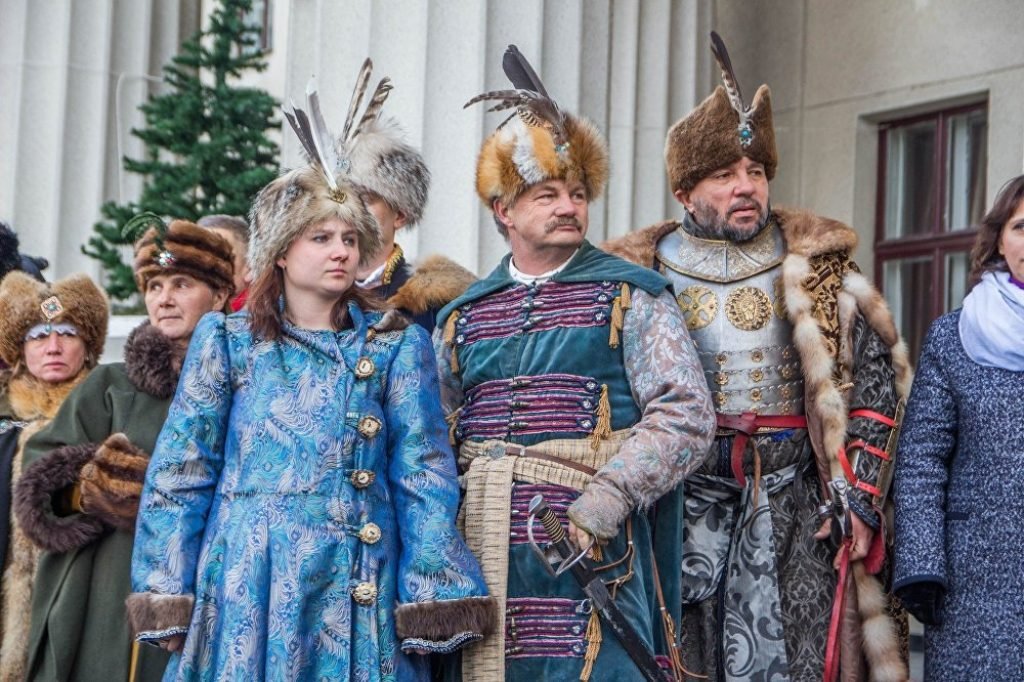
Sarmatian clothing revealed almost as much about its owner as his coat of arms. The żupan was a long inner garment, worn beneath a kontusz with split sleeves that could be thrown back over the shoulders. A fur-trimmed cap with a feather, high boots and a karabela completed the outfit. Young nobles often shaved their heads high, leaving a strip or crest of hair. By the late seventeenth century, the resulting silhouette could never be mistaken for a French court suit.
Many of its most striking details had come from the East. Ottoman and Persian fabrics entered the Commonwealth through merchants, diplomatic gifts and the spoils of war. Particularly prized were the sashes brought from Persia and the Ottoman Empire by Armenian traders. A ceremonial sash could reach four metres in length. Woven from silk with gold and silver thread, it was wrapped several times around the waist. Eventually the sashes were manufactured within the Commonwealth itself, with the Radziwiłł workshop at Słuck becoming the most famous.
Decorative cords and tassels—the famous kutasy—could hang from the belt. In seventeenth- and eighteenth-century Polish, the word kutas meant precisely this kind of ornament. Rich tassels glittered and swung as their owner walked, informing everyone around him that he could afford to spend gold even on objects with no practical purpose whatsoever.
Clothing gradually became a political declaration. A kontusz signalled loyalty to native tradition, while a French suit might expose an admirer of the royal court, reform and foreign novelties. A man quite literally wore his convictions on his body.
The nobleman called the Commonwealth a bulwark of Christendom, fought the Ottoman Empire and imagined himself as the defender of Europe—yet he went into battle with an Eastern sabre, a Persian sash and a coat cut in an Eastern style. He saw no contradiction. Everything borrowed had long since become native, Polish and ancient. The East, whether defeated or held at bay, seemed to surrender its most beautiful possessions to the Sarmatian.
A Chosen People in a Wooden Manor
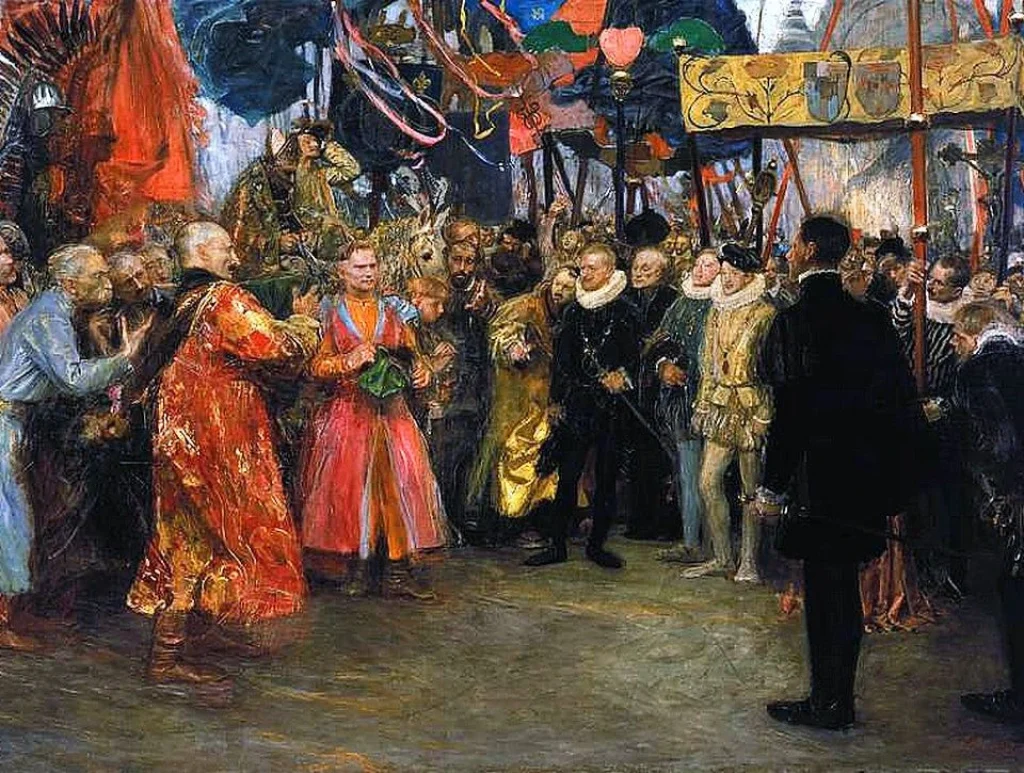
Sarmatism shaped far more than ceremonial dress. Its ideal hero was the landowner-warrior. In peacetime he lived on his estate, supervised the farm, hunted, entertained his neighbours and sued them in court; when danger came, he mounted his horse. From this ideal grew a culture of prolonged feasts, elaborate speeches, ostentatious hospitality and endless quarrels over honour. Even a man of limited means wanted to receive his guests in a manner that would be discussed throughout the district. A popular saying captured the temptation to ruin oneself for appearances: mortgage everything if you must, but put on a show.
Every manor needed ancestors. Stern, moustachioed men appeared on the walls, while family trees lengthened until they reached a legendary warrior, prince or participant in some ancient battle. If a suitable forefather could not be found, his biography could always be improved. A man descended from the Sarmatians in general could easily discover several particularly distinguished Sarmatians within his own family.
A nobleman left the world as theatrically as he had lived in it. During an elaborate funeral, a many-sided portrait of the dead man was attached to the end of his coffin, allowing him to stare back at the assembled mourners. The procession might be led by an archimimus, a horseman impersonating the deceased. Inside the church, he broke a lance against the coffin to show that the warrior’s earthly service had ended. Sermons spoke of the vanity of riches while the ceremony itself sometimes consumed a fortune.
Religion occupied an immense place in the Sarmatian world. In the sixteenth century, the shared culture of the nobility could still unite Catholics, Orthodox Christians and Protestants. The Counter-Reformation and the wars of the seventeenth century gradually drew the ideas of “Sarmatian”, “Catholic” and “defender of the fatherland” closer together. The Commonwealth came to be imagined as the frontier fortress of Christendom, its people entrusted by God with a special mission. Some writers carried the idea remarkably far. The Franciscan Wojciech Dembołęcki argued that Polish was older than every other language and that it was the language God had used when speaking to Adam and Eve.
Respect for tradition was hardening into a belief that the Sarmatian world was perfect by definition. The ancestors had created it and God had sanctified it. Nothing therefore needed to be repaired.
When Liberty Became Paralysis
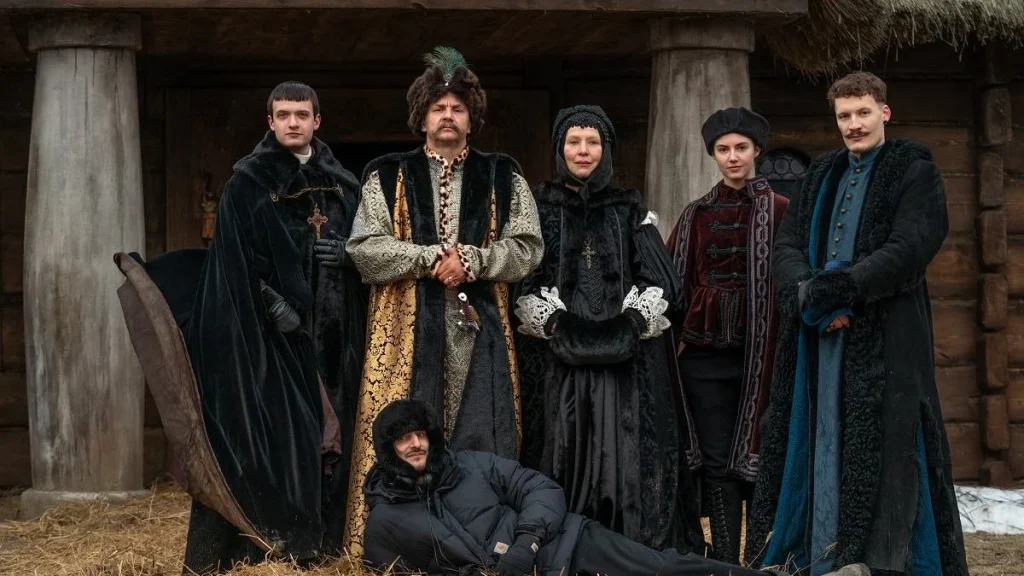
The fall of the Polish-Lithuanian Commonwealth cannot be explained by Sarmatism alone. The country was devastated by wars, epidemics and economic crises. Magnates built political factions of their own, neighbouring powers bought supporters and interfered in royal elections, while Russia, Prussia and Austria had no intention of waiting patiently for the Commonwealth to solve its difficulties.
Sarmatian confidence in the perfection of the old order nevertheless made those threats harder to confront. Any strengthening of central government looked like absolutism. A permanent army required taxes, taxes required the agreement of the Sejm, and changes to the rules seemed like an assault on the inheritance of the ancestors. Liberty, created to protect the citizen from arbitrary power, increasingly protected the state from making decisions.
Behind the appearance of equality, magnate power continued to grow. A poor nobleman retained his vote, his sabre and his right to call himself the voivode’s brother, but he often depended on a wealthy patron for wages, credit or protection. The system remained republican in its language while becoming oligarchic in practice.
During the eighteenth century, supporters of reform turned the word “Sarmatism” into a term of ridicule. Curiously, the word itself was rarely used during the culture’s heyday. Noblemen called themselves Sarmatians, but they did not claim to follow Sarmatism. The label entered circulation in the 1760s through Enlightenment critics who used it to mean ignorance, coarse manners, drunkenness, provincial conceit and hostility to change. The complicated world of several centuries was compressed into a caricature of a moustachioed pan shouting about liberty as he disrupted yet another Sejm.
That caricature was also unfair. Sarmatian culture produced political obstinacy and class arrogance, but it also fostered personal dignity, participation in public affairs, a belief that authority was bound by law, a vivid literature and an unmistakable artistic tradition. Its love of liberty reached a dead end because the nobility refused to extend that liberty beyond its own estate or adapt its old institutions to a changing world.
Sarmatism After the Sarmatians
The Partitions of the Commonwealth transformed attitudes towards the vanished world. What Enlightenment reformers had mocked as a relic became, in the nineteenth century, a memory of the lost country. Adam Mickiewicz filled Pan Tadeusz with the last noble feasts, quarrels, sabres and Słuck sashes. In his Trilogy, Henryk Sienkiewicz created an appealing image of the Sarmatian as noisy and sinful, yet still capable of heroism. The old nobleman returned no longer as the culprit behind a national catastrophe, but as the hero of a national legend.
The kutasy returned with him. In Pan Tadeusz, they once again glitter from an ornate Słuck sash—perfectly respectable tassels from a world in which clothing was a political statement, liberty belonged to a minority and an invented ancestry could shape the destiny of an enormous state.
The Polish nobility did not descend from the ancient Sarmatians. After several generations, however, that ceased to matter. The myth proved stronger than genealogy: it gave the estate a common appearance, a common language and an explanation for its power. People invented their ancestors—and then began to live as though those ancestors had truly bequeathed them a sabre, a country and Golden Liberty.