After repeated strikes on Iran’s Eagle 44 airbase, the logical response might have been to abandon construction and disperse whatever equipment had survived. Iran did the opposite. While ruined buildings remain untouched, construction crews are clearing taxiways and extending a second route toward the tunnels inside the mountain. Tehran clearly does not regard the underground base as lost—even after its adversaries demonstrated exactly where to strike in order to trap its aircraft below ground.
An Airfield Hidden in the Zagros Mountains
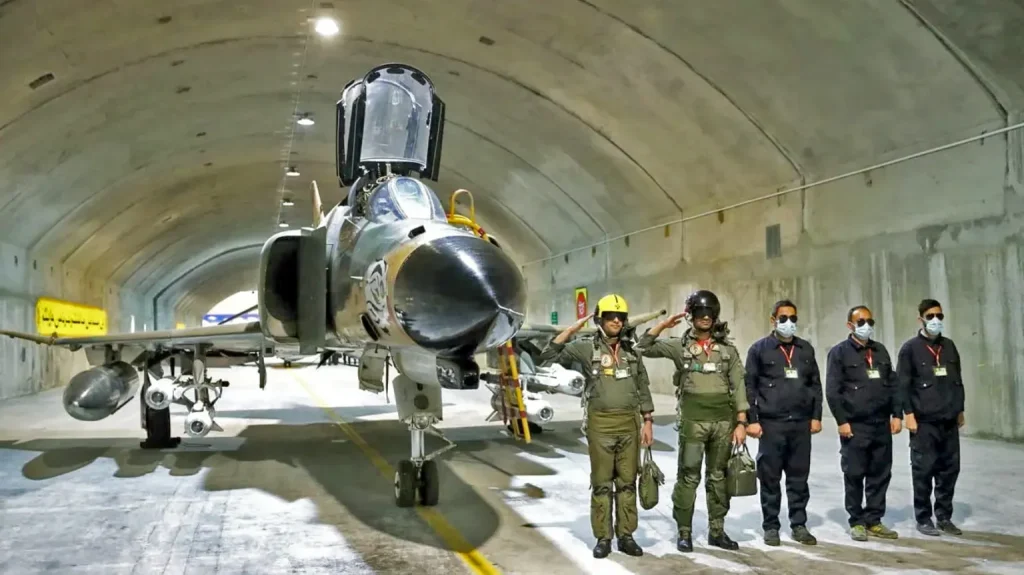
Iran first unveiled Eagle 44, or Oghab 44, in February 2023. The number commemorated the 44th anniversary of the Islamic Revolution, while the official footage was intended to display a new level of protection for Iranian airpower. F-4 Phantom fighters taxied through brightly lit tunnels, with drones and aviation weapons visible nearby. Iranian officials claimed that the complex could support aircraft armed with long-range cruise missiles.
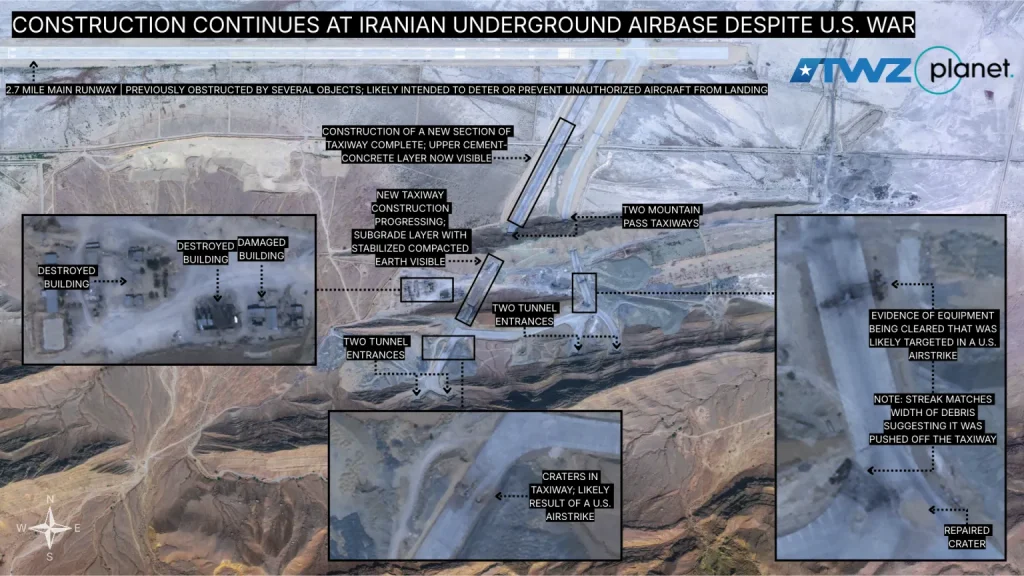
The location was carefully chosen. The base lies in Hormozgan Province, roughly 100 miles, or 160 kilometres, from the Strait of Hormuz, one of the world’s most important shipping routes. Its underground shelters were carved into the foothills of the Zagros Mountains, while a runway approximately 2.7 miles, or 4.3 kilometres, long was built across the valley floor. Four entrances lead into the main tunnel complex. Aircraft reach the runway through two taxiways, sections of which pass through a smaller mountain ridge.
Work at the site began as early as 2013, although construction of the runway started much later. The base was still incomplete when it was ceremonially unveiled. One taxiway was operational, the second remained under construction, and the internal layout was known only from carefully selected footage released by Iranian state television.
Why Hide Old Aircraft Inside a Mountain?
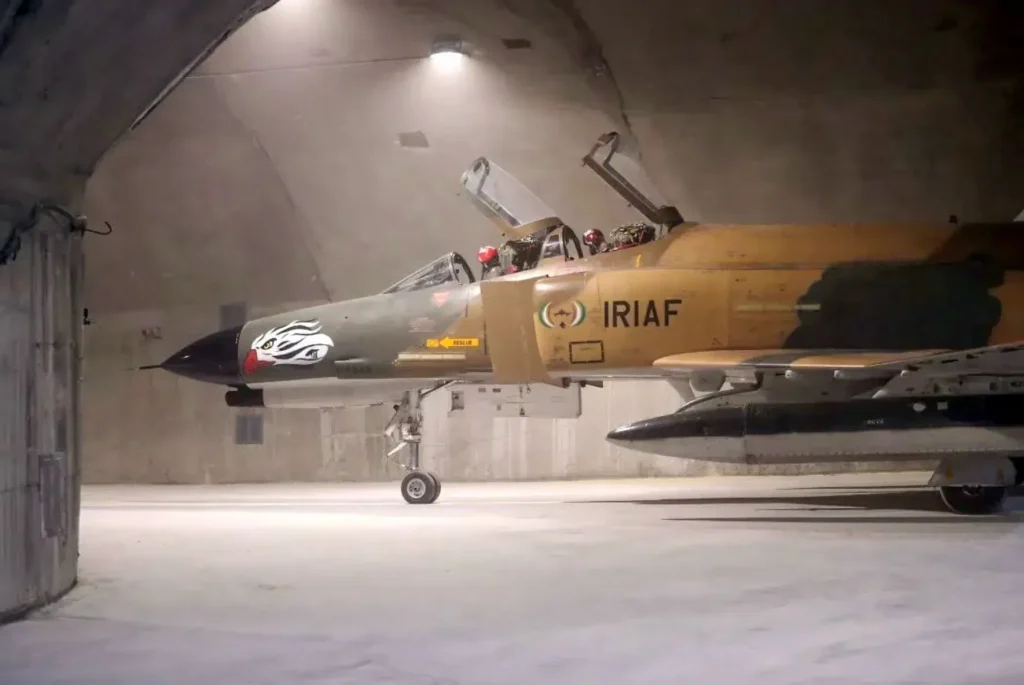
Eagle 44 appears to be an attempt to solve the Iranian Air Force’s greatest weakness with millions of tons of rock. Much of Iran’s combat fleet consists of aircraft purchased before the 1979 revolution or acquired several decades ago. On an exposed airfield, those aircraft, along with fuel stores and maintenance facilities, would present convenient targets for precision-guided weapons.
The mountain gives them a chance to survive an initial strike. Aircraft can be fuelled, armed, and serviced inside the tunnels before being moved rapidly toward the runway. Even a handful of surviving F-4s carrying anti-ship or cruise missiles could threaten warships and military bases across the Persian Gulf. The tunnels could also shelter drones, missiles, and ammunition, so the complex does not lose its value simply because Iran’s crewed combat fleet has declined.
The rock, however, protects only what is inside it. An aircraft still needs a tunnel exit, a taxiway, and an exposed runway. Those features turn an enormous underground fortress into a system with a handful of highly visible weak points.
The Attackers Did Not Need to Penetrate the Mountain
Eagle 44 endured at least three rounds of strikes in 2026. The first attacks left little clearly visible damage, but satellite imagery from late March showed craters near the tunnel approaches, a destroyed building, and damage to the taxiways. Small mounds also appeared along the runway, apparently placed there by Iran to prevent hostile aircraft from using the airfield.
The logic behind the strikes was simple: there was no need to destroy the underground hangars. Severing the routes between the tunnels and the runway would be enough. The aircraft, fuel, and weapons inside might remain intact, but they would become little more than goods in a warehouse if they could not be brought to the surface. The base was struck again in July, leaving new craters, wrecked equipment, and damage to facilities associated with the continuing construction effort.
The United States does possess heavy bunker-busting bombs that might be capable of reaching more deeply buried sections. The most powerful of these, the GBU-57 Massive Ordnance Penetrator, can only be delivered by B-2 bombers, and available stocks are limited. Temporarily disabling the base by repeatedly striking its portals and taxiways is far cheaper. These can be repaired, but every repair requires time, machinery, and personnel—and the work itself remains visible from space.
What Changed After the Strikes
Planet Labs imagery captured in late September showed that Iran had chosen to rebuild. Obstacles were removed from the main runway, wrecked equipment was pushed off the operational taxiway, and construction crews completed a new concrete section of the second route to the underground hangars. On the far side of the ridge tunnel, the foundation for the next section had already been prepared.
Two buildings in the support area remain destroyed, a third is damaged, and craters are still visible in front of the western entrances. Iran appears to be restoring neither comfort nor the entire support complex first, but the ability to move equipment out of the mountain. A second operational taxiway would remove the base’s original bottleneck: if one route were cut again, aircraft or drones could still use the other.
Satellite imagery cannot reveal what is currently stored inside the tunnels or how many operational aircraft Iran has left. The continued construction nevertheless suggests that Tehran views Eagle 44 as more than a conventional airfield. Even if the Iranian Air Force has suffered heavy losses, the mountain could still protect drones, cruise and ballistic missiles, ammunition, and other military equipment.
Eagle 44 proved to be neither an invulnerable fortress nor a useless showpiece. The strikes demonstrated that an underground airbase can be sealed without penetrating the mountain itself. The reconstruction demonstrated the other side of the problem: keeping it sealed permanently is far more difficult. As long as the tunnels remain intact, Iran only has to clear and repair a few hundred metres of concrete to put the base back into play.