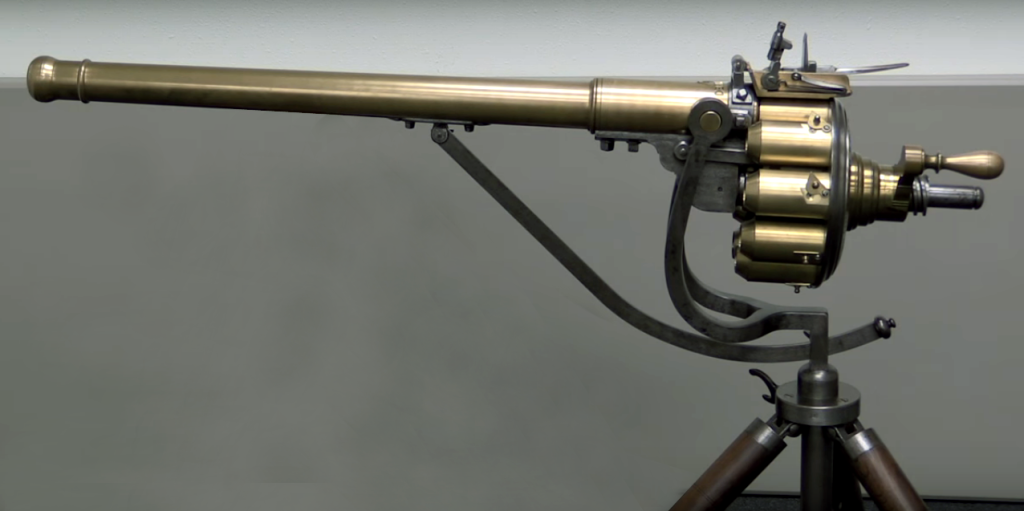
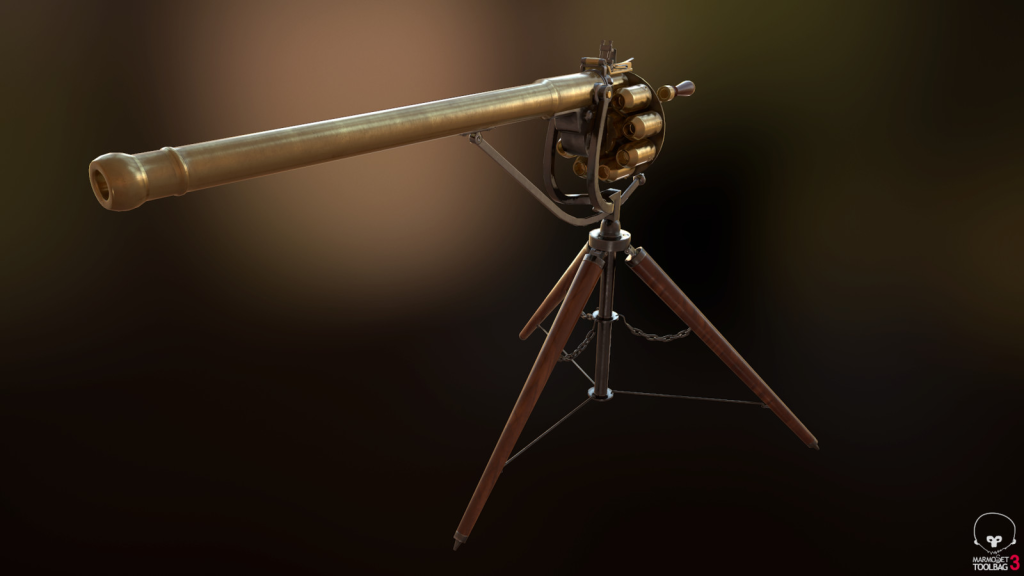
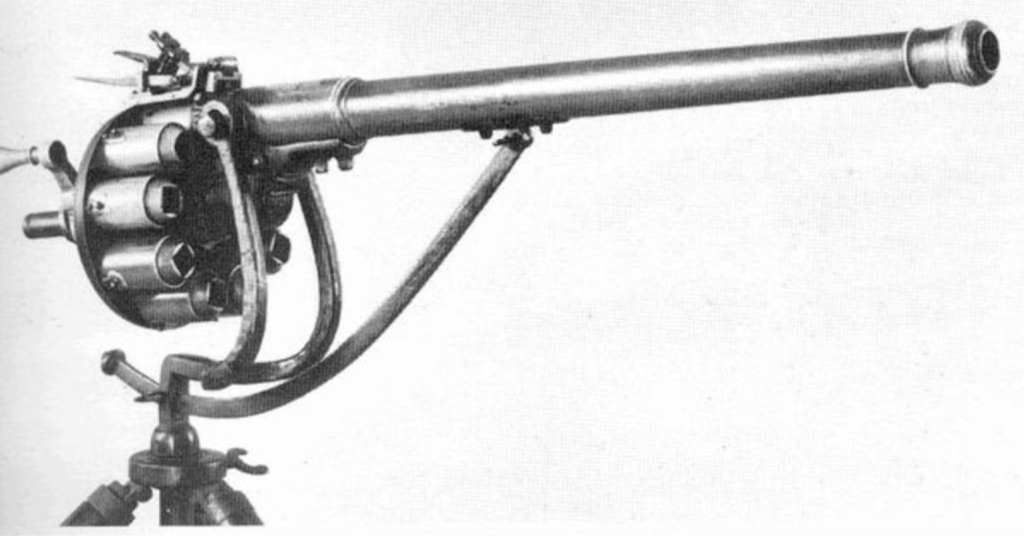
In May 1718, London notary and writer James Puckle patented a weapon that looked as though it had arrived from another century. Mounted on a folding tripod was a long barrel, behind which sat a revolving cylinder containing several preloaded chambers. The operator fired, rotated the cylinder to bring the next charge into position, and pulled the trigger again.
A well-trained soldier of the early 18th century could fire a musket two or three times per minute. According to the widely cited results of one demonstration, the Puckle gun fired 63 shots in seven minutes—nine rounds per minute. That is why it is frequently described as the world’s first machine gun.
It was not actually a machine gun. The weapon did not use the energy of firing, reload automatically, or provide continuous fire. Technically, it was closer to an enormous flintlock revolver mounted on a tripod.
Its real importance lies elsewhere. Puckle was among the first inventors to separate firing from the slow process of muzzle-loading and to concentrate several shots into a short period. He correctly anticipated the future of firearms, but offered it to an industry that was not yet capable of manufacturing it.
The Notary Who Wanted to Stop Boarding Parties
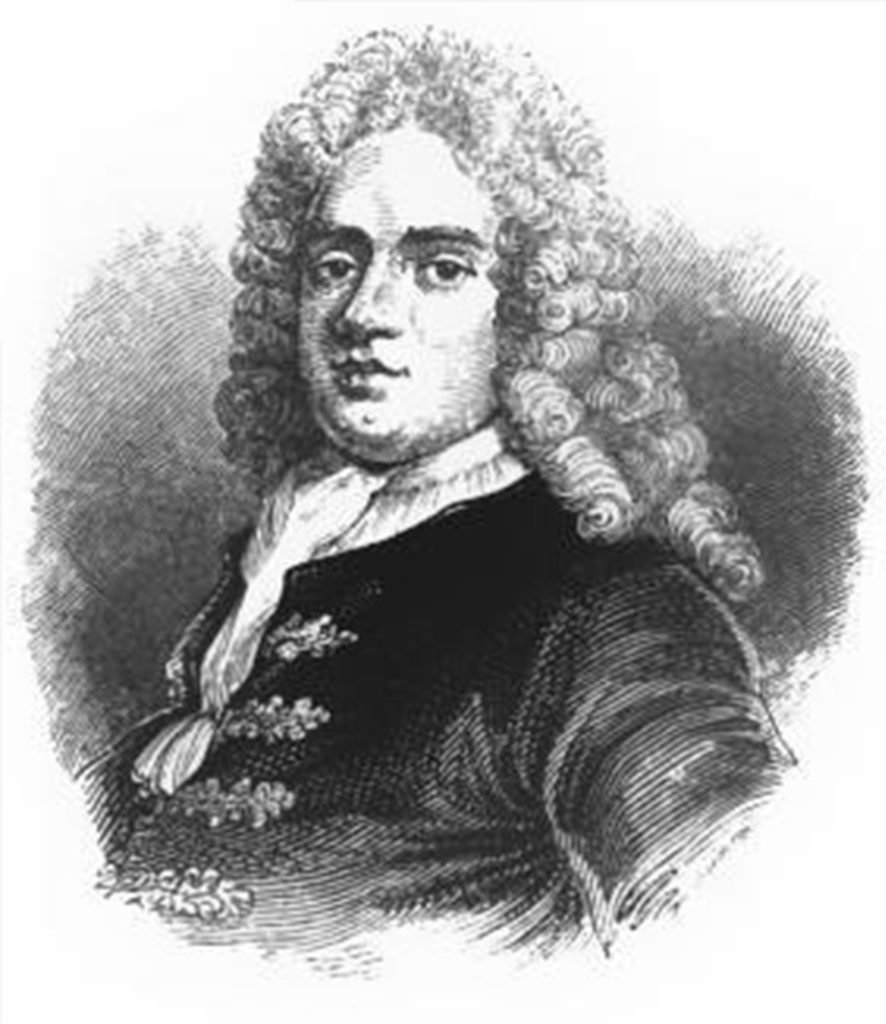
James Puckle was neither a professional gunsmith nor an artillery officer. He worked as a notary, participated in commercial ventures, and wrote political and moral essays. He belonged to a class of early 18th-century gentlemen inventors who moved freely between business, publishing, and mechanical experimentation.
Puckle called his weapon the Defence. Its patent described a portable gun or machine capable of firing many bullets rapidly and being reloaded quickly. Its intended environment was the deck of a ship.
That choice made sense. Large naval guns worked well against an enemy vessel’s hull, masts, and sails, but were less useful when a boat filled with armed men approached the side. Before boarding, the attackers had to cross the final few dozen meters, climb onto the deck, and engage the crew at close range. At that moment, several rapid shots could be particularly valuable.
Puckle proposed mounting his weapon near the ship’s rail and using it against approaching boats. Once one cylinder had been emptied, it could be removed and replaced by another that had already been loaded. On paper, a ship would gain a compact defensive position capable of firing several times faster than a single musketeer.
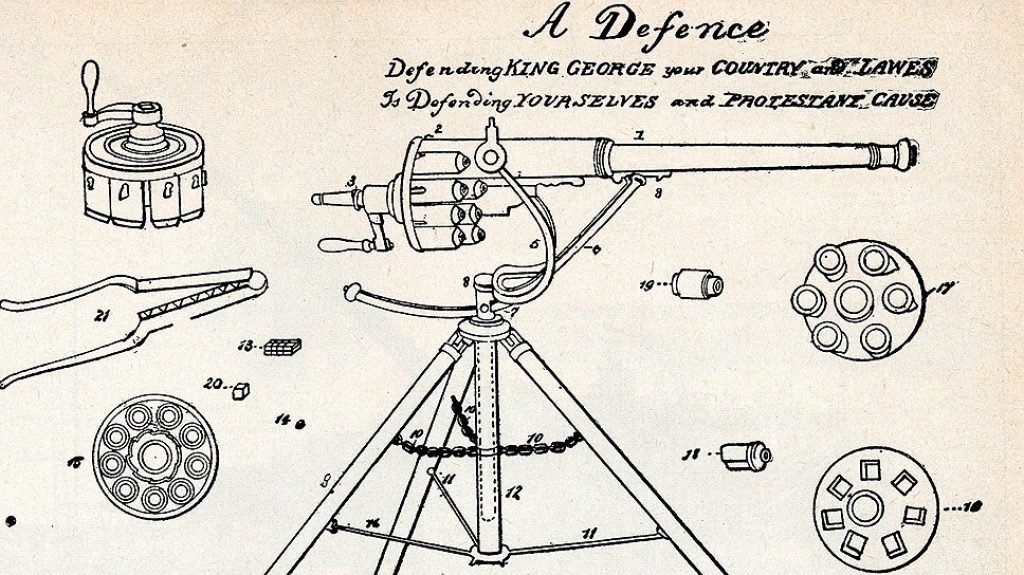
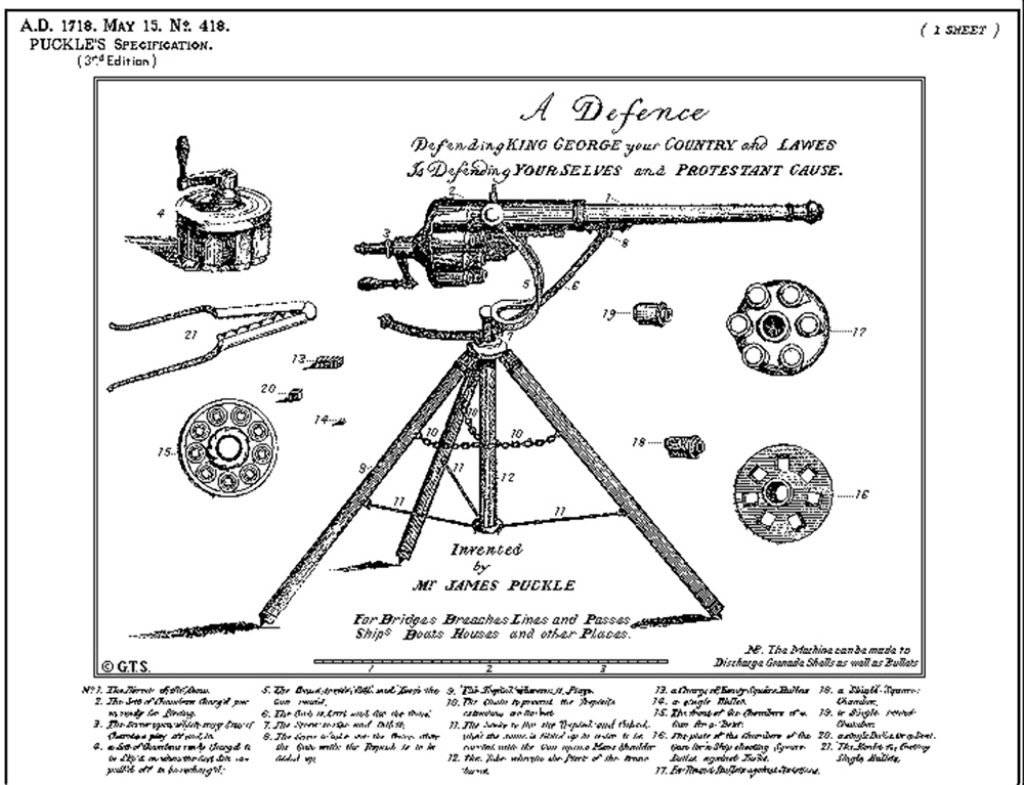
Patent No. 418 was issued on May 15, 1718. It included not only a description of the idea but also a relatively detailed drawing of the mechanism—something still unusual in early English patents.
How the Giant Flintlock Revolver Worked
The Puckle gun had a single fixed barrel approximately 90 centimeters long and a bore of around 32 millimeters. Behind the barrel was a cylinder containing separate firing chambers. The number of chambers differed between drawings and surviving versions of the design, with cylinders holding six, seven, nine, or more charges being described.
Each chamber was loaded in advance with loose gunpowder and a projectile. Simply turning the cylinder, however, was not enough. After every shot, the operator loosened a large screw at the rear, pulled the cylinder slightly away from the barrel, and manually rotated it until the next chamber was aligned. The screw was then tightened again, pressing the chamber against the breech of the barrel.
This created a primitive but important gas seal. If a large gap remained between the chamber and the barrel, part of the propellant gas escaped, reducing the projectile’s velocity and potentially burning the operator. A tight connection improved performance, but it also required carefully fitted metal components.
After rotating the cylinder, the operator still had to prepare the flintlock: check the priming powder in the pan, cock the mechanism, aim, and fire. There was no automation in the modern sense. Every part of the cycle was performed manually.
When all the charges had been fired, the rear screw could be removed completely, allowing the cylinder to be exchanged. It was not a magazine in the modern sense. There were no self-contained cartridges being fed into a common chamber. The entire cylinder was a collection of separate loaded chambers and formed part of the breech mechanism itself.
Nevertheless, the underlying idea was remarkably modern. Puckle proposed preparing ammunition before the battle, replacing it as a complete unit, and avoiding the need to push powder and a ball down a long barrel after every shot.
Nine Rounds Per Minute: Was That Really Impressive?
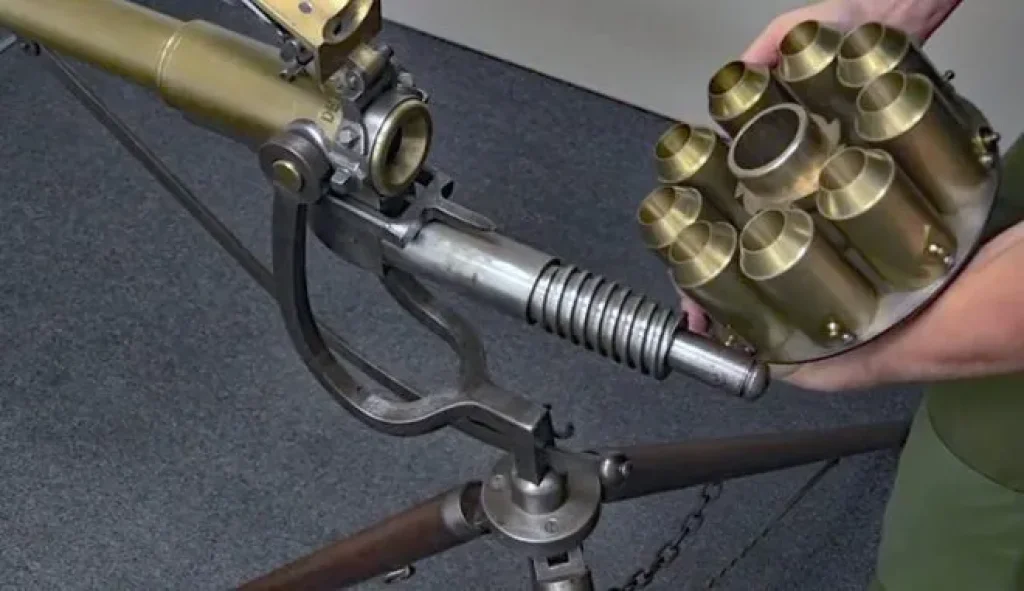
According to the most famous account of its trials, the Puckle gun fired 63 shots in seven minutes during a 1722 demonstration, reportedly in heavy rain. Its average rate of fire was therefore nine rounds per minute.
Compared with a flintlock musket, that was genuinely impressive. A conventional musketeer had to take out a paper cartridge, tear it open, pour some powder into the priming pan, empty the remainder down the barrel, insert the ball, draw the ramrod, ram the charge home, replace the ramrod, cock the weapon, and aim. Any mistake or excessive haste could produce a misfire.
Puckle’s design moved much of this work to the period before the battle. While one cylinder was mounted on the gun, other cylinders could be loaded separately. For several dozen seconds, the crew could deliver an unusually high concentration of fire.
The advantage disappeared once the prepared cylinders had been emptied. Every chamber then had to be cleaned and manually reloaded with powder and a projectile. A brief burst of rapid fire was followed by a lengthy reloading process.
Nine rounds per minute did not make the Puckle gun a wonder weapon. Several musketeers could provide a similar combined rate of fire, engage different targets simultaneously, and continue fighting if one weapon failed. A small swivel gun loaded with grapeshot could strike several attackers with a single discharge.
Puckle had created an expensive and complicated mechanism for a task that could already be performed by a group of ordinary soldiers or a small cannon.
Why the Cylinder Was More Difficult Than It Looked
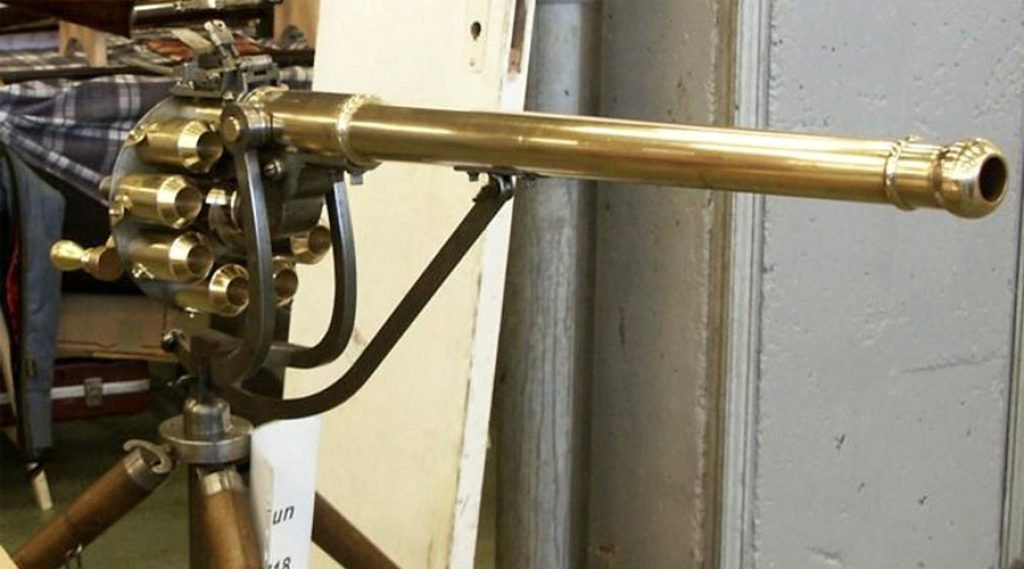
The Puckle gun’s greatest enemy was not the conservatism of British admirals but the manufacturing technology of the 18th century.
For the mechanism to work, each chamber had to align precisely with the barrel. The rear screw had to press it tightly against the breech, while remaining loose enough for the crew to rotate the cylinder quickly. Every component was made by hand. True interchangeability had yet to become an industrial standard.
Two apparently identical cylinders might require individual fitting. Wear or minor deformation could destroy the gas seal. Black-powder fouling and unburned particles accumulated on the components, obstructing the cylinder and rear screw. After several shots, the mechanism became hot and dirty.
The system looked particularly questionable aboard a ship. Salt air encouraged corrosion, a rolling deck complicated maintenance, and moisture was a constant enemy of the flintlock and its priming powder. A weapon that demanded precise fitting and careful attention was intended for the very environment in which keeping it in perfect condition would be most difficult.
Puckle had no percussion cap, sealed metallic cartridge, or industrial machinery capable of producing large numbers of identical components. He had designed a firearm mechanism without most of the supporting technologies required to make it reliable.
Round Bullets for Christians, Square Bullets for Turks
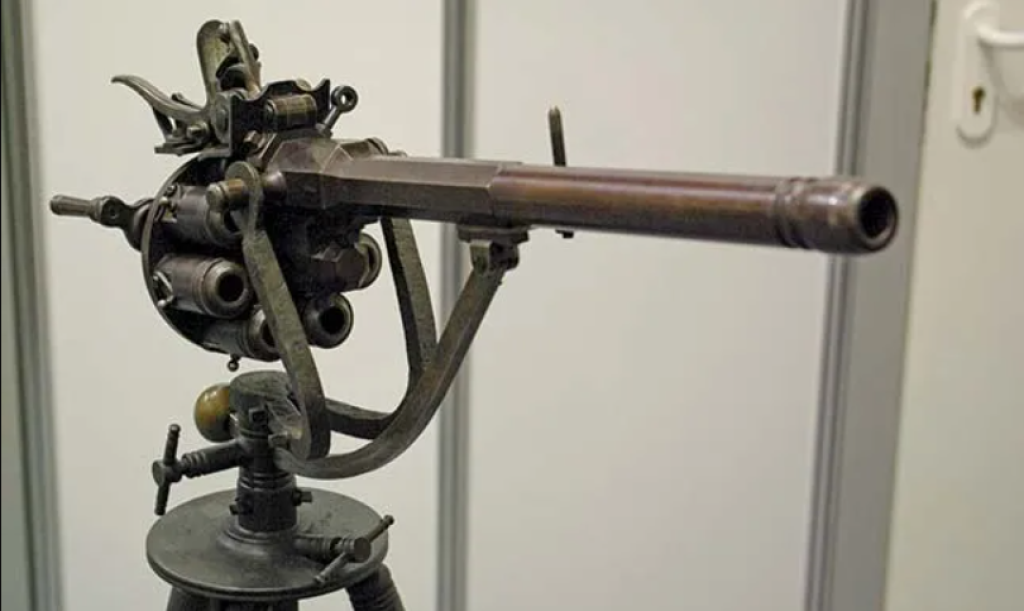
The most famous feature of the Puckle gun is not a later legend. The original patent illustration really does show different cylinders: one intended for round bullets and another for unusual cube-shaped projectiles.
Puckle proposed using round bullets against Christian enemies and square bullets against the Turks. The patent claimed that the square projectiles would inflict more serious wounds and demonstrate to the enemy the supposed benefits of Christian civilization.
The practical value of this idea was doubtful even by early 18th-century standards. A round lead ball passed relatively easily through a smoothbore barrel and behaved somewhat predictably in flight. A cube-shaped projectile complicated the gas seal, lost velocity more rapidly, and could follow a highly unpredictable trajectory.
The square bullets were probably less of a genuine technical improvement than a marketing device. Puckle was promoting his invention against the background of wars with the Ottoman Empire and fears of maritime raiders. The unusual ammunition allowed him to present the Defence not merely as a mechanism, but as a special weapon intended for use against a religious enemy.
There is no reliable evidence that the square bullets were ever used in combat. Yet three centuries later, they remain the most recognizable part of the Puckle gun story.
A Successful Demonstration That Attracted No Buyers
Puckle reportedly demonstrated an early version of the weapon to Britain’s Board of Ordnance in 1717. The military showed little interest. After securing his patent, he attempted to attract private investors and establish a company to manufacture the gun.
The timing could hardly have been worse. In 1720, Britain experienced the collapse of the South Sea Company, after which projects promising investors quick profits were greeted with suspicion and ridicule. The Puckle gun also became the target of satire. One popular verse joked that the terrible machine had so far wounded only those who owned shares in it.
The only reliably documented major customer was John Montagu, 2nd Duke of Montagu. He purchased two guns for a 1722 expedition to the Caribbean islands of Saint Lucia and Saint Vincent. Shipping documents described them as two of “Puckle’s Machine Guns,” one of the earliest known uses of the expression.
The expedition ended unsuccessfully, and there is no evidence that the weapons were ever used in combat. Two complete original examples remained in the collection of the duke’s descendants.
The exact number of Puckle guns manufactured is still disputed. Reports exist of at least one additional example containing original components, but the weapon certainly never entered mass production.
What About Peter the Great?
Popular Russian-language accounts frequently claim that Peter the Great became interested in the Puckle gun and that one example eventually reached Saint Petersburg. Some versions even place it in the collection of the Military Historical Museum of Artillery.
There is no reliable evidence supporting this story. Collectors’ literature has mentioned rumors of Puckle guns in Russia, China, Denmark, and several other countries. These were possible leads in the search for surviving examples, not confirmed locations.
The two weapons purchased by the Duke of Montagu have traceable histories. The supposed Russian gun has no similarly documented provenance. The Peter the Great episode should therefore be treated as an unconfirmed legend unless an acquisition record, museum catalogue, or surviving weapon with a proven history can be produced.
Was the Puckle Gun an Ancestor of the Machine Gun?
There is no direct technological path from the Puckle gun to the Gatling gun or the Maxim gun. No evidence shows that 19th-century designers copied Puckle’s mechanism or even studied it in detail.
The Gatling gun used a rotating cluster of barrels and mechanical ammunition feeding. Rotation distributed heat between the barrels and sequentially performed loading, firing, and cartridge extraction. Hiram Maxim went further by using the recoil of the previous shot to reload and fire the weapon automatically.
Puckle’s gun had no rotating barrels, mechanical feeding system, extraction mechanism, or automatic action. Its cylinder merely aligned preloaded chambers with a stationary barrel. Between the Defence and a true machine gun stood the percussion cap, metallic cartridge, industrial standardization, reliable ammunition feeding, and greatly improved metallurgy.
Puckle did, however, formulate the basic problem: a single crew needed to fire many bullets in a short time without reloading a long barrel after every shot. In that limited sense, the Defence can be regarded as one of the earliest steps toward the machine gun—not as its direct ancestor, but as an early attempt to produce concentrated mechanical fire.
The Right Idea Arrived Too Early
The Puckle gun was not a forgotten wonder weapon capable of transforming 18th-century warfare. It was expensive, complicated, sensitive to fouling, and only briefly more effective than a group of ordinary musketeers. The British military rejected it not because its officers failed to understand the future, but because they were offered a mechanism with uncertain advantages and obvious operational problems.
Yet the outline of a new era was already visible in Puckle’s failure. A replaceable block of charges, a weapon mounted on a stable support, a crew instead of an individual shooter, and an attempt to concentrate fire within a few seconds would all become familiar features of later rapid-fire weapons.
Puckle had discovered the principle, but he could not provide it with a reliable cartridge, precision machinery, or a suitable ignition system. The machine gun did not appear when someone first wanted to fire faster. It appeared when industry learned to repeat the same firing cycle over and over again without hand-fitting every component.
The Puckle gun remained standing on the boundary between two eras: no longer an ordinary musket, but not yet a machine.