Three Hulls, 16 Missiles, and No Sailors: Why China Is Building a Strange Trimaran Submarine

Satellite images of Chinese shipyards have revealed a vessel that is difficult to place in any familiar category. It has a long central hull, two smaller outriggers, a sail fitted with a snorkel, and enormous compartments occupying most of its internal volume. The craft looks like a combination of a submarine, a trimaran, and a floating missile battery.
It has no officially announced name. China has disclosed neither the vessel’s purpose nor its armament—or even whether it has a crew. Satellite imagery nevertheless suggests that it may be an unusual uncrewed missile carrier capable of approaching a launch area while submerged, surfacing, and firing as many as 16–18 large missiles.
The most dramatic theory claims that these will be YJ-20 hypersonic anti-ship missiles. Yet the most interesting part of the project is not the missile but the vessel itself. China may be attempting to create an entirely new category of naval weapon: an underwater arsenal that requires no crew.
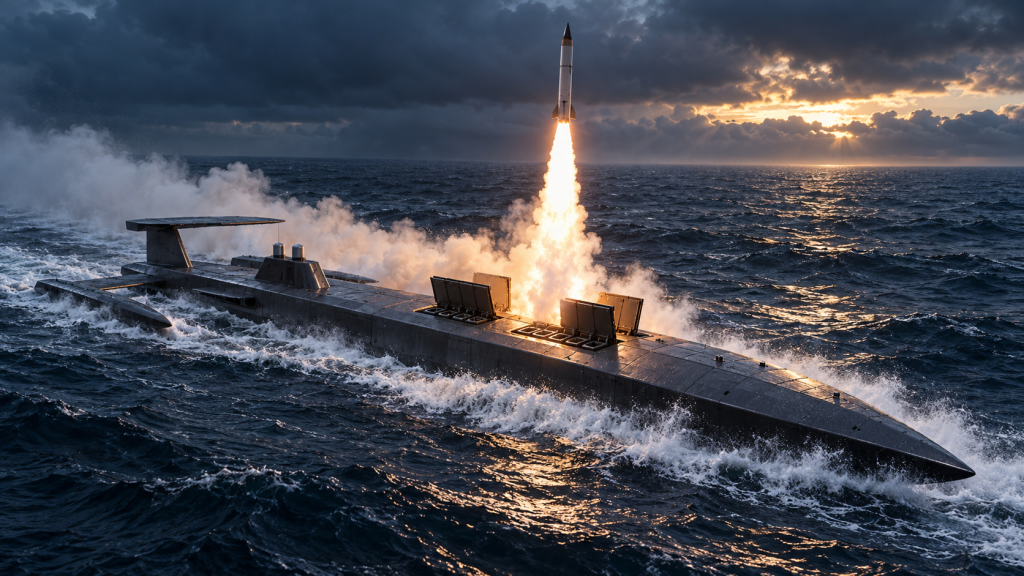
A Submarine That Prefers the Surface
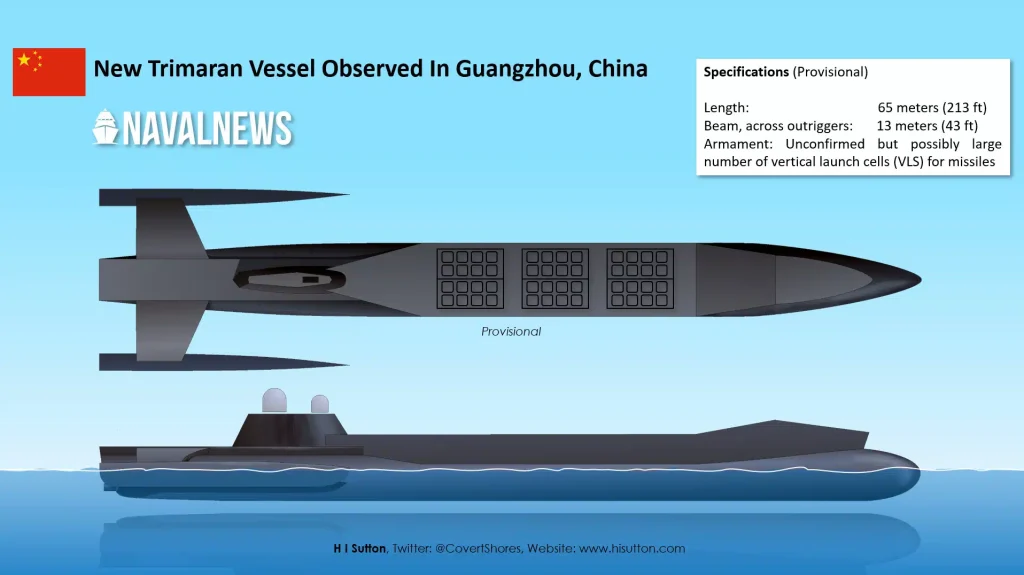
The unusual craft, estimated to be approximately 65 meters long, was built at the Guangzhou–Huangpu shipyard in southern China. Satellite imagery placed it in Dalian in May 2026, after which it was reportedly transferred to Huludao on the Bohai Sea, where it is believed to be undergoing trials. Its submerged displacement has been estimated at roughly 900 tonnes.
It can formally be described as a submarine, but its design points to a somewhat different philosophy. It may be better understood as a surface vessel capable of spending much of its time in a semi-submerged condition. A prominent snorkel would allow its diesel engines to draw air while most of the hull remains beneath the surface.
The central hull probably contains the diesel engines, generators, and main propulsion system. The two outrigger hulls appear to carry ducted propellers or small waterjets, possibly using electric power for quieter movement and precise maneuvering.
The trimaran configuration was not chosen for appearance. The side hulls provide considerably greater stability on the surface. That is not usually a submarine’s most important characteristic, but the Chinese vessel may need to raise heavy missile launchers above its hull. Without the outriggers, the craft could develop a dangerous list.
The Missiles Are Stored Horizontally
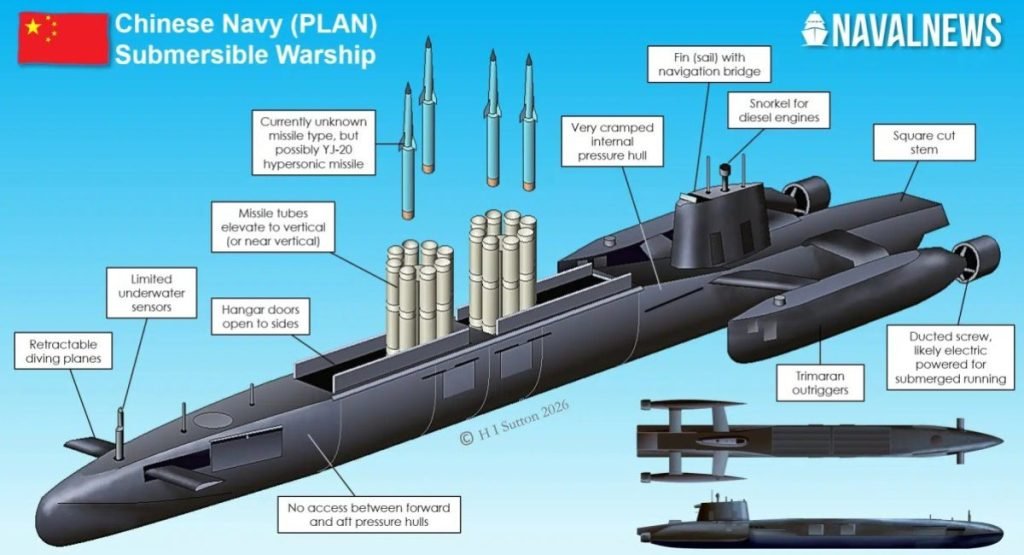
Two elongated compartments occupy much of the central hull. Judging by their shape, they may contain groups of missile canisters stored horizontally. Before firing, the vessel would have to surface completely, open the compartment doors, and elevate the launchers into a vertical position.
Available imagery provides reasonable evidence for at least eight launch tubes. If both compartments share an identical arrangement, the total capacity could reach 16–18 missiles. This remains an estimate based on external dimensions, however, rather than a confirmed specification.
At first glance, the arrangement seems strange. Modern submarines have long been capable of launching missiles while submerged. Why should a new vessel expose itself by surfacing and opening two enormous weapons bays?
The answer probably lies in cost and internal volume. A genuine submarine launch system must withstand water pressure and allow a missile to exit safely through the sea. Such installations are complex, heavy, and expensive. If the vessel is intended to be a relatively inexpensive uncrewed platform, it may be easier to install conventional shipboard launch canisters and fire from the surface.
The result would be an imperfect submarine capable of carrying an enormous payload for its size. Soviet Project 651 diesel-electric cruise-missile submarines, which employed a broadly similar tactic of surfacing before an attack, carried only four heavy anti-ship missiles. The Chinese craft may be able to deliver a salvo comparable to that of a large surface warship.
Does It Really Carry YJ-20 Missiles?
Some reports already describe the vessel as a carrier for YJ-20 hypersonic anti-ship missiles with a range of 1,500–2,000 kilometers and a speed of approximately Mach 9. Such claims should be treated cautiously.
The craft’s armament has not been officially disclosed. Naval News identifies the YJ-20 as only one possible candidate, alongside conventional anti-ship missiles and land-attack cruise missiles. The size of the weapons bays suggests that the launchers are intended for substantial weapons, but it is impossible to identify a missile type from satellite imagery alone.
The precise performance of the YJ-20 also remains classified. Even its estimated range and speed are based largely on open-source assessments. Claims that China already possesses an operational “submarine carrying 18 hypersonic missiles” therefore run ahead of the available evidence.
The vessel could nevertheless be compatible with such a weapon. Because its canisters rise above the water before launch, it would not require a missile specifically designed for underwater firing. In theory, it could employ almost any suitably sized weapon, from anti-ship missiles to land-attack systems.
Where Did the Crew Go?
Estimates of the internal layout reveal another unusual feature. Once the engines, fuel, and two enormous missile compartments have been accommodated, very little space appears to remain for people. There is no obvious room for proper accommodation, an extensive control center, or major life-saving equipment.
This is the principal reason analysts believe the craft is uncrewed. A small open bridge on top of the sail may be intended for a temporary crew handling harbor departures, docking, and navigation through confined waterways. Once at sea, control would pass to its autonomous systems.
Removing the crew gives designers considerable freedom. The vessel requires no cabins, food and water stores, air-regeneration equipment, sanitary facilities, or extensive escape systems. Almost all useful internal volume can be devoted to fuel and weapons. Losing the platform would also not mean losing dozens of sailors.
A fully autonomous voyage across the ocean would nevertheless be an exceptionally demanding undertaking. The craft would need to avoid collisions, navigate while submerged, monitor mechanical failures, and respond to unexpected damage without human intervention. Communication with a submerged vessel is limited, while prolonged snorkel operation could expose it to radar and maritime patrol aircraft.
The earliest examples may consequently function as remotely supervised platforms with a high degree of automation rather than genuinely independent underwater robots.
Not a Hunter, but an Underwater Missile Truck
The Chinese trimaran would not have to find an aircraft carrier by itself. More probably, it would serve merely as a launcher within a much larger reconnaissance and strike network. Target coordinates could be supplied by satellites, aircraft, surface ships, or other uncrewed systems.
After receiving the data, the vessel would enter its assigned launch area, surface, raise its canisters, and fire a massed salvo. It would then submerge again and attempt to leave the area.
That may be the project’s true value. China could distribute its missile inventory among numerous relatively small platforms. Destroying one would not eliminate a major warship or kill hundreds of crew members. An opponent, meanwhile, would have to search a vast ocean for an unknown number of low-profile targets.
The trimaran would not be invulnerable. Before firing, it must surface, open its compartments, and raise the launchers. At that moment it would be highly visible and largely unable to maneuver. Once it had fired, its position would be known, while a small diesel-powered craft would be unlikely to match the underwater performance of a true nuclear submarine.
A more fundamental problem is targeting. Striking a stationary object from a thousand kilometers away is comparatively straightforward. An aircraft carrier group may travel dozens of kilometers during a missile’s flight. Attacking it requires continuous tracking, updated coordinates, and an uninterrupted chain of communication despite electronic and physical countermeasures.
Hypersonic speed reduces the defender’s reaction time, but it does not answer the most important question: how does the missile know where the ship is?
The Idea Is More Dangerous Than the Trimaran
For now, the unidentified Chinese vessel remains an experimental platform. Its uncrewed status has not been confirmed, its number of launchers has been estimated from satellite imagery, and the YJ-20 is merely a possible armament option. Even the vessel’s intended mission could change following trials.
The design nevertheless appears entirely logical. China is not attempting to build a miniature nuclear submarine. Instead, it may be creating a specialized missile truck: slow, cramped, and uncrewed, but capable of delivering a large payload to a launch area.
One such trimaran would hardly alter the balance of power in the Pacific. Dozens of them, dispersed across different approaches and connected to a shared reconnaissance network, would present a much more serious problem. They would not need to be perfect. It would be enough for some of them to reach their assigned positions and fire.
The most important feature of the Chinese project is therefore not the YJ-20 hypersonic missile, whose presence has yet to be established. It is the attempt to turn a submarine into an expendable uncrewed arsenal. If the trials prove successful, this strange three-hulled craft could become the first representative of a new class positioned somewhere between a submarine, an uncrewed surface vessel, and a floating missile battery.