The Laser That Didn't Make It to War: How DragonFire Came Within a Hair's Breadth of Actual Combat

Sometimes the future is revealed not in high-profile premieres, but in decisions that never came to fruition.
In 2024, the United Kingdom was ready to take a step that, until recently, had seemed impossible even for military experiments: to deploy a laser weapon—still in the final stages of development—to a combat zone. Not a production model, not a proven system, but a prototype—with those very “teething problems” that usually take years to iron out.
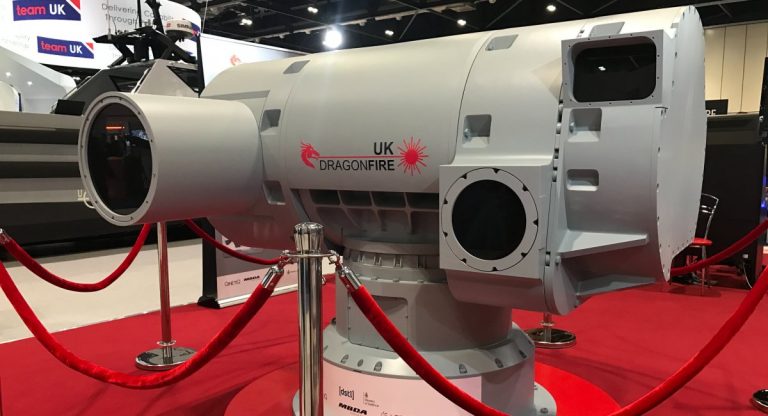
The discussion centered on the DragonFire system. And although it ultimately never made it to the Ukrainian front, the very attempt itself points to something far more significant: the nature of war is changing faster than new types of weapons can be developed.
Weapons that, just yesterday, were considered “the future”
The concept is simple yet radical: the target is destroyed not by a projectile, but by a concentrated beam of energy. No explosion, no shrapnel, no conventional “shot”—just the instantaneous heating of the target’s vulnerable area until it is destroyed. For drones, especially lightweight ones, this is more than enough.
In tests, the system demonstrated a level of accuracy that is often described figuratively as “hitting a coin from a kilometer away.” But what’s far more important is the cost per shot, which is literally measured in pounds. Compared to interceptor missiles, which can cost hundreds of thousands, this represents a technological breakthrough capable of transforming the very economics of war.
Why did this particular conflict become the “ideal testing ground”?
The idea to send DragonFire to Ukraine didn’t come out of nowhere. Modern warfare, especially in its current form, has created a unique situation in which laser weapons seem not just useful—but almost essential.
The battlefield turned out to be swarming with cheap drones. They’re everywhere, there are so many of them, and they keep coming back. And to counter them, we have to use weapons that are incomparably more expensive. This creates an imbalance: to shoot down a relatively cheap target, you have to use an expensive missile.
From this perspective, a laser seems like the ideal solution. It doesn’t “run out” like ammunition, doesn’t require complex logistics, and—most importantly—allows for an instantaneous response. That is precisely why the idea of testing it in actual combat did not seem like a reckless gamble, but rather an attempt to bridge the gap between development and deployment.
A decision that was never made
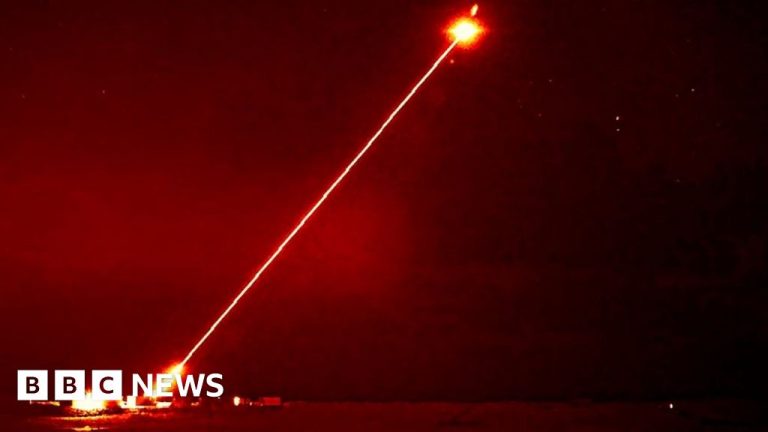
Nevertheless, despite their willingness to take a risk, DragonFire was not sent to Ukraine. And that is perhaps the most telling aspect of the whole story.
The problem isn’t that the system doesn’t work. The problem is that it hasn’t yet become reliable in environments where errors are unacceptable. Laser weapons remain sensitive to weather conditions—fog, rain, and dust can significantly reduce their effectiveness. They require significant energy resources, which means they need complex infrastructure. And finally, they’re still at a stage where every failure is not just a technical problem, but a risk of discrediting the entire concept.
There is another, less obvious factor: technology. Sending even a prototype to a combat zone carries the risk of losing it. And with that comes the risk of leaking solutions that have been years in the making. In the context of the technology race, this could prove to be too high a price to pay.
An old principle, a new pace
This whole story actually follows a familiar pattern: war always accelerates the adoption of technology. The only difference is the scale of that acceleration.
During the Apollo era, many decisions were also made at the very limit of acceptable risk. But back then, it took years to fine-tune the systems. Today, it takes just months.
DragonFire found itself at a crossroads where engineering caution clashed with military necessity. And for now, the former has prevailed.
Lasers as a Response to the New Economy of War
The main lesson from this story lies not in the context of this specific complex, but runs much deeper. The current conflict has shown that the traditional model of armaments is beginning to fail.
Inexpensive offensive capabilities are pitted against expensive defensive capabilities. And if this imbalance is not corrected, the defense begins to lose even at the economic level.
Laser weapons represent an attempt to restore balance—to make interception affordable, widespread, and sustainable once again. It is no coincidence that the development timeline for DragonFire is already being accelerated, and interest in such systems is growing worldwide.
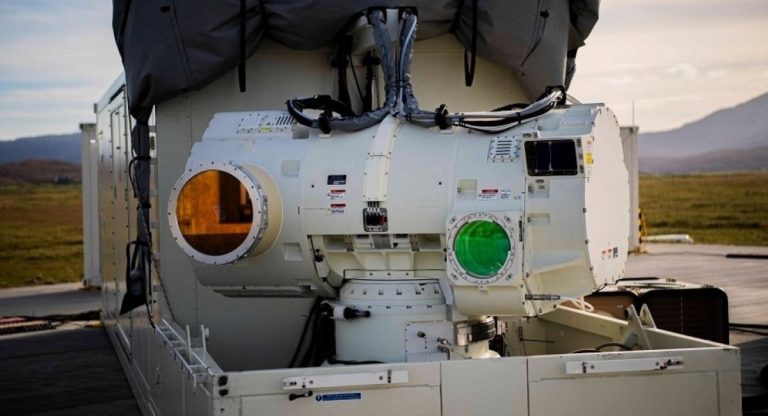
Technical Specifications and Developer: DragonFire
Although the system is still in the final development stage, some of its specifications are already known. It is important to understand that this is not a production model, but a demonstration and combat system, whose specifications are still subject to change.
| Parameter | Meaning |
|---|---|
| Name of the complex | DragonFire |
| Weapon Type | Laser Directed-Energy Weapons |
| Purpose | Engaging drones, missiles, and small aerial targets |
| Range | Up to several kilometers (estimated) |
| Type of Impact | Thermal Destruction of the Target (Heating) |
| Rate of damage | Virtually instantaneous (at the speed of light) |
| Cost per shot | About 10 pounds sterling |
| Energy source | Land-based or ship-based power plant |
| Accuracy | High (small-target hit rate) |
| Development Stage | Testing and refinement leading to a production model |
| Planned Implementation | Toward 2027 |
The complex’s developers
DragonFire is being developed not by a single company, but by a consortium of British defense industry firms:
| Participant | Role |
|---|---|
| MBDA | Overall Project Coordination |
| Leonardo | Guidance Systems and Sensors |
| Kinetic | Laser Technologies and Testing |
| UK Ministry of Defence | Client and Funding |
| Parameter | Meaning |
|---|---|
| Laser power | Estimated at ~50 kW (tactical systems class) |
| Laser Type | Solid-state (fiber-optic or hybrid) |
| Operating Hours | Continuous beam with target lock-on |
| Time to Hit the Target | From fractions of a second to several seconds (depending on the objective) |
| Energy Consumption | Total in hundreds of kilowatts (taking system efficiency into account) |
| System Efficiency | About 20–35% (typical for such facilities) |
| Cooling System | Mandatory, high-load (liquid) |
Conclusion
DragonFire never made it to the war. But that may just be a matter of time.
What’s far more important is this: the very fact that they were ready to send it into combat even before development was complete. This means that technology is no longer waiting for perfection.
They appear when they’re needed.
And while lasers are still in a transitional phase today, tomorrow they may become the very tool that will forever change the rules of the game—quietly, without flashes, but at the speed of light.
Based on materials from https://en.defence-ua.com/news/uk_was_ready_to_send_unfinished_dragonfire_laser_prototypes_to_ukraine_for_combat_testing_but_never_delivered-18033.html