Just a year ago, there was barely any dry land here.
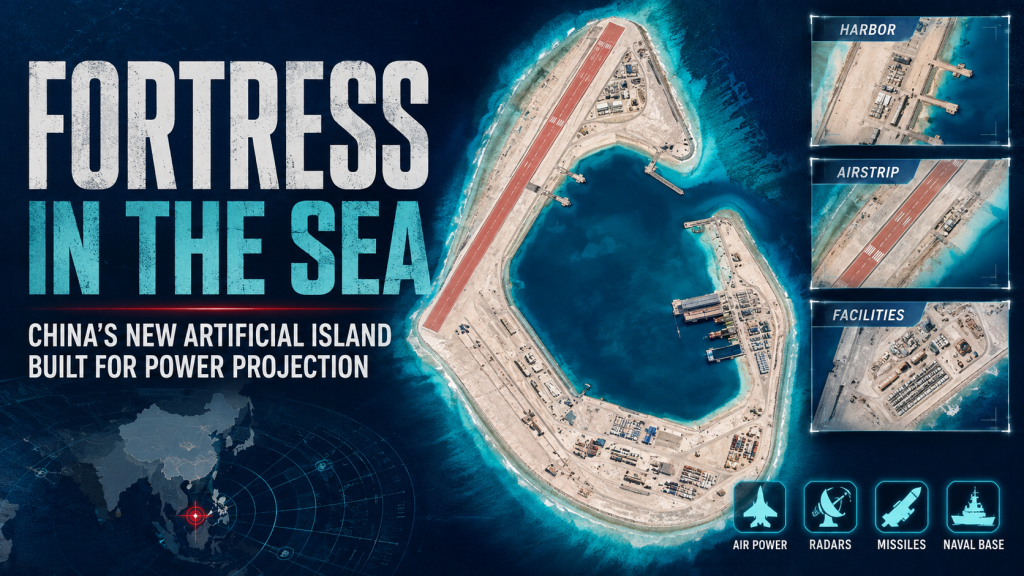
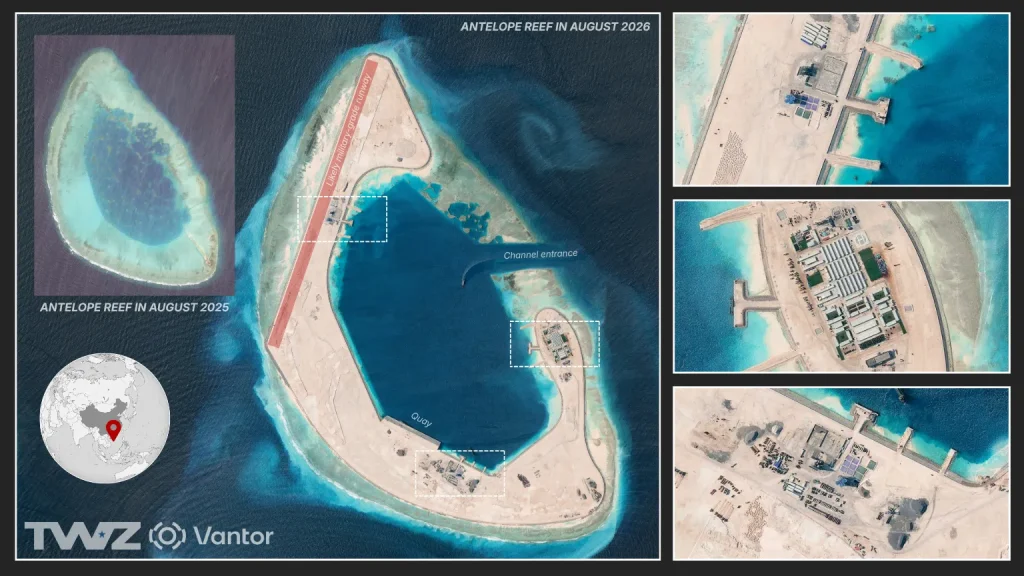
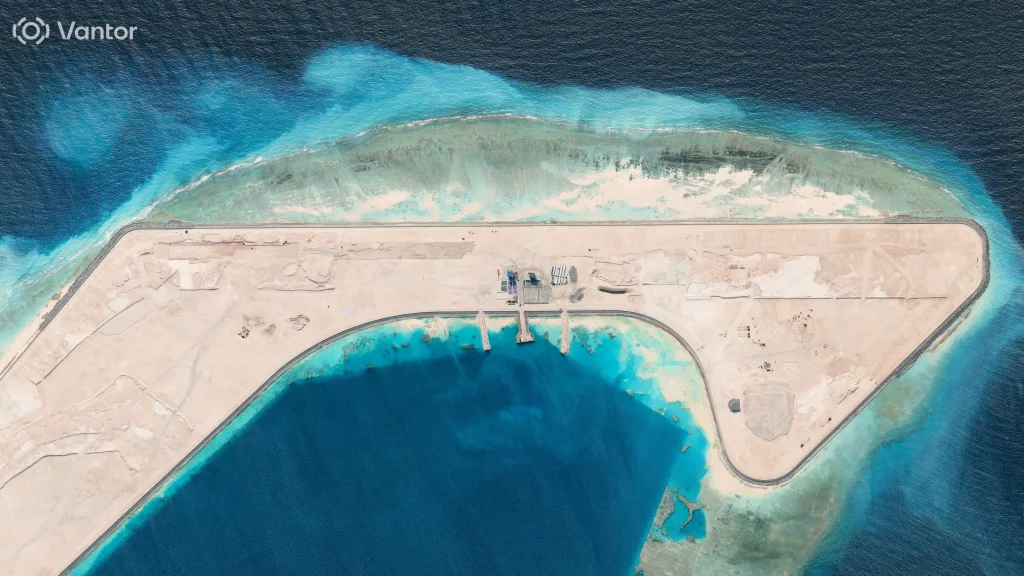
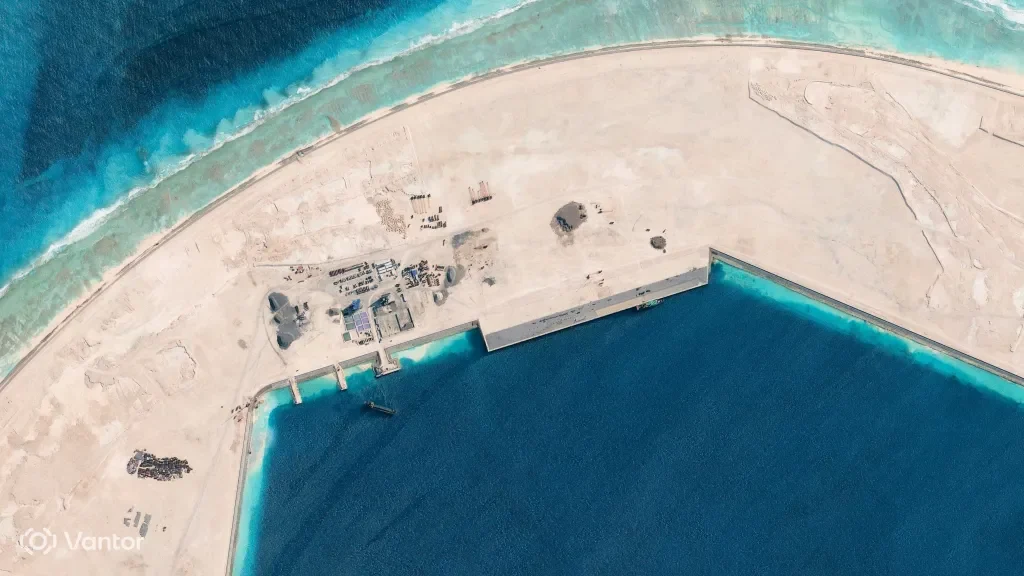
Antelope Reef in the Paracel Islands was largely a submerged reef, with little visible above the surface. But in October 2025, Chinese dredgers arrived. In roughly ten months, they transformed the reef into an artificial island covering about 1,500 acres — roughly 6 square kilometers. It now stretches approximately 3.7 miles, or 6 kilometers, and already features breakwaters, roads, a deep-water harbor, a roughly 680-meter quay, a helipad, buildings, and concrete production facilities. Along its northwestern side, work is preparing the ground for a runway approximately 3,000 meters long.
The scale is genuinely impressive. Earlier estimates put Antelope’s reclaimed area at around 1,490 acres. For comparison, Woody Island — China’s principal base in the Paracels — covers roughly 890 acres, while the enormous Mischief Reef installation in the Spratlys occupies around 1,504 acres. In other words, China has effectively created from scratch a piece of land comparable in size to some of its largest artificial islands in the South China Sea.
Beijing currently emphasizes primarily civilian purposes for the site. But previous experience gives us a fairly good idea of what such islands can eventually become.
And that raises a much more interesting question.
Why, in an age of satellites, long-range missiles, and modern combat aircraft, would anyone build an enormous immovable fortress in the middle of the sea?
At first glance, it looks like a return to military thinking from a century ago.
In reality, China has created an entirely new form of maritime fortification.
Once, a Fortress Meant Concrete
The idea of turning a small island into an “unsinkable” military installation is nothing new.
The naval history of the 19th and first half of the 20th century was filled with sea forts. States built coastal batteries, concrete fortifications, and heavily defended islands intended to control harbor entrances and strategic straits.
Huge guns were installed in concrete casemates and armored turrets.
Ammunition magazines were buried underground.
Garrisons could remain operational for months with considerable autonomy.
The logic was simple: a ship could be sunk, while an island was considerably harder to destroy.
After World War II, however, the traditional maritime fortress rapidly lost much of its relevance. Guided weapons, jet aircraft, and eventually precision-guided missiles made large fixed fortifications extremely vulnerable.
The era of island fortresses appeared to be over.
China’s construction program in the South China Sea suggests that only the old form of the fortress disappeared.
A Modern Fortress No Longer Needs Huge Guns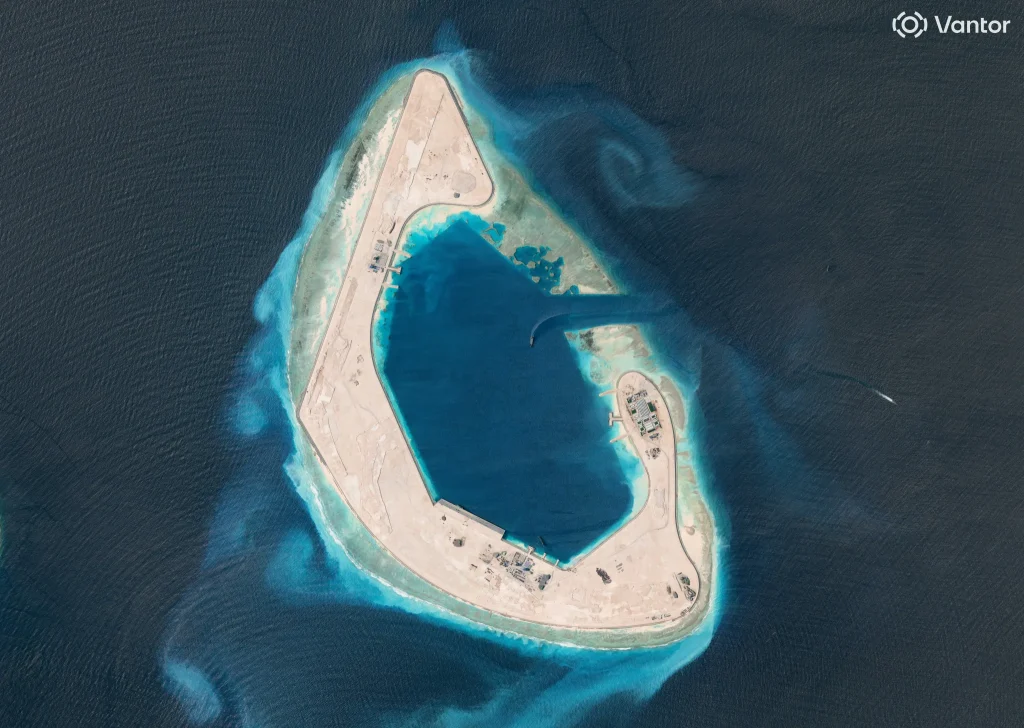
Look at China’s installations on Fiery Cross, Subi, and Mischief Reefs.
Instead of heavy coastal artillery, they have long runways.
Instead of observation towers, they have radar complexes.
Instead of gun casemates, they have hardened positions capable of supporting mobile missile systems.
Instead of a small military pier, they have harbors capable of accommodating large ships.
On China’s three largest installations in the Spratly Islands, hangars were constructed with space for approximately 24 combat aircraft on each island, along with separate larger hangars capable of accommodating transports, reconnaissance aircraft, tankers, or bombers. Radar systems, communications equipment, and hardened facilities suitable for mobile missile launchers also appeared.
The infrastructure has continued to evolve. More recent construction has included facilities associated with electronic warfare, signals intelligence, and broader ISR — intelligence, surveillance, and reconnaissance.
This creates an interesting situation.
The modern sea fortress does not necessarily fire the weapons itself.
It allows everything around it to fire more effectively.
The Island’s Most Important Weapon May Be 3,000 Meters of Concrete
The most important installation on Antelope Reef will probably run along its northwestern side.
The runway.
Satellite imagery indicates enough prepared space for a runway roughly 10,000 feet, or around 3,050 meters, long. Similar runways already exist on Fiery Cross, Subi, and Mischief Reefs.
Three kilometers of concrete fundamentally changes what a small piece of land can do.
It can support much more than fighters.
A runway of this length can accommodate transport aircraft, airborne early-warning platforms, maritime patrol aircraft, reconnaissance aircraft, and, with appropriate infrastructure, considerably heavier aircraft.
China has already demonstrated the ability to operate H-6 bombers from Woody Island. Large hangars on Fiery Cross, Mischief, and Subi are also dimensioned to accommodate aircraft in the H-6 size category and other large types.
At that point, an island stops being just an island.
It becomes an air base that cannot move — but also cannot be sunk by a torpedo.
Why Is an Air Base in the Middle of the Sea So Valuable?
Air power is fundamentally constrained by distance.
A fighter may have an impressive combat radius, but it still needs somewhere to take off, refuel, rearm, undergo maintenance, and launch its next mission.
If the airfield is on the mainland, hundreds of kilometers of combat radius may be consumed simply reaching the patrol area.
Move the airfield 500 or 1,000 kilometers forward, and the geometry changes.
Aircraft can spend more time over the operational area.
Persistent air patrols become easier.
Reaction times decrease.
Reinforcements can arrive faster.
This is why China’s artificial island bases matter far beyond the immediate coastline. The combination of airfields on Fiery Cross, Mischief, Subi, and Woody Island potentially allows Chinese aviation to operate across much of the South China Sea.
But aircraft are only the first layer.
The Second Layer Is Radar
Look at satellite images of China’s artificial islands and it is difficult to miss the numerous domes, towers, and antenna fields.
These may ultimately be even more important than the fighters.
A radar positioned on an island far from the mainland effectively pushes the surveillance network hundreds of kilometers forward.
But modern reconnaissance is not limited to conventional radar.
The islands can accommodate signals-intelligence systems, communications intercept equipment, sensors designed to detect radar emissions, and electronic-warfare systems.
The result is a permanent sensor post in the middle of the sea.
And unlike a ship, it does not have to return to port.
Its crew does not have to rotate with an entire vessel.
It does not have to continuously burn fuel simply to remain on station.
It is there 24 hours a day.
That persistent surveillance capability is one of the most important advantages of China’s island infrastructure.
And then we add the third layer.
Missiles Turn a Radar Outpost Into a Combat Node
Chinese island bases have already hosted air-defense systems and anti-ship missiles.
The HQ-9 surface-to-air missile system, for example, has been deployed on Woody Island, while China has demonstrated the ability to position anti-ship missiles on its South China Sea outposts. Hardened structures suitable for mobile missile launchers have also been constructed on Fiery Cross, Mischief, and Subi.
This is where the modern island fortress begins to make complete sense.
The radar detects a target.
The command system distributes the information.
A missile system engages.
Aircraft receive targeting data.
Ships can use information from the same network.
The island itself becomes one node in a much larger distributed system.
This is fundamentally different from an old coastal battery.
A 19th-century fort could engage targets only as far away as its guns could fire.
A modern island is no longer limited by the range of a single weapon positioned on it.
It is part of a network of sensors and weapons.
And Here Comes the Famous Acronym: A2/AD
The United States commonly describes this concept as Anti-Access/Area Denial — A2/AD.
In simplified terms, the objective is to create an area where entering or operating becomes excessively dangerous or expensive for an adversary.
There is no single wonder weapon that accomplishes this.
It requires a system.
Long-range radars detect aircraft and ships.
Satellites and reconnaissance aircraft refine target positions.
Surface-to-air missiles threaten aviation.
Anti-ship missiles threaten naval forces.
Fighters extend the controlled airspace.
Submarines add another dimension of danger.
Electronic warfare interferes with communications and sensors.
Artificial islands tie some of these elements together into permanent geographic nodes.
And the more such nodes exist, the more interesting the overall picture becomes.
One Fortress Is Vulnerable. Ten Become a Network
Imagine a single artificial island in the middle of the sea.
Its coordinates are known.
It cannot move.
For modern precision weapons, it appears to be the perfect stationary target.
This has led some observers to conclude that China’s artificial island bases would be useless in a major war.
But that is too simplistic.
China has not built one island.
There is Fiery Cross.
Mischief.
Subi.
Woody.
Now Antelope.
And a number of smaller installations.
Each can perform at least some of the functions of the others.
Instead of one fortress, China is creating an archipelago of military infrastructure.
One radar can be destroyed — neighboring sensors remain.
One runway can be damaged — aircraft may operate from another.
One harbor can be disabled — ships still have alternative logistics points.
This is no longer a defensive line in the traditional sense.
It is a geographically distributed network of bases.
Antelope Is Particularly Interesting Because of Its Location
The new artificial island lies approximately 160 nautical miles south of Hainan and roughly 200–216 nautical miles from Da Nang in Vietnam.
And Hainan is not simply a Chinese tourist island.
Its southern coast is one of China’s most important naval regions.
Major People’s Liberation Army Navy facilities are located around Sanya. Aircraft carriers operate from the area, while the Yulin/Longpo complex is associated with China’s submarine force, including nuclear-powered submarines.
Antelope therefore sits in a particularly useful position as a forward outpost.
A harbor.
An airfield.
A radar node.
Potential air-defense positions.
Intelligence systems.
All of it roughly 300 kilometers farther south than Hainan.
That is why the island’s significance cannot be measured simply by the amount of reclaimed land.
It changes the geographic distribution of Chinese military infrastructure.
But There Is One Problem: You Really Cannot Move an Island
Now we have to address the greatest weakness of this type of fortress.
Everyone knows exactly where it is.
Satellites can observe construction.
Intelligence agencies can map the runway.
A hangar cannot be hidden.
A harbor cannot quietly move twenty kilometers overnight.
In a major conflict, such installations would become obvious targets for cruise missiles, ballistic missiles, aircraft, and other long-range weapons.
Concrete is not a magical solution.
A three-kilometer runway does not have to be completely destroyed.
Several large craters in critical locations may be enough to temporarily stop normal flight operations.
Fuel storage, power generation, communications systems, radars, and port facilities are also vulnerable.
This is why Chinese artificial islands should not literally be regarded as “unsinkable aircraft carriers.”
An aircraft carrier can move.
An island cannot.
But an Island Can Be Repaired
There is, however, another side to the equation.
A warship suffering a catastrophic hit can sink along with its radar, missiles, fuel, and much of its infrastructure.
An artificial island hit by a missile remains an island.
A runway crater can be filled and resurfaced.
A damaged hangar can be rebuilt.
A destroyed radar can be replaced.
Construction equipment, repair units, and building materials can be stockpiled in advance.
Antelope itself already has concrete-production facilities as part of its ongoing development.
This means the survivability question is more complicated than “missile hits base, base disappears.”
Reliably suppressing a large island installation may require not one strike, but repeated attacks to prevent repairs and restoration.
That consumes weapons.
This Is Where 21st-Century Fortification Really Begins
The purpose of a fortress has never been absolute invulnerability.
A medieval castle could be captured.
A concrete fort could be destroyed by heavy artillery.
A coastal battery could be suppressed by air power.
The fundamental purpose of fortification is to force the enemy to spend disproportionate amounts of time, effort, and ammunition neutralizing it.
In that respect, an artificial island is surprisingly similar to a traditional fortress.
To stop it from functioning, an opponent may have to crater the runway.
Suppress air defenses.
Destroy radars.
Hit ammunition storage.
Damage port facilities.
Attack fuel infrastructure.
And then repeat the process after repairs begin.
Every missile fired at the island is a missile that cannot be used against another target.
That is why immobility alone does not make the base irrelevant.
But These Islands May Be Most Valuable Before a War Ever Begins
There is another point that often disappears in discussions about how many missiles would be required to destroy a Chinese island base.
For most of its existence, a military base is not fighting a war.
And this is where artificial islands become especially useful.
Radars can operate continuously.
Aircraft can deploy there.
Coast Guard vessels can use the facilities.
Communications systems remain active.
Surveillance continues.
Permanent presence is established.
China does not have to dispatch a ship from the mainland every time it wants to maintain a presence in the area.
The fortification starts working simply by existing.
It turns temporary presence into permanent presence.
And that may be more important than the number of missiles stationed there.
China Is Effectively Building Geography
This is perhaps the most remarkable aspect of Antelope Reef.
Military strategy normally has to accept geography as it exists.
If there is an island in the right place, an airfield can be built there.
If there is a deep enough harbor, a naval base can be established.
If there is no land, there can be no permanent base.
China’s approach changes the premise.
If there is no island where one is needed, an island can be built.
The development of Fiery Cross Reef was already a major turning point a decade ago. China was no longer merely placing forces on existing islands; it was transforming reefs into platforms capable of supporting sustained military power projection.
Antelope demonstrates how far the technology and industrial process have progressed.
In roughly ten months, what had been largely a submerged reef became approximately six square kilometers of land, with a harbor and preparations for a three-kilometer runway.
This is no longer simply the construction of a base.
It is changing the map to suit military strategy.
And Yet It Is Not an Aircraft Carrier
China’s artificial islands are often described as “unsinkable aircraft carriers.”
It is a memorable comparison, but technically it is not quite right.
An aircraft carrier exists primarily to support aviation.
An artificial island is much more versatile.
It can simultaneously function as:
an airfield;
a harbor;
a radar station;
a communications hub;
an intelligence facility;
an air-defense position;
a potential anti-ship missile site;
a storage facility;
a repair base;
a logistics hub;
and a permanent garrison.
It therefore makes more sense to compare one not with a ship.
It is a naval base compressed onto a single island and placed where there previously was almost no land at all.
Sea Fortresses Really Have Returned
That is why the story of Antelope Reef is not primarily about how much sand Chinese dredgers managed to move in ten months.
It demonstrates the evolution of a very old military idea.
A century ago, a sea fortress was a concrete island armed with heavy guns. Its purpose was to dominate a particular stretch of water with artillery fire.
China’s 21st-century sea fortress works very differently.
It does not need a 406mm coastal gun.
Its weapons are a three-kilometer runway, a deep-water harbor, radar systems, electronic intelligence equipment, air defenses, anti-ship missiles, aircraft, and the ability to connect all of them with ships, satellites, and other bases in a single network.
Yes, everyone knows its coordinates.
Yes, it would become a priority target in a major war.
Yes, precision weapons could severely damage such a base.
But none of that eliminates its central advantage.
Before Antelope Reef was reclaimed, there was almost nothing there but a reef.
Now the site could support an airfield capable of handling large aircraft, a harbor for military vessels, and a permanent intelligence and surveillance node roughly 300 kilometers south of Hainan.
China did not reinvent the sea fortress.
It did something more interesting.
It replaced concrete walls with an information network, guns with missiles and aircraft — and instead of searching for the right island, learned to build the island first.