Sweden Developed an Engine for a Long-Range Weapon in Less Than a Year. But the Technological Breakthrough Is Not the Engine

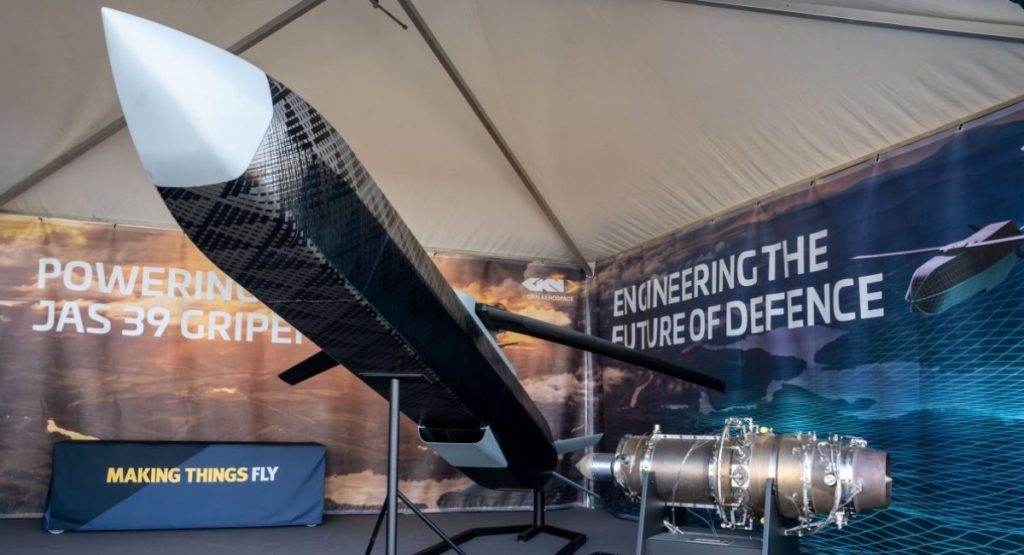
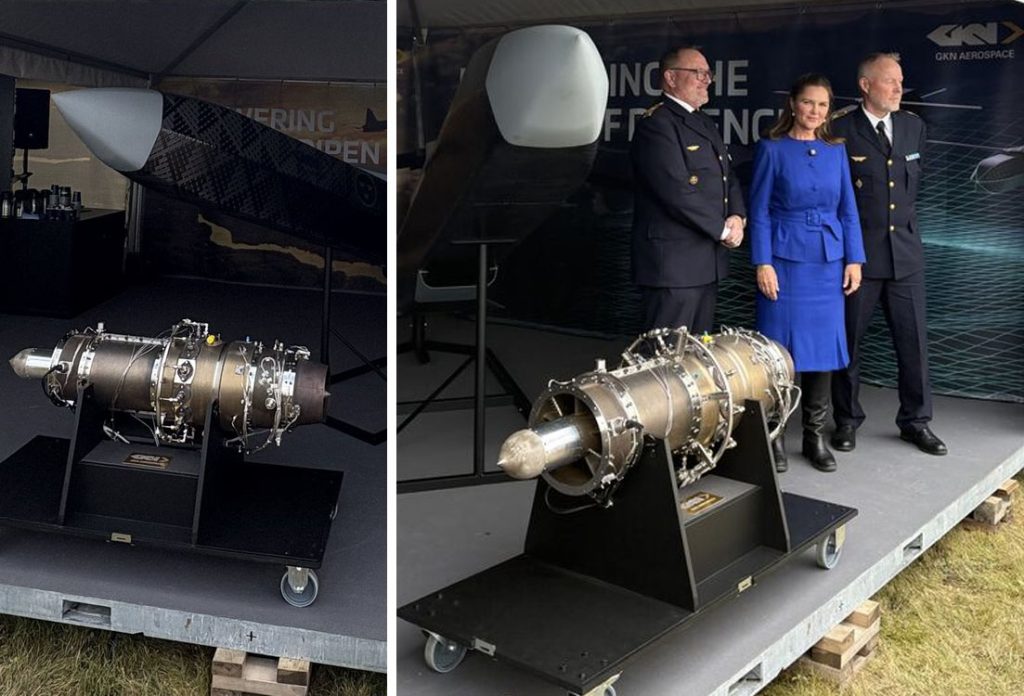
In August 2026, GKN Aerospace unveiled something rather interesting in Sweden: a full-scale mock-up of a new unmanned aerial vehicle together with a compact turbojet engine developed specifically for the program. The project had started only in November 2025 under a contract from Sweden’s Defence Materiel Administration, FMV, worth around SEK 150 million. The original schedule allowed just 18 months to develop and demonstrate the flying vehicle, its engine, and onboard systems, with initial flight testing planned for 2027. Roughly nine months after the program began, GKN was already able to publicly display both a full-scale airframe mock-up and the actual propulsion system.
Specialized media quickly added even more eye-catching figures to the story: a payload of around 300 kg over approximately 600 km, or roughly 100 kg over more than 1,000 km, extensive use of additive manufacturing, and, importantly, an effort to make the propulsion system ITAR-free — independent of U.S.-controlled components that could restrict exports. GKN itself has been more cautious, describing the project as a flexible experimental UAV intended to test different technologies and operational concepts. Calling the aircraft a ready-made cruise missile would therefore be premature. Officially, it remains a demonstrator, and one that has not yet flown.
That actually makes the story more interesting. At first glance, this looks like another tale of a technological breakthrough: European industry has developed a new jet engine in less than a year for an aircraft potentially capable of flying more than 1,000 kilometers. Yet when we look specifically at the engine, there is little revolution to be found. Humanity has been building small air-breathing jet engines for more than eighty years, and compact turbojets have long ceased to be a technological mystery available only to a handful of superpowers.
This is where the real significance of the Swedish project begins to emerge. GKN is not demonstrating how quickly a jet engine can be invented today. It is demonstrating how quickly well-established technologies can potentially be turned into a new, mass-producible long-range weapon. And that may prove far more important than another record for thrust, service life, or turbine temperature.
More Than 80 Years Have Passed Since the V-1. The Physics Has Not Changed Much
The first genuinely mass-produced long-range cruise weapon appeared during the Second World War. Germany’s V-1 was extremely primitive by modern standards: it used an Argus As 014 pulsejet, had a relatively simple guidance system, and offered poor accuracy by today’s standards. Yet the fundamental architecture was already there: airframe, engine, fuel, guidance system, and warhead combined into a vehicle capable of flying hundreds of kilometers to a predetermined target.
Of course, there is no direct technical equivalence between the V-1 and a modern cruise missile. Today’s weapons can fly at low altitude, use inertial and satellite navigation, follow complex routes, exploit terrain, and strike targets with a degree of precision that engineers in the 1940s could hardly have imagined. Propulsion has changed enormously as well. A primitive Argus pulsejet and a modern compact turbojet are very different machines.
But if we strip away the details, the basic physical problem has changed much less than it might appear. The objective is still to make a relatively small aircraft travel for several hours at high subsonic speed. No new physical principle is required to accomplish that. More importantly, modern industry already understands most of the technologies needed to solve the problem.
That is what fundamentally separates 2026 from 1944.
The Biggest Revolution Happened Around the Engine, Not Inside It
Imagine a country deciding several decades ago that it wanted to develop its own long-range precision weapon. Beyond the engine itself, it would have faced an enormous range of difficult technological challenges: a compact inertial navigation system, onboard computer, autopilot, sensors, control actuators, route-correction systems, and associated electronics. Many of those components were advanced technologies in their own right and were available only to a limited number of countries.
Today, much of that technological foundation already exists in mature or near-mature form. MEMS gyroscopes and accelerometers have become mass-produced components. Satellite navigation is commonplace. The computing power available in compact electronics has increased by orders of magnitude. Digital automatic flight-control systems are found even in small civilian drones, while composites and modern manufacturing techniques are accessible to a much broader industrial base.
That does not mean building a modern cruise missile has become easy. Reliable navigation under electronic warfare conditions, low-altitude flight, precision, aerodynamic design, testing, and especially large-scale production remain extremely difficult engineering problems. But the number of technologies that genuinely have to be invented from scratch has declined dramatically.
As a result, the question is changing. It used to be: “Can we build such a weapon at all?” Increasingly, the question is becoming: “How quickly and cheaply can we manufacture thousands of them?” That is where Project Otto becomes much more interesting than the engine itself.
The Engine Does Not Have to Be Exceptional
This is one of the fundamental characteristics of expendable long-range weapons. When Rolls-Royce, General Electric, Pratt & Whitney, or Safran develops an engine for a passenger aircraft, designers face an enormous list of requirements. The engine must operate for thousands or tens of thousands of hours, withstand huge numbers of cycles, minimize fuel consumption, comply with noise and emissions standards, achieve extremely high reliability, undergo maintenance and repairs, and then return to service again and again.
A cruise-missile engine needs almost none of that. Suppose an aircraft has to travel 1,000 kilometers at an average speed of around 800 km/h. Its engine would need to operate for roughly an hour and fifteen minutes. Even after allowing for launch, maneuvering, and some reserve, we are still talking about a few hours of operation rather than thousands. At the end of the flight, the propulsion system will be destroyed together with the rest of the vehicle.
That radically changes the engineering philosophy. Such an engine does not need a service life of 10,000 or 20,000 hours, scheduled overhaul intervals, easy access to individual modules, or the ability to remain operational for decades. It needs to start reliably, provide sufficient thrust and fuel efficiency, and continue working until the end of a single mission.
This creates an almost paradoxical engineering question: How imperfect can an engine be while still being good enough to complete the mission?
Not the Best Engine — Just a Good Enough One
Traditional aircraft engine development has spent decades pursuing higher performance. Engineers increase service life, reduce specific fuel consumption, raise turbine inlet temperatures, improve materials, reduce weight, and increase reliability. But every additional improvement costs money, time, more sophisticated materials, and more complicated manufacturing.
For an expendable engine, the logic can be reversed. Not maximum service life, but the minimum necessary. Not the best possible fuel efficiency, but enough to achieve the required range. Not the most advanced material available, but the cheapest one that can reliably survive the required temperatures and operating time. The goal is no longer to optimize the engine as an engineering masterpiece in its own right. The goal is to optimize the cost of one successful mission.
That is where additive manufacturing becomes much more interesting. The simple fact that a jet-engine component can be 3D-printed in metal is no longer remarkable. GKN Aerospace already uses additive processes for aviation components and points to shorter production times, reduced material waste, and the ability to manufacture geometries that are difficult to produce using conventional methods.
For an expendable propulsion system, the more important question is what additive manufacturing removes from the production chain. If several components that would otherwise require casting, machining, welding, and assembly can be replaced by a single integrated part, the benefit is not merely a lower part count. It can also mean fewer manufacturing operations, less tooling, fewer suppliers, and fewer potential bottlenecks.
3D Printing Matters Here Because It Can Remove Parts of the Factory From the Engine
In conventional aircraft engine manufacturing, a relatively small component can sit at the end of a surprisingly large industrial chain. One supplier produces the blank, another machines it, a third applies coatings, after which the component has to be transported to an assembly facility, inspected, and finally installed. The more complicated the product, the more potential bottlenecks appear.
Additive manufacturing can compress parts of that chain. A metal printer obviously does not turn a turbojet into something that can be built in a garage. Specialized alloys and powders are still required, as are heat treatment, machining, quality control, balancing of rotating components, and numerous other processes. But if several critical stages can be eliminated, the effect can become significant when engines are meant to be produced in large numbers.
The wording used by GKN itself is revealing. The company is not only talking about developing a new aircraft, but also about exploring ways to develop, integrate, and manufacture complex aerospace systems more quickly. Scalable production is explicitly mentioned as part of the program. In other words, the experiment is not only the UAV itself. The development and manufacturing process is part of the experiment.
ITAR-Free May Matter More Than All the Talk About 3D Printing
In reports about the Swedish program, this detail can easily look secondary, even though strategically it may be extremely important. ITAR — the International Traffic in Arms Regulations — is the U.S. system controlling the export of military products and technologies. If critical components of a weapon fall under American restrictions, a manufacturer may not always be free to decide what happens to its own system. Exports, re-exports, and transfers of certain technologies may require U.S. authorization.
For a small experimental program, that is an inconvenience. For a weapon potentially intended for large-scale production and export, it becomes a political factor. Developing a European propulsion system with a supply chain that minimizes critical dependence on U.S.-controlled technology therefore means more than simply replacing an imported component. It potentially gives the manufacturer and customer greater freedom to decide how many systems to produce, where to export them, and how to develop them further.
This is also why it matters who is developing Project Otto. GKN Aerospace is not a small startup that suddenly learned how to build jet engines. It is a major aerospace supplier with established experience in aircraft structures and propulsion. The Swedish program combines expertise from GKN operations in Sweden, the Netherlands, and the United Kingdom, covering propulsion, aerostructures, and systems integration. GKN also supports the RM12 engine used by Sweden’s Gripen fleet and is involved with the RM16 powering the Gripen E.
So “A Jet Engine in Nine Months” Is a Slightly Misleading Description
Nobody went from a thermodynamics textbook to an independent jet-engine industry in nine months. GKN drew on decades of accumulated expertise, existing engineering teams, software, testing infrastructure, manufacturing technologies, and experience with aircraft propulsion.
That does not make the result less interesting. It simply means the achievement has to be measured correctly. We are not talking about nine months from discovering a new physical principle to producing an engine. We are talking about roughly nine months from the start of a specific government program to a physical full-scale airframe mock-up and a purpose-built propulsion system.
There is another important caveat. The aircraft shown in August is still a full-scale mock-up, and the program is not complete. The FMV contract calls for an 18-month development and demonstration cycle, while the first flight tests are expected in 2027. Headlines claiming that “Sweden built a 1,000-km cruise missile in nine months” are therefore running well ahead of reality. Actual range, reliability, and overall performance still have to be demonstrated in flight.
Even So, Eighteen Months Is Very Fast
Developing a new military aviation system can traditionally take a decade or more. Here, FMV and GKN deliberately set themselves a different target: create a clean-sheet flying demonstrator together with its own propulsion system within 18 months. The initial contract is worth around SEK 150 million — approximately £12 million when it was announced. By aerospace-program standards, that is a relatively modest sum.
Of course, comparing this directly with developing a complete production aircraft would be misleading. Project Otto remains a demonstrator rather than a finished combat system with a full support infrastructure, complete testing program, certification, and established production line. But that is precisely the point: first test the architecture, propulsion system, and development methodology as quickly as possible, and only then decide what operational system should emerge from the platform.
This fits into a much broader trend in modern defense manufacturing.
Not the Most Advanced Weapon — but Lots of Weapons That Are Good Enough
For decades, Western defense development largely moved toward maximizing individual performance. Better sensors, greater precision, longer range, lower signatures, more sophisticated electronics. The resulting systems can be extraordinarily effective, but improvements in capability have often been accompanied by rising cost and longer production times. A country may possess exceptional weapons while having comparatively few of them.
Increasing attention is therefore being paid to a different concept: affordable mass. The objective is not necessarily to build the best weapon in the world. It may be more important to build a weapon that is good enough and that industry can manufacture faster than it is consumed.
An expendable turbojet is an excellent illustration of this shift in priorities. It does not need to compete with a fighter engine, or even with the engine of a civilian aircraft. It needs to be the cheapest possible device that can reliably perform one specific mission.
In effect, the engine becomes part of the munition.
In Aviation, an Engine Is an Asset. Here, It Is a Consumable
We normally think of a jet engine as one of the most valuable components of an aircraft. The aircraft returns to base, the engine is inspected, serviced, repaired, individual modules are replaced, and then it flies again. In a cruise missile or expendable long-range UAV, that logic is reversed: the fate of the propulsion system is known before its first start.
The criteria for efficiency therefore change as well. Engine life by itself becomes less important than the combination of cost, range, payload, reliability during the single mission, and production rate. If one engine delivers 10% better performance but another costs half as much and can be produced three times faster, the second may be considerably more valuable for a mass-produced expendable weapon.
This is why the claimed range of around 1,000 kilometers is not especially remarkable on its own. Long-range cruise missiles have existed for decades. What will matter much more is how much the potential system costs and how many can be manufactured each month. GKN has not disclosed those figures, while the company itself has yet to publish definitive performance data for the future platform. Any assessment of its actual military value therefore remains preliminary.
Because Modern Air Defense Counts Money Too
Imagine an extremely sophisticated cruise missile. It is stealthy, has advanced navigation, follows an optimized route, and offers a high probability of penetrating air defenses — but costs several million dollars. Now imagine a much simpler weapon that is easier to detect, has less sophisticated electronics, and offers a lower individual probability of penetration, but costs several times less and can be manufactured much faster.
Quantity then becomes part of the equation. Instead of ten sophisticated missiles, an attacker may be able to launch several dozen simpler ones. Air-defense systems have physical limits as well: finite tracking capacity, finite numbers of launchers, and finite stocks of ready-to-fire interceptors. Expended missiles must be replaced, while new ones have to be manufactured and delivered.
At some point, the question “whose missile is technologically more sophisticated?” begins to matter less than another one: who can manufacture more usable missiles per month? That is why production technology can become strategically more important than a few additional percentage points of engine performance.
The Result Is a Rather Strange Paradox
Over the past eight decades, aviation technology has become fantastically more sophisticated. A modern fighter can barely be compared with a Second World War aircraft in terms of electronics, materials, engines, and weapons. A modern civilian turbofan is one of the most sophisticated mass-produced machines humanity has ever built.
Yet one promising direction in long-range weapons development is moving almost the opposite way. Do not maximize service life where it is unnecessary. Do not use an expensive material where a cheaper one is sufficient. Do not install an imported component if it creates a critical political dependency. Do not complicate the design for capabilities that do not materially improve the mission. Make maximum use of digital design, additive manufacturing, and mature technologies, and invest the savings in production scale.
Seen from this perspective, the Swedish engine really is interesting — just not for the reason that first attracts attention.
The Real Breakthrough May Be That There Is No Breakthrough
Project Otto is not yet a finished cruise missile. Its actual performance still has to be demonstrated in flight. We do not know its production cost, future manufacturing rate, precise range, or even the final set of missions the Swedish military may assign to the platform. GKN itself emphasizes the experimental nature of the program and its ability to support different configurations and operational concepts.
But the project already illustrates an important shift in the logic of weapons development. Creating a long-range unmanned aircraft no longer necessarily requires a technological revolution. Most of the necessary building blocks already exist: compact turbojets, digital autopilots, inertial navigation, satellite correction, composites, modern electronics, computing systems, and additive manufacturing. The challenge is increasingly to combine them correctly, eliminate unnecessary complexity, minimize external dependencies, and make the design suitable for rapid production scaling.
More than eighty years ago, the V-1 demonstrated that relatively inexpensive long-range cruise weapons were possible. The decades since then have added vastly more accurate navigation, compact electronics, modern materials, and radically better manufacturing techniques. That means the most important question raised by Project Otto is not what revolutionary new jet engine Sweden has managed to create.
It is something else.
How long does a developed industrial base now need to take mature technologies and turn them into a new long-range weapon?
If the answer really is moving from something like a decade toward eighteen months, that may matter far more than another incremental improvement in engine performance.