Why Did the Kettenkrad Need a Front Wheel? The Strange Feature That Actually Made Engineering Sense

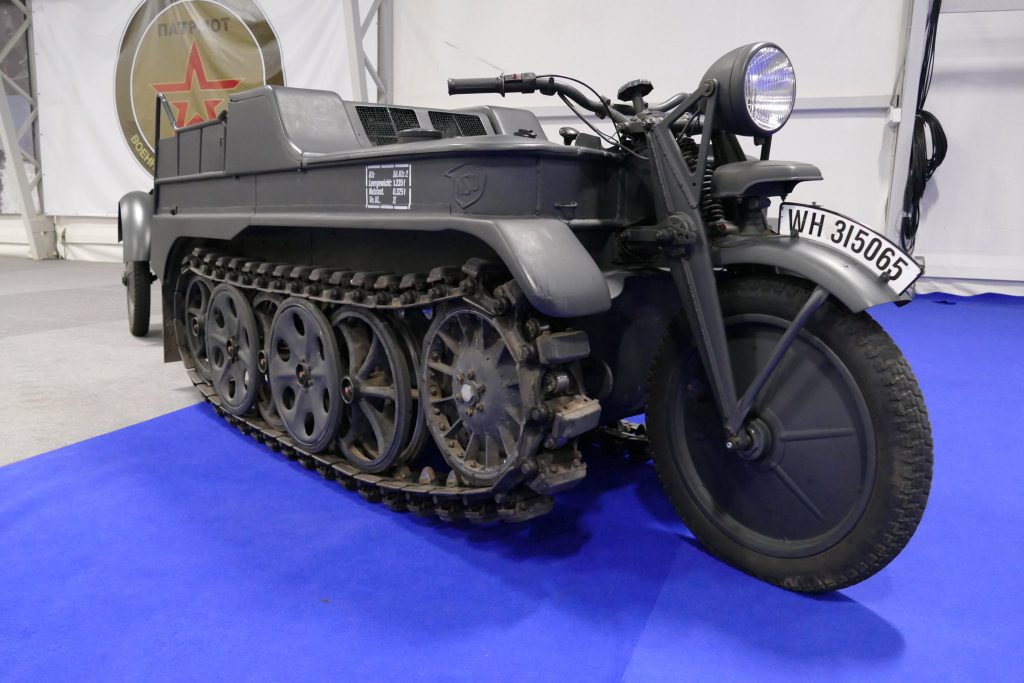
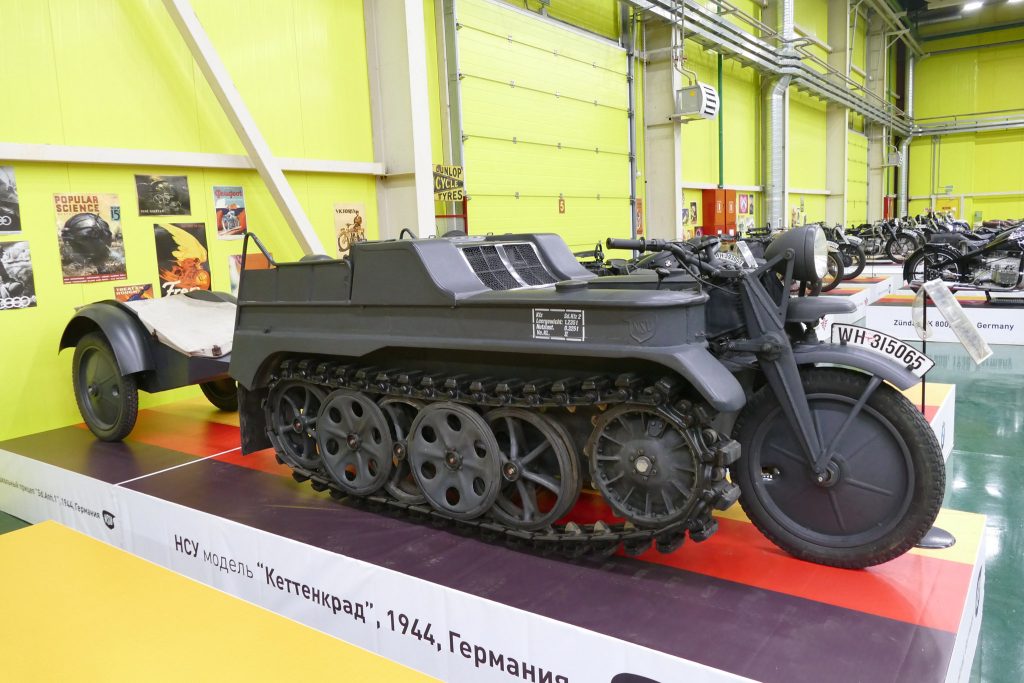
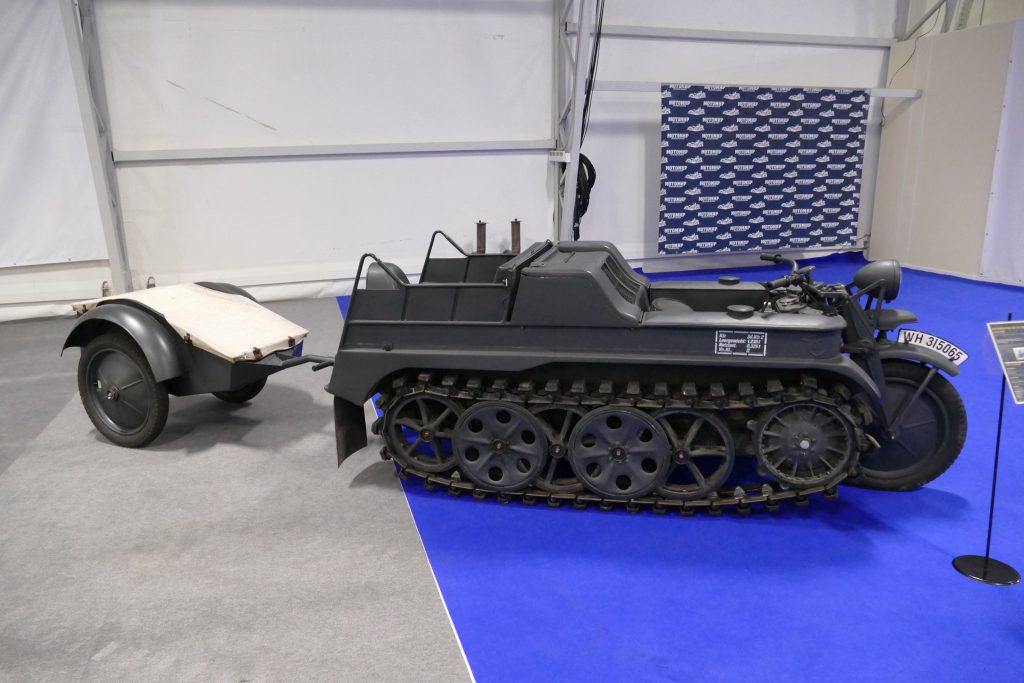
Some vehicles make sense the moment you look at them. A car has four wheels, a tank has two tracks, and a motorcycle has two wheels. The German Sd.Kfz.2 Kleines Kettenkraftrad HK 101, much better known as the Kettenkrad, seems almost deliberately designed to violate this logic. At the rear it has a full tracked running gear with overlapping road wheels; at the front, a single wheel mounted in a motorcycle-style fork; and the driver sits astride a saddle holding conventional handlebars. The whole arrangement looks so unusual that the Kettenkrad is often treated almost as a technical curiosity of World War II — another product of Germany’s famous tendency toward overly complicated engineering.
There is a problem with that interpretation. The Kettenkrad was not an experimental machine produced in a handful of examples. Thousands were built, they served from North Africa to the Eastern Front, and they were used as light tractors, transports, cable-laying vehicles, and airfield utility machines. The design proved viable enough that production even continued after the war for civilian customers. More importantly, the Kettenkrad could actually operate without its front wheel at all. In deep mud and particularly difficult terrain, the wheel could be removed, effectively turning the vehicle into a tiny fully tracked tractor.
That makes the question even more interesting: if the wheel was not essential for movement and could actually become a liability in difficult terrain, why did German engineers bother fitting this motorcycle-like front end in the first place?
The Kettenkrad Wasn’t Really a Motorcycle
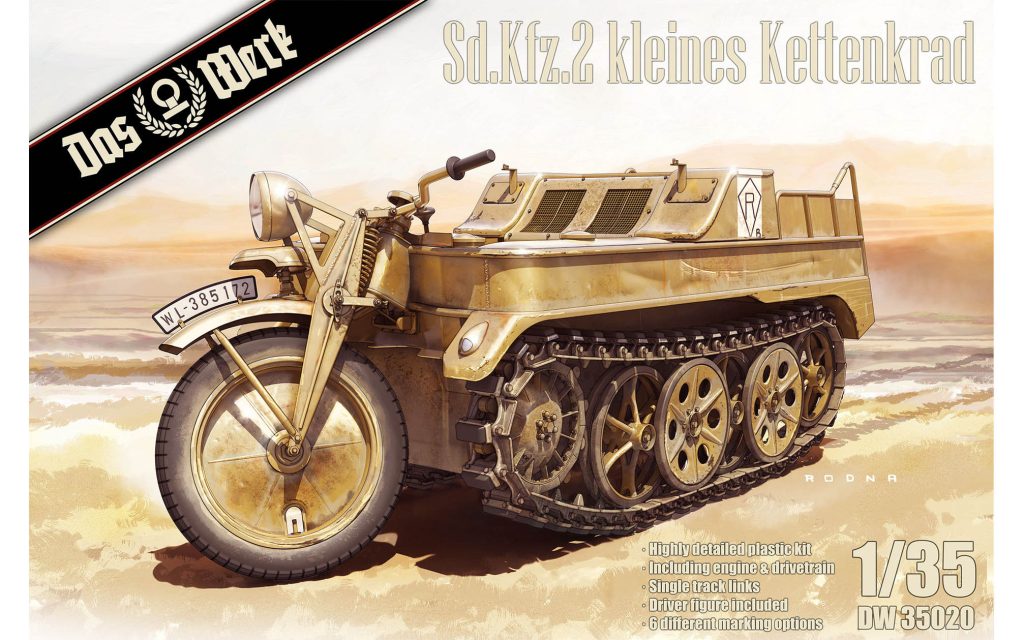
The name itself can be misleading. Kettenkrad essentially means “tracked motorcycle,” and the driver certainly sat on a saddle, steered with handlebars, and had a motorcycle-style fork in front of him. Mechanically, however, it makes much more sense to think of the vehicle as an ultra-compact tracked tractor fitted with an auxiliary steering wheel.
The HK 101 was originally developed by NSU as a lightweight high-mobility vehicle, including for airborne formations. One of the crucial requirements was compactness: the vehicle had to fit inside a Junkers Ju 52 transport aircraft. The result was a machine only about 3 meters long and exactly 1 meter wide. An empty Kettenkrad weighed roughly 1,235 kg, while maximum loaded weight reached about 1,560 kg, leaving approximately 325 kg of useful payload. Its crew consisted of a driver and two rear-facing passengers.
The engine was anything but motorcycle-sized. Inside was an approximately 1.5-liter four-cylinder Opel gasoline engine producing around 36 hp, connected to a transmission with an additional reduction range. That was enough for a machine weighing little more than a ton to reach road speeds of roughly 70 km/h, although practical operating speeds could be lower.
And this is where the front wheel begins to make sense.
Because 60–70 km/h is a very high speed for a tracked tractor only one meter wide.
The Kettenkrad Actually Had Two Steering Systems
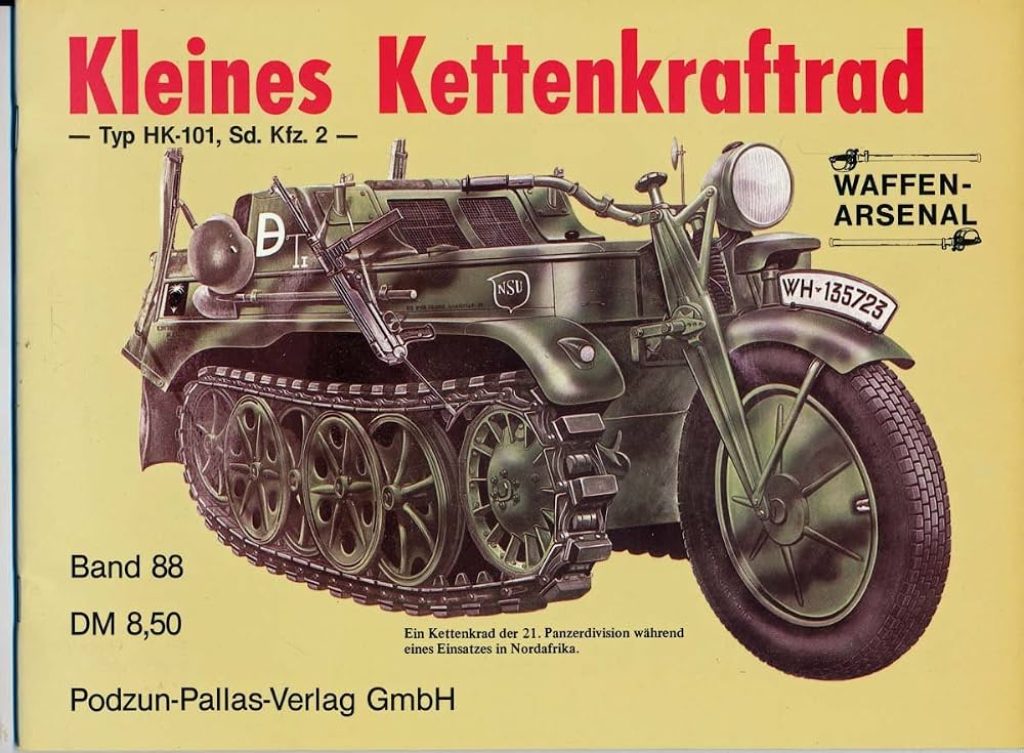
Looking at the vehicle, it is natural to assume that the driver turned the handlebars, the front wheel changed direction, and the tracks simply pushed the Kettenkrad through the turn. The actual system was considerably more sophisticated. The handlebars controlled two different methods of steering, with the transition between them occurring automatically.
With a small movement of the handlebars, only the front wheel turned. The vehicle could therefore follow a gentle curve without disturbing the tracks. But when the driver turned the handlebars farther, a system of mechanical linkages connected to the steering column began operating the track brakes. A wartime American technical examination of the captured vehicle reported that braking assistance began at a steering angle of only around five degrees.
From that point onward, the Kettenkrad behaved more like a conventional tracked vehicle. The track on the inside of the turn was braked while the outer track continued moving faster, and the resulting difference in track speed helped rotate the machine much more sharply. The transmission used a controlled differential with separate steering brakes for either side.
The clever part was that the driver did not have to consciously select between the two systems. He simply turned the handlebars. A small movement produced gentle wheel steering; a larger movement automatically brought the tracks into the process.
And this is where the apparently absurd motorcycle handlebar begins to look surprisingly rational.
But Why Have a Wheel at All?
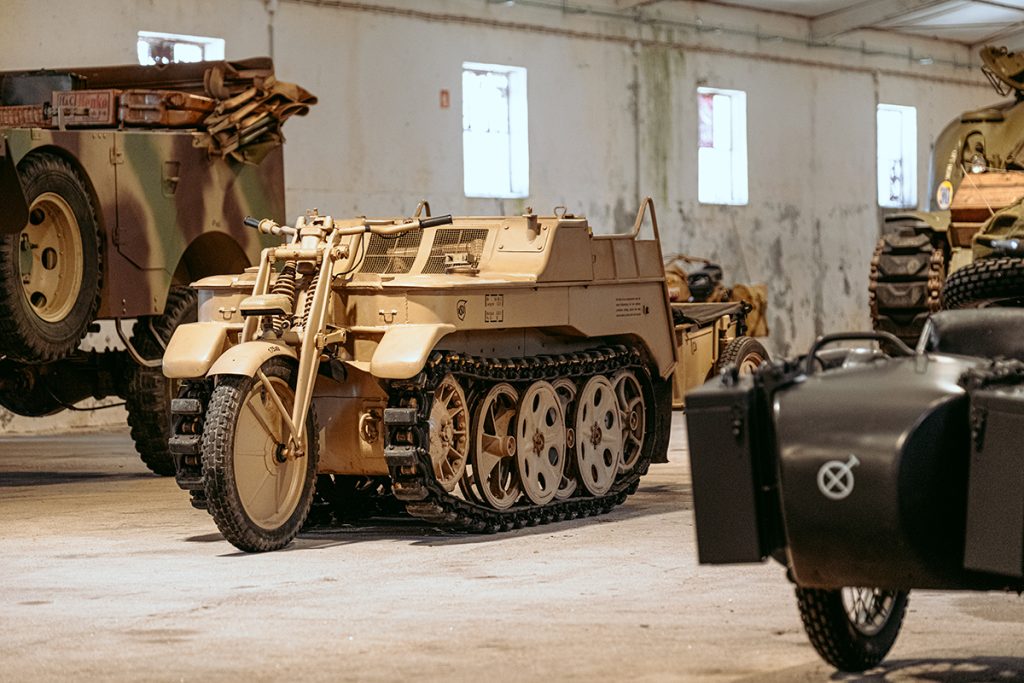
The obvious alternative would have been to eliminate the front wheel entirely and steer solely by braking the tracks, just as many conventional tracked tractors did. After all, this was exactly how the Kettenkrad could still maneuver after the front wheel had been removed.
The answer lies in where and how fast the vehicle was expected to operate.
Brake steering has an inherent disadvantage. To change direction, the vehicle must create a speed difference between its left and right tracks. With a simple system, one side is slowed down and part of the engine’s power is effectively converted into heat. At the same time, the track has to scrub against the ground. For a sharp turn at low speed, that is perfectly acceptable. For continuous road travel involving numerous small steering corrections, it is far less attractive.
Imagine a Kettenkrad traveling along a road at 40 or 50 km/h. Without its front wheel, every small change of direction would require some degree of differential track steering. That means additional brake and track wear, energy loss, and, perhaps most importantly, a much more abrupt response at high speed.
The front wheel provided another option. Small course corrections could be made without interfering with the tracked running gear. Both tracks continued to propel the vehicle at essentially the same speed while the wheel gently guided the machine into a new direction.
This is why the Kettenkrad’s front wheel is better understood not as its primary steering mechanism, but as a high-speed fine-steering device.
The Front Wheel Barely Supported the Vehicle
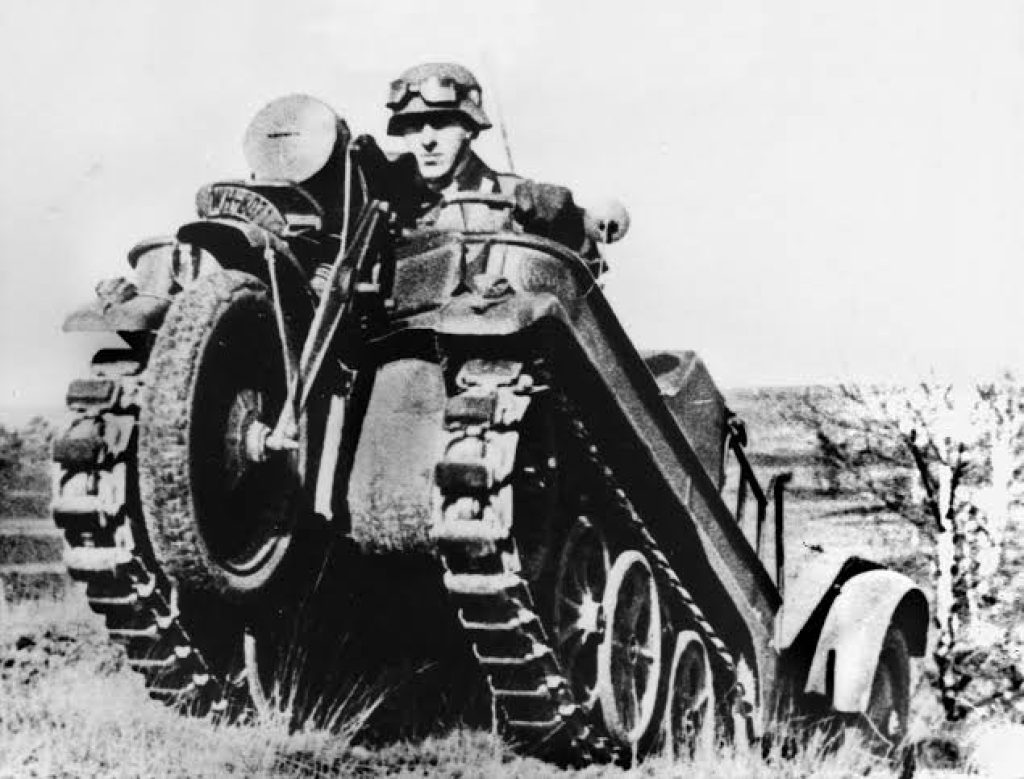
One particularly revealing figure helps explain the entire concept. At a maximum loaded weight of around 1,560 kg, only approximately 95 kg rested on the front wheel. Almost the entire mass of the machine — close to a ton and a half — was supported by the tracks.
This was therefore very different from a conventional half-track such as the Sd.Kfz.251, where the front wheels formed a significant part of the running gear. On the Kettenkrad, the wheel was a lightly loaded auxiliary component. It provided no propulsion and contributed little to the vehicle’s fundamental cross-country capability.
This also explains why its behavior deteriorated in particularly difficult terrain. On relatively firm ground, the wheel performed its function perfectly well. In deep mud, loose snow, sand, or heavily broken terrain, however, it could become a narrow, unpowered source of resistance. The tracks wanted to push the vehicle forward while the wheel could dig in, fall into ruts, or catch on obstacles.
At that point, removing it actually made sense.
Without the Wheel, the Kettenkrad Became a True Tracked Tractor
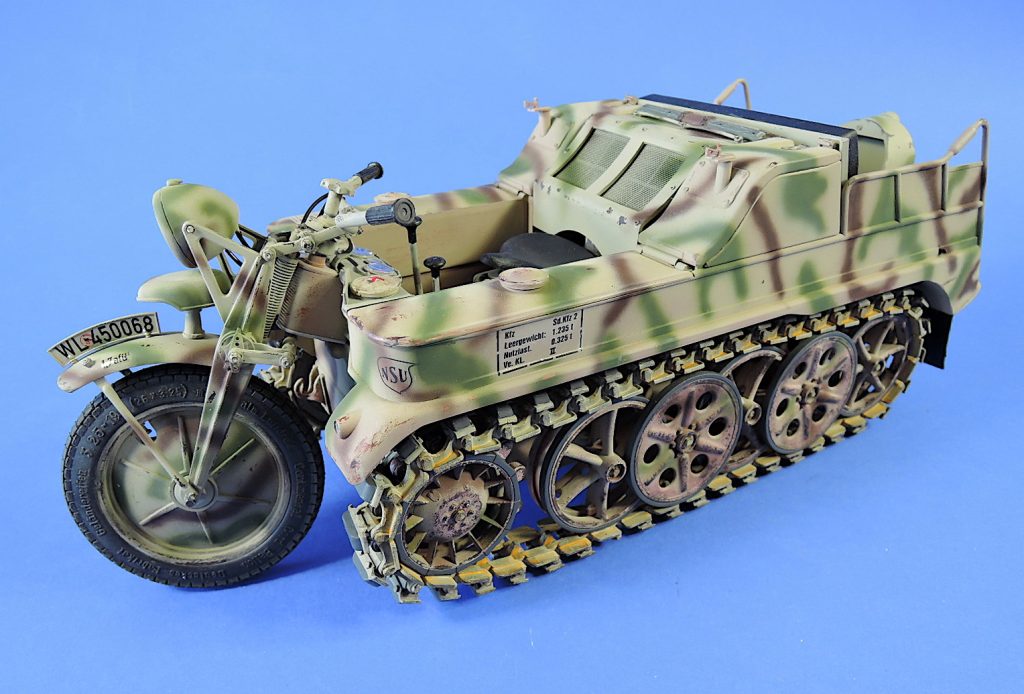
This is perhaps the strongest indication that the designers understood the limitations of their own arrangement. Operating guidance allowed the front wheel to be removed under particularly difficult conditions. Steering did not disappear with it: the driver continued turning the same handlebars, but their movement now operated the track brakes. The machine effectively became a fully tracked vehicle while retaining its ability to maneuver.
At first glance, this seems to prove that the wheel was unnecessary. In reality, it demonstrates almost the opposite. The Germans had effectively created a two-mode running system. On roads and firm terrain, the wheel provided smoother steering and made high-speed travel more manageable. In severe off-road conditions, where speed would be low anyway, it could be removed and the advantages of a purely tracked layout could take over.
So asking whether the Kettenkrad could operate without the wheel is the wrong question.
Of course it could.
But without it, the vehicle became worse precisely in the conditions where the wheel was most useful.
Remember How Fast This Tiny Tractor Was
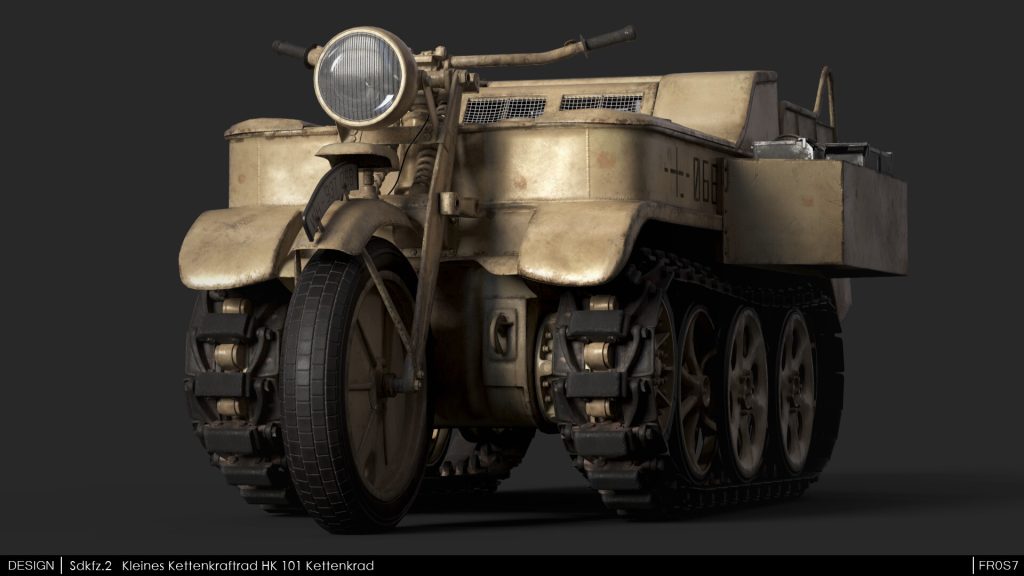
The dimensions of the Kettenkrad are essential to understanding its design. It was only one meter wide, around 1.2 meters high, and weighed little more than a ton when empty. Yet on a road it could reach approximately 70 km/h. Even if that maximum speed was not used continuously, sustained travel at several tens of kilometers per hour represented a serious operating regime for such a narrow tracked platform.
Pure brake steering at those speeds would have been far from ideal. A relatively small driver input could create a substantial difference in track speed and produce an abrupt change of direction. Combined with the narrow track width and relatively high center of gravity, this could become a question not merely of comfort but of stability.
The front wheel made the machine’s response to small steering inputs considerably more predictable. As long as the driver made gentle corrections, the track brakes barely became involved. A serious turn naturally required reducing speed, at which point differential track steering could assist.
In effect, the Germans had created a purely mechanical form of variable steering sensitivity long before electronics could perform such a function.
But the Solution Wasn’t Free
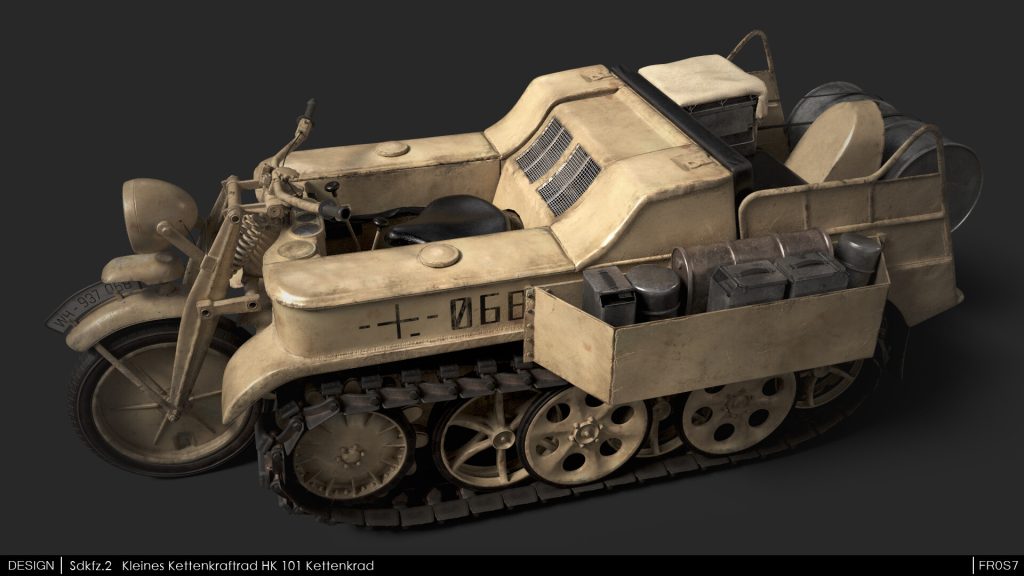
The front wheel added weight, a fork, a steering column, and mechanical linkages. It reduced mobility in certain terrain and could become trapped in ruts. In difficult off-road conditions its advantages largely disappeared because track steering alone was entirely adequate at low speed. Nor can the Kettenkrad itself be described as a masterpiece of mechanical simplicity. Its running gear used the German Schachtellaufwerk system of overlapping road wheels, while the tracks incorporated numerous carefully manufactured components and bearings. The result provided good ride quality but also required maintenance.
There was another problem that no clever steering mechanism could solve: the Kettenkrad was extremely narrow. This was one of its greatest advantages — a width of only one meter allowed it to pass through places inaccessible to normal vehicles and larger tractors. But the narrow track width also reduced lateral stability, particularly when traversing slopes. High speed only increased the potential risk of overturning.
The Kettenkrad should therefore not be regarded as some forgotten engineering ideal. It was a machine built around compromises, some of them quite expensive. But the front wheel was not among its most irrational features.
So Why Didn’t Everyone Copy the Kettenkrad After the War?
If the concept worked, why did the postwar world not fill up with tiny tracked tractors equipped with motorcycle wheels?
Because the Kettenkrad solved a very specific problem. The Germans wanted an extremely compact machine capable of fitting inside a transport aircraft, towing light guns and trailers, operating confidently away from roads, and still moving reasonably quickly on them. All of this had to fit within a width of about one meter.
That combination of requirements was rarely encountered after the war. If high road speed was the priority, a four-wheel-drive vehicle was simpler. If maximum cross-country mobility mattered most, a conventional fully tracked transporter made more sense. If both were required, increasingly sophisticated transmissions, improved suspension systems, rubber tracks, and later electronic controls provided better solutions.
The Kettenkrad was therefore a product of a very particular technological moment. Wheeled vehicles had already become fast and reliable, tracked tractors could be made compact, but combining both sets of qualities in one simple machine remained difficult.
The Germans essentially connected two different solutions mechanically.
So Was the Front Wheel a Mistake?
From an engineering perspective, probably not.
If we look exclusively at difficult off-road terrain, the wheel does indeed appear unnecessary. The Kettenkrad could steer perfectly well using its tracks alone, and under particularly severe conditions the front wheel could even be removed. But the machine was not designed exclusively to crawl slowly through mud. It also had to travel between operational areas on roads, tow loads, and reach unusually high speeds for such a small tracked platform.
That was precisely where the wheel became useful. It allowed gentle directional changes without constantly braking one track, reduced the need for differential steering during small course corrections, and made the machine more controllable at speed. When a sharper turn was required, the handlebars automatically brought the track brakes into action, giving the driver both steering methods through a single familiar control.
The result is rather ironic. The strangest-looking component of the Kettenkrad was not particularly strange from an engineering standpoint. The front wheel was never intended to turn a one-and-a-half-ton tracked tractor into a motorcycle, nor was it essential to the machine’s cross-country mobility. It supported only a small fraction of the vehicle’s weight and could be removed when conditions demanded it.
Its purpose was much more practical: to make a tiny tracked tractor behave like a manageable road vehicle.
And that is the real engineering paradox of the Kettenkrad. German designers built a machine that did not need its front wheel in order to turn — but did need it so that it would not have to steer with its tracks every time the driver merely wanted to make a small correction to his course.