A 100-mm anti-drone gun. What will the naval version of the “Citadel” look like?

Continuing the discussion on the development of the ZAK-30 “Citadel,” let’s talk about another very intriguing component that may be included in the system and has the potential to fundamentally change our understanding of counter-drone operations.
Strange as it may seem, I’d like to start with the shortcomings of the base “Citadel.” These shortcomings are relative—to each his own, as they say—but they’re still worth noting. The first and main one is that the area of shrapnel created by the munition isn’t very large, and the fragments themselves are quite small. As a result, it’s not always possible to hit a target, and even if you do, there’s no guarantee that the damage inflicted on the aircraft will be critical. The second drawback is that the 2A42 cannon, which forms the basis of the ZAK-30, can engage targets at an altitude of 2,000 meters, meaning it is not capable of combating high-flying targets.
One might argue that the drone flies low as it approaches its target—which is precisely where the main challenge lies—but with proper reconnaissance, taking all factors into account, adjustments can be made to the route; and, for example, in front of a target protected by “Citadel,” the drone could gain altitude and dive at angles that are inaccessible to the system. We could deploy the “Pantsir-SDM,” which is capable of solving all these problems, but then we’d run up against the air defense system’s main drawback—expensive interceptors, as well as their relatively slow production rate. In theory, you could install several launchers on every building, but reality gets in the way. It would be good to find a compromise that could address the shortcomings of the ZAK-30 without incurring significant costs.
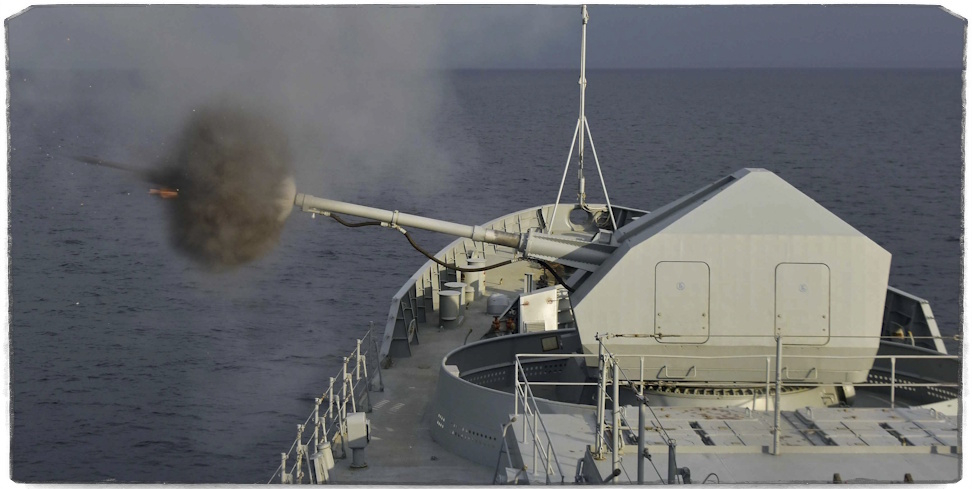
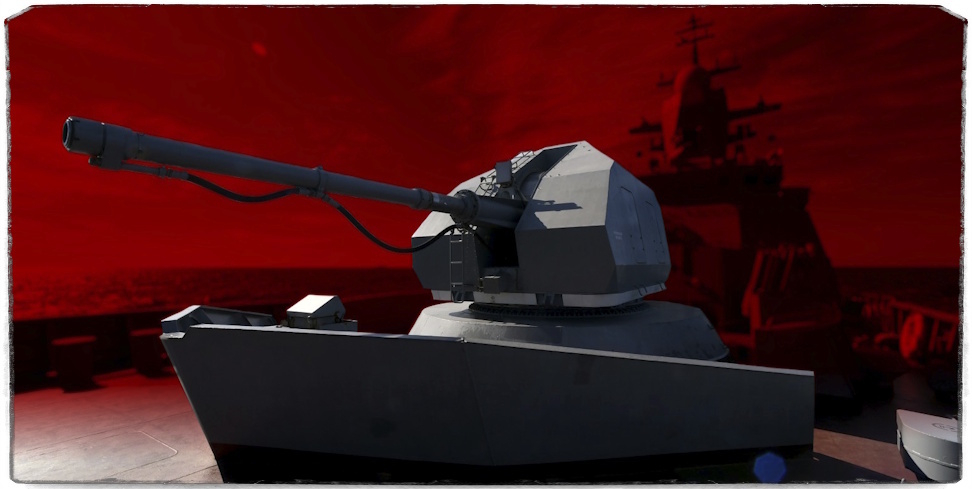
And then information appeared online stating that the lineup of the base “Citadel” is planned to be expanded with the addition of one extremely unusual vehicle—the A-190 “Universal.” This is a 100-mm naval artillery system, which renders all the previously mentioned considerations irrelevant. Let’s take it one step at a time, and perhaps start with the firing range—the A-190 is capable of firing over 20 kilometers, which is roughly 7 to 10 times the range of the 2A42 gun. Needless to say, the “Gvozd” missile from the “Pantsir” system has a range of 10–12 kilometers. The situation is similar in terms of altitude—the ceiling is about 10 kilometers, which is more than enough to take down most targets.
The only issue is rate of fire. In its natural environment, the “Universal” is capable of firing up to 80 rounds per minute, but it does so thanks to barrel cooling with seawater. In the land-based version, water will either have to be transported separately or cooling will have to be forgoing, resulting in a lower rate of fire. Which path the designers choose depends on the volume of water required and how practical it is to carry it along.
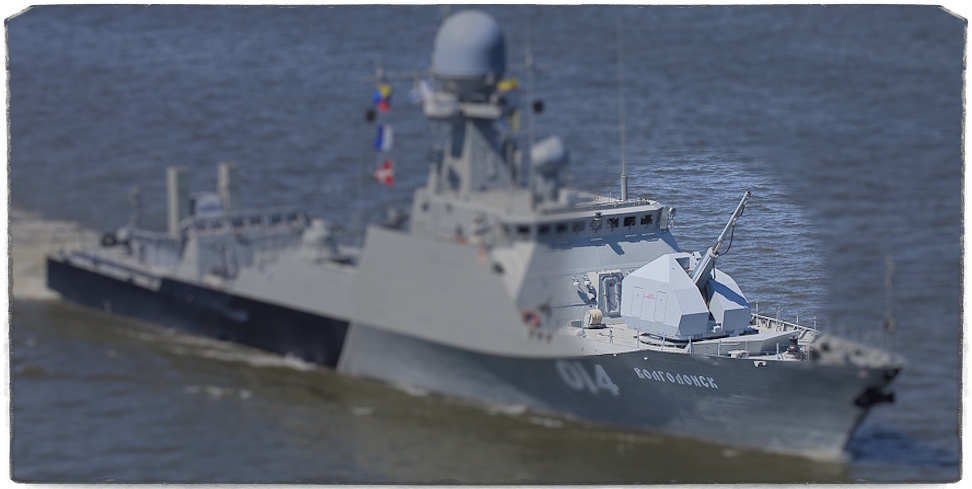
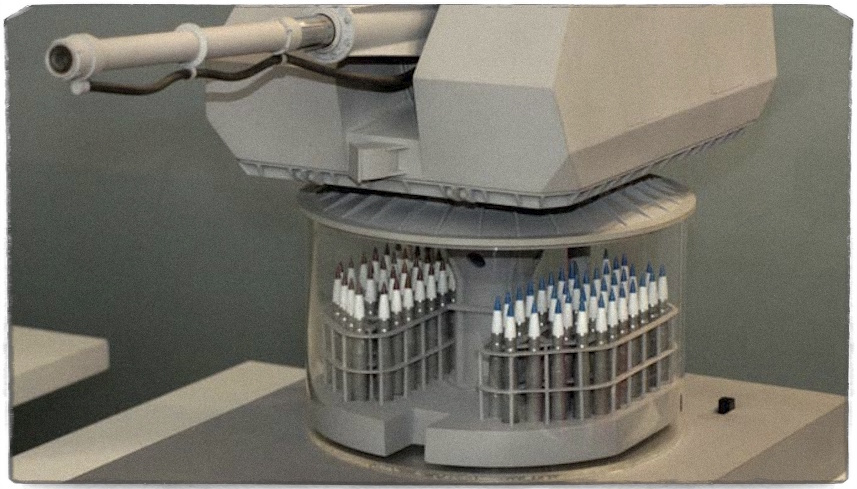
However, the decision to choose the A-190 was not based solely on its outstanding performance—the key factor lies in “smart” munitions and their well-established production. While no precise data is publicly available, it is known that at least two types of munitions exist. The first is a round with programmable remote detonation. The operating principle is simple and mirrors that of the base ZAK-30: a laser rangefinder determines the distance to the target, the data is programmed into the munition immediately before firing, and it then detonates at a specific point. Moreover, unlike the 30-mm round, the fragmentation zone is significantly larger, which means the chances of taking down a target with just one or two shots increase.
The second type of munition is more complex because it can maneuver in flight. Roughly speaking, it’s an interceptor missile, but it uses a propellant charge instead of a rocket stage. It’s likely expensive, but clearly cheaper than a conventional surface-to-air missile—a sort of hybrid capable of partially addressing the main shortcomings of both approaches. As for guidance, it uses a semi-active IR seeker with laser beam alignment—inexpensive but effective.
To sum up, we have the following: the basic ZAK-30 “Citadel” is responsible for the close-range sector, while the A-190 “Universal” handles more complex and distant targets. It all sounds good on paper, but the plan isn’t without its flaws. The main one is the price of the A-190 itself. After all, this isn’t a conventional artillery system, but a rather rare piece of equipment—production will have to be scaled up.
A logical question arises: won’t this end up being more expensive than integrating the “Pantsir”? And it’s not entirely clear where they plan to deploy it—as a mobile system or only as a stationary one? We’ll wait and see, as they say, and then we’ll see—whether it’s a good solution or not. But looking ahead, we’ll note that, by design, this is essentially a new element in the fight against drones, with the promise of high effectiveness in all aspects.
Source — https://dzen.ru/a/aierowe9HTkGPZh4