Even the Excavator Needs Armor Now: Why the UAT-SPIDER Is Being Protected Almost Like a Combat Vehicle

There are machines on the modern battlefield that almost never become the stars of spectacular military videos. They carry no guns, missiles, or anti-tank weapons, do not participate in assaults, and often look little different from equipment found on an ordinary construction site. Yet it is their work that creates trenches, shelters, command posts, vehicle positions, earthworks, and access roads. This is why the UAT-SPIDER, unveiled by the Ukrainian company UkrArmoTech, is interesting not so much as another new armored vehicle but as a revealing answer to a simple question: why does even an excavator suddenly need armor on the modern battlefield?
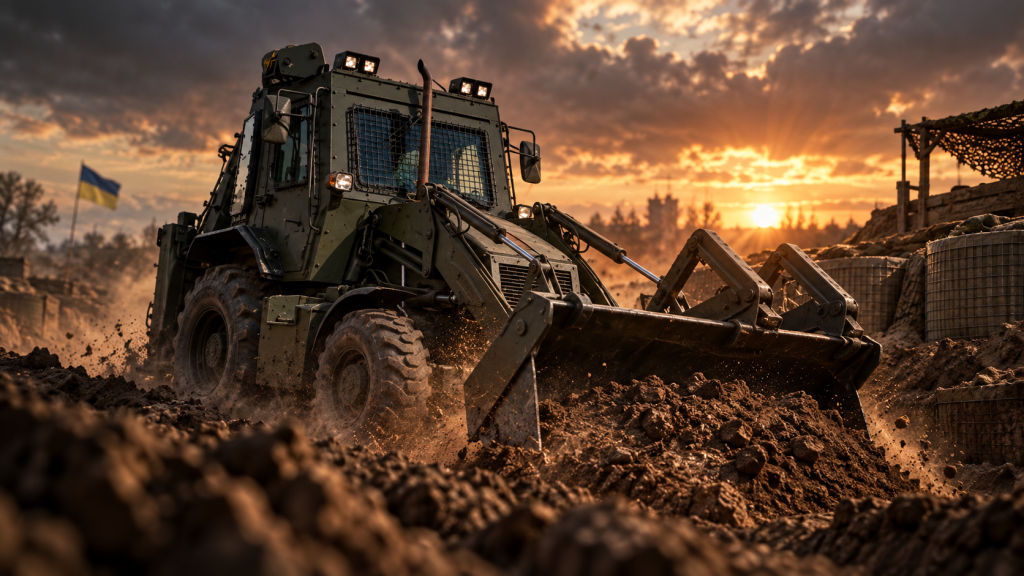
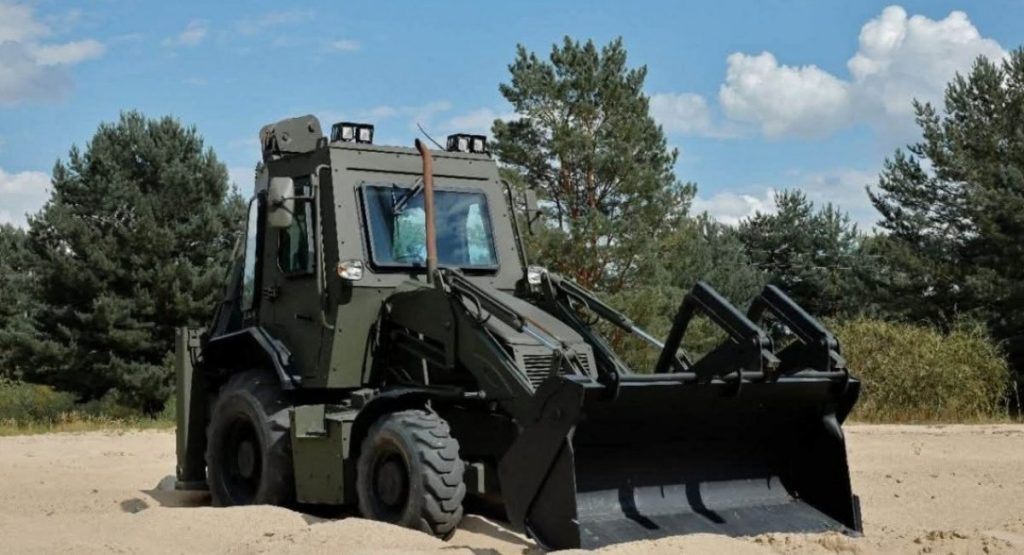
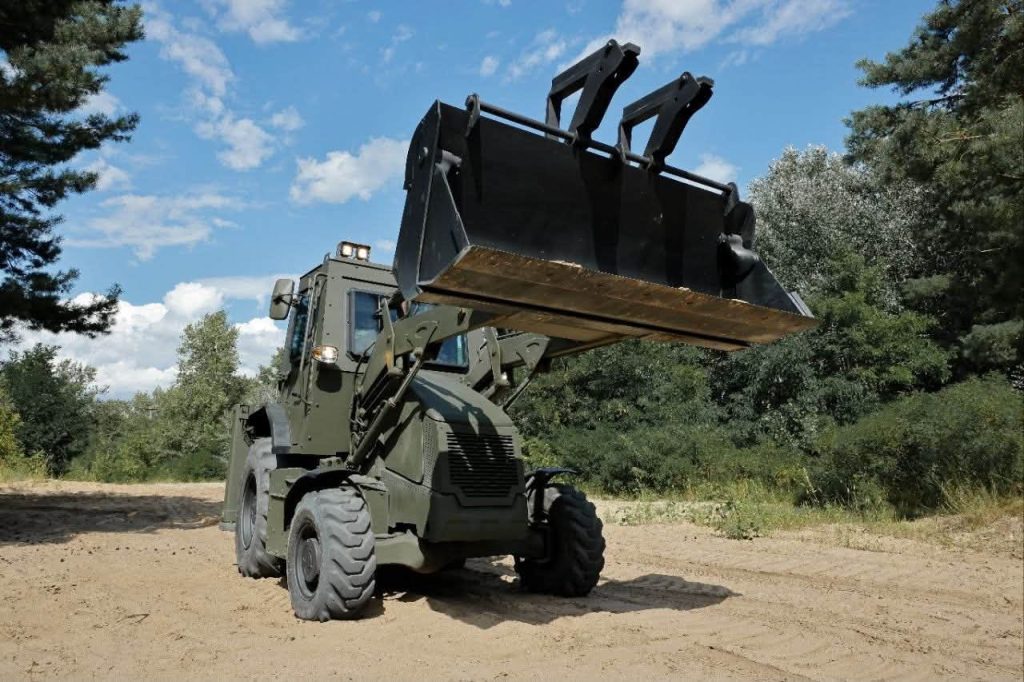
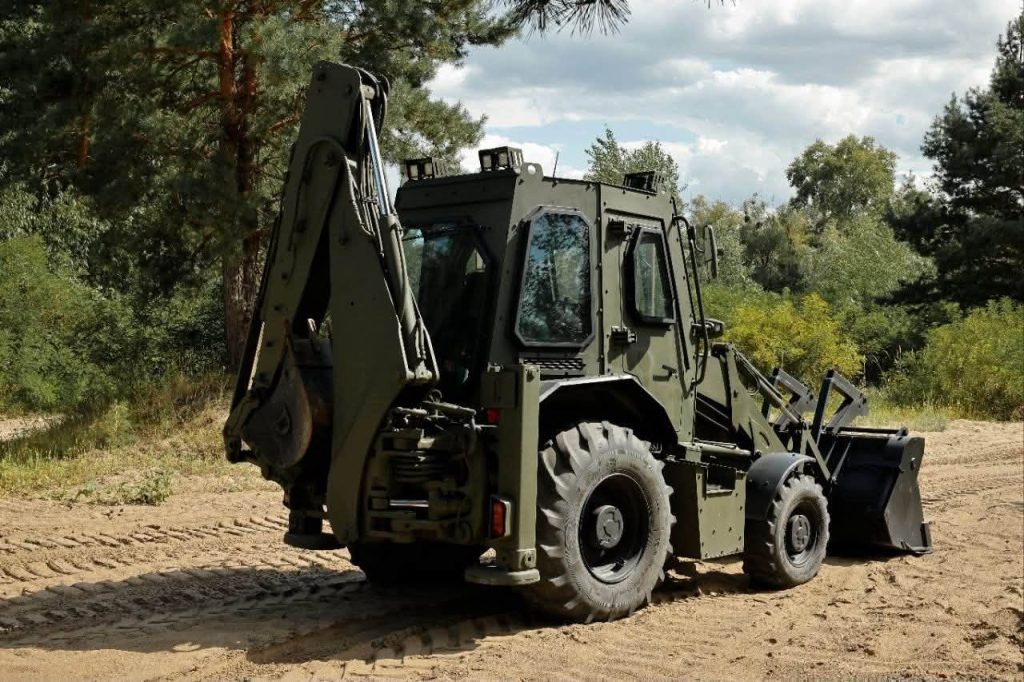
The UAT-SPIDER is an armored backhoe loader designed primarily to support infantry units with engineering work. The vehicle has completed testing, received codification from Ukraine’s Ministry of Defense, and, according to its manufacturer, is ready for contracts and serial production. Its rated lifting capacity is 3.2 tons, while its maximum speed is up to 38 km/h. Several configurations are planned, along with a modified chassis and the option of larger front wheels. The armored cab complies with STANAG 4569 Level 1, while additional protection is provided for a number of important components; the engine, for example, is shielded by a grille made from armored material. Its intended missions are remarkably mundane: preparing positions and command posts, building and repairing roads, moving earth, and performing various engineering and logistical tasks.
There is, of course, nothing revolutionary about the idea of an armored engineering vehicle. Armies have used armored bulldozers, combat engineering vehicles, and other protected specialist machines for decades. What makes the UAT-SPIDER more interesting is that it sits much closer to an ordinary construction backhoe loader than to a heavy engineering vehicle built on a tank chassis. In essence, a familiar civilian type of machine is being adapted for an environment in which unprotected construction equipment has become too vulnerable. And that transition tells us quite a lot about how much the space between the front line and what used to be considered a relatively safe rear area has changed.
Because a Trench Will Not Dig Itself
War has always been an enormous construction project. An individual soldier can dig a fighting position with a shovel, and a squad can gradually prepare a short section of trench. But once the objective becomes a complete defensive system, the scale of earthmoving increases dramatically. Trenches and communication routes have to be dug, shelters and buried command posts constructed, positions prepared for vehicles and artillery, embankments raised, and access roads built. At the same time, roads need to be repaired, obstacles cleared, and routes restored after damage. All of this means moving enormous quantities of soil—work that would require vastly more people and time if done manually.
An excavator in wartime is therefore effectively a machine that converts diesel fuel into man-hours. A single operator with a hydraulic bucket can perform work that would otherwise require many soldiers. UkrArmoTech itself identifies reducing the amount of heavy physical labor required from personnel as one of the objectives of the UAT-SPIDER. This matters for more than convenience. The less time soldiers spend outside cover performing earthworks, the less time they are exposed to danger, while the unit itself receives a prepared defensive position much sooner.
Mechanization, however, comes with its own price. A group of soldiers with shovels can disperse; each person is a relatively small target and can quickly seek cover if necessary. An excavator, by contrast, is large, noisy, and conspicuous. More importantly, it often has to remain in essentially the same place for a considerable period. To excavate a serious shelter, the machine cannot simply race through the danger zone at maximum speed. It must stop, deploy its equipment, and methodically move soil. This creates a peculiar paradox: the faster an army wants to fortify its positions, the more dependent it becomes on large machines that are themselves attractive targets.
An Excavator Works Exactly Where Someone May Soon Start Shooting
In the past, distance partly solved this problem. Ordinary construction machinery could operate in relatively safe areas, while specialized armored engineering vehicles were reserved for locations where direct enemy fire was a serious possibility. But the spread of reconnaissance drones, long-range weapons, and increasingly persistent reconnaissance-strike networks is gradually erasing this distinction. A machine no longer has to be sitting directly on the front line to be detected and attacked. Large equipment working for several hours in the same area is inherently conspicuous.
Moreover, an engineering vehicle reveals not only itself but also the purpose of its work. Freshly disturbed earth, new trenches, access tracks, embankments, and changes in terrain can reveal where a new position is being prepared. The problem therefore goes beyond the possibility of losing the excavator itself: detecting intensive engineering activity may also indicate the location of a new strongpoint, command post, or vehicle position. Modern fortification consequently becomes a race against time. The maximum amount of work has to be completed between the moment a location is selected and the moment the enemy detects what is happening and can respond.
This is where the armor of the UAT-SPIDER begins to make much more sense. It is not intended to allow an excavator to continue digging while under direct fire from a tank gun. STANAG 4569 Level 1 is a relatively basic level of protection, intended to provide resistance against defined small-arms, fragmentation, and blast threats rather than turn a construction vehicle into an infantry fighting vehicle. The objective is much more modest: increase the probability that the crew survives and that the machine remains operational when exposed to the kinds of threats it may realistically encounter near a combat zone.
Why Not Simply Armor an Excavator Like a Tank?
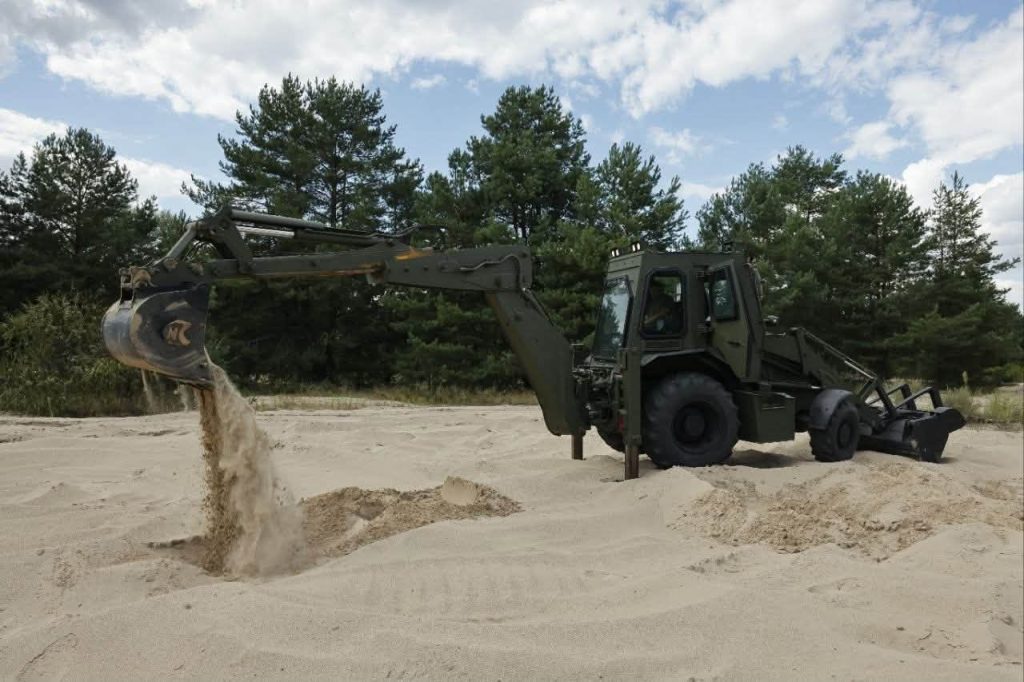
Because armor has weight, and weight affects almost everything an engineering vehicle is supposed to do. The heavier the protection becomes, the greater the load on the chassis, the more difficult transportation becomes, fuel consumption increases, and manufacturing and repair become more expensive. A backhoe loader also has to remain a backhoe loader: a stable working platform with useful lifting capacity, mobility, and the ability to operate conventional engineering equipment. If protecting it requires turning it into a 40-ton specialized armored vehicle, much of the advantage of using a relatively simple construction-derived chassis disappears.
Absolute protection is impossible anyway. Heavy armor can improve survivability, but the modern battlefield contains weapons against which turning an excavator into an “engineering tank” simply makes little economic sense. The UAT-SPIDER therefore represents a different approach: protect the crew and the most important components while retaining the characteristics of a comparatively light engineering platform. Even protecting the engine has its own logic. The crew may survive a burst of fragments, but if the radiator or another critical component is destroyed and the machine becomes immobilized in a dangerous area, the mission has still failed.
Armor on the UAT-SPIDER is therefore less about making the machine invulnerable than about expanding its zone of acceptable risk. An ordinary civilian excavator has to be withdrawn once the danger to its operator becomes too high. A protected machine can potentially continue working for longer or operate somewhat closer to a hazardous area. For a combat vehicle, such an advantage might be measured in additional chances of surviving a hit. For an engineering machine, it can also be measured in additional cubic meters of earth moved before the area has to be abandoned.
But Armor Solves Only Half the Problem
The greatest threat to such equipment simultaneously demonstrates the limits of the armored-excavator concept itself. If a small reconnaissance drone detects the vehicle and passes its coordinates to a heavier weapon, STANAG Level 1 is no longer a universal answer. Protection can continue to be increased, but this rapidly becomes the classic contest between armor and warhead—a contest an engineering vehicle is almost certain to lose economically. There is little sense in giving an excavator main-battle-tank levels of protection simply so it can spend several hours digging a trench.
Protecting the vehicle therefore requires more than armor. Camouflage, reducing the amount of time spent in one location, dispersing engineering equipment, choosing the right time to conduct work, and integrating engineering units with other battlefield capabilities all become important. Speed is particularly significant. In the past, an excavator’s productivity was primarily an economic characteristic. Under persistent observation, it increasingly becomes a survivability characteristic. A machine that completes a task in two hours instead of four cuts the time available for the enemy to detect, classify, and organize an attack against it. The actual probability of attack obviously does not decrease in such a perfectly linear fashion, but the principle remains the same: engineering productivity becomes part of protection.
This is also why the UAT-SPIDER’s maximum speed of 38 km/h matters, although nobody intends to race armored excavators. Mobility allows the machine to reach a work site, perform its mission, and leave more quickly. The same applies to its ability to operate in confined spaces and difficult terrain. On civilian construction machinery, these are mainly questions of convenience and productivity. On a military vehicle, every one of these characteristics also influences the amount of time spent inside the danger zone.
The Next Step May Be an Excavator With Nobody Inside
This is where the UAT-SPIDER unexpectedly intersects with another major trend in military technology: unmanned ground vehicles. A military robot is usually imagined as a small tracked machine carrying a machine gun, anti-tank missile, or cargo platform. Yet engineering work may prove to be one of the most logical areas for ground-vehicle automation. An excavator does not need to fight an aircraft, travel at highway speeds, or instantly distinguish friend from foe. Much of its work consists of relatively slow, repetitive operations within a defined area.
Armor currently solves the problem in the traditional way: because a human remains inside the vehicle, a protected volume has to be built around that person. The next logical step is remote control, allowing the operator to remain in a shelter or some distance from the work site. Armor would then primarily protect valuable machinery, while losing the vehicle would no longer automatically mean losing its crew. From there, individual operations could gradually become automated, eventually leading toward greater autonomy. This does not mean a robotic excavator is an easy engineering problem. Human operators constantly judge soil conditions, obstacles, bucket position, vehicle stability, and numerous other variables; communications can be jammed, and the machine itself remains vulnerable to attack. But the direction of development is relatively clear.
The result is an interesting evolutionary chain: an ordinary civilian excavator is first painted in military colors and sent to work for the armed forces; then it receives a protected cab and armor for critical components; remote control subsequently removes the operator from the most dangerous area; and automation gradually reduces the amount of direct human involvement required. The UAT-SPIDER remains near the beginning of this transition—it is still a conventional crewed engineering vehicle—but the very reason it needs armor helps explain why future generations of such equipment may increasingly dispense with a person inside.
Sometimes the Most Important Vehicle on a Position Has No Weapons at All
In photographs of any army, attention inevitably goes to tanks, infantry fighting vehicles, artillery, aircraft, and missile systems. Yet a unit’s ability to remain in position for a long time depends on a huge number of far less spectacular machines. Someone has to build the road, clear the obstruction, prepare the shelter, move supplies, restore a damaged route, and dig the trench. The longer a confrontation lasts and the denser the fortification system becomes, the more important precisely this kind of equipment becomes.
That is why the UAT-SPIDER is interesting precisely because there is no revolution here. Ukrainian engineers have not invented a new principle of fortification or created a machine that changes the laws of warfare. They have done something much more straightforward: taken one of the most useful tools on any construction site and attempted to adapt it to an environment where an ordinary construction excavator has become too vulnerable. The result is an armored cab, protection for critical components, an adapted chassis, and several possible configurations. The vehicle has already passed testing and codification, although readiness for contracting and serial production should not yet be confused with the existence of a large production order.
And that simplicity may tell us more than any revolutionary concept could. The modern battlefield is gradually forcing armies to protect everything that must spend significant time close enough to danger. Armor was first needed by vehicles expected to take fire and break through enemy defenses. Then transport, recovery, and engineering vehicles received protection. Now armor is appearing on a machine whose only job is to dig earth.
A tank can be as advanced as technology allows, drones can transmit imagery in real time, and artillery can receive target coordinates within minutes. But when a unit actually has to hold a piece of ground, the end of this entire technological chain still comes down to an astonishingly old problem.
Someone has to dig a hole.
Preferably before the enemy figures out exactly where you are digging it.