An article from the “Historical Weapons Studies” channel on Yandex Zen.
Contents:
The “Historical Weapons” channel continues its series of translations of Paul Scarlata’s articles on pistols and revolvers from the turn of the 19th and 20th centuries. Today, subscribers are invited to read the article “The Austro-Hungarian 8-mm M.7 ‘Roth’ Pistol: A Historical Overview,” which was published in Firearms News in 2024.
At the same time, we’ll continue our series of articles on pistols designed by Karel Krnka.
I think this article will be interesting not only for its historical overview but also for the results of the pistol’s testing.
Translation by me; photos from the article.
The Austro-Hungarian 8-mm M.7 “Roth” Pistol: A Historical Overview
The Austro-Hungarian M.7 “Roth” Repeating Pistol—possibly the first semi-automatic pistol adopted by a major military power
Some armies were well known for their practice of adopting firearms with unique characteristics. Whether this was the result of a fascination with a particular mechanical feature, the influence of an outstanding engineer or administrator, national pride, financial constraints, or the absence of external influence, some countries tended to produce military small arms with a “national character.” Of these, perhaps none is better known than the Austro-Hungarian Empire. The short-barreled weapons used by the empire during this period, such as the massive 11-mm Gasser Cavalry Revolver M.1870, underscored a tendency toward unique (or strange?) designs. Fortunately, in the field of rifle design, the Austro-Hungarian Army found salvation in the talents of Ferdinand von Mannlicher. And although his magazine-fed rifles were indeed the first truly practical military multi-shot rifles, they are better known for their straight-pull bolt—while the rest of the world had switched to a rotating-bolt design.
In 1898, the Austro-Hungarian Army took its first tentative steps toward modernizing its small arms by adopting the 8-mm Rast & Gasser infantry revolver. The first successful—albeit not very practical—semi-automatic pistols appeared at the end of the 19th century. Several Central European firearms designers became enthusiastic about adapting Mauser’s new loading system (detachable magazine) to a new generation of self-loading pistols. And although the resulting pistols cannot be considered particularly practical, it is not surprising that they achieved their greatest popularity in the Austro-Hungarian Empire.
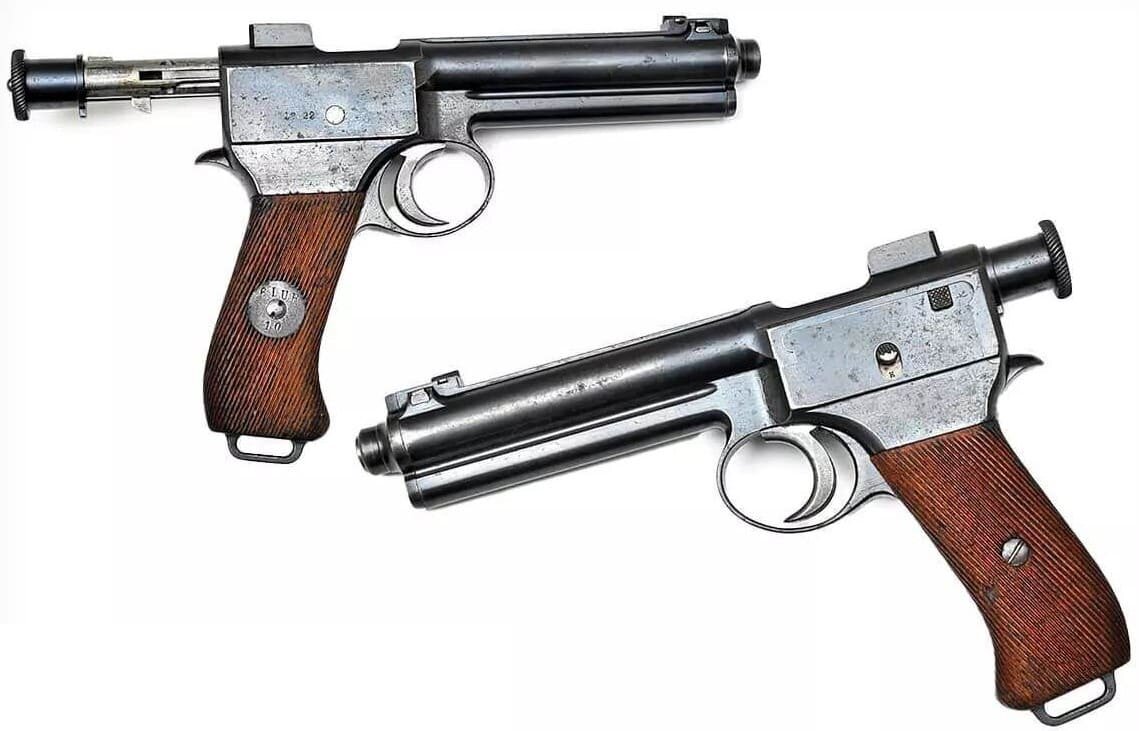
Roth-Steyr Pistol, Model 1907
Karel Krnka (1858–1926), a Czech engineer and one of the most prolific firearms designers of his time, patented a semi-automatic pistol in 1895 that featured two characteristics that became the hallmarks of his pistol designs: a long-stroke recoil system and a fixed magazine inside the grip, which was loaded using a loading device.
In 1898, Krnka began working at the Patronenfabrik in Lichtenwert, Austria, owned by Georg Roth, who gave him the opportunity to refine his pistol. Since Roth’s factory lacked the facilities to manufacture firearms, a decision was made around 1900 to have the Krnka pistol produced by Sauer in Germany under the name 7.65-mm Roth-Sauer Selbstladepistole.
Although commercial success and military contracts initially eluded them, Krnko’s (and Roth’s) fortunes changed in 1905, when the Austro-Hungarian Army announced a series of trials aimed at developing a semi-automatic pistol. Roth submitted an improved version of Krnka’s design for consideration, and after comparative trials with the Luger and Mauser pistols, it was adopted in 1907 as the 8-mm Repetier-Pistole M.7 (also known as the M.7 Roth-Krnka or the M.07 Roth-Steyr).
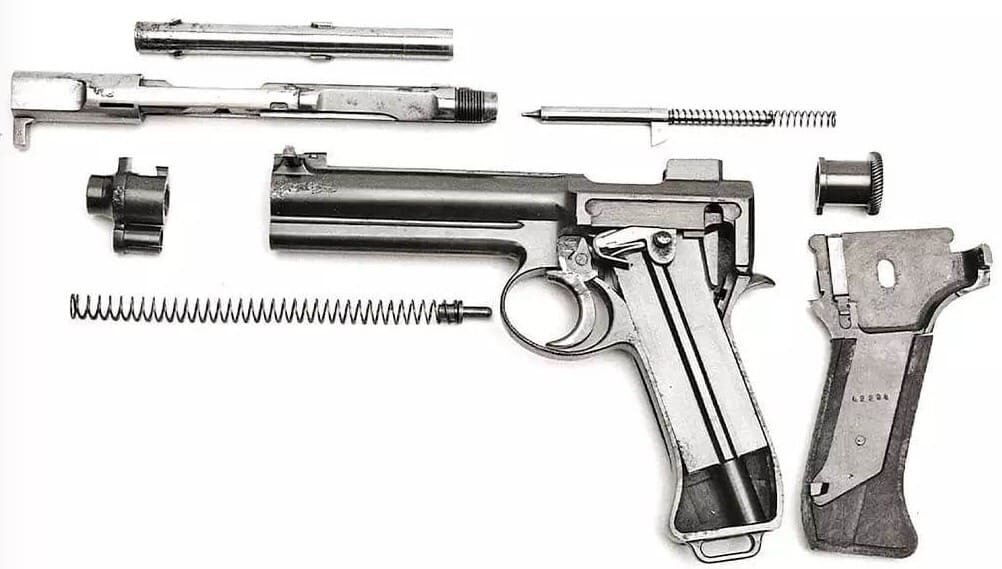
Partial Disassembly of a Firearm
Note: Austria-Hungary became the first major military power to adopt a semi-automatic pistol as its standard-issue weapon. And before my already overworked editor is inundated with angry letters from readers, let me add that although the Swiss adopted the Parabellum pistol in 1900, I do not consider them a “major” military power. And although the Parabellum was also adopted by Germany in 1904, it was used only by the Imperial Navy and did not become standard issue for the entire armed forces until 1908.
The M.7 shared the distinctive features of the earlier Roth-Sauer pistol, with a rounded grip, a tubular receiver, and a separate slide with an open, rifled cocking lug (a link to the article on the Roth-Sauer pistol will be provided at the end—IO). It used a rotating barrel for locking and unlocking, which was typical of Austrian service pistols, although it was rarely used in other systems.
The bolt extended the entire length of the tubular housing. The front part of the bolt was hollow to encase the barrel. Four cam lobes on the barrel—two at the front and two at the rear—moved within helical grooves along the barrel sleeve and, at the rear, within the bolt cavity, engaging the bolt with the barrel.
When fired, the M.7’s bolt and barrel recoil backward together by about half an inch, after which the front lugs begin to move within the grooves of the barrel sleeve to rotate the barrel, which, in turn, rotates two lugs at the rear of the barrel by approximately 90 degrees to disengage the bolt from the barrel and allow the bolt to continue moving backward, extracting and ejecting the spent cartridge case. The bolt is then pushed forward by the recoil spring, extracting the next round from the magazine, feeding it into the chamber, and forcing the barrel to move forward. As the barrel moves forward, it rotates again in the opposite direction, locking the bolt.
To load the M.7, you had to pull the slide back and press the small square button on the left side of the frame at the rear, which locked it in place. Next, a ten-round loader was inserted into the guides at the rear of the ejection port, and the rounds were pushed into the magazine. After that, the magazine was removed, the bolt was pulled back slightly, released from the hold-open position, began to move forward, and fed a round into the chamber. As the bolt moved forward, the firing pin was held in a partially cocked position, and its tail protruded from the end of the bolt handle, serving as an indicator that a round was in the chamber.
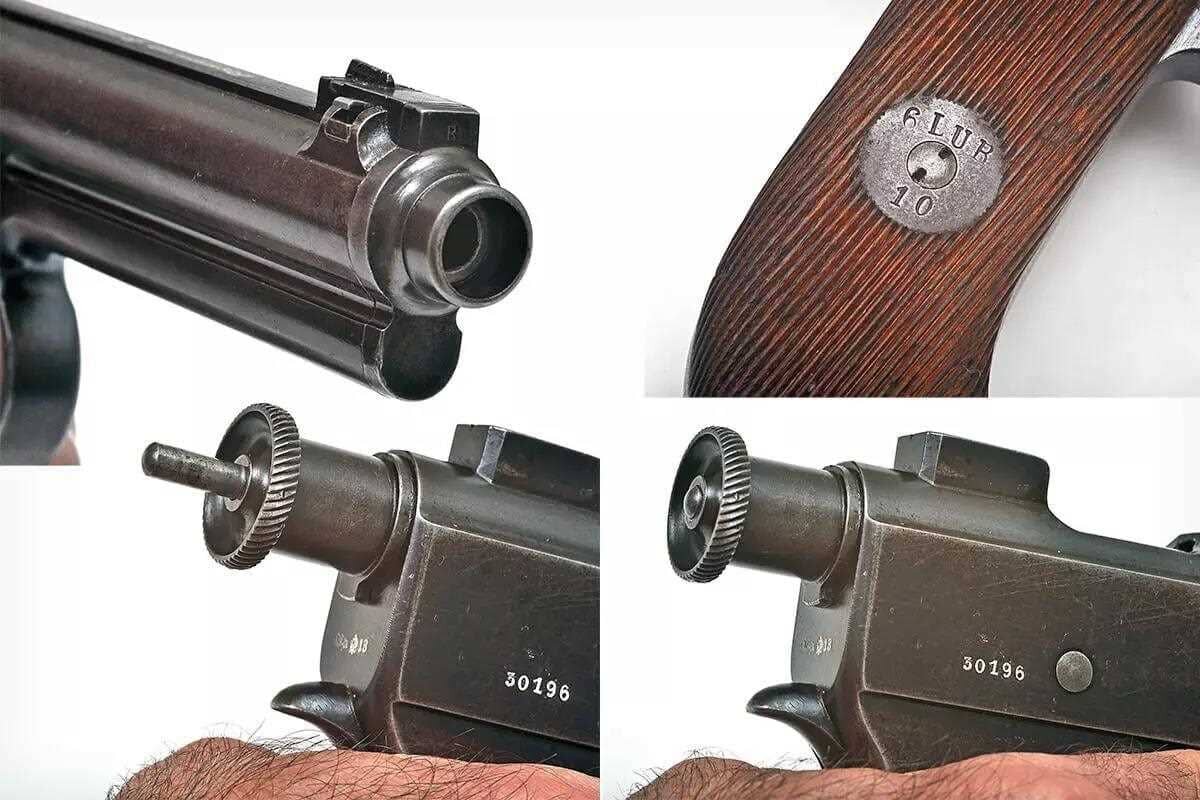
Pistol Components
The pistol used a rather rare semi-double-action trigger system—with a fairly long and heavy pull—that pulled the partially cocked hammer back to full cock before releasing it to fire. To unload the magazine, one had to pull the slide back, lock it in the open position, and then press the lever above the left side of the grip, which ejected the magazine’s contents through the top of the pistol.
The cavalry—the most prestigious branch of the Austro-Hungarian armed forces—considered the M.7 to possess all the advantages of the new semi-automatic pistols: a large magazine capacity, quick reloading, and easier handling, while still featuring traditional revolver-style safety mechanisms. It was believed that this combination of features would prevent accidents similar to those that might occur if soldiers on spirited horses were armed with pistols featuring light, single-action triggers.
Roth organized the production of the M.7 at the Österreichische Waffenfabrik-Gesellschaft factory in Steyr. Additional M.7s were also manufactured at the Femaru Fegyver és Gepgyar factory in Budapest, Hungary, and the manufacturer’s name appears on the top of the receiver. Limited production apparently continued at both factories after World War I.
The M.7 was designed for the proprietary 8 mm M.7 scharfe Pistolepatrone cartridge (also known as the 8 mm Roth-Steyr). It consisted of an 18.5-mm-long straight-walled, rimless cartridge case containing a 116-faceted (7.6 g — IO) full-metal jacket (FMJ) bullet had a nominal muzzle velocity of 1,088 feet per second (332 m/s — IO).
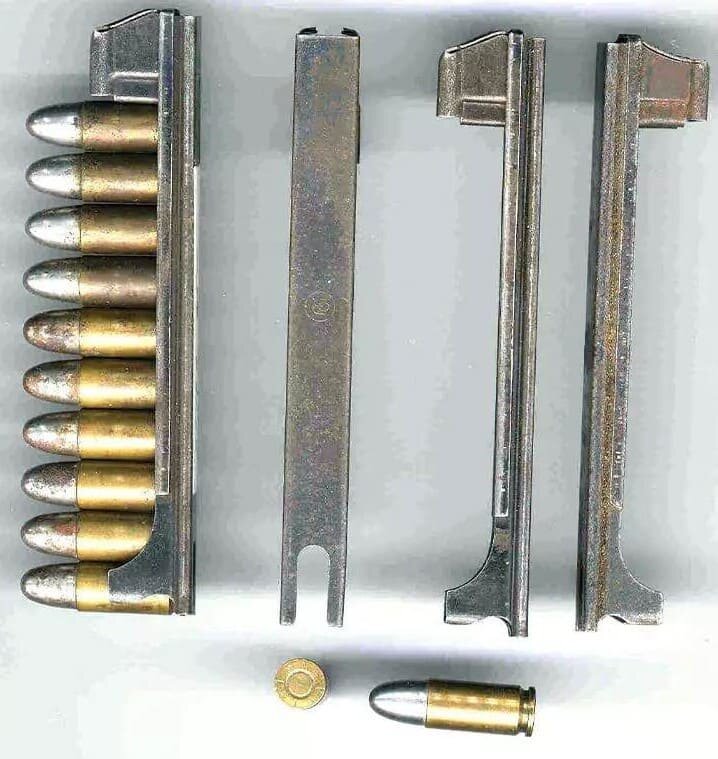
Charger and Cartridge
According to Austrian author and military historian Josef Metz, the pistol was used by all branches of the Austro-Hungarian armed forces and navy, and a limited number were released to the civilian market. At the end of the war, many M.7s were transferred to the Air Corps, where they were called “Flieger-Pistolen.” After the war, both Austria and Hungary continued to use the M.7 pistols, while a number were supplied to other countries—including Serbia, Greece, Romania, Italy, Poland, and Czechoslovakia—as war reparations.
When Hitler incorporated Austria into the German Reich in 1938, most Austrian army units were re-equipped with German weapons, while Austrian weapons, including the M.7 pistols, were placed in storage.
During World War II, the Wehrmacht was in an increasingly desperate need of additional small arms, and some of the M.7 pistols were taken out of storage. Others ended up in the hands of partisans in the Balkans, while the Italians continued to produce 8-mm M.7 ammunition for their pistols.
My friend Tim Hawkins lent me a Steyr M.7, whose acceptance markings indicated that it had been adopted in 1909, and had a marking disc indicating that it was the 10th pistol produced for the 6th Uhlan Regiment of the Landwehr.
I fired a test shot from Tim’s M.7 offhand from seven yards. It aimed very naturally, and the trigger had a distinct two-stage pull with a fairly light trigger pull. Despite its small sight and using 8-mm Fiocchi Steyr ammunition, I placed all my shots in zone A and the “head” of the target. And despite its age, I didn’t experience a single malfunction. Not bad for an “altes Mädchen” (old girl) from Steyr.
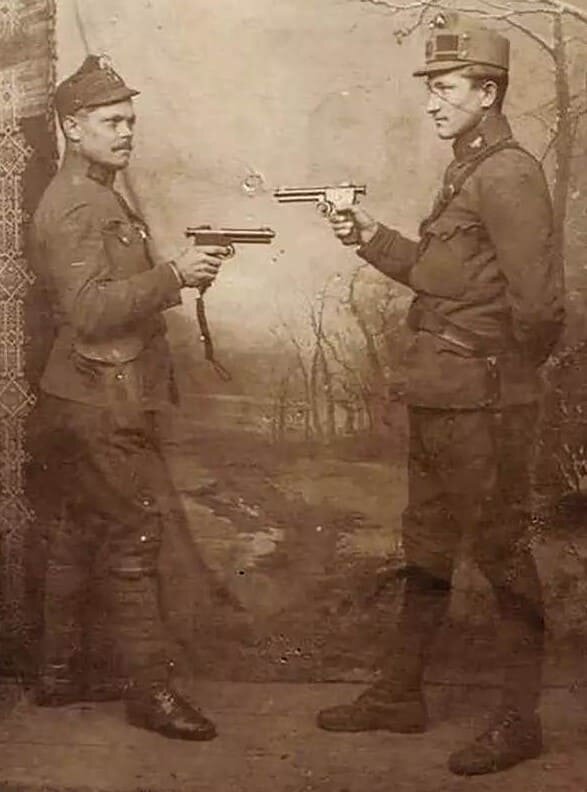
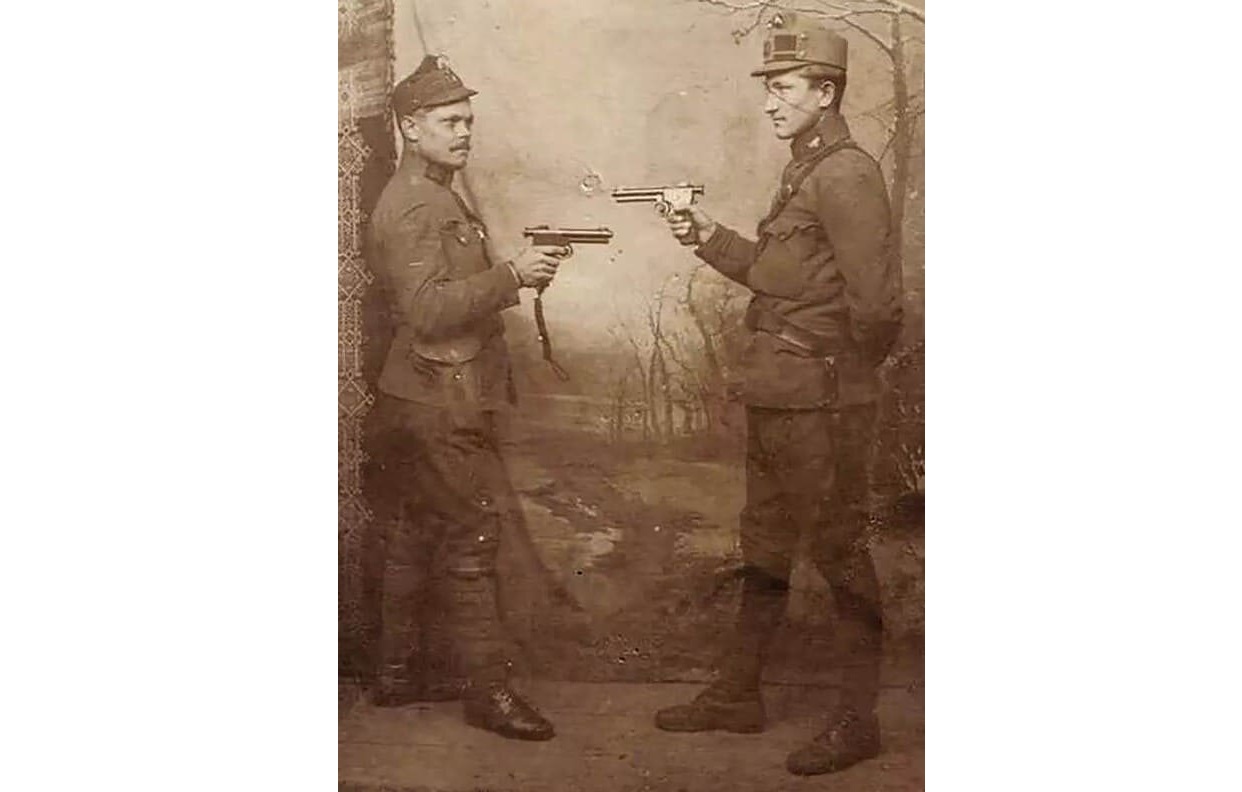
Austro-Hungarian soldiers with a pistol
A brief comment from “Historical Weapons Studies”
It should be added that Austro-Hungarian military leaders began working on self-loading pistols as early as the late 19th century: the first systems tested by the Military Technical Committee were the Laumann pistol, modified to be self-loading; the Salvator-Dormus pistols; and the Kromar pistol (designed by the Austrian artillery officer Konrad Adler von Kromar) — in 1897.
In 1898, 1901–02, and 1903–04, another series of tests was conducted, in which the Mannlicher and Roth/Krnka pistols emerged as the top performers.
The Rot-Krnka pistol emerged as the ultimate winner and was officially adopted on December 5, 1907—Emperor Franz Joseph I signed the corresponding decree.
M7 Technical Specifications
Overall length: 234 mm
Barrel length: 132 mm
Weight: 1.021 kg
Cartridge: 8×19 mm Roth
Muzzle velocity: 332 m/s
Energy: 409 J
Effective range: 50 m
Magazine capacity: 10 rounds
Production of the weapon began in 1909 and continued through 1914. According to experts’ estimates, a total of about 100,000 pistols were manufactured.
It was somewhat surprising to learn that the Roth pistol had won the competition against the Luger and Mauser pistols.
However, I would guess that the main reason was that it was a pistol made by the Austrian Rot — in 1898, the Krnka-Roth pistol was entered in a pistol competition held by the Swiss and didn’t even make the shortlist; the Luger pistol won instead.