Tag: small arms

  • Andrei Haruk. The Second Polish-Lithuanian Commonwealth’s Most Secret Weapon

    An article by Andrei Haruk from the WARSPOT website, dated February 1, 2018.

    Contents:

    One of the most popular areas of development in anti-tank defense during the interwar period was the design of anti-tank rifles. Designers took various approaches to creating such weapons. One approach involved developing “cannon-caliber” models (20 and even 24 mm) with a relatively heavy projectile and low muzzle velocity. Another approach focused on maximizing the muzzle velocity of a standard “rifle” caliber bullet (6–8 mm). One of the products of this second concept was the Polish wz. 35 anti-tank rifle.

    Among the engineers who developed the first small-caliber anti-tank rifles (PTR) was the German Hermann Gerlich. His 6.5-mm rifle, developed in the late 1920s, achieved a muzzle velocity of 1,400 m/s (compared to 900 m/s for a standard “Mauser”). This increase in velocity yielded phenomenal results: when striking a 12-mm armor plate, the lead-core bullet punched a hole in it with a diameter of about 15 mm (whereas a standard rifle bullet left only a 2-mm-deep dent). Interestingly, the Gerlich bullet did not actually penetrate the armor: it vaporized instantly upon impact, but knocked a “plug” out of the armor that could ricochet and shatter into fragments inside the tank or armored vehicle. This phenomenon became known as the “Gerlich effect.”

    Gerlich’s work was no secret and was widely discussed in the specialized press. In Poland, they caught the attention of Lieutenant Colonel Tadeusz Felštyn of the Central Rifle School in Toruń, where a purchased example of Gerlich’s rifle was tested in 1929. In the years that followed, Felštyn demonstrated the feasibility of developing a small-caliber anti-tank rifle and succeeded in sparking interest among both military officials and entrepreneurs. The gunpowder factory in Pionki invested 10,000 zlotys of its own funds into the development of a suitable nitrocellulose powder (its cylindrical grains each had three channels inside to increase the combustion area). The ammunition factory in Skarżysko developed a cartridge case capable of withstanding 50% more pressure than that of a standard rifle. However, the leading role in the development of the new weapon was played by designers at the Institute of Armament Research and the Warsaw Rifle Factory.

    Design

    The development of the rifle was entrusted to Józef Maroszek, an employee of the technical bureau at the Institute of Armaments Research (a graduate of the Faculty of Mechanical Engineering at the Warsaw University of Technology). Despite his youth, Maroszek had already established himself as a talented design engineer. Felštyn had this to say about him:

    “The young engineer, a talented designer, was filled with youthful enthusiasm, a certain mysterious instinct, and quick wits.”

    Юзеф Марошек, фото начала 30-х годов. armiakrajowa.org.pl

    Józef Maroszek, photo from the early 1930s. armiakrajowa.org.pl

    The weapon designed by Maroshek was distinguished by its simple design and relatively light weight. The rifle fired 7.92 × 86 mm cartridges with standard SC bullets. At a distance of 100 m and an angle of incidence of 30°, the bullet punched a 20-mm-diameter hole in a 20-mm armor plate. However, the very first tests revealed a serious problem—rapid barrel wear, which rendered the barrel completely unusable after just a few dozen rounds. It took several years to remedy this flaw. By 1935, the barrel’s service life had been extended to 250–300 rounds—given the weapon’s intended use, this figure was considered quite acceptable. This was achieved by increasing the barrel length from 1,000 to 1,200 mm, as well as by modifying the bullet design to include a longer cylindrical section (which contributed to more stable bullet flight through the barrel and reduced barrel wear). The cartridge was completely redesigned, with the case length increased; the new ammunition was designated 7.92 × 107 mm DS. The cartridge weighed 61.51 g, and the bullet weighed 12.78 g. The modified PTRs successfully passed range tests—at a distance of 300 m, the bullet punched a 15-mm-diameter “plug” through 20-mm armor.

    Обычный «маузеровский» патрон (снизу) и патрон DS. warrelics.eu

    A standard “Mauser” cartridge (bottom) and a DS cartridge. warrelics.eu

    The model was adopted by the Polish Army under the designation Karabin wz. 35 — “Model 35 Rifle” (according to Polish terminology, a rifle is called a karabin, while what is known as a “carbine” in Russian is referred to as a karabinek in Polish). There was no hint in the name that the weapon was intended for anti-tank use—the Polish command feared that information about the new anti-tank rifle would fall into the hands of potential enemies, who would then reinforce the armor of their tanks.

    Общий вид ПТР wz. 35. 2mps.org

    General view of the wz. 35 PTR. 2mps.org

    The wz. 35 rifle is a magazine-fed weapon that is manually reloaded after each shot. It features a longitudinally sliding, rotating bolt that locks onto three symmetrically spaced locking lugs. The barrel is detachable and is attached to the chamber via a threaded connection. The barrel must be replaced after 200–300 rounds; this can only be done in a gunsmith’s shop and requires the use of special tools. The barrel has six right-hand rifling grooves and is equipped with a powerful muzzle brake that absorbs 65% of the recoil energy, as well as a two-legged, forward-folding stock. The magazine is detachable, box-type, with a capacity of 4 rounds; it is secured in the well by two spring-loaded latches—one at the front and one at the rear (replacing the magazine requires two hands). The open-sight system is calibrated for a range of 300 m. The stock and buttplate are monoblock and made of walnut. A short wooden guard is mounted on top of the barrel to protect the shooter’s hands. A leather strap attached to two sling swivels is used to carry the rifle.

    Production and Supplies to the Troops

    Five pre-production PTR rifles were manufactured at the turn of 1935 and 1936, and mass production began a year later at the Rifle Factory in Warsaw, where a secret workshop called “Ur” had been set up. The name was coined by Colonel Tadeusz Pelczyński, head of the intelligence department of the General Staff of the Polish Army—in his opinion, it gave the impression that the workshop was producing weapons for Uruguay. Modern Polish researchers believe that the barrels were supplied by some other company, but exactly which one is unknown. This fact eloquently attests to the secrecy surrounding the production of the new PTRs. At the Skarżysko Ammunition Factory, measures were also taken to ensure secrecy—bullets and cartridge cases were produced in general workshops, but the loading of cartridges took place in a special workshop with restricted access.

    The order volume totaled 7,610 units; by October 1938, 2,000 PTRs had passed military acceptance testing. Polish researchers estimate total production at 3,500–3,600 units. This quantity was generally sufficient for the peacetime army, but there was no mobilization reserve. Given that some of the weapons inevitably ended up in storage, many units of the Polish Army had not yet received anti-tank rifles by the time of the September 1939 campaign.

    To the Polish Army units, the PTRs were delivered in sealed wooden crates labeled “Measuring Equipment” and numbered 1 through 3. Box No. 1 (measuring 178 × 27 × 18.3 cm) contained the PTR itself and the instruction manual; Box No. 2 contained three spare barrels; and Box No. 3 — the tools needed to replace the barrel, as well as spare parts. Ammunition was delivered in boxes labeled “21 K Export.” Each box contained two hermetically sealed zinc containers, each with 12 cardboard packs of 12 rounds—that is, a total of 288 rounds per box. An anti-tank gunner’s portable ammunition load consisted of 24 rounds (6 magazines), carried in two canvas pouches from a “Browning” wz. 28 light machine gun.

    Картонная пачка с 12-ю патронами DS. warrelics.eu

    Cardboard pack containing 12 DS cartridges. warrelics.eu

    Lieutenant Colonel Felštyn, the architect of the new weapon (who had retired by the late 1930s), believed that anti-tank rifles should be issued to every squad. The command decided otherwise: three rifles were allocated to an infantry company (one per platoon), and two more to the regimental reconnaissance company (one each for the bicycle and horseback platoons). Thus, an infantry regiment had 29 PTRs, while a cavalry regiment had 13 (three per squadron, plus one in the bicycle platoon).

    Переноска «карабина обр. 35» при действиях в пешем строю. warrelics.eu

    Carrying the “Model 35 Carbine” during operations on foot. warrelics.eu

    The crates containing “measuring equipment” could only be opened with the permission of the Minister of War. The corresponding order was sent to the troops on July 15, 1939. According to the order, a limited number of military personnel were to be trained on the new weapons: three riflemen from each infantry company and cavalry squadron, one rifle master, as well as the commanders of companies, squadrons, battalions, and regiments. The training consisted of one or two rounds of target practice at a distance of 200 meters, using no more than six rounds per company or squadron. Afterward, they were instructed to pack the rifle back into its box and seal it, then collect the spent cartridge cases in a box with the ammunition and seal that as well. It is clear that such “familiarization” allowed the riflemen to gain only the most general understanding of the weapon they were to take into battle.

    Способ перевозки «карабина обр. 35» кавалеристом, вид сбоку. warrelics.eu

    A cavalryman carrying a “Model 35 carbine,” side view. warrelics.eu

    Способ перевозки «карабина обр. 35» кавалеристом, вид сзади. warrelics.eu

    A cavalryman carrying a “Model 35 carbine,” rear view. warrelics.eu

    Транспортировка двух «карабинов обр. 35» на конском вьюке. warrelics.eu

    Transportation of two “Model 35 carbines” on a horse-drawn pack. warrelics.eu

    Combat Use

    The works we have reviewed contain no mention of any single order to issue the wz. 35 anti-tank rifle to units in connection with mobilization. Polish researchers believe that such decisions were made independently by division, brigade, or even regimental commanders. The most proactive among them issued the relevant orders on August 31, 1939, while others did so in the very first days of the war. Information on the combat use of anti-tank rifles is quite scarce; nevertheless, it can be asserted that in battles against German light tanks and armored vehicles, the “Model 35 carbines” demonstrated fairly high effectiveness. One of the soldiers of the 67th Tank Battalion of the Wehrmacht’s 3rd Light Division wrote:

    “We’ve been fighting for two hours now […] We can see anti-tank rifles, their fire riddling our armor with holes. We tirelessly pull the triggers of our machine guns and watch the bodies of men and horses fall amid the fiery fans of tracer bullets. There is only one rule: it’s either you or them. Our tracks grind up the dead and the living who held out to the very end. Despite this, the Polish artillery and anti-tank defenses continue to fire with unrelenting fury. Fountains of earth rise between the tanks. Sparks from bullets striking the armor frequently flash…”

    The effectiveness of the PTR in the September campaign depended directly on the resolve of commanders and soldiers. Where units did not succumb to panic, the “Model 35 carbines” were used right up until the end of hostilities (or until their ammunition was exhausted). Although no tactical guidelines on the use of PTRs had been issued to the troops (due to that same notorious secrecy), resourceful commanders figured out ways to use them on the fly.

    The wz. 35 anti-tank rifle was used as part of mixed anti-tank defenses alongside the 37-mm Bofors wz. 36—in such cases, the anti-tank rifles were tasked with “finishing off” tanks that had broken through the artillery barrage. There are frequent mentions of anti-tank rifles being used from ambushes—fire was directed at the sides of enemy armored vehicles. In areas vulnerable to tank attacks, anti-tank riflemen were sometimes deployed ahead of the main line of defense, with machine-gun fire providing cover. Lieutenant Colonel Stanislav Sosabovsky, commander of the 21st Infantry Regiment, wrote about the battle on September 3 for the village of Chrostowo Wielkie:

    “Our anti-tank weapons are excellent—both the cannons and the anti-tank rifles […] The soldiers gained confidence in the anti-tank rifles when they saw for themselves that their fire could immobilize a tank from a distance of about 100 m.”

    Experience has shown that a superficial understanding of the PTRs did not pose a serious obstacle to their successful use: first, the “Model 35 carbine” proved easy to use; second, commanders assigned their best marksmen to these rifles, and they picked up the skills on the fly. A much more serious problem was the assignment of only one shooter to each PTR instead of a crew of at least two—this led to the almost inevitable loss of the rifle in the event of a soldier’s death. Another drawback was the lack of external indicators of a hit—the bullets from the “Model 35 carbine” were non-tracer.

    Despite its effectiveness against light armored vehicles, the wz. 35 anti-tank rifle was by no means a “wonder weapon” capable of saving Poland from defeat. Could these rifles have been used more effectively? Probably yes, but they were no match for the concentrated attacks of the Wehrmacht’s mobile units.

    ПТР wz. 35 среди другого польского оружия, захваченного вермахтом. Mackiewicz M. Karabin przeciwpancerny wz. 35 // Poligon. – 2014. – №5

    The wz. 35 anti-tank rifle among other Polish weapons captured by the Wehrmacht. Mackiewicz, M. “The wz. 35 Anti-Tank Rifle” // Poligon. – 2014. – No. 5

    A significant number of wz. 35 anti-tank rifles (at least 900) fell into German hands as war trophies. The Wehrmacht adopted the weapon under the designation PzB 35(p) and used it during the Blitzkrieg in the West in 1940. The Germans reloaded the Polish cartridges with bullets from the R318 cartridge featuring a tungsten carbide core (such ammunition was used in the German PzB 38 and PzB 39 anti-tank rifles). In 1941, a cartridge with a different primer and a propellant charge from the P318 was introduced—the muzzle velocity increased from 1,270 to 1,295 m/s, but barrel wear accelerated. As a result, having a sufficient number of PzB 39 anti-tank rifles, the Wehrmacht discontinued the use of the PzB 35(p) and transferred 630 of these anti-tank rifles to Italy. Under the designation Fucile controcarro 35(P), they were used in North Africa, on the Eastern Front, and in Italy itself.

    Американские солдаты с интересом рассматривают трофей — Fucile controcarro 35(P). Италия, 1943 год. warthunder.com

    American soldiers examine a trophy—the Fucile controcarro 35(P)—with interest. Italy, 1943. warthunder.com

    A small number of wz. 35 anti-tank rifles made their way to Hungary in September 1939 along with the retreating Polish troops, and in March of the following year, the Hungarian government sold 30 of these rifles to Finland. In the Finnish Army, these submachine guns were designated 8 mm pst kiv/38. In 1941, they were used in combat against the Red Army, but were soon withdrawn from service and sent to storage due to a shortage of ammunition and spare parts. After 1956, about a dozen and a half of these rifles were sold to collectors in the United States.

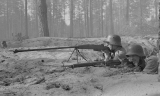
    Финские военнослужащие с ПТР 8 mm pst kiv/38. sa-kuva.fi

    Finnish soldiers with the 8 mm pst kiv/38 anti-tank rifle. sa-kuva.fi

    Tactical and Technical Specifications of the wz. 35 Anti-Tank Rifle

    Calibre, mm7,92
    Weight of AT rifle (with bipod, without magazine), kg10
    Weight of loaded magazine, kg0,5
    Combat weight (with magazine and sled mount)57,7
    AT rifle length, mm61,5
    AT rifle length, mm1760
    Barrel length, mm1200
    Muzzle velocity, m/s1270
    Practical rate of fire, rounds/min8-10
    Sighting range, m300
    Armor penetration at normal incidence, mm:
    at 100 m

    at 300 m
    33
    15

    Bibliography

    1. Konstankiewicz, A. Small Arms and Artillery Equipment of Polish Formations and the Polish Army, 1914–1939. – Lublin, 2003
    2. Mackiewicz, M. Model 35 Anti-Tank Rifle // Poligon. – 2014. – No. 5
    3. Nowakowski, T. Model 35 Anti-Tank Rifle // New Military Technology. – 1995. – No. 6
    4. Satora, K. The Polish Model 35 Anti-Tank Rifle (UR) // Military Historical Review. – 1996. – No. 2
    5. Słupczyński, W. A Little More on the “Ur” Anti-Tank Rifle // Poligon. – 2015. – No. 1
    6. Zasieczny, A. Weapons of the Polish Army, 1939–1945. – Warsaw, 2010

    Source: https://warspot.ru/11091-samoe-sekretnoe-oruzhie-vtoroy-rechi-pospolitoy