An article from the “Historical Weapons Studies” channel on Yandex Zen.
Contents:
The “Historical Weapons” channel continues its series of articles on converting the Kalashnikov assault rifle into a bullpup. Today we’ll discuss the Finnish Valmet Rk-82 assault rifle, which was developed based on the Finnish Rk-76 assault rifle—which, in turn, was a modified version of the Kalashnikov assault rifle (links to other articles in the series will be provided at the end).
Well, as a supplement and for comparison, let’s take a look at the AK-74M assault rifle, which was converted into a bullpup configuration by specialists at the Serpukhov Institute of Engineering Physics.
A Brief Introduction
According to experts, the idea to develop an assault rifle with a “bull-pup” configuration came to the engineers at the Finnish firearms company Valmet by chance.
Finnish military leaders, who had never had a decent budget at their disposal, were quite satisfied with the “Valmet” copies of the Kalashnikov assault rifle—which were supplied with both fixed and folding stocks—and had no plans to replace them with anything else, and so, when work began in 1978 to design their own bullpup rifle, Finnish arms manufacturers embarked on the project at their own risk.
One might assume that, when considering the future of this model, the designers were counting on it becoming fashionable (Bull-Pup rifles had been adopted by the armies of Austria, England, and France) and on some international competitions, but judging by the way Finnish gunsmiths created their version of this fashionable design, I’d say it was more of a whim.
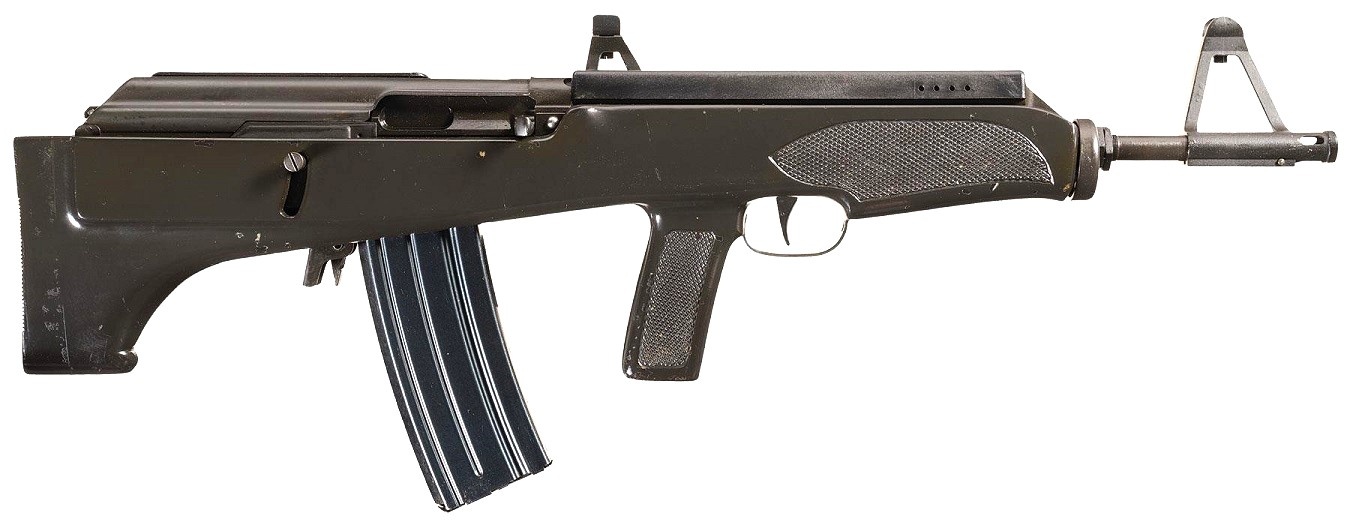
Valmet Rk-82 Assault Rifle
Design Features
Finnish gunsmiths didn’t try to overcomplicate things; instead, they decided to convert the RK-76 assault rifle—which they had “refined” from a Kalashnikov assault rifle—into a bullpup design. To put it bluntly, the Finnish gunsmiths cast a beautiful stock out of plastic and then tried to “squeeze” the receiver, barrel, and other necessary components of the RK-76 assault rifle into the casting.
The major changes made to the system were dictated solely by the need to connect the forward-mounted pistol grip and trigger to the firing mechanism, which remained deep inside the receiver. This connection was achieved in a rather conventional manner—using a curved link (the curvature was necessary to go around the magazine).
The rod ran between the receiver and the stock.
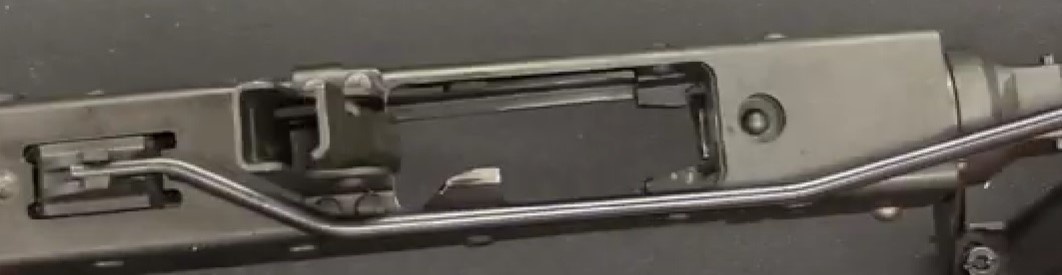
A Passion for USM
Everything else was done with “extraordinary ease.”
To ensure that the safety lever plate would continue to function as intended, a hole was cut into the receiver through which a small lever moved; this lever was screwed into the plate (it had to be removed when disassembling the weapon).
To prevent the shooter from accidentally burning himself on the gas pipe, it was covered with a thick plastic cover.
A unique feature of the system was its sights—which were not only high but also offset to the left. They consisted of an adjustable front sight and a fixed rear sight with a diopter.
To align the shooter’s eye with the sight line, a special plate was mounted on the left side of the receiver cover, and the stock was equipped with a correspondingly positioned “cheek rest.”
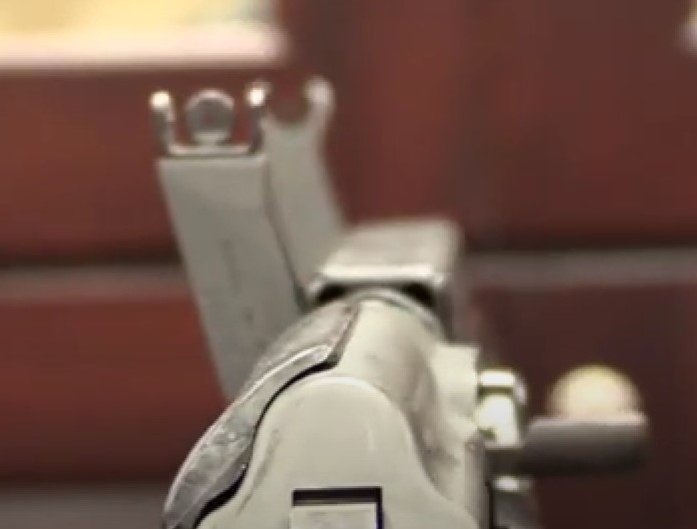
Sights and a cover plate on the receiver
The rifle’s stock was made of polyurethane and gave the system a very futuristic look.
The weapon was designed to fire two types of ammunition: the 7.62×39 mm cartridge, adopted by the Finnish Army, and the 5.56×45 mm Remington cartridge—for export.
Ammo was fed from a detachable 30-round magazine that was inserted into the receiver in the same way as the “good old” Kalashnikov assault rifle.
It’s also worth noting that by unscrewing the screw from the buttplate, the shooter could remove all the “metal parts” of the Rk-76 assault rifle from the Rk-82’s plastic stock.
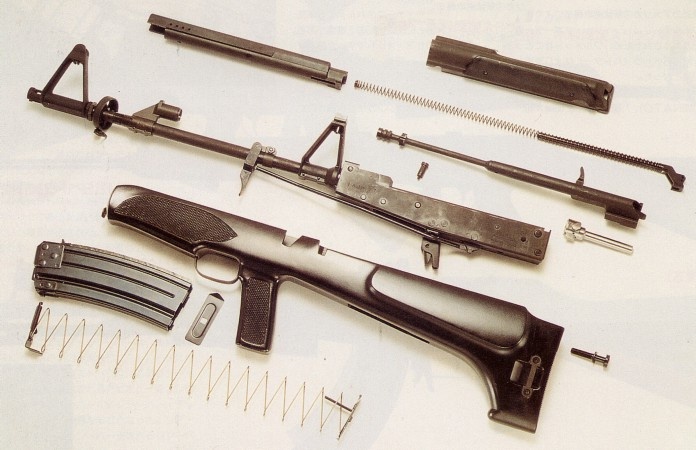
Partial Disassembly of a Firearm
Technical Specifications
Length: 710 mm
; Barrel length: 415 mm
; Weight (unloaded): 3.73 kg
; Cartridge: 7.62×39 mm
; Rate of fire: 750 rounds per minute
; Magazine capacity: 30 rounds
The Fate of Weapons
Unfortunately, the new weapon did not interest Finnish military leaders. And it wasn’t even because they lacked funds, but because the system turned out to be ill-suited for use in the army.
Finnish paratroopers, who received a state-of-the-art system for field testing, found this out firsthand.
Tests have shown that the RK-82 rifle is poorly balanced, is unsuitable for left-handed shooters (in addition to the left-offset sight line, the weapon also retains a movable cocking handle), and has an unpleasant tendency to dig into various parts of a paratrooper’s face upon landing.
Production of the RK-82 was discontinued in 1986.
A total of about 2,000 units were manufactured, most of which were supplied to the U.S. market in automatic (prior to the assault weapons ban) and self-loading versions.

The Valmet RK-82 submachine gun in the movie *The Terminator* (1984)
The “Valmet RK-82” had its moment of glory in the movie *The Terminator*, where it served as one of the “weapons of the future”—the “Westinghouse M25A1” plasma carbine, caliber 4 mm, which Kyle Reese was armed with in his time and which he sorely missed in the past. Interestingly, the filmmakers even left the “original” sights in place.
As a bonus: a bull-pup by Igor Vasilyev
The Russian counterparts of the Finnish arms manufacturers—from the Serpukhov Institute of Engineering Physics—set out to develop a conversion kit that would allow them to transform the “classic” AK-74M into a non-classic bullpup (clearly inspired by the American experience).
Everything was done, so to speak, in the traditional way: the stock, the forend, and the barrel shroud were removed, and a plastic forend with two grips (the front one for support, the rear one with the trigger) and a shortened stock were installed.
The link connecting the new trigger to the old one ran inside the receiver
In addition to this essential component, the following were also included:
-
-
- a cheek rest on the receiver cover;
- a deflector for ejected casings, which also served as a face guard for the shooter when firing left-handed;
- a cover for the old trigger;
- a guide for “blind” magazine insertion;
- a linkage for the magazine release button, which was mounted above the new pistol grip;
- a safety (on the pistol grip).
-
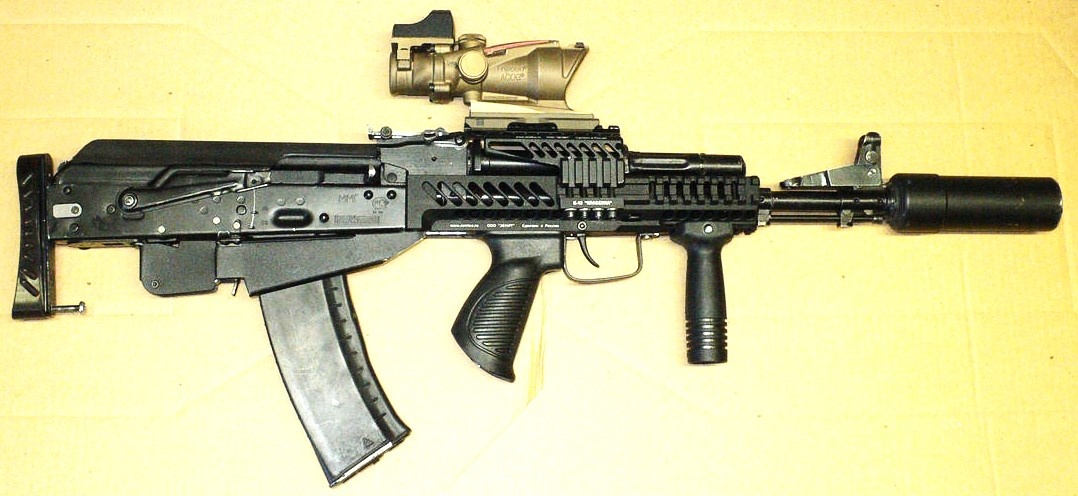
AK-74M with a bullpup kit. Photo: guns.ru
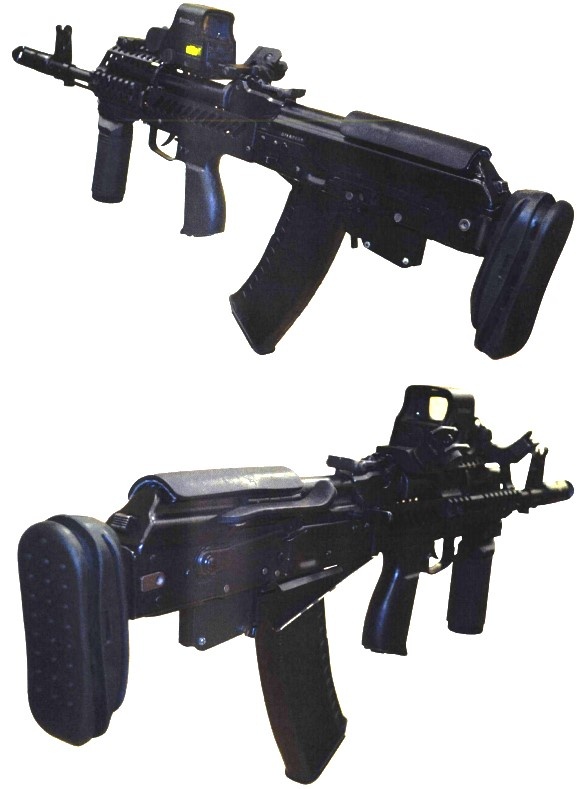
AK-74M with a bullpup conversion kit. Photo from the patent
According to the person who came up with the idea, the system not only retained its performance characteristics but actually improved:
“Aiming while holding the gun with one hand is only slightly worse than holding it with two; group size per burst increased by a factor of 2–3 due to reduced muzzle rise (the higher the butt plate, the less muzzle rise). The test of the fire-transfer exercise showed a reduction in time by approximately 1.4 times” (quoted from the Guns.ru website)
The resulting system underwent testing and was patented in 2015; however, I have not found any information indicating that it was adopted for military use.
A brief comment from “Historical Weapons Studies”
Personally, I got the impression that it wasn’t Finnish gunmakers who were trying their hand at creating an assault rifle with a “trendy” design, but rather that Finnish manufacturers of plastic parts were demonstrating to both the military and civilians their ability to produce attractive and durable plastic components.