The Future of Russia's AWACS. Choosing the Ideal Platform for a Domestic AEW&C System?

One of the key components of the Air Force (VVS) and the Aerospace Forces (VKS) is long-range airborne early warning and control (AEW&C) aircraft.
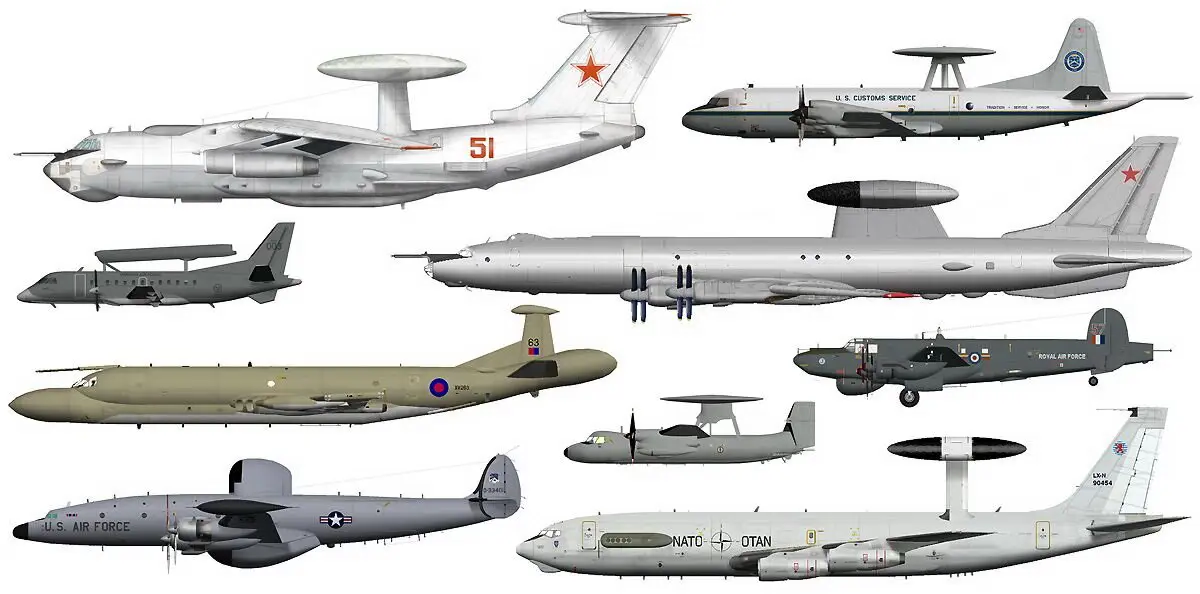
Currently, the Russian Aerospace Forces are facing a serious shortage of such aircraft, especially when compared to the armed forces of the world’s leading powers. This applies primarily to the United States, but China is rapidly closing the gap by actively developing both manned and unmanned versions of AEW&C aircraft. In addition, other countries are also seeking to incorporate these aircraft into their air forces.
The main challenge stems from the fact that the effective range of air-to-air missiles and anti-aircraft guided missiles has increased significantly in recent years, and this trend continues to intensify. As a result, the risks of AEW&C aircraft being destroyed are increasing, as previously mentioned in the article “A Dying Breed: The Uncertain Future of AEW&C Aircraft.”

The
American AIM-174B Gunslinger air-to-air missile, with a range of approximately 240 kilometers
Given the high complexity and significant cost of AEW&C aircraft, as well as the increased risk of their destruction, the world’s leading armed forces are compelled to seek new methods of ensuring air situational awareness. One such approach is to distribute the functions of AEW&C aircraft among several compact manned and/or unmanned platforms. Today, we will examine the potential capabilities of the Russian Aerospace Forces in this area.
Limited selection
According to open sources, the Russian Aerospace Forces are facing difficulties not only in developing radar systems for AEW&C aircraft, but also in selecting suitable platforms. In one of our previous articles—“AEW&C Aircraft for the Russian Air Force: Fast, Plentiful, Inexpensive”—we discussed the idea of creating a “make-shift” AEW&C aircraft based on the promising Il-114, using the from the Su-35S, which has proven itself in the zone of the special military operation (SMO).

A “substitute”
concept for the DRLOiU-114-300 aircraft featuring several “Irbis” radar units mounted on the wings
However, development of the Il-114 is being delayed, and the start date for mass production, as well as production volumes, remain unknown. Of course, one could consider using the Tu-214 as a platform, but production of these aircraft is also limited, and their large size and low maneuverability make these aircraft vulnerable even to less-maneuverable air-to-air missiles and long-range anti-aircraft guided missiles.
What other options are available?
There aren’t many options. We have serious problems with light aircraft—for several decades now, we’ve been unable to develop a replacement for the “Kukuruznik.” As a result, there isn’t much to choose from, and so far we haven’t been able to create anything comparable to the American Grumman E-2 Hawkeye.

The
American E-2C Hawkeye AWACS aircraft and the Chinese KJ-600—it’s a shame that we’re unlikely to be able to do something like that, at least in the foreseeable future, due both to the lack of a comparable carrier aircraft and the lack of an airborne early warning system for it
Recently, the use of unmanned aerial vehicles (UAVs) as platforms for mounting long-range radar detection (LRD) equipment has been gaining popularity, with control functions (“C”) being placed on separate platforms. For example, China is developing the WZ-9 Divine Eagle AEW&C UAV, specifically designed to detect low-observable air targets.

БПЛА WZ-9 Divine Eagle
When it comes to unmanned systems, the situation in Russia is the opposite: while small UAVs are being actively developed and mass-produced, there are certain challenges with medium and heavy platforms.
The “Orion” medium-altitude UAVs have insufficient payload capacity—they can be used in conjunction with a low-power radar station to detect enemy kamikaze UAVs or unmanned surface vessels (USVs), but they are not suitable for tasks related to ensuring air superiority. A similar situation is likely to arise with the heavier medium-altitude “Altheus” and “Sirius” UAVs.
There is a project for the “Helios-RLD” radar surveillance UAV; however, it appears that this aircraft currently exists only as a concept and a scale model. There is no information regarding the development of the first prototype. It can be assumed that the “Helios-RLD” will enter service with the Russian Aerospace Forces by the time similar aircraft in Western countries have already begun to become obsolete, as they will be replaced by low-observable platforms capable of surviving in combat against a high-tech adversary.

Model / Prototype of the “Helios-RLD” UAV
According to publicly available information, the U.S. Air Force plans to replace its RQ-4 Global Hawk strategic high-altitude reconnaissance aircraft with more advanced and extremely stealthy RQ-180 White Bat unmanned aerial vehicles. These new UAVs are being developed to meet requirements for high stealth and the ability to operate effectively in the face of countermeasures from high-tech air defense and electronic warfare systems, which significantly increases their survivability and effectiveness in reconnaissance and surveillance missions.

БПЛА RQ-180 White Bat
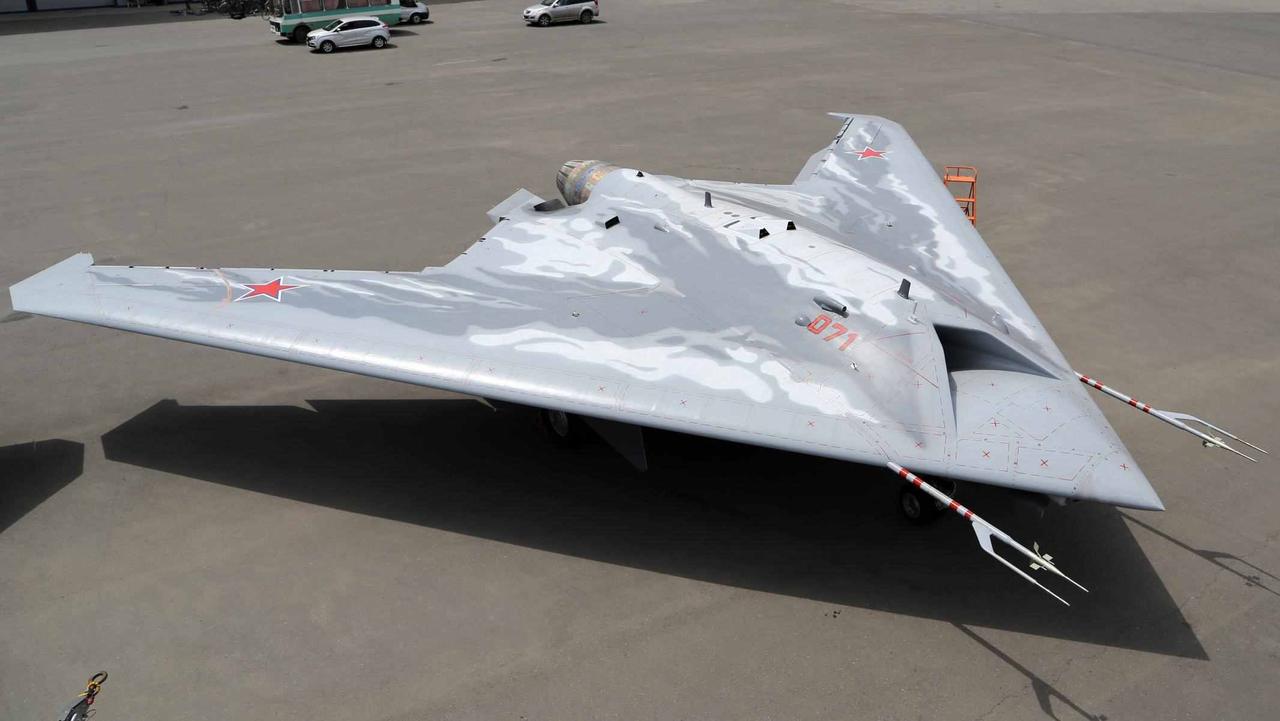
In the Russian Aerospace Forces’ arsenal, within the low-observable unmanned aerial vehicle segment, the S-70 “Okhotnik” heavy stealth UAV—designed in a flying-wing configuration—plays a key role. Based on available information, development of this aircraft is nearing completion, making it the most likely candidate for mass production. Consequently, the S-70 “Okhotnik” may be of great interest as a platform for housing a radar system integrated into a distributed long-range radar detection and control system.
To what extent is it justified to consider the S-70 “Okhotnik” as a prototype for an AEW&C aircraft, or will it be used to address other priority tasks facing the Aerospace Forces?
S-70 “Okhotnik” UAV
The S-70 “Okhotnik” drone project, being developed by Sukhoi, is shrouded in a high degree of secrecy. An analysis of open-source information reveals two main scenarios for the use of this UAV.
First, the autonomous use of the S-70 “Okhotnik” to engage ground targets with guided weapons (let’s hope this aircraft isn’t designed to deliver strikes with unguided bombs).

Dropping an unguided aerial bomb from an S-70 “Okhotnik” UAV during testing
The second is the use of the S-70 “Okhotnik” UAV in conjunction with the fifth-generation multi-role fighter Su-57 as a “trusted wingman.”

The Su-57
fighter jet and the S-70 “Okhotnik” UAV
Modern high-intensity armed conflicts, such as the special military operation in Ukraine or a potential conflict between Iran and Israel, require the air force to make extensive use of long-range, high-precision weapons.
In Ukraine, air bombs equipped with a universal planning and correction module (UPCM) have become the primary high-precision munitions used by the Russian Air Force. However, the use of air bombs with the UMPK in conjunction with the S-70 “Okhotnik” UAV is unlikely to be economically justified. For routine tasks involving the destruction of ground targets, the use of the “Grom”-class UAV, currently under development by Kronstadt, appears to be a more promising option.

“Grom” UAV
Models/Prototypes
It would seem more appropriate to equip the S-70 “Okhotnik” with sophisticated and effective high-precision munitions for striking high-value targets. However, it is important to note that even the low-observable S-70 “Okhotnik” UAV is not invisible or invulnerable to enemy air defense systems and air-to-air missiles, and will undoubtedly be a priority target for the enemy.
This means that if the S-70 “Okhotnik” enters enemy airspace, it could be detected and destroyed by fighter aircraft or anti-aircraft missile systems (AAMS) operating from ambush positions. We must also not forget the risks of interception or jamming of the control signal—this problem remains a concern for Russian unmanned aerial vehicles until the country develops its own high-speed, secure satellite communication system.

According to unconfirmed reports, the remains of the S-70 “Okhotnik” UAV lost in Ukraine
As for the use of the S-70 “Okhotnik” as a “wingman” for the Su-57 fighter, this also raises a number of questions.
For example, the Su-57 is capable of reaching supersonic cruising speeds without using afterburner, while the S-70 “Okhotnik” is most likely a subsonic aircraft. Consequently, when carrying out missions together, the group’s speed will be limited by the capabilities of the slower unmanned aircraft.
The S-70 “Okhotnik” onboard avionics system also plays an important role, particularly its radar. If the UAV is equipped with a modern and effective radar—for example, one based on the “Belka” radar system of the Su-57 fighter jet with an active phased array antenna (APAA)—then the range of tasks the S-70 “Okhotnik” can perform will expand significantly. However, this will substantially increase the cost of the aircraft, since a modern radar system/electronic warfare suite can account for one-third or even half the cost of the entire combat aircraft.
Thus, the optimal and most effective use of the Su-57 and the S-70 “Okhotnik” will be in missions to destroy high-value targets at a considerable distance from their home bases, when a group consisting of the Su-57 and the S-70 “Okhotnik” flies at subsonic speeds, and the increased risk of losing the expensive S-70 “Okhotnik” is justified. In other cases, such as for jamming or delivering additional munitions near the front lines, it is more practical to use the cheaper and simpler “Grom” UAVs.
It should also be noted that the Su-57 is a single-seat aircraft. Will the pilot be able to fly the fighter and control the S-70 at the same time? For a two-seat version of the Su-57, this configuration seems more logical; however, there is currently no reliable information regarding the development or procurement of two-seat Su-57s for the Russian Aerospace Forces.
These issues were previously discussed in the article “The ‘Hunter’ Is Coming: Prospects for the Use of the Heavy, Low-Visibility S-70 Stealth UAV in Ukraine.”
Conclusions
Based on the above, it is highly likely that the S-70 “Okhotnik” heavy UAV will enter mass production in the near future.
Deploying the S-70 “Okhotnik” over enemy territory would carry a high risk of losing these aircraft due to attacks by enemy air defense systems and fighter aircraft, as well as the possibility of interception or jamming of control channels.
On the front lines, for routine tasks such as dropping aerial bombs from UAVs, a more promising solution is to use inexpensive “Grom” UAVs equipped with simple avionics, which should be produced in large quantities.
It is advisable to use the S-70 as the “lead” aircraft “Okhotnik” should be used only in a limited number of missions to destroy particularly important targets located at a considerable distance from their bases, given the high risks of losing modern combat vehicles and their potential capture by the enemy.
As a “follower”—a platform for electronic warfare (EW) systems, anti-radar missiles (ARM), or air-to-air missiles—the optimal choice will most likely be the same UAVs “Grom” UAVs, especially in the low-observable configuration for which this UAV was originally designed.
Thus, it is possible to consider using the S-70 “Okhotnik” as an airborne platform for developing a next-generation spatially and functionally distributed AEW&C system.
Based on material from — https://topwar.ru/269805-perspektivnyj-rossijskij-aviacionnyj-kompleks-dalnego-radiolokacionnogo-obnaruzhenija-vybor-platformy.html