What is the status of the future flagship of the global aviation industry? When will the Boeing 797 take to the skies, and what will it be like?

Probably only someone completely unfamiliar with aviation has never heard of the Boeing 797: that is the hypothetical name for a promising new aircraft that will replace the aging Boeing 757 and 767. Within the company, the project is referred to as the NMA: New Mid-size Airplane. The concept was first introduced in 2015, and the last official public mention of it took place in the fall of 2024, when striking workers demanded that production of this promising aircraft be based in Seattle specifically, and not anywhere else. Management, in turn, promised that it would be built in the Puget Sound region, Boeing’s home base—that is, Seattle, Everett, and the surrounding area.

What kind of aircraft will it be? There has been a lot of talk about the need for Boeing to replace the 757 (the last of which were produced in 2004) and the 767 (the last major order for the passenger version was in 2008). But the 737 MAX will also need to be replaced eventually: it’s clear that this family was developed in a rush to at least somewhat compete with the A320neo. At the same time, there wasn’t enough time to develop a new family from scratch, and the old one had reached the limits of what could be modernized. Even the 737-10 still hasn’t been certified, and the trend is clear: airlines need increasingly spacious aircraft. In the “small” segment, the 737 MAX 7 is already struggling to compete with the Airbus A220, and once the A220-500 is introduced, the situation will become even more complicated.
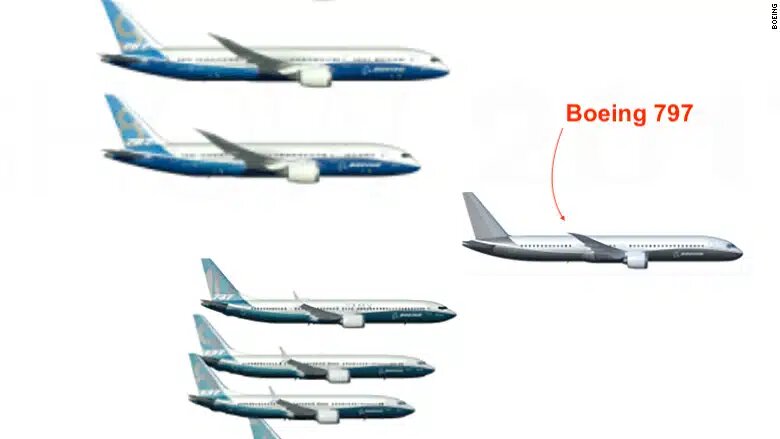
Accordingly, we need to move toward increasing passenger capacity and develop a family of aircraft in which one variant will be designed for 240–250 seats—that is, to compete with the Airbus A321neo, including the LR/XLR versions: that model can’t be lengthened any further. The second variant would have 280–290 seats. The result would be something similar to the 757-200 and 757-300, only based on modern technology with the corresponding level of efficiency, without attempting to modernize an aircraft dating back to the 1970s—a “workhorse” for medium-haul flights with the capability to operate transatlantic routes as well. And, to avoid having to do it twice, create a third, shortened version with 200 seats to finally put the 737 family out of commission.
The first concept for this aircraft was completed in 2017; at that time, the plan was to build a wide-body aircraft that was relatively narrow, with an elliptical fuselage cross-section, a 2-3-2 seating configuration, and 7 seats per row, in two versions: one seating 225 passengers and the other 275 in a two-class cabin, with ranges of up to 9,300 and 8,300 km, respectively, and the ability to operate from relatively short runways approximately 2 km long. It was expected to replace both the 737—generating a third more revenue on comparable flights—and the 767, compared to which the cost per seat-kilometer would be 30–40% lower. At least in theory. The aircraft’s advantage was described as “the economy of a narrow-body with the capabilities of a wide-body.” An elliptical fuselage cross-section would provide the comfort of a wide-body aircraft while reducing aerodynamic drag by eliminating excess baggage compartment volume. However, it’s not certain that the aircraft would be wide-body—an elliptical fuselage cross-section would require it to be much stronger, and thus heavier and more expensive compared to a cylindrical one (pressure!), Boeing never got around to serious R&D in this regard: there were only sketches and marketing presentations.
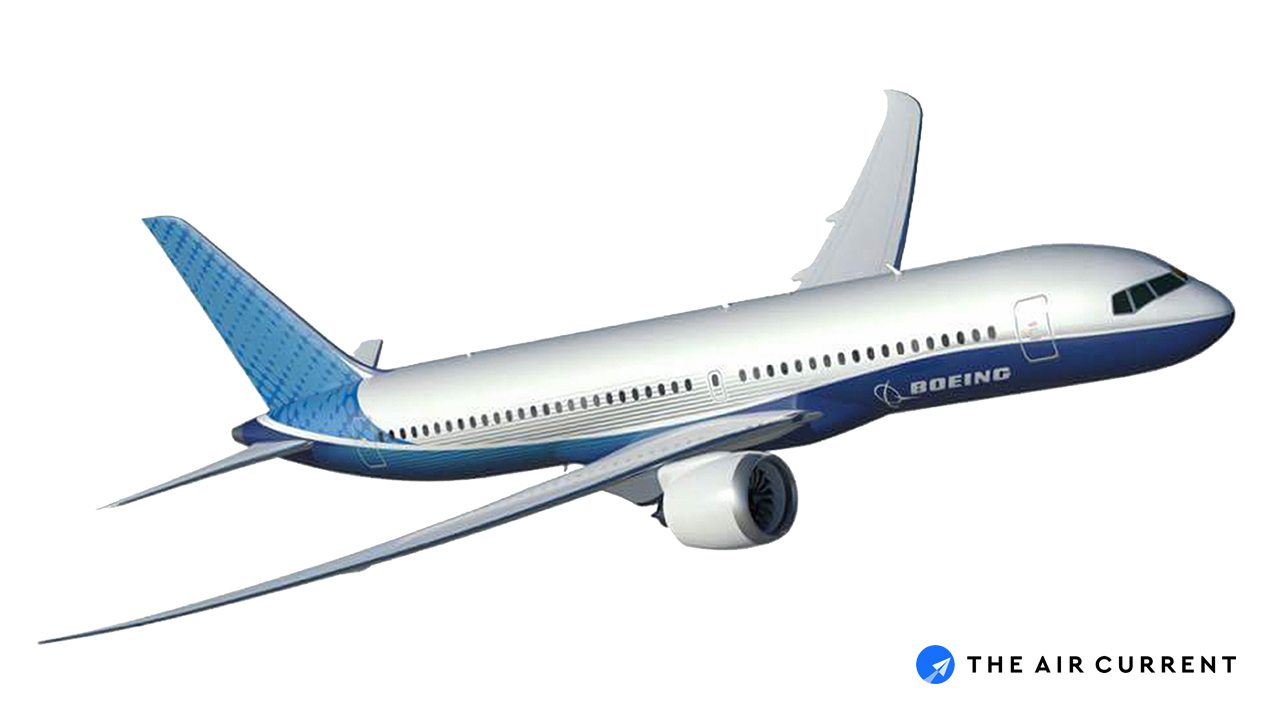
Commercial operations were scheduled to begin in 2025.
But in 2020, it was announced that work on the project would be suspended and that it needed to be rethought—which made sense, since all efforts at the time were focused on getting the troubled 737 MAX family back in the air. At the same time, there were suggestions to “dust off” the previously canceled 787-3: a high-density, shorter-range variant of the “Dreamliner” originally intended for the Japanese market. But this is, after all, a different market niche—for 300+ passengers—with questionable efficiency and targeting a very narrow segment.
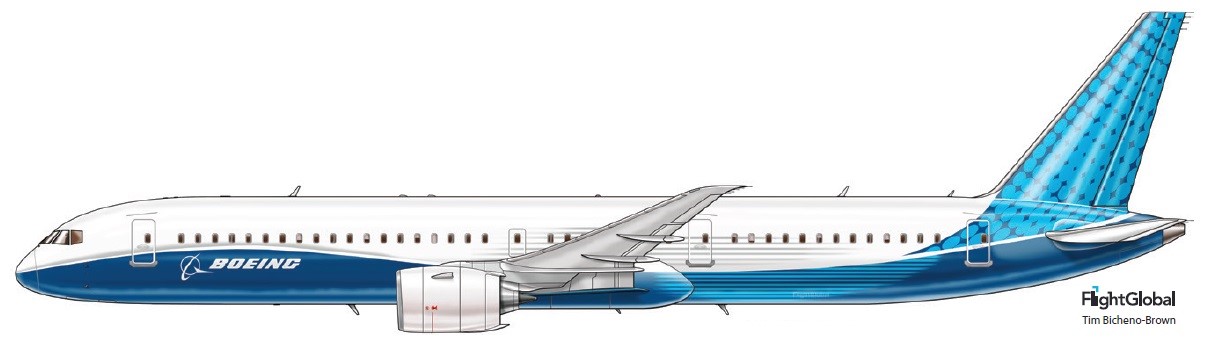
Profile Boeing 797
In 2021, they announced the resumption of work on the program, including a mention of the obvious shortened version. But in 2022, they said, “Galya, it’s canceled!” It turned out that there are no engines for the new aircraft; the only ones with the required thrust of around 200–220 kN are the good old CF6, RB211, and the like; and, as anyone would suspect, it’s simply not possible to just scale up the CFM LEAP or PW1000 (we’ll write a separate article on why that’s the case—the issue of aircraft engine scalability is quite an interesting topic). At the same time, Rolls-Royce itself withdrew its proposal to supply engines for the NMA back in 2019, realizing that a scaled-down version of the still-unfinished Ultrafan wouldn’t work, and there were no other promising programs. The situation with the GEnx is roughly the same; they’re larger than needed—incidentally, there were plans to use them for a hypothetical re-engining of the Boeing 767, but those plans were scrapped.
However, in July of this year, the U.S. Air Force announced a requirement for engines with thrust in the 160–230 kN range for next-generation military transport aircraft. Perhaps the military contract will spur engine manufacturers, and the introduction of a new family of engines will give a boost to the program’s further development—by the late 2030s, it will become even more relevant.
Ilya Shatilin
Source — https://dzen.ru/a/aLhfSmyOLXjP71dB