The U.S. Unveils the AIM-424 Malice: Why Does a Fighter Need a Nearly 700-Kilogram Air-to-Air Missile?

The U.S. inventory of air-to-air weapons is becoming increasingly crowded. The AIM-120 AMRAAM remains the primary medium- and long-range air-to-air missile. The highly secretive AIM-260 JATM has been under development for years as its successor. Then, in 2024, the enormous AIM-174B appeared — an air-launched derivative of the Navy’s SM-6 surface-to-air missile. One might think that would be more than enough long-range weapons for a single service.
But now the U.S. Navy has revealed another missile.
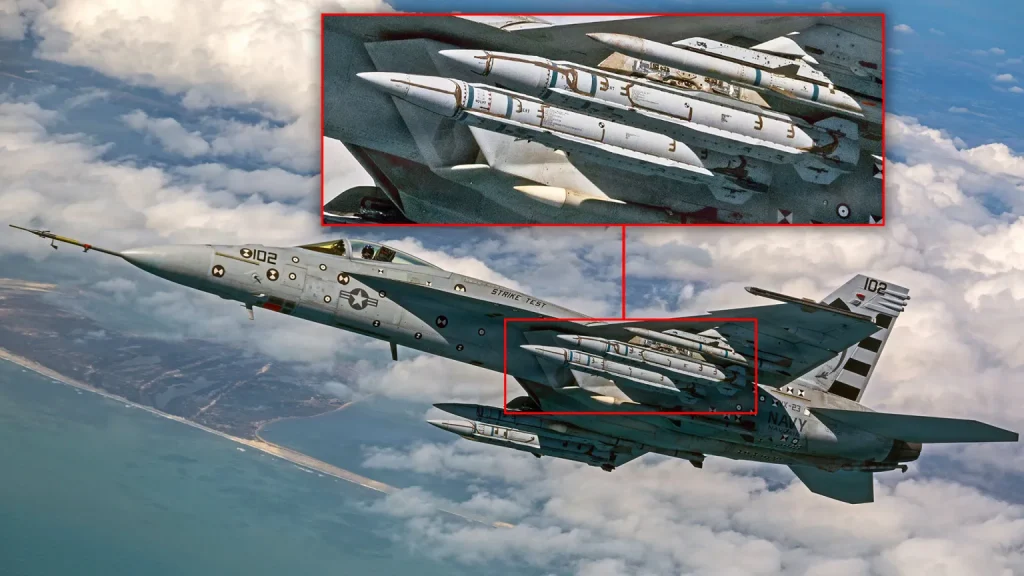
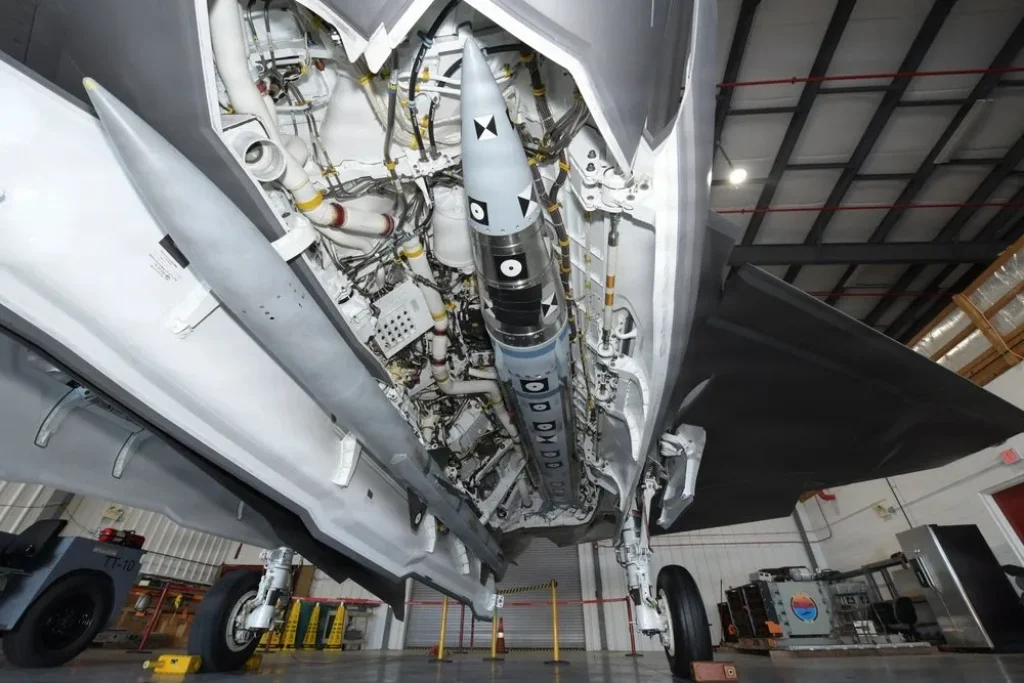
It has been designated AIM-424 LRAAM and given the name Malice. This is not an early computer rendering or a paper concept. An official photograph shows a VX-23 F/A-18E/F Super Hornet carrying four of the missiles, with the image dating back to April. Another official image shows an AIM-424 inside the weapons bay of an F-35C. The missile is already undergoing testing and is intended for the Super Hornet, F-35C, and the future F/A-XX carrier-based fighter.
Then the Navy released specifications that made the scale of the program much clearer. The AIM-424 is 4.11 meters long, has a diameter of 343 mm, a wingspan of 665 mm, and a launch weight of approximately 680 kilograms. Its officially stated range is more than 250 nautical miles, or over 463 kilometers. Raytheon is identified as the developer. The missile uses a high-explosive fragmentation warhead and solid-propellant propulsion.
This creates an apparently strange situation. The United States already has the AIM-120. It has the new AIM-260. It has the enormous AIM-174B. And now it has the AIM-424.
Why does one air force and naval aviation system need so many different long-range air-to-air missiles?
The answer becomes clearer when we stop looking at the missiles themselves and consider how air combat is changing.
This Is Definitely Not Another AMRAAM
The easiest way to understand the scale of the AIM-424 is to look at its weight. Later versions of the AIM-120 weigh roughly 150–160 kilograms. Malice weighs around 680 kilograms, making it more than four times heavier than a typical AMRAAM. That puts it closer to the weight class of a small aerial bomb.
Its dimensions are correspondingly substantial. At 4.11 meters long, the AIM-424 is considerably larger than the AIM-120, yet it has still been designed to fit inside the F-35C. This is an extremely important detail. The missile was not developed simply to hang beneath a Super Hornet. It was created with future low-observable carrier aviation in mind. The Navy explicitly states that it is intended for fourth-, fifth-, and sixth-generation aircraft.
But range is the most striking figure. An official specification of “more than 250 nautical miles” means at least 463 kilometers. The actual effective range of any air-to-air missile depends heavily on the altitude and speed of the launching aircraft, the target’s heading and maneuvers, the flight profile, and how much energy the missile must retain during the terminal phase. It would therefore be incorrect to interpret 463 kilometers as a guaranteed fighter kill range.
Nevertheless, the scale of the figure tells us what Malice is designed to do.
This is an air-to-air weapon operating at distances that, until recently, were more commonly associated with anti-ship and cruise missiles.
But the United States Already Has the AIM-260
This is where the story becomes particularly interesting. The AIM-260 Joint Advanced Tactical Missile was developed as the future successor to the AIM-120. The program began in 2017, partly in response to the emergence of new Chinese long-range air-to-air missiles. For years, almost everything about the JATM remained classified, with clear images of the missile only emerging relatively recently.
The key advantage of the AIM-260 appears to be a different design philosophy. Based on the information available, it remains broadly within the same size class as AMRAAM. That allows it to fit inside the existing weapons bays of the F-22 and F-35 without forcing each aircraft to sacrifice much of its missile capacity for a few enormous weapons.
In other words, the AIM-260 is intended to become the new standard long-range air-to-air missile. Where AMRAAM is used today, JATM is expected to gradually take its place.
Malice is intended for something else.
It is substantially larger, heavier, and capable of reaching much farther. Rather than directly replacing AMRAAM, the United States is effectively creating another tier of air-to-air weapon.
And Then There Is the Enormous AIM-174B
In the summer of 2024, another unexpected American missile appeared: the AIM-174B Gunslinger. Its origins are particularly unusual because it is essentially an air-launched version of the Navy’s SM-6 surface-to-air missile.
The SM-6 was designed for the vertical launch systems of U.S. warships and was therefore never constrained by the dimensions of conventional fighter weapons. As a result, the AIM-174B is a huge missile weighing around 850 kilograms, carried externally by the Super Hornet. It gives carrier aviation an entirely new level of air-to-air reach, but it has an obvious limitation: a weapon this large cannot simply be placed inside the weapons bay of an F-35C.
This is where the role of the AIM-424 begins to emerge.
Malice is substantially larger and more capable than conventional weapons such as the AIM-120 and AIM-260, but it is still compact enough for internal carriage aboard the F-35C. In an image released by the Navy, a test article can indeed be seen inside the Lightning II’s weapons bay.
A kind of ladder of size and range is therefore beginning to appear. The AIM-120 remains the current standard weapon. The AIM-260 is gradually taking its place. The AIM-424 becomes a specialized very-long-range missile compatible with low-observable aircraft, while the AIM-174B provides another heavy long-range option for external carriage by the Super Hornet.
This no longer looks like unnecessary duplication.
It looks like the creation of an entire family of weapons.
Why Shoot at Something 500 Kilometers Away?
It is easy to become distracted by the impressive range figure. At first glance, it seems that the Americans simply want a fighter capable of shooting down another fighter from nearly 500 kilometers away.
But that is probably not the missile’s most important purpose.
The most valuable airborne targets are often also the largest and least maneuverable: airborne early warning aircraft, aerial command posts, tankers, electronic and signals intelligence aircraft, maritime patrol aircraft, and potentially large combat drones in the future.
Modern air operations depend heavily on these platforms. A fighter may have an excellent radar, but an AEW&C aircraft allows an entire formation to see farther and coordinate its actions. Strike aircraft may have considerable combat radius, but without aerial tankers the effective reach of an air campaign can shrink dramatically. Electronic warfare and reconnaissance platforms help detect the enemy and disrupt its systems.
Destroying a single tanker or AEW&C aircraft could therefore have a much greater effect on an operation than destroying one fighter.
And that is where a missile with a range exceeding 460 kilometers begins to look very different.
China Has Made This Mission Particularly Important
For U.S. carrier aviation, the question of range has a very specific geography: the Pacific. China has been steadily developing its own long-range air-to-air missiles while simultaneously building a broader military system intended to keep U.S. carrier groups and their aircraft as far away from the Chinese coastline as possible.
One of the best-known Chinese weapons is the PL-15. Even more interesting is the much larger PL-17, which is generally associated with engaging high-value airborne targets at very long ranges.
The logic is straightforward. There is no need to immediately destroy an enemy fifth-generation fighter if it is possible instead to eliminate the aircraft refueling it, supplying it with radar information, or coordinating the wider operation.
The United States faces exactly the same problem from the opposite direction.
As a result, the competition in long-range air-to-air weapons is gradually becoming a race to attack the infrastructure of air warfare without having to approach it directly.
But How Do You Find a Target 500 Kilometers Away?
This is where the main technical problem appears.
The fighter’s own radar will not always be capable of independently detecting and maintaining a high-quality track on a target at a distance corresponding to the maximum range of the AIM-424. This is especially true if the target is not a large aircraft flying at high altitude.
But a modern missile does not necessarily have to receive all of its targeting information from the aircraft carrying it.
The target could be detected by an AEW&C aircraft, another fighter, a ship, or an uncrewed aircraft. In the future, targeting information could also come from various reconnaissance and space-based systems.
The launching aircraft becomes only one element in the kill chain. It fires the missile, after which updated target information can be transmitted through a datalink until the missile’s own seeker is able to acquire the target.
At that point, the weapon’s range is no longer constrained by the detection range of a particular F-35.
This is one of the defining features of future air combat: the aircraft that fires the missile does not necessarily have to be the aircraft that sees the target.
The F-35 Is Particularly Interesting Here
The photograph of the AIM-424 inside an F-35C may ultimately be more important than the image of a Super Hornet carrying four missiles.
A low-observable aircraft can approach an adversary much more closely while remaining difficult to detect. But it does not necessarily have to switch on its own radar at full power and advertise its position.
Consider a theoretical scenario. A remote sensor detects a high-value airborne target. An F-35C receives the target data through the network, approaches the launch area without using its own radar in an active mode, and fires an AIM-424. After launch, the missile receives updated target information from external sources until its own seeker takes over during the terminal phase.
It is in this kind of architecture that the Malice’s long range becomes most useful.
This is not simply “a very long missile for a very long shot.”
It is an element of a distributed air-combat system.
Why Is the Missile So Heavy?
Physics is difficult to cheat. Sending a guided missile hundreds of kilometers while preserving enough energy to intercept a target at the end of the trajectory requires a substantial amount of propellant.
Available information confirms that the AIM-424 uses solid-propellant propulsion. Early reports also pointed to a two-stage architecture, although the Navy’s published specifications do not disclose the detailed propulsion arrangement. For now, it is therefore important to distinguish confirmed characteristics from earlier reporting.
The basic logic of a multi-stage air-to-air missile would make sense. An initial stage could rapidly accelerate the weapon and send it to high altitude, where atmospheric drag is significantly lower. Once its propellant is exhausted, unnecessary mass could be discarded while the next stage continues the flight. High speed combined with a lofted trajectory can dramatically increase range.
The Pentagon is already studying even more radical concepts, including air-to-air weapons with prospective ranges of as much as 1,000 miles, or roughly 1,600 kilometers. AIM-424 is nowhere near that figure, but it demonstrates the direction in which development is moving.
463 Kilometers Does Not Mean a Fighter Kill at 463 Kilometers
This distinction is important. Maximum missile range and effective engagement range against a particular target are very different things.
If a large AEW&C aircraft is flying high, relatively slowly, and without performing aggressive maneuvers, conditions for a long-range interception are favorable. If a fighter detects the launch, turns away, descends, and begins maneuvering aggressively, the missile has to spend a considerable amount of energy correcting its trajectory and pursuing the target.
The official figure of “more than 250 nautical miles” should therefore not be interpreted as the guaranteed destruction radius against any aircraft.
It is better understood as an indication of the missile’s energy potential.
And the AIM-424 clearly has a great deal of it.
Why Not Just Keep the AIM-174B?
Because range is only one characteristic of an air-launched weapon.
The AIM-174B is enormous. It works well with the Super Hornet, which can carry it externally, but it is poorly suited to the philosophy of a low-observable aircraft. Hanging such a missile beneath an F-35 would sacrifice a substantial part of the aircraft’s stealth advantage.
Malice is considerably more compact.
It fits inside the F-35C.
And in the future, it is also intended for the F/A-XX, the Navy’s next-generation carrier-based fighter.
This makes the Navy’s logic much clearer. The AIM-174B provided a relatively rapid way to obtain an extremely long-range air-to-air weapon based on an existing naval missile. The AIM-424, by contrast, appears to be a weapon designed from the beginning around the future architecture of naval aviation.
One weapon addresses an immediate requirement.
The other is being developed for the next generation.
The United States Is Building an Entire Ladder of Air-to-Air Missiles
Once the secrecy and still-unknown characteristics are set aside, the emerging American system begins to look fairly logical.
The AIM-9X Sidewinder remains the compact weapon for short-range air combat. The AIM-120 AMRAAM is today’s standard medium- and long-range missile. The AIM-260 JATM is intended to become its much more capable successor while preserving the ability to carry a substantial missile load inside stealth fighters.
Above them sits the AIM-424 Malice — a heavy very-long-range air-to-air missile weighing around 680 kilograms and officially capable of reaching more than 463 kilometers. Alongside it is the AIM-174B Gunslinger, an even larger weapon derived from the SM-6 and intended primarily for external carriage.
The Pentagon is therefore effectively abandoning the idea that one universal air-to-air missile should perform every mission.
Instead, it is creating a toolbox.
Each weapon is optimized for a different range, aircraft, and target set.
The Most Important Detail Is That Malice Fits Inside the F-35C
This is perhaps the central point of the entire story.
Building a missile weighing nearly 700 kilograms and capable of flying more than 460 kilometers is difficult, but there is nothing fundamentally revolutionary about making a very large long-range missile. Add a large body, plenty of propellant, and hang it beneath an aircraft. To some extent, that is exactly how the AIM-174B solution emerged.
The much harder task is to make such a weapon compact enough to fit inside a low-observable fighter.
And the Navy has already shown the AIM-424 inside the F-35C.
This means U.S. carrier aviation could combine two characteristics that previously sat rather uncomfortably together: a low-observable launch platform and an extremely long-range air-to-air weapon.
An F-35C would not necessarily have to approach an AEW&C aircraft or tanker to normal AMRAAM engagement distances. It could potentially remain much farther away, receive targeting information from other elements of the network, and launch a heavy missile from its internal bay without sacrificing its stealth configuration.
The future F/A-XX can be designed from the outset with weapons of this class already in mind.
Air Combat Is Gradually Ceasing to Be a Duel Between Fighters
This is why the AIM-424 is much more interesting than simply another American missile with a dramatic name.
For decades, air combat has generally been imagined as a contest between two fighters. Who detects the opponent first? Who launches first? Who maneuvers better? Whose missile has the longer reach?
The emerging picture is far more complicated.
One aircraft may detect the target. Another sensor may track it. A third platform may make the engagement decision. A fourth may launch the missile. And the target itself could be hundreds of kilometers away from the aircraft that actually fired the weapon.
In such a system, missile range is no longer simply a characteristic of the missile.
It defines the dimensions of the entire combat network.
And the AIM-424 shows where that network is heading.
Today, the officially stated range is more than 463 kilometers. The Pentagon is already studying concepts for weapons capable of reaching around 1,600 kilometers. There is an enormous technological gap between those two figures, and there is no guarantee that such extreme concepts will ultimately prove practical.
But the direction is already visible.
AMRAAM was designed for a world in which a fighter needed to shoot down another fighter first.
Malice is being developed for a world in which something else may matter much more: destroying the aircraft without which a dozen enemy fighters cannot fight effectively at all.
And that is why an air-to-air missile weighing almost 700 kilograms suddenly no longer looks excessive.
based on https://www.twz.com/air/aim-424-malice-very-long-range-air-to-air-missile-emerges-from-the-shadows