Three Times Lighter Than Steel – Non-melting aluminum based on the reinforced concrete principle

Continuing the topic of new aerospace materials, I’d like to bring to your attention a new Canadian development in this field.
Engineers from the University of Toronto (U of T Engineering) have unveiled a material that appears capable of solving one of the oldest problems in aircraft manufacturing. They have succeeded in creating a lightweight and incredibly strong alloy that retains its properties even when subjected to extreme heat.
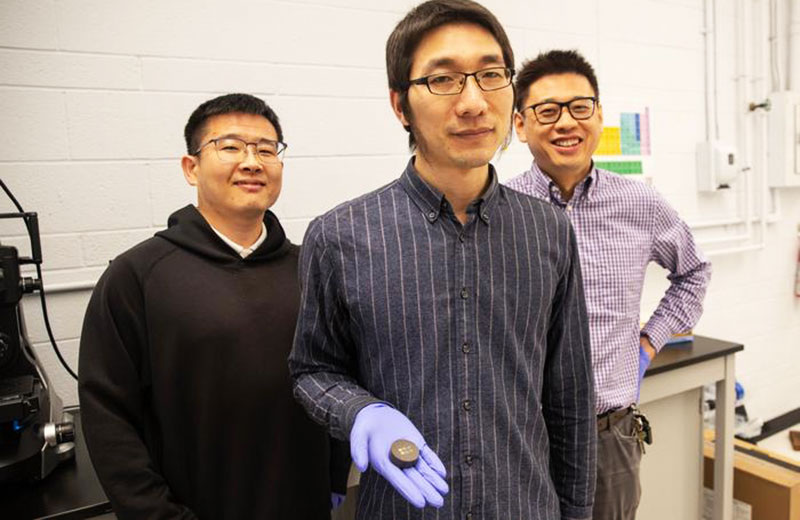
The secret to its success lies in a structure modeled after ordinary reinforced concrete but replicated on a microscopic scale. Details of the technology and test results have already been published in the scientific journal *Nature Communications*.
The «Reinforced Concrete» Principle
We are talking about a new metal matrix composite—a class of materials in which a metal matrix is reinforced by the incorporation of another substance.
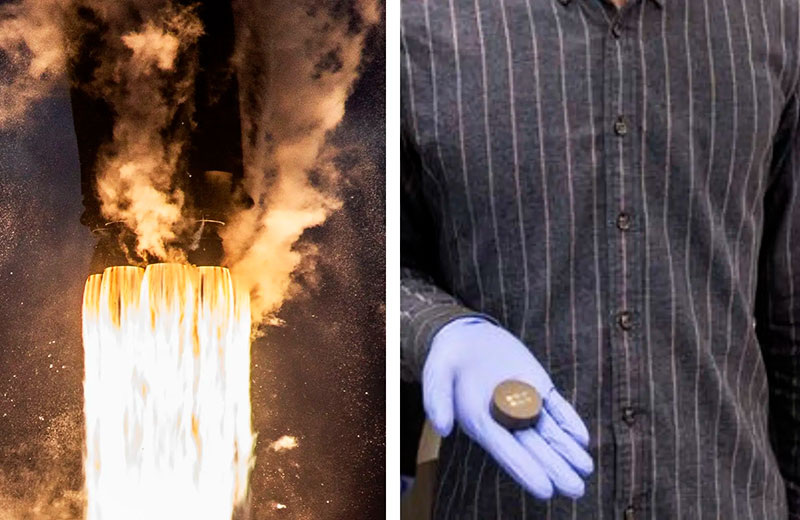
The Canadian invention can easily withstand temperatures of up to 500 °C (932 °F). According to Professor Yu Zhou, who led the research, the idea was literally right under their noses—in the construction industry.
“We looked at how steel rebar holds concrete together in skyscrapers and decided to replicate that trick, but with metals,” says Zhou. “This used to seem impossible, but with the advent of additive technologies, such as 3D metal printing, we’ve been able to let our imaginations run wild. The resulting composite has properties that we previously thought were the stuff of science fiction.”
While heavy, reliable steel still reigns supreme in the automotive industry, the aviation industry swears by aluminum. The reason is simple: weight. In the aerospace industry, the battle is literally over every gram—the lighter the aircraft, the less fuel is needed to get it airborne. This is the classic concept of “lightweight design.”
Overcoming «Thermal Weakness»
However, aluminum has its own Achilles’ heel. Chenwei Shao, the lead author of the research paper, explains the crux of the problem simply: this metal cannot withstand heat.
“Traditional aluminum parts are vulnerable to high temperatures,” the scientist explains. “The more you heat them, the softer they become, which makes them completely unsuitable for components operating under load.”
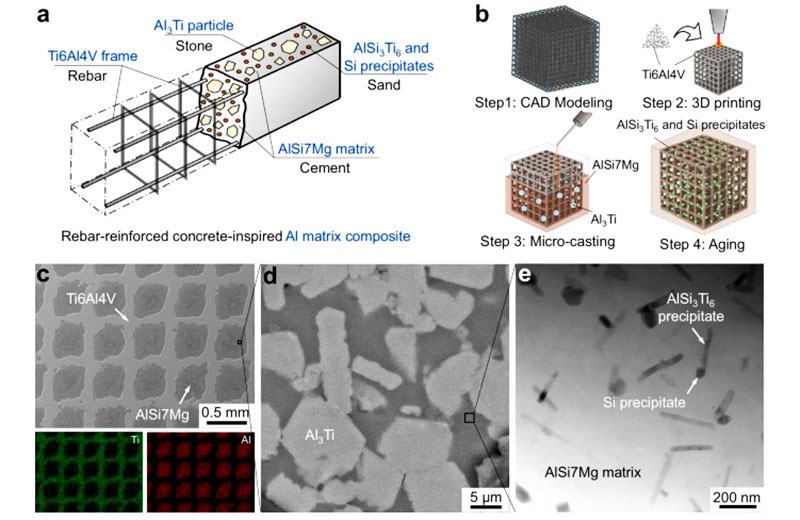
To overcome this physical limitation, a team of engineers designed a composite material whose structure is virtually identical to that of reinforced concrete:
-
First, a rigid titanium alloy frame is printed on a 3D printer using the laser sintering process. It is an extremely fine lattice structure in which the thickness of the struts does not exceed 0.2 mm.
-
The voids are then filled with a molten mixture of aluminum, magnesium, and silicon. This is done using a microcasting technique.
-
To achieve the desired final hardness, microscopic micrometer-sized particles of aluminum oxide and nanoprecipitates are added to the alloy.
Record-breaking performance of the material
When the material was sent to the test bench, the results surprised even its creators.
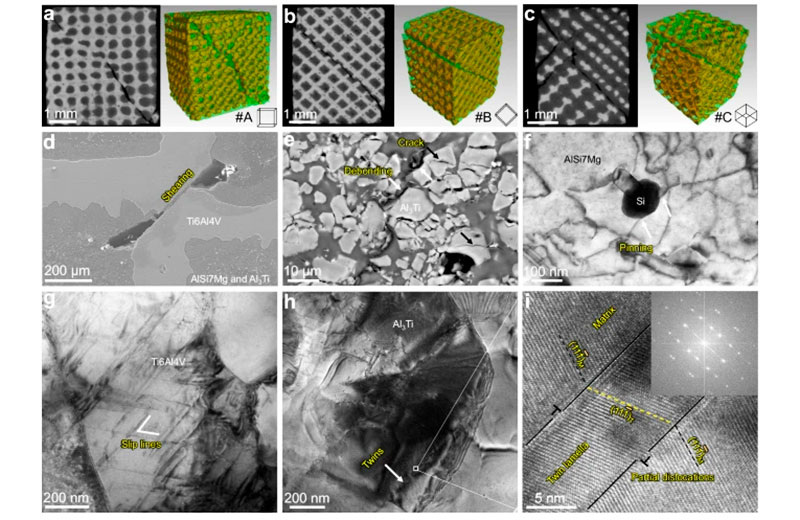
At room temperature, the yield strength—the point at which a part begins to deform irreversibly—reached an impressive 700 megapascals (MPa). To put this into perspective: conventional aluminum alloys yield a modest 100–150 MPa under such conditions.
But the composite really showed its true colors in the furnace. Heated to 500 °C, it maintained a strength of 300–400 MPa.
“Under such conditions, ordinary aluminum turns into putty with a strength of about 5 MPa,” Shao explains. “Our material performs on par with medium-strength steel, but weighs one-third as much.”
Interestingly, computer simulations have revealed an unexpected mechanism: this phenomenal heat resistance is due to what is known as “enhanced twinning” of the crystal lattice.
This process, which increases strength, is triggered specifically at extreme temperatures, as if the material were getting a second wind.
Source: https://dzen.ru/a/aSQxW2MMN0V389JN