The Soviet Union's Alternative Missile Program of the 1940s–1950s (v2.0)

I’ve already written a post on this topic and decided to revise it. In this post, I’ll cover the main stages and explain each one and why. Overall, the goal is to describe how the early domestic rocket program could have developed in a more structured and, on the whole, more effective way.
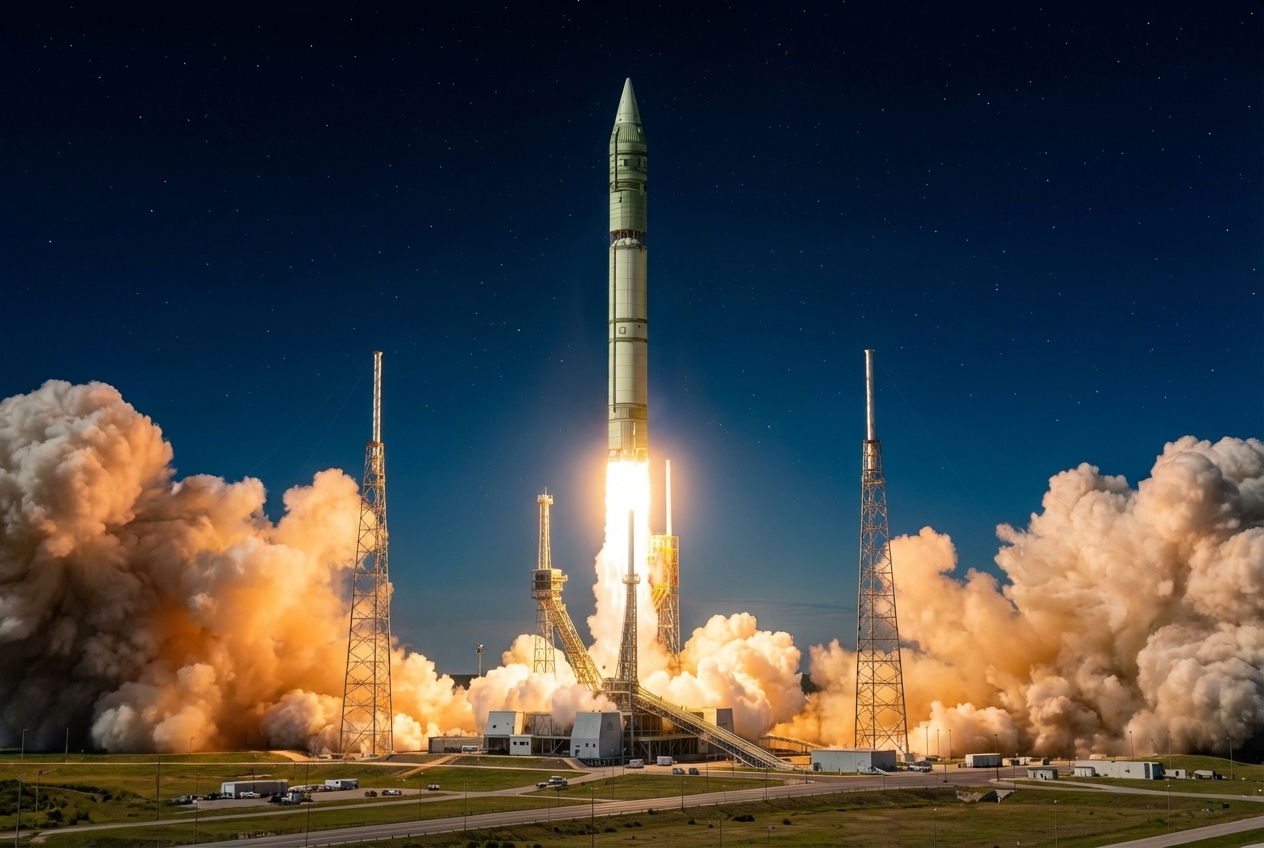
Starting Conditions
As a starting point, I’ll choose the 1935 “Popadun” scenario in Tukhachevsky (the most convenient option); I’ll also assume a more successful course of the Great Patriotic War and a victory, say, by May 9, 1944. The world is largely the same, but Germany and Austria are entirely within the Soviet sphere of influence; the Cold War begins earlier but without nuclear weapons. Through its intelligence services and the earlier end of the war, the USSR delays the Manhattan Project—let’s say by a year. Within the USSR itself, nuclear weapons are developed and tested roughly simultaneously with the U.S. in late 1946.
The Development of Basis, 1935–1944
Overall, there was no need to develop ballistic missiles before World War II. It is very difficult, expensive, and, most importantly, pointless. The main foundational developments and expertise could be borrowed from the Germans at no cost. Nevertheless, it is extremely important to lay the groundwork.
- First, Korolev and his team must, of course, be protected from reprisals for sabotage and directed toward the development of powder-based rockets, and later (in 1939–44) asphalt-based composite liquid-propellant rockets for heavier rockets. This experience would later prove useful in the development of solid-fuel ballistic missiles.
- We need to begin work on ultra-high-quality bearings for gyroscopes and centrifuges. This is an extremely specialized field that requires experience and a culture of manufacturing—both of which were sorely lacking in the USSR of the 1930s. This is a long and painstaking process that must be started as soon as possible.
- To accelerate the transition from cryogenic to high-boiling-point components, it is necessary to develop methods for synthesizing NDMG, purifying AT, creating additives, and developing more durable materials. Overall, this will not require significant investment but will take time.
- The Development of Semiconductors. For a long time, semiconductors played a secondary role, especially in the USSR. Nevertheless, with knowledge of the zone melting method, it was possible to create functional germanium transistors as early as the 1930s, though mass production would most likely not be achieved until after the war. Based on these, it would be possible to create more efficient missile control systems and the first computers, moving beyond vacuum tubes and relays (as well as radar and radio). Later, in the 1950s, the transition to silicon would be necessary.
The Appropriation of the German “Legacy,” 1944–1946
After the war, using German personnel and German production facilities, we must resume production of the V-2 and establish two new design bureaus.
The mixed-nationality Design Bureau No. 1, led by Korolev, was responsible for liquid-fuel rocket development, while the purely Soviet Design Bureau No. 2, led by Yuri Pobedonostsev, was responsible for solid-fuel rocket development.
The initial task of Design Bureau No. 1 was to master the technology for producing the V-2 directly at German facilities, since in AI, all of Germany falls within the Soviet occupation zone. However, as of early 1944, the V-2 was still more of a prototype, and given the setbacks on the Eastern Front, the situation with its development was likely even worse than that of the Re-1. Overall, there is no point in adopting it for service, so the R-1 in AI remains an experimental ballistic/geophysical missile.
At the same time, Design Bureau No. 2 is working on improving the TTRD and developing boosters for anti-aircraft and meteorological rockets.
1946-1953
In 1946, OKB-1 began work on developing a completely new-generation medium-range ballistic missile (R-3) using long-life components and semiconductor electronics, while production of NDMG and hydrazine was launched simultaneously.
At the same time, safety procedures were developed for working with toxic fuel components and for handling rockets in general.
A 50/50 mixture of NDMG and hydrazine (Aerosine-50) was selected as the propellant; it provided a slightly higher propellant density and specific impulse compared to pure NDMG. Diazotetroxide (Amyl) was selected as the oxidizer. This fuel pair was chosen primarily because it allows the rocket to be stored continuously in a fueled state for years—which is practically impossible with AK—and also because of its maximum energy performance.
The main drawback of this fuel pair was its toxicity (which is inevitable). Also, unlike NDMG/kerosene paired with AK-27, this fuel pair requires temperature control due to its narrow temperature range. The storage temperature range for Aerozin is -8° to +70°; for AT, it is -11° to +22°, respectively.
In that same year, 1946, Design Bureau No. 456 was established under Glushkov’s leadership; in cooperation with German specialists, he was tasked with developing a new engine for the R-3 using high-boiling-point components. The engine was intended to be extremely advanced; in which the main fuel components were also used in the gas generator (instead of hydrogen peroxide); the combustion chamber design was simplified; and heat resistance was increased due to the higher combustion temperature. Thrust increased by a factor of 1.5 compared to the RD-100. In 1948, the first engine tests began, focusing on verifying combustion stability and the reliability of the engine’s components.
To test the new rocket, a new launch complex was built between 1946 and 1949, not in Germany but in Kazakhstan (Baikonur).
The first test launch of the R-3 took place in 1950, and by 1952 it had been adopted for service with a nuclear warhead.
In addition, in 1952, a naval variant of the R-3FM was developed for submarines—first diesel-electric and later nuclear-powered. It was adopted for service in 1953.
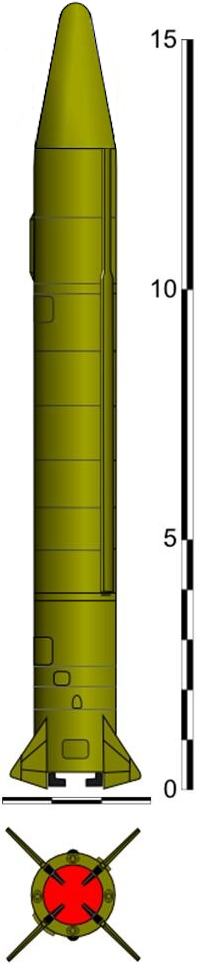
Design of the R-3 Rocket
The R-3 featured aluminum fuel tanks, semiconductor electronics, and an aerodynamically unstable configuration. Gas-filled control surfaces were used for roll and pitch control, while aerodynamic control surfaces were used for roll; radio correction was employed to improve accuracy. Overall, the missile was designed for deployment from any base—ground, silo, submarine, rail, or wheeled mobile platforms based on a variant of the MAZ-535.
TTX R-3:
- Starting weight: 23 metric tons;
- Dry Weight: 2 metric tons;
- Range: 1,400 km;
- Warhead: weight 1,500 kg; initially a 40-kiloton fission warhead, then a 2.3-megaton thermonuclear warhead;
- Engine: RD-201 with 37 metric tons of thrust, specific impulse 265/295 sec;
- Fuel mixture: Aerosine+AT;
***
In parallel with the development of the first second-generation liquid-fueled BRSD at Design Bureau No. 2, work continued on new types of solid propellant based on aluminum ammonium perchlorate and polyurethane, with the propellant cast directly into the engine, bench testing, and other procedures.
1953-1960
In 1953, upon completion of work on the R-3, Design Bureau No. 1 took on a new task: to develop the R-5 ICBM, capable of delivering a 3-metric-ton payload over a range of 8,000 km for silo- and rail-based deployment; The rocket was not built from scratch but was largely based on the R-3. To maximize compactness and efficiency, a two-stage configuration with transverse separation was chosen; to improve efficiency, gas rudders were abandoned in favor of a single-plane gimbal suspension. The first stage used four RD-202 (an upgraded RD-201), and the second stage used the RD-203 (a four-chamber RD-202 adapted for vacuum, with a configuration similar to that of the RD-111).
By borrowing components from the R-3, the rocket was developed in a short period of time, and the first launch took place as early as August 1956 (though it failed because the second stage did not ignite). A successful launch followed in December. In April 1957, the first artificial Earth satellite was launched to coincide with the International Geophysical Year; the 500-kg satellite carried a large amount of scientific equipment and solar panels for power generation. It detected radiation belts; at the same time, the rocket was adopted into service ahead of schedule and was also displayed at the military parade on May 9, 1957. Later, based on the R-5, the three-stage “Kosmos” launch vehicle was developed, featuring an enlarged second stage without a conical section, a third stage, and a booster. It was capable of launching 3 metric tons to low Earth orbit and 0.8 metric tons on a lunar trajectory. Later, it served as the launch vehicle for the first artificial satellites and the first human spaceflight.
The R-5 became the Soviet Union’s first and only liquid-fueled ICBM; after its development was completed, Design Bureau No. 1 shifted its focus to peaceful launch vehicles. Throughout the 1960s, it served as the backbone of the Soviet strategic nuclear forces. Later, the focus shifted to the next generation of heavy solid-fuel ICBMs.
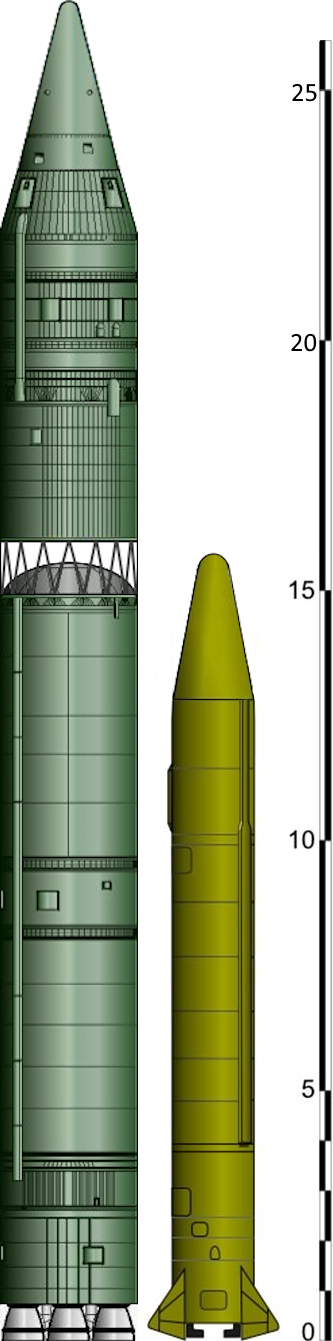
TTX P-5:
- Starting weight: 100 metric tons;
- Range: 8,000 km;
- Warhead: weight 3 metric tons, thermonuclear, 5 metric tons;
- First-stage engine: 4 RD-202 engines with 40 metric tons of thrust, UI 272/303 sec;
- Second-stage engine: 1 RD-203, 48 metric tons, burn time 320 seconds;
- Fuel mixture: Aerosine+AT;
Technical Specifications of the “Kosmos” Launch Vehicle
- Starting weight: 120 metric tons;
- Range: 8,000 km;
- Payload: 3 metric tons at LEO, 0.8 metric tons on the trajectory to the Moon;
- First-stage engine: 4 RD-202 engines, each with 40 metric tons of thrust, UI 272/303 sec;
- Second-stage engine: 1 RD-203 with 48 metric tons of thrust and a burn time of 320 seconds;
- Third-stage engine: 1 RD-204 (single-chamber RD-203) with 12 metric tons of thrust and a specific impulse of 320 seconds;
- Fuel mixture: Aerosine+AT;
***
Meanwhile, Design Bureau No. 2 was working on the world’s first solid-fuel intercontinental ballistic missile to replace the R-3.
Building on earlier developments, a solid-fuel BRSD was created; its main advantages were ease of operation and the absence of any risk of leakage of toxic or explosive fuel components (which is particularly critical for submarines). Despite the apparent simplicity of TTRDs, they are quite complex to develop. As a result, development was delayed, and the first test launch did not take place until 1958; the system was not adopted for service until 1960.
Building on the experience gained from the development of the RT-1, the first submarine-launched intercontinental ballistic missiles (ICBMs) and heavy ICBMs to replace the R-5 were later developed.
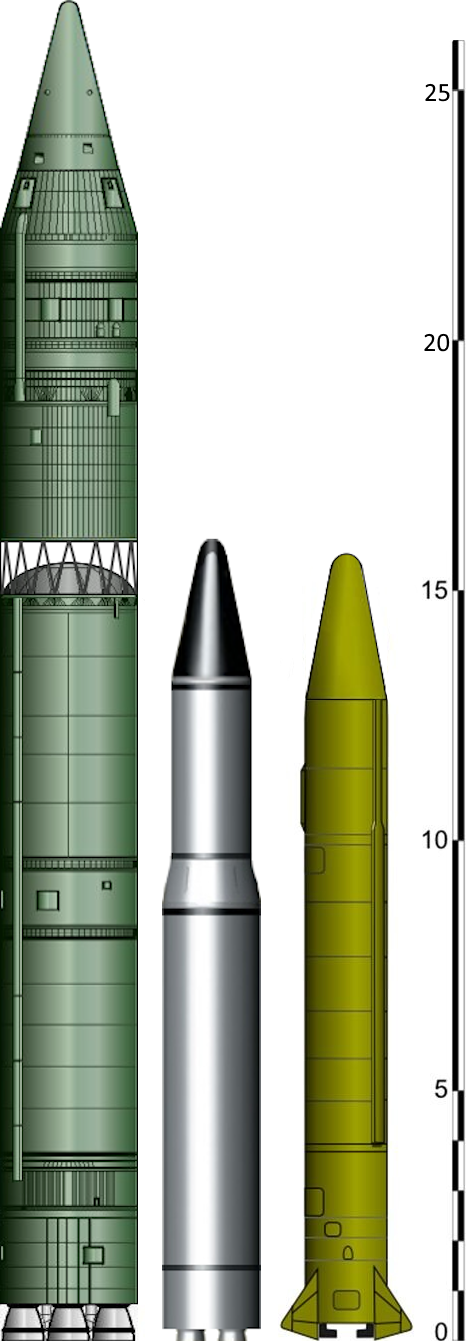
TTX RT-1:
- Starting weight: 30 metric tons;
- Range: 2,000 km;
- Warhead: weight 1,500 kg, thermonuclear, 2.3 metric tons;
- First-stage thrust: 60 metric tons;
- Fuel; A composite based on ammonium perchlorate and aluminum;