Russia Is Already Building Its Own Rassvet Satellite System. Why Are a Few Dozen Satellites Still Not Enough?

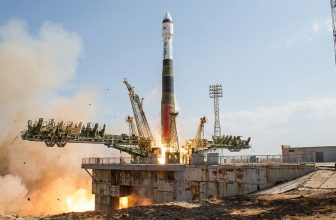
On March 23, 2026, the first 16 production satellites of Russia’s new low-Earth-orbit communications system, Rassvet, were launched from Plesetsk. A second batch of another 16 spacecraft followed in July. This was no longer an experiment: the earlier Rassvet-1 and Rassvet-2 missions consisted of just three satellites each and were primarily intended to test key technologies. Bureau 1440 has now begun deploying an operational orbital constellation designed to provide broadband internet access at speeds of up to 1 Gbps, with claimed latency of up to 70 milliseconds.
Problems appeared almost immediately. One spacecraft from the first batch failed to raise its orbit properly and burned up in the atmosphere on June 6. Two satellites from the second launch are now also under scrutiny: by late August, their orbits had dropped to roughly 290 kilometers, with perigees of around 277 kilometers, and no obvious orbit-raising maneuvers had been observed. Unless that changes, atmospheric drag could eventually lead to their loss.
At first glance, the obvious conclusion seems to be that Russia’s answer to Starlink is already losing satellites before the service has even entered full operation. But this is where the story becomes much more interesting. Losing one, two, or even several spacecraft does not by itself say much about the viability of a low-Earth-orbit system. Constellations of this type are designed from the outset around redundancy, individual satellite failures, and continuous replacement.
The real challenge is far greater.
To build your own Starlink, it is not enough to learn how to manufacture satellites. You have to learn how to manufacture an entire satellite system almost like an industrial assembly line.
Rassvet Is the System; Rassvet-3 Is the Satellite Generation
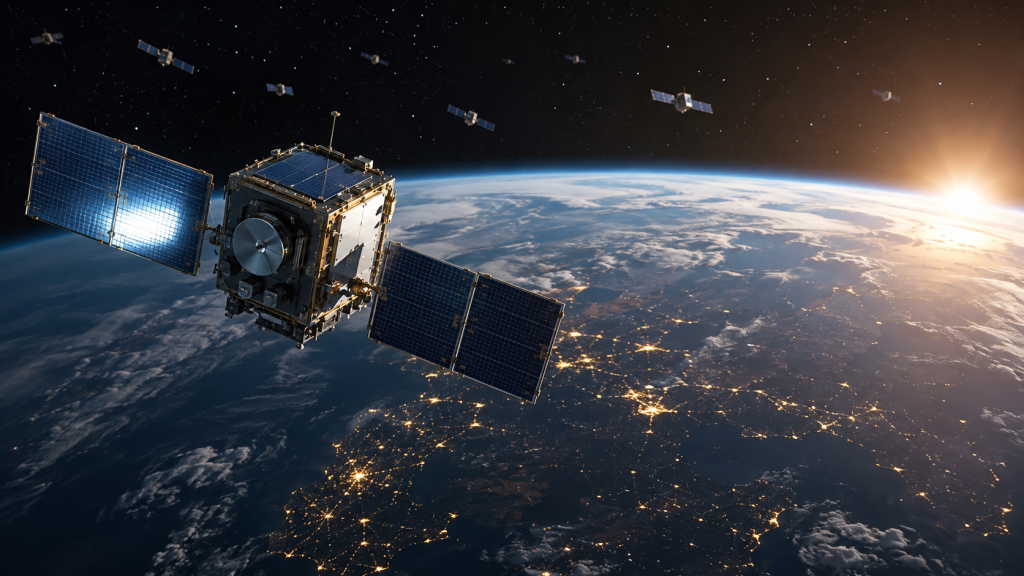
First, it is worth clarifying the terminology because the names can easily become confusing. Rassvet is the low-Earth-orbit broadband communications system being developed by Russian aerospace company Bureau 1440. The first experimental missions were called Rassvet-1 and Rassvet-2. Three spacecraft were launched in June 2023 and another three in May 2024. They were used to test the key technologies required for the future network.
In 2024, for example, the company reported testing inter-satellite laser communications. More than 200 GB of data were transmitted between spacecraft at speeds of up to 10 Gbps. A communications session was also conducted between a satellite and the company’s own user terminal using 5G NTN technology. In other words, long before mass deployment began, Bureau 1440 was testing not merely individual spacecraft but the core components of the future network.
The 2026 launches represent a different stage. These are the first spacecraft of the operational constellation, known as Rassvet-3. The first batch contained 16 satellites, and the second another 16. The project has therefore moved beyond proving that the concept works and into the actual construction of the network.
And this creates the first paradox.
Thirty-two satellites sound like a substantial space constellation.
For a Starlink-type system, they are almost nothing.
Because the Satellite Does Not Stay Above You
The defining feature of low-Earth-orbit satellite communications is both its greatest advantage and its greatest problem. The spacecraft do not sit in geostationary orbit 35,786 kilometers above Earth. Instead, they operate only a few hundred kilometers above the surface. Signals therefore travel much shorter distances, making significantly lower latency possible.
But such a satellite is constantly moving relative to the user.
It rises above the horizon, crosses the sky, and soon disappears again. The user terminal must hand the connection over to another spacecraft, then another, and another.
With too few satellites, connectivity exists only during specific windows.
Add more satellites, and the gaps become shorter.
Only when there are enough spacecraft distributed across enough orbital planes does the user receive something approaching continuous connectivity.
Low-Earth-orbit broadband is therefore fundamentally a numbers game.
One excellent satellite is almost useless.
What matters is the network.
Even the Operational Orbit Still Raises Questions
The current configuration of Rassvet is also interesting. Bureau 1440’s official material lists an altitude of approximately 800 kilometers for the future system. However, the satellites are not delivered directly to that altitude. After separating from the launch vehicle, they are expected to raise their own orbits using onboard propulsion.
The first batch was launched in March. By early August, most surviving spacecraft were operating at altitudes of roughly 500–540 kilometers. One satellite had already been lost, while several others remained significantly below the main group.
The second batch entered initial orbits of roughly 289–326 kilometers after its July launch. The spacecraft then began to separate in altitude: some activated their propulsion systems and started climbing, while several continued descending. By August 5, clear orbit-raising maneuvers had been observed from 11 satellites in the second group.
This is why the original news should be interpreted carefully. Two low-flying satellites may indeed be lost. But that does not mean the entire second batch has failed. On the contrary, most of the spacecraft have begun carrying out orbital maneuvers.
The more interesting point is that even the first batch remained significantly below the publicly stated 800-kilometer altitude months after launch. The company has not publicly explained every detail of this deployment profile. It would therefore be premature to conclude that the entire constellation has a technical problem, but it would be equally premature to say that the final operational configuration has already been achieved.
One Lost Satellite: Accident or Statistics?
In traditional spaceflight, losing a spacecraft worth tens or hundreds of millions of dollars can be a major event. It may have taken years to design, only one example may have been built, and after launch there is no replacement waiting nearby.
Megaconstellations operate differently.
The individual satellite gradually changes from a unique spacecraft into a serially produced piece of infrastructure. It must be cheap enough to manufacture in quantity, standardized enough to build in large batches, and replaceable enough that the loss of one unit has almost no effect on the network.
This is why one Rassvet-3 burning up in the atmosphere is not, by itself, the most important indicator of the program’s health.
The question needs to be asked differently:
Can the system receive new satellites faster than it loses old ones?
If the answer is yes, individual failures eventually become ordinary operational statistics.
If the answer is no, every lost spacecraft delays the arrival of continuous coverage.
This Is Where the Real Difficulty Begins
Bureau 1440 lists virtually all the major components required for the future network: its own satellites, inter-satellite laser terminals, user terminals, and ground gateway stations. The company says its spacecraft will effectively function as 5G base stations in orbit, while laser links will allow data to move between satellites and reduce dependence on large numbers of terrestrial gateways.
That is already much more complicated than simply manufacturing a satellite.
The company simultaneously needs spacecraft, phased-array antennas, laser terminals, plasma propulsion systems, solar arrays, constellation-management software, user terminals, and terrestrial infrastructure.
Then all of it has to be mass-produced.
And this is the real dividing line between an experimental satellite network and a genuine Starlink competitor.
Starlink’s Revolution Was Primarily About Scale
SpaceX did not invent the basic idea of low-Earth-orbit satellite communications. Similar concepts had existed for decades. Neither phased-array antennas nor electric propulsion nor satellite user terminals were fundamentally new technologies.
The revolution was scale.
SpaceX transformed the satellite from an almost handcrafted spacecraft into something much closer to a mass-produced industrial product. Satellites are manufactured in batches, launched dozens at a time, gradually replaced by newer generations, and failed spacecraft are simply removed from the network.
This is why comparisons between every new LEO broadband system and Starlink can be misleading.
The important comparison is not satellite versus satellite.
It is the industrial machinery behind those satellites.
Rassvet Now Has to Make an Enormous Leap
Sixteen spacecraft were launched in March. Another 16 followed in the summer. Even if we ignore the satellite already lost and the two potentially in trouble, that still amounts to only a few dozen spacecraft.
The plans are on an entirely different scale.
According to Russian business newspaper Kommersant, the constellation is expected to reach 292 satellites, including orbital reserves, by 2030. Earlier reports indicated that more than 250 spacecraft would be required to provide continuous global coverage. Commercial services are expected to begin earlier, around 2027–2028, initially with an emphasis on corporate customers.
That means the two launches conducted so far represent only the beginning of a much longer campaign.
If the current configuration of roughly 16 spacecraft per launch were maintained, deploying nearly 300 satellites would require many additional missions. Some launch capacity would also eventually have to be dedicated to replacing spacecraft that fail or reach the end of their operational lives.
So it is not enough to manufacture hundreds of satellites.
There must also be a steady supply of rockets.
This Is Why SpaceX Having Its Own Rocket Matters So Much
One of Starlink’s greatest advantages is not in orbit at all.
It sits on the launch pad.
SpaceX both manufactures the satellites and operates the launch system that places them into orbit. The company can coordinate satellite production with the Falcon 9 launch cadence and effectively treat rockets as another part of the same industrial supply chain.
Bureau 1440 operates under a different model. It builds the satellites, while Soyuz-2.1b launch vehicles deliver them into orbit. This is a completely normal arrangement in the global space industry and is not inherently a disadvantage.
The difficulty appears when the project reaches megaconstellation scale.
It is no longer enough to conduct several space launches per year. Rockets, launch slots, and manufacturing capacity must be continuously allocated to replenishing one specific network.
If a bottleneck appears anywhere in that chain, deployment of the entire constellation slows down.
Even Launching Satellite Number 292 Will Not Finish the Job
Suppose the planned constellation is successfully completed by the end of the decade.
Production still cannot stop.
Low Earth orbit has one inconvenient characteristic: the extremely thin remnants of Earth’s atmosphere gradually slow satellites down. Spacecraft therefore have to perform periodic orbit corrections. This is exactly what the Rassvet satellites are doing after separating from their launch vehicle.
If a satellite loses its ability to maneuver, its orbit begins to decay.
The lower it gets, the denser the atmosphere becomes.
The denser the atmosphere, the stronger the drag.
This creates a feedback loop that eventually ends with atmospheric reentry.
But even perfectly functioning spacecraft do not last forever. Solar arrays and batteries degrade, electronics age, propulsion consumables are exhausted, and more capable generations of satellites eventually appear.
The constellation therefore has to be continuously renewed.
In other words, a factory cannot be built merely to manufacture 292 spacecraft once.
It has to keep producing satellites for as long as the system exists.
This Is the Real Test of the Project
The current problems affecting two or three Rassvet spacecraft are therefore interesting, but secondary.
If Bureau 1440 can mass-produce hundreds of satellites within the next several years, regularly launch new batches, manufacture user terminals at scale, and maintain a functioning network, today’s losses will become little more than a footnote in the history of the program.
If the necessary industrial tempo cannot be achieved, even a perfectly reliable satellite will not solve the problem.
That is why Rassvet has now reached a particularly interesting stage of its development.
The project can no longer be dismissed as a presentation or a collection of prototypes. Two experimental missions have flown, laser inter-satellite communications have been demonstrated, user terminals have been tested, and deployment of the operational constellation began in 2026. One spacecraft has been lost, two more may be in trouble, but most of the first production satellites continue operating and maneuvering in orbit.
So the first question — “Can Russia build such a satellite?” — is gradually receiving a positive answer.
Now comes the second question.
And it is much harder.
Building the Satellite Was Only the Beginning
This is the central paradox of the Rassvet story.
You can build a modern spacecraft. You can equip it with laser inter-satellite communications. You can develop your own user terminal. You can launch 16 satellites on a single rocket. You can repeat the launch a few months later.
But none of this alone creates a full-scale satellite system.
That requires hundreds of spacecraft, dozens of launches, continuously operating production lines, mass-produced user terminals, terrestrial infrastructure, automated network management, and constant replenishment of the orbital constellation.
This is why losing several Rassvet-3 satellites does not prove very much yet. Individual failures are inevitable in a system of this kind.
The real test will begin when the constellation has to grow not by dozens of spacecraft, but by hundreds.
The main question is no longer whether Bureau 1440 can build another good satellite. The question is whether Russia’s space industry can turn satellite manufacturing into the continuous production of an entire satellite network.
And the answer to that question will determine whether Rassvet becomes a full-scale low-Earth-orbit communications system — or remains a technologically interesting but ultimately too small constellation.