An Unexpected “Make-Shift Air Defense” System for the Russian Army. What If We Combined R-77 Air-to-Air Missiles with an “Ural” Truck?

In 2024, the practice of employing air defense systems saw the emergence of a concept for adapting air-to-air missiles for ground-based launch. Specifically, projects were carried out in Ukraine to integrate the AIM-132 ASRAAM and AIM-9 Sidewinder missiles into mobile, land-based launchers. Technical solutions included modifications to the guidance and launch systems, which made it possible to use munitions originally intended for use from fighter aircraft to engage air targets from the ground. These developments, unofficially designated “FrankenSAM,” demonstrate the ability to rapidly adapt airborne munitions to meet the requirements of ground-based air defense units when appropriate target-indication systems are available.
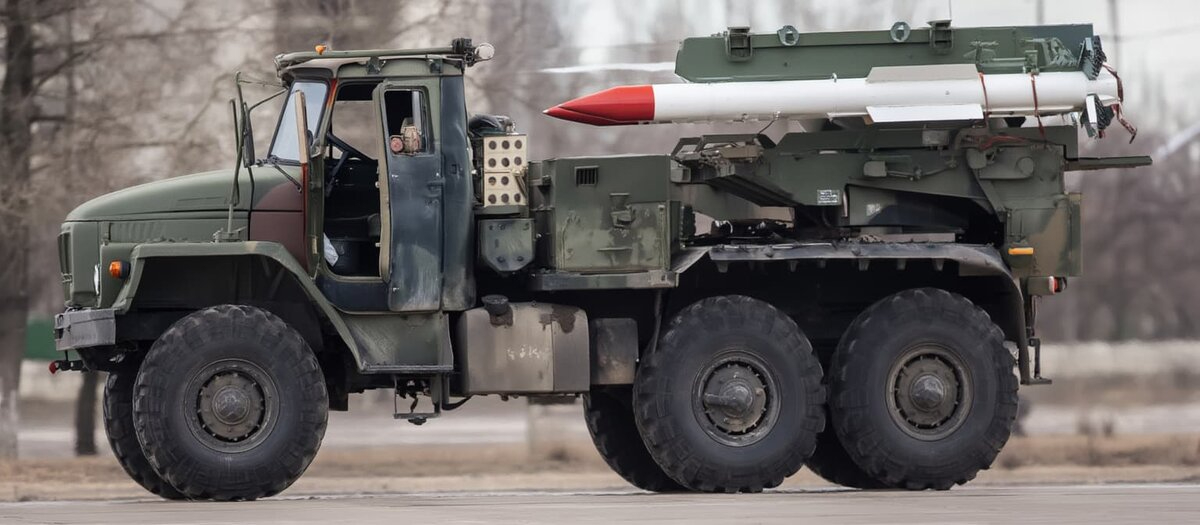
Description of the Russian system based on the «Ural» vehicle
In the Russian Federation, an anti-aircraft missile system has also been observed; it is based on the chassis of a «Ural» truck and uses R-77 air-to-air missiles adapted for ground launch. The system was spotted near the city of Orel and consists of a mobile launcher carrying four medium-range air-to-air guided missiles. Structurally, the system includes a mechanism for raising the missiles into the launch position, similar to those used in mass-produced anti-aircraft systems, and allows for rapid deployment at unprepared positions.
Technical Specifications and Operational Characteristics of the R-77 Missiles
The R-77 missile, standard equipment on the Su-35 fighter jets, MiG-35, and Su-30 fighter jets, retains its active radar homing head in its ground-launched variant and is capable of engaging targets at altitudes of up to nine kilometers and ranges of up to twelve kilometers when launched from the ground. The system’s effectiveness depends directly on the availability of external target-indication channels, including mobile radar detection stations and integration with a unified airspace control system. The lack of built-in detection capabilities within the launcher itself requires coordination with external sources of air situation data.
Historical Developments and Contemporary Implementation
The concept of ground-based deployment of the R-77 missiles was developed as far back as the Soviet era, but it was never actually implemented in the form of mass-produced models. The current solution involves adapting existing aircraft munitions to meet the requirements of mobile air defense units without significantly modernizing the missile itself. This approach makes it possible to rapidly increase the density of air defense in specific areas by utilizing existing stockpiles of air-launched missiles.
International Experience in Adapting Air-to-Air Missiles for Air Defense Missions
International experience shows that similar technical solutions are becoming increasingly common. In particular, the NASAMS and IRIS-T systems use AIM-120 and AIM-9 air-to-air missiles as part of fixed and mobile air defense systems. The British Raven system, equipped with AIM-132 ASRAAM missiles, also implements the principle of integrating air-to-air munitions into ground-based launchers. The technical characteristics of such systems vary depending on the type of missile used, the guidance systems, and the capabilities for integration into the overall air defense architecture.
Advantages and Limitations of the Approach
The advantage of an approach using adapted air-to-air missiles is that it reduces the time required to deploy new air defense systems and allows for the use of existing logistical infrastructure for ammunition. Limitations stem from the need for external target designation, as well as from the aerodynamic characteristics of the missiles when launched from a standstill, which may affect the range and altitude at which targets can be engaged compared to their use in an airborne configuration.
Prospects for the Development of This Field
Further development of such systems involves improving guidance algorithms, integration with automated control systems, and the possible development of specialized launch accelerators to compensate for the lack of initial velocity of the carrier. The technical feasibility of such solutions is confirmed by both domestic and foreign projects in the field of adapting aviation munitions for ground-based air defense missions.