An Airplane Without an Airfield: How the Harrier Became the West's Most Unusual Combat Jet

In June 2026, the U.S. Marine Corps officially retired its last AV-8B Harrier IIs. The aircraft, which for more than forty years remained a symbol of American carrier-based aviation and expeditionary operations, is finally giving way to the F-35B Lightning II. To many, this looks like a routine generational shift in military technology. But in reality, an entire era is coming to an end along with the Harrier—an era when engineers sought to solve one of aviation’s most challenging problems: creating a jet fighter that didn’t need an airfield.
The Harrier’s history is also interesting because it was arguably the only vertical takeoff and landing aircraft that truly proved successful. The Soviet Union developed the Yak-38 and Yak-141; the French experimented with their own designs; and the Germans and Americans tested dozens of unusual aircraft. But it was the British Harrier that not only went into production but also became a full-fledged combat aircraft that served for more than half a century.
The Birth of the “Jumping Jet”
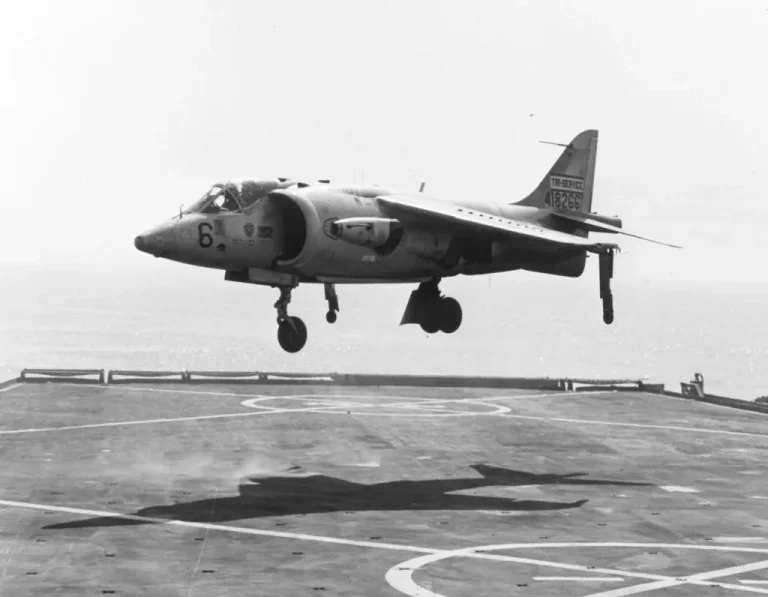
In the early 1950s, military analysts on both sides of the Atlantic reached an unpleasant conclusion: in the event of a major war, airfields would be among the first targets for air and missile strikes.
Even the most advanced fighter jet is useless if its runway has been turned into a pile of concrete.
It was then that the British company Bristol began experimenting with the Pegasus engine, which was capable of changing the direction of thrust. The idea seemed almost fantastical. Instead of using separate lift engines, as many competitors had proposed, the British decided to create a single powerful engine with swiveling nozzles.
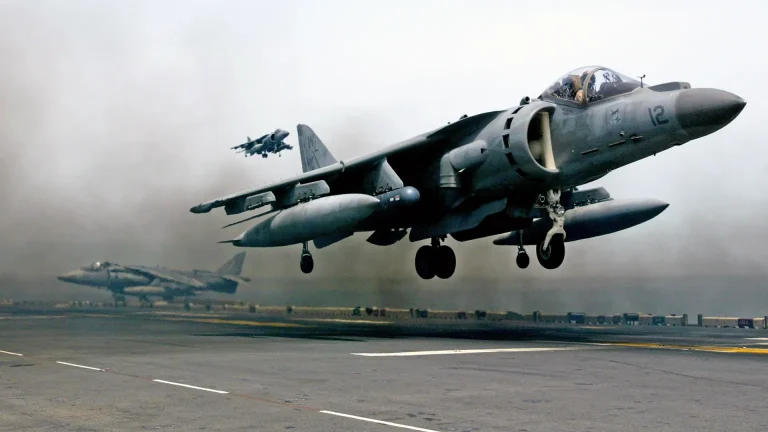
The solution turned out to be ingenious in its simplicity. Four nozzles on the sides of the fuselage could pivot downward, allowing the aircraft to hover and take off vertically. They were then moved back, transforming the aircraft into a conventional jet.
In 1967, the first production Harrier took to the skies. That’s how the famous Jump Jet—the “jumping jet”—came to be.
Why the U.S. Marine Corps Fell in Love with a British Aircraft
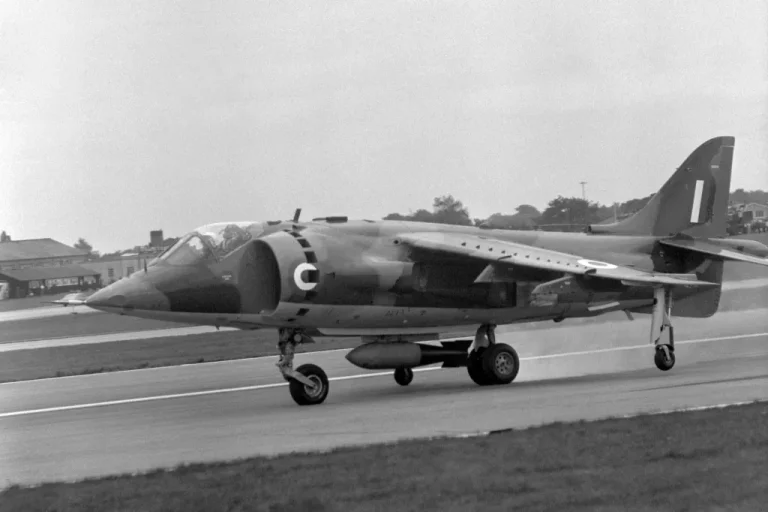
It would seem that this British development was meant to remain a local project of the Royal Air Force. However, it was the Americans who took the greatest interest in it.
The reason was simple. The U.S. Marine Corps had always sought to have its own air force capable of operating in close proximity to the Marines. But full-fledged aircraft carriers belonged to the Navy, and it was impossible to build large airfields at every beachhead.
The Harrier offered a unique solution.
The aircraft could be based on small amphibious ships, temporary sites, stretches of highway, and even makeshift airfields set up in literally just a few days. For the Marine Corps, this was a true revolution. As early as the 1970s, the Americans adopted the AV-8A Harrier.
However, it soon became clear that the first version had serious limitations.
From the AV-8A to the AV-8B: The Americans Are Building Their Own Harrier
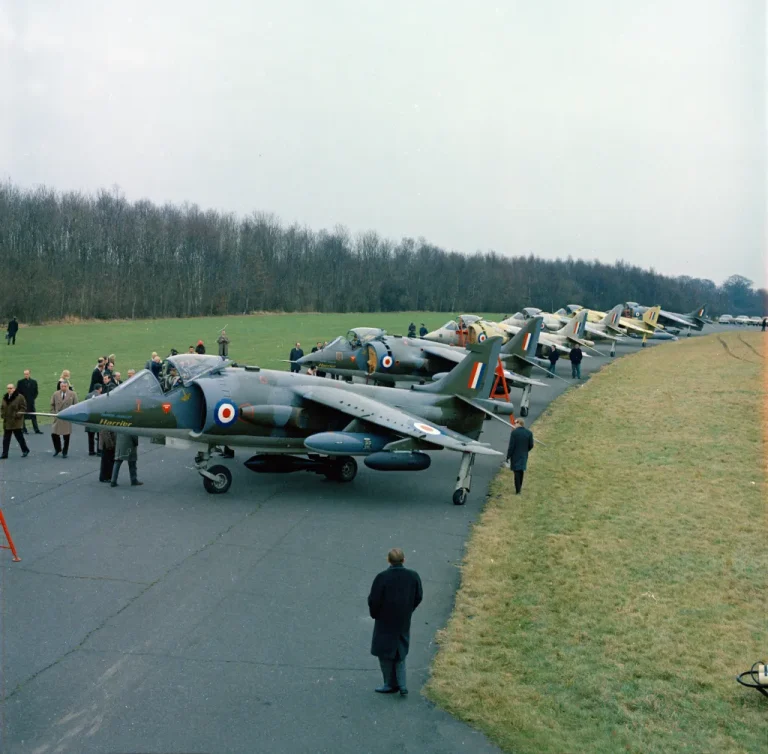
The first Harriers had outstanding takeoff and landing performance, but there was a price to pay for that.
Its combat radius was relatively short. Its weapons load was also inferior to that of traditional attack aircraft. In some configurations, the aircraft carried less ordnance than the older A-4 Skyhawk, which it was intended to replace.
Therefore, in the 1970s, McDonnell Douglas, in collaboration with its British partners, began a major modernization of the aircraft.
The new AV-8B Harrier II features a larger composite wing, larger fuel tanks, improved aerodynamics, and state-of-the-art avionics. The cockpit has been raised, improving the pilot’s visibility. The aircraft is now not only more powerful but also significantly easier to operate.
In fact, the AV-8B was essentially a new aircraft that retained only the general design concept of its predecessor.
It is this model that has become the best-known member of the family.
The plane that saw action almost everywhere
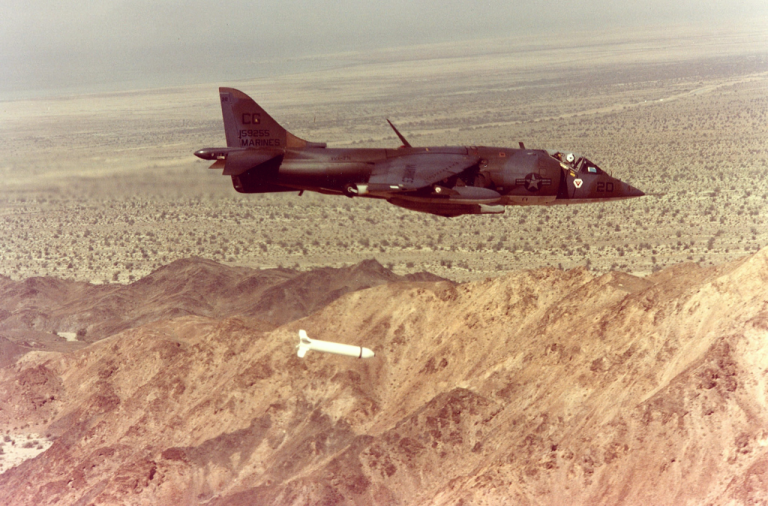
By the time the Harrier II was introduced, the Cold War was coming to an end, but the aircraft did not remain out of service.
During Operation Desert Storm in 1991, the AV-8B was actively used to provide direct support to coalition forces. The aircraft operated from both amphibious ships and forward airfields, striking artillery, armored vehicles, and fortified positions.
Later, Harriers took part in operations in the Balkans, Afghanistan, Iraq, and Libya.
Their ability to operate close to the front lines proved particularly valuable. While heavy aircraft were tied to large air bases, the Harriers were able to operate practically from field conditions.
In Iraq, the AV-8B earned very high praise from the Marine Corps. According to the U.S. military, the aircraft’s operational readiness rate exceeded 80 percent, and the use of LITENING guidance pods transformed the Harrier into a highly accurate strike aircraft.
The most challenging airplane for a pilot
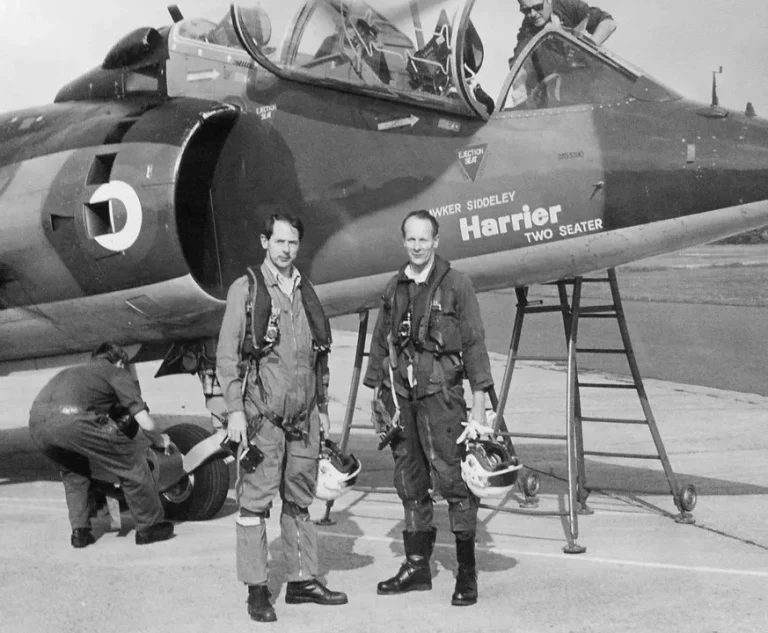
The Harrier also had its downsides.
The aircraft required exceptionally high pilot skill. Landing in vertical flight was similar to flying both a jet and a helicopter at the same time.
The pilot had to control the engine thrust, the position of the four swivel nozzles, the rate of descent, and the aircraft’s stability. The slightest mistake could have led to a disaster.
It is no coincidence that throughout its service life, the Harrier maintained a reputation as one of the most difficult aircraft to operate. Even the U.S. military acknowledged that without rigorous training, the accident rate rose rapidly.
In essence, the Harrier was an aircraft that demanded much more from the pilot than most of its contemporaries.
The Harrier’s legacy lives on in the F-35B
When people talk about the F-35B today, many think of it as an entirely new aircraft. But in reality, without the Harrier, this aircraft might never have been developed.
It was British and American engineers, who had spent decades working on the challenges of vertical takeoff and landing, who accumulated a wealth of experience that later formed the basis of the F-35B program. Many technical solutions, pilot training methods, and even the very concept of expeditionary aviation stemmed directly from the operational experience with the Harrier.
Therefore, the Harrier’s retirement cannot be viewed simply as the scrapping of an old aircraft.
This marks the conclusion of a unique experiment that turned out to be surprisingly successful.
Tactical and Technical Specifications of the AV-8B Harrier II
Type: Vertical/Short Takeoff and Landing (V/STOL) attack aircraft
Crew: 1 person
Engine: Rolls-Royce Pegasus 11-61
Maximum speed: 1,085 km/h
Operational range: up to 550 km
Practical range: over 3,300 km with auxiliary fuel tanks
Practical ceiling: 15,000 m
Maximum takeoff weight: approximately 14 metric tons
Combat load: up to 4,200 kg
Armament:
- GAU-12 Equalizer 25-mm cannon;
- guided and unguided bombs;
- AGM-65 Maverick missiles;
- ракеты AIM-9 Sidewinder;
- a wide range of NATO aviation weapons.
Today, the last remaining Harriers are still in service only in Italy and Spain, but their days are gradually coming to an end. But the history of this aircraft has long transcended the scope of a single machine. The Harrier proved that a jet aircraft is capable of taking off from almost anywhere, and sometimes that capability proves more important than speed, range, or the number of missiles under its wings.
источник https://www.twz.com/air/the-hidden-history-of-americas-harrier-jump-jets