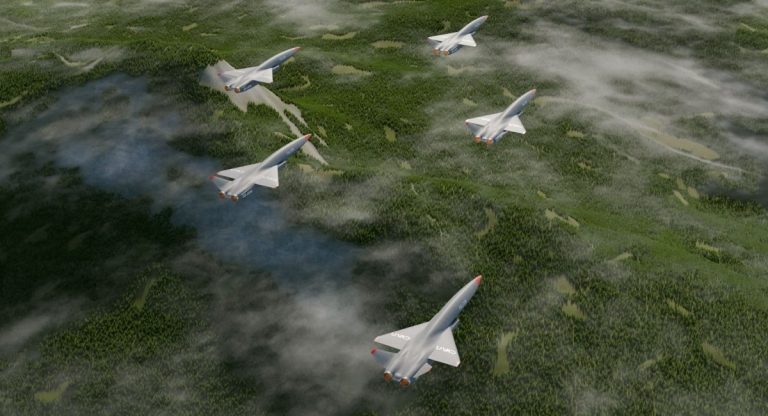
Over the past few decades, drones have become increasingly slow and stealthy. Designers have focused on low radar visibility, long flight times, and the ability to circle over a combat zone for hours on end. The Canadian company UVAD Technologies has decided to take a different approach. Instead of yet another low-observable propeller-driven aircraft, it is developing the Falcon—a supersonic drone capable of reaching speeds of up to Mach 1.6 and breaking through the enemy’s layered air defense system. The aircraft’s maiden flight is expected in 2027.
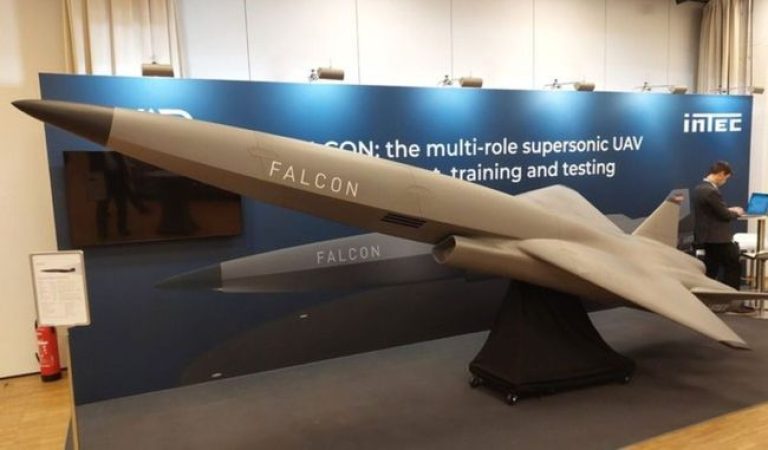
At first glance, the Falcon looks like just another experimental drone. However, there is a much more interesting idea behind this project. The Canadians are, in fact, trying to create a low-cost, mass-produced jet-powered drone capable of fulfilling several roles at once—from a target for training air defense crews to a strike vehicle, a decoy, or even a wingman for future fighter jets.

From an aerial target to a combat drone
The story of the Falcon did not begin as a story about a weapon.
The project was originally conceived as a supersonic aerial target for training pilots and air defense crews. Modern armies face a serious shortage of realistic targets capable of simulating cruise missiles or future unmanned threats.
That is precisely why UVAD decided to create a relatively inexpensive platform capable of simulating complex aerial targets during exercises. However, as the project progressed, it became clear that the device’s capabilities were much broader.
Today, developers view the Falcon not only as a target but also as a multi-purpose platform. In various configurations, it can be used as a reconnaissance drone, a decoy, a carrier of electronic warfare equipment, a strike drone, or even a so-called “Loyal Wingman”—an unmanned escort for manned fighter jets.
Why Speed Is Becoming Important Again
Recent years have revealed an interesting trend. Most modern drones prioritize stealth and affordability, but they remain relatively slow targets.
Falcon offers a completely different approach.
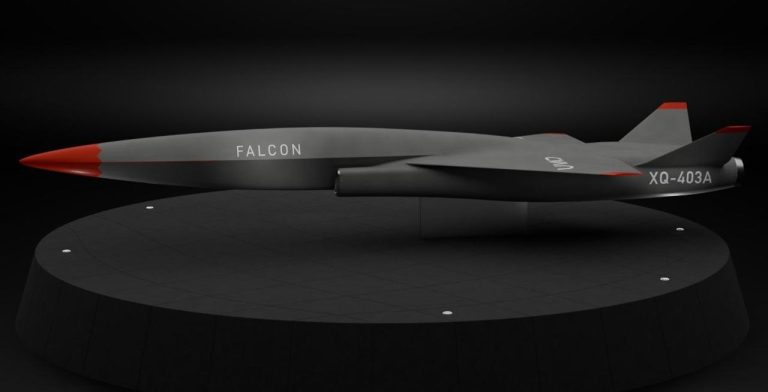
The aircraft’s maximum speed is 1.6 Mach—approximately 1,960 kilometers per hour. By comparison, most modern attack drones fly at speeds ranging from 150 to 500 km/h. Even many cruise missiles are slower than the Falcon.
According to the developers, it is the combination of high speed, compact size, and stealth features that should be the aircraft’s main advantage.
Modern air defense systems will have to respond to such a target in much the same way as they would to a full-fledged cruise missile. And that means expending costly anti-aircraft missiles and overloading the detection system.
In fact, the Falcon can serve as a sort of “air defense sponge,” forcing the enemy to expend its ammunition even before the main strike forces arrive.
Small but very fast
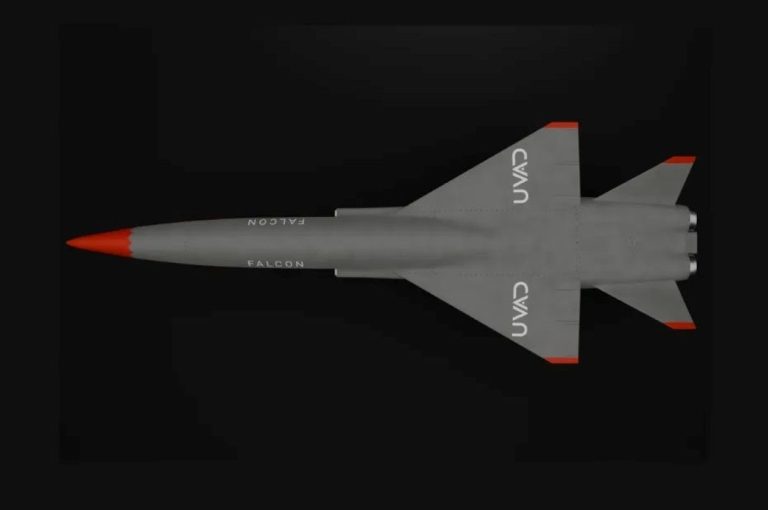
Despite its impressive speed, the Falcon remains a fairly compact aircraft.
The drone is only 5.8 meters long, with a wingspan of about 2.2 meters. Its maximum takeoff weight is 450 kilograms. Its payload capacity is estimated at approximately 50 kilograms.
Interestingly, the developers initially focused on the system’s mobility. According to published reports, the launcher and two drones can be housed in a standard shipping container.
This solution makes it possible to quickly transport the complex by virtually any mode of transportation and deploy it without having to build special infrastructure.
A drone that doesn’t require an airfield
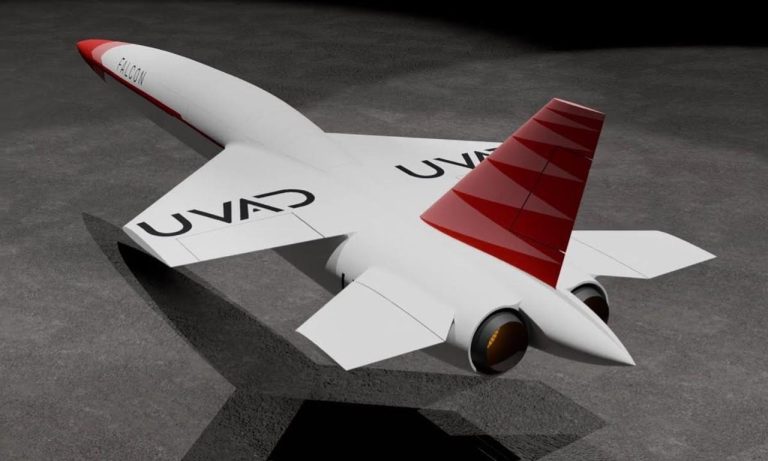
Another unusual feature of the Falcon is the way it launches.
The aircraft does not require a runway. A pneumatic catapult is used for takeoff, and after completing its mission, the drone can return to the ground using a parachute system and a special inflatable cushion.
This approach greatly simplifies operation and allows the aircraft to be used in field conditions where it is not possible to build a full-scale airfield.
In addition, the Falcon is designed from the outset as a reusable system, which is particularly important for training and testing purposes.
Could Falcon become a weapon?
Perhaps this is the question that is generating the most interest today.
Officially, the developers continue to position the Falcon as an aerial target and test platform. However, they themselves acknowledge that the design allows for the creation of strike variants.
A payload of 50 kilograms is not enough to replace a full-fledged winged missile, but it is quite sufficient to carry reconnaissance equipment, electronic warfare systems, or a warhead of limited yield.
In that case, the Falcon becomes a highly dangerous tool for suppressing air defenses. Its high speed significantly reduces the reaction time of air defense units, and its relatively low cost allows for its widespread deployment.
It is no coincidence that the project has already attracted the attention of Raytheon, which invested in its development early on in the program.
TTX Falcon
Type: Multipurpose supersonic UAV
Developer: UVAD Technologies (Canada)
First flight: expected in 2027
Length: 5.8 m
Wingspan: 2.2 m
Maximum takeoff weight: 450 kg
Payload: up to 50 kg
Maximum speed: 1.6 Mach (about 1,960 km/h)
Practical range: up to 10 km
Flight duration: up to 30 minutes
Launch: Pneumatic Catapult
Landing: parachute system and inflatable cushion
Proposed tasks:
- air target;
- reconnaissance;
- a false goal;
- electronic warfare;
- attack drone;
- unmanned guided vehicle.
A New Category of Air Threats
The introduction of the Falcon shows that the drone market is gradually moving beyond the traditional concept of slow, propeller-driven aircraft.
While stealth used to be considered the primary way to increase survivability, developers are now once again focusing on speed. As a result, systems are emerging that fall somewhere between a drone and a cruise missile.
Whether the Canadian project will live up to expectations will become clear after the first flight tests in 2027. But even now, the Falcon appears to be one of the most unusual unmanned projects of recent years—a craft that aims to combine the speed of a jet aircraft, the flexibility of a drone, and a cost that is affordable for mass adoption.