There are some real stars among military helicopters. Everyone knows the “Apache,” and many have heard of the “Black Hawk” or the giant CH-53 Super Stallion. But there is one helicopter that has been performing one of the most dangerous and underappreciated missions at sea for decades. It didn’t attack submarines, deploy special forces, or hunt down enemy ships. Its enemy was naval mines—a weapon that, over the past hundred years, has sent more ships to the bottom of the sea than many missile systems.
We’re talking about the MH-53E Sea Dragon—the largest helicopter ever to serve in the U.S. Navy. The aircraft is so unusual that it is often referred to not as a mine-sweeping helicopter, but as a veritable flying mine sweeper.
When a Mine Is More Dangerous Than a Rocket
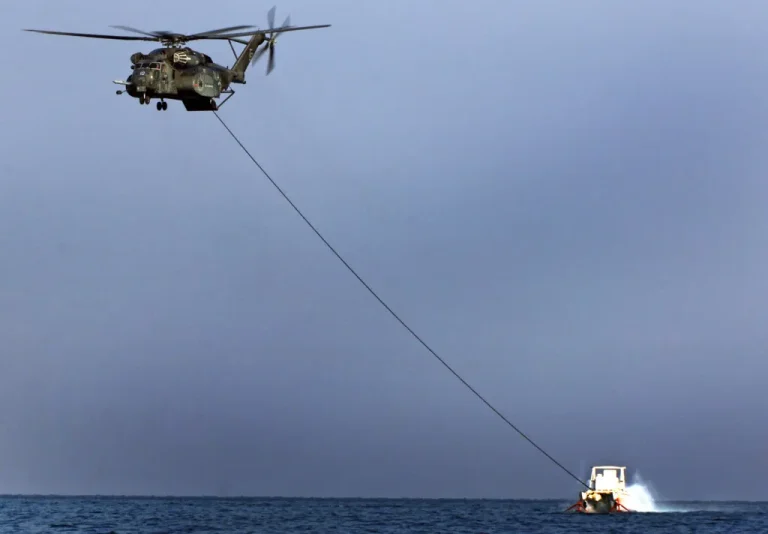
During the Cold War, the U.S. Navy faced an unpleasant reality: any conflict at sea could begin with a massive mine-laying operation.
Unlike anti-ship missiles, mines are relatively inexpensive but capable of paralyzing an entire fleet. It is much easier to block a harbor entrance, seal off a strait, or prevent a marine landing with a few dozen properly placed mines than with expensive ships.
This problem became particularly acute following the events in the Persian Gulf in the 1980s. It became clear then that the navy needed a system capable of quickly cleaning up vast areas of the sea.
That is how the MH-53E Sea Dragon came to be.
In fact, it was not a new helicopter, but a major redesign of the CH-53E Super Stallion heavy-lift transport helicopter. However, the new helicopter’s mission requirements were so specific that it differed from the base model much more significantly than might appear at first glance.
The U.S. Navy’s Largest Helicopter
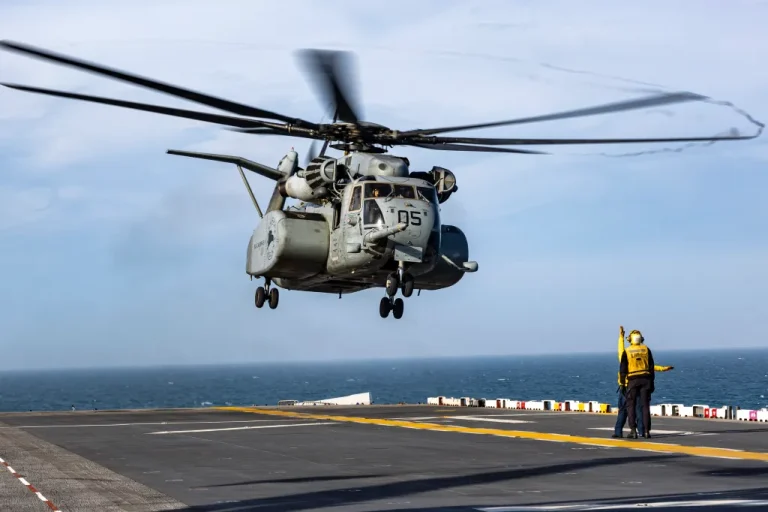
When you see the Sea Dragon for the first time, it’s hard to believe that it’s a helicopter.
The aircraft’s total length is nearly 30 meters, the diameter of its main rotor exceeds 24 meters, and its maximum takeoff weight is close to 32 metric tons. By comparison, many modern passenger aircraft are lighter than this giant.
Hidden beneath the fuselage are three General Electric T64-GE-419 turboshaft engines, each with an output of 4,750 horsepower. It is thanks to this powerplant that the Sea Dragon is capable not only of lifting heavy loads but also of towing massive mine-clearing equipment.
From the outside, the helicopter is easily recognizable by its huge side pods. They’re there for a reason. They house additional fuel tanks, which allow the Sea Dragon to remain over the sea for hours at a time while conducting search operations.
How Can a Helicopter Search for Mines?
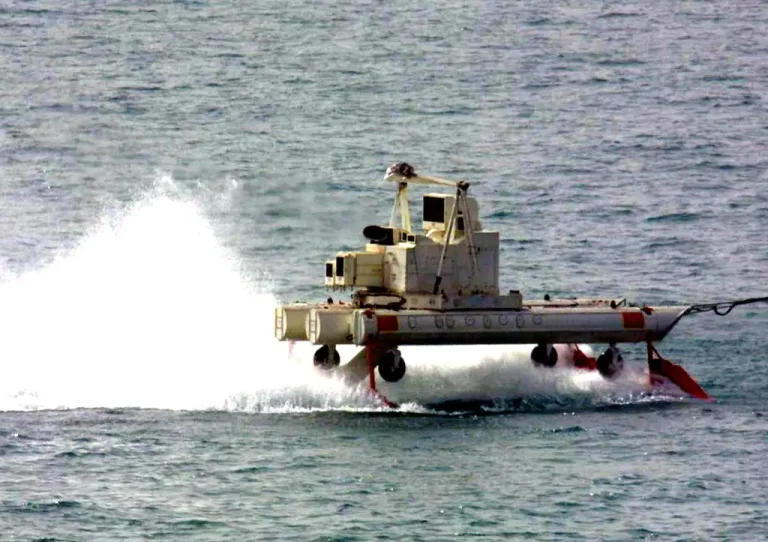
The most interesting part begins when the Sea Dragon gets to work.
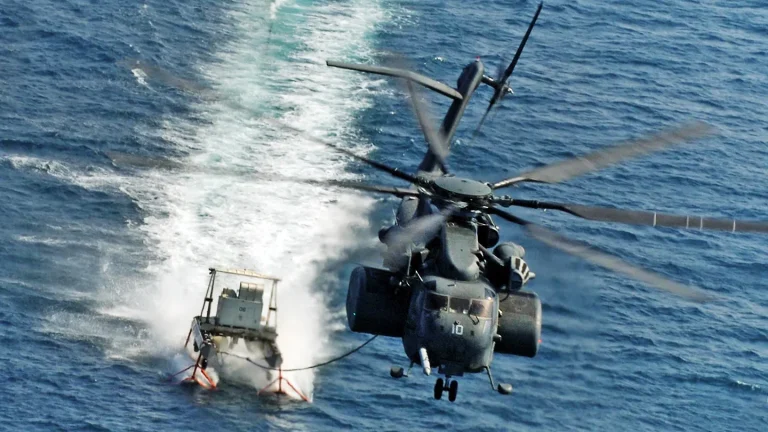
Instead of missiles or torpedoes, the helicopter carries special trawls, sonar devices, and magnetic generators on external pylons.
There are several ways to deal with sea mines.
Some respond to the noise of ship propellers. Others are triggered by the magnetic field of a large metal hull. Still others use combined sensors.
To fool this type of mine, the Sea Dragon tows special equipment designed to mimic the passage of a large ship. The mine mistakes the tow for a target and detonates long before the real ship appears.
In other cases, the helicopter can tow hydroacoustic search systems, detecting mines on the seabed and transmitting their coordinates for subsequent disposal.
In fact, the MH-53E is capable of clearing a sea lane much faster than traditional minesweepers.
A flying minesweeper for the Persian Gulf
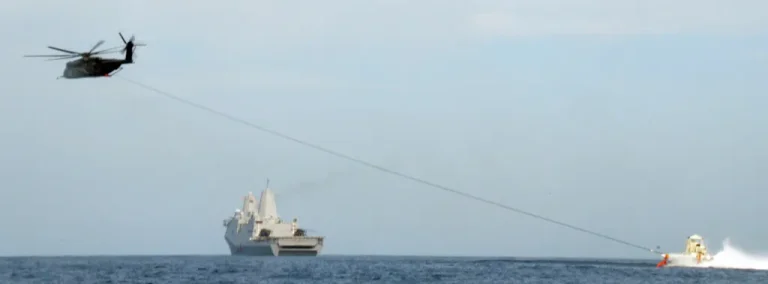
The Sea Dragon gained its greatest fame in the Middle East.
The Persian Gulf has long been considered one of the world’s most dangerous regions in terms of mine warfare. Narrow straits, heavy shipping traffic, and constant military and political tensions make the issue of mines particularly pressing.
That is precisely why MH-53E helicopters were regularly deployed to the region to ensure the safety of shipping and maintain readiness to clear maritime routes in the event of a crisis.
Unlike minesweepers, a helicopter can be quickly deployed to the desired area and begin operations almost immediately upon arrival.
This proved to be a huge advantage for the fleet.
Not just a minesweeper
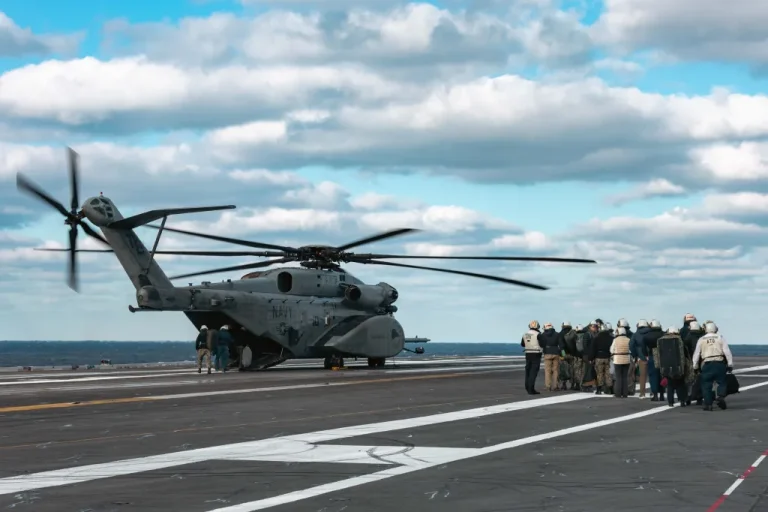
Despite its specialized design, the Sea Dragon proved to be a surprisingly versatile vehicle.
Its enormous carrying capacity made it possible to use it to transport equipment, cargo, and personnel between ships and the shore.
In its transport configuration, the helicopter can carry up to 55 military personnel or more than 14 metric tons of cargo on external slings.
In essence, the U.S. Navy has acquired both a heavy-lift transport helicopter and a specialized mine-countermeasures platform.
However, its primary purpose has always been its role in mine countermeasures.
Why the «Sea Dragon» Is Going Down in History
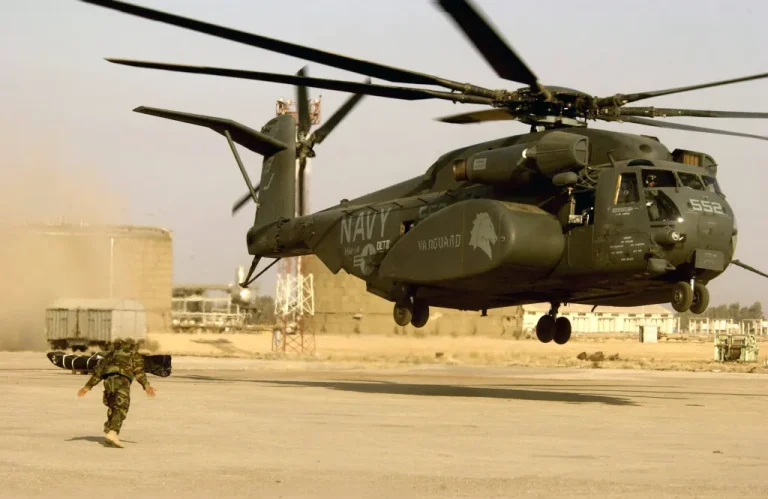
Despite its impressive capabilities, the Sea Dragon’s time is gradually coming to an end.
The reason is simple: the car turned out to be incredibly complex and expensive to operate.
Three engines, their enormous size, and constant flights over the sea make maintenance extremely costly. In addition, most of the existing helicopters were built back in the 1980s.
At the same time, unmanned mine-detection systems are being actively developed. Modern surface and underwater drones are capable of performing many tasks without putting the crew at risk and at significantly lower operating costs.
That is precisely why the U.S. Navy is gradually phasing out the Sea Dragon, transferring some of its functions to new autonomous systems.
The Last Knight of the Mine War
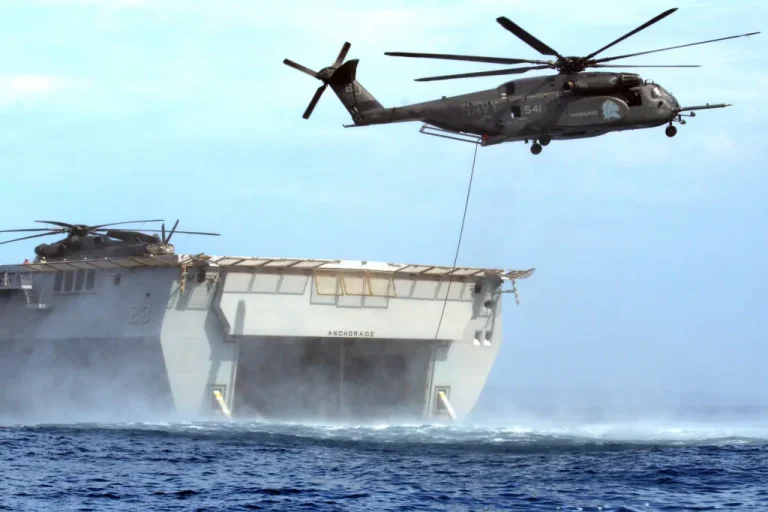
The history of the MH-53E Sea Dragon is a good example of just how unusual military equipment can be.
While the world marveled at stealth fighters and aircraft carriers, this massive helicopter spent decades performing a mission on which the safety of the fleet directly depended. It didn’t take part in aerial dogfights and rarely made the front pages of newspapers, but it was precisely these machines that ensured ships could pass through areas where the sea could be deadly.
The Sea Dragon represented the pinnacle of aerial minesweeping technology—a massive, three-engine giant capable of literally “sweeping” mines out of the sea. And although the era of manned mine-hunting helicopters is gradually coming to an end, replacing this aircraft has proven to be much more difficult than many admirals had anticipated.
MH-53E Sea Dragon Specifications
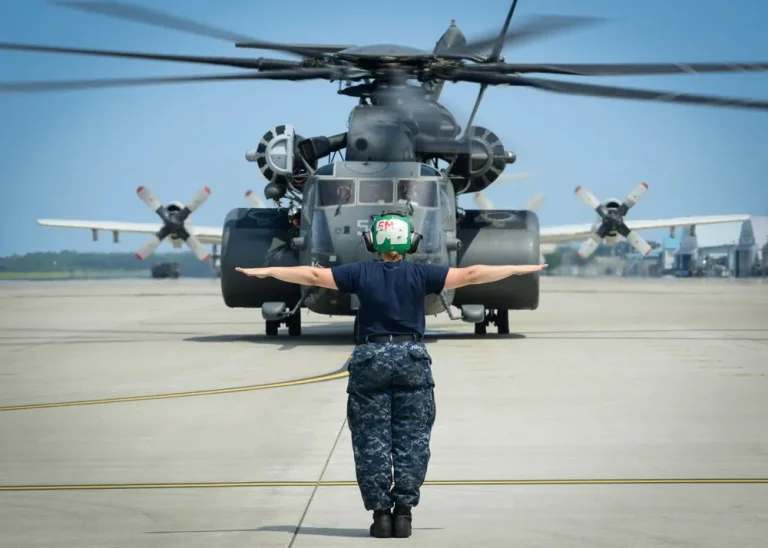
Type: Heavy anti-mine and transport helicopter
Manufacturer: Sikorsky Aircraft
First flight: 1981
Entered service: 1986
Crew: 2 pilots + up to 6 crew members
Engines: 3 × General Electric T64-GE-419
Power: 4,750 l.s. per engine
Maximum takeoff weight: 31,693 kg
Length: 30.2 m
Diameter of the main propeller: 24.1 m
Maximum speed: about 278 km/h
Flight range: up to 1,050 nautical miles (about 1,940 km)
Lifting capacity: up to 14.5 metric tons on the external suspension
Main objectives:
- search for sea mines;
- minefield clearance;
- freight transportation;
- support for airborne operations;
- Vertical transfer of cargo between ships.