An article from the “Citadel of the Sane” channel on Yandex Zen.
Continuing this series on the conditions and living world of “alternative” Venus, I’d naturally like to get right to the point. But I have to repeat the introductory remarks, since I’ve noticed that readers aren’t too eager to follow links. These introductory remarks, of course, may raise questions—and valid ones at that. However, the answers to them—whether convincing or not—have already been provided in the previous parts.
Therefore, by way of introduction: In terms of its geology and astronomical characteristics, this alternative Venus is as close as possible to the real one—however, it did not undergo overheating early in its history, retained its water, and eventually developed an oxygen-rich atmosphere. Nevertheless, it is a planet without Earth-like plate tectonics, without signs of volcanism, and with an extremely slow rotation. Seasons are replaced by daily cycles—day and night each last two Earth months.
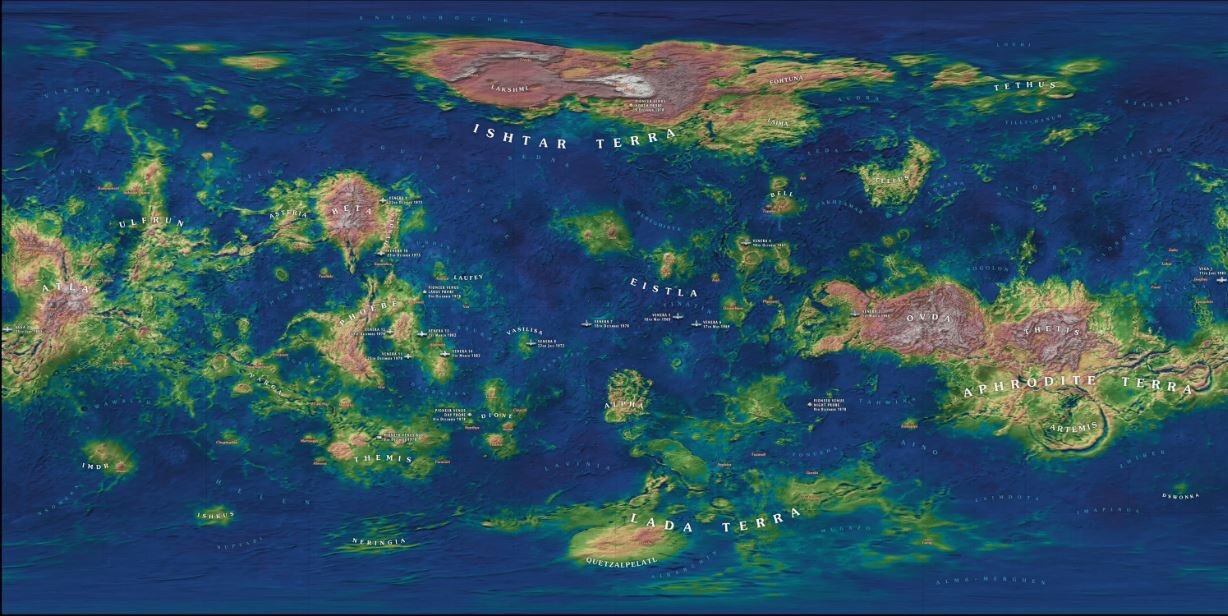
The climate on Venus, as one would expect, is hot. On the northern, subpolar continent of Ishtar, it is rainy, and the temperature hovers around +12. The day, when the Sun rolls low over the horizon, gives way to a “white” night. The continent is covered with forests on the southern, “sunny” slopes, and meadows on the northern ones… Moreover, vertebrates had to come ashore precisely there—this is one of the points discussed in previous publications. The tropical islands are too small, and the equatorial region of Aphrodite is far too extreme.
…Well, to say it’s “hot” there would be an understatement. At the height of the day, the air temperature rises to +80, and the water on the shoals reaches +60 degrees. Consequently, during the day, life retreats underground—animals into their burrows and plants into their rhizomes. The grassy forest bakes in the sun, only to be drenched by hot downpours by evening and left to rot at night. Thus, life on the continent boils over twice. In the morning and after sunset, when enormous insects emerge from their shelters to process dead organic matter… As noted earlier, Aphroditian life forms consist primarily of arthropods and turtles. Due to the absence of plate tectonics, Venus’s landmasses have never coalesced into supercontinents. On every fragment of its land, including tropical islands with conditions transitional from Ishtarian to Aphroditian, evolution proceeds independently…
That is, of course, before the birds appeared on Ishtar.
What might Ishtarian birds look like? In principle, they could be quite ordinary. A particular challenge is local seasonality, but how do birds respond to it? Long-distance migrations to areas with optimal conditions are characteristic of this class—sometimes (albeit rarely) even from one hemisphere to another.
As for Ishtar, there’s no need to fly far. Daytime birds—it’s logical to expect that most will join this group, since primary biomass is mainly generated during the day, —will stay on one side of the continent from dawn to dusk, then move to the opposite side—where dawn is breaking. Ishtar’s asymmetry will create some problems—one of the coasts, the less favorable one at that, will become overcrowded during the day, so birds will likely build their nests only in the southern part of Ishtar. A certain sequence will emerge, with species distributed along longitudes. This will allow them to feed their chicks in turn, precisely when the most productive time of day arrives at a given longitude.
But nocturnal migratory birds may also appear on Ishtar—following the darkness. There are fewer resources at night, however, and less competition for them. The fact that the nights are “white” will make adaptation much easier. There’s no need to invent anything beyond an owl’s vision. And even that would prove somewhat excessive.
The claim that there are no migratory or non-flying birds on Ishtar is questionable. On the one hand, the adaptation of vision to darkness is entirely compatible with daytime vision. But it’s unclear why. From the perspective of sensory efficiency, an “all-season” bird would be at a disadvantage compared to one specialized for a specific light level.
And it’s important to understand this. On Earth, a bird cannot avoid the night, when it becomes vulnerable. But it can easily wait out the night by hiding and going without food—we’re talking about just a few hours. On Venus, that won’t work. At night, they must search for food, exposing themselves—in the absence of specialized adaptations—to additional risk. Under these conditions, migration offers too great an advantage.
It stands to reason that bats would also become migratory on Venus. On the one hand, it is possible to stay in caves during the day. But that’s a waste of time—and why bother, if the twilight boundary shifts by 10 kilometers every Earth day?
…What’s most interesting, though, is that flight routes will follow not only longitudes but also latitudes. At low latitudes, the “reach” of “morning” migrations is constantly growing; however, in the tropics, life in a perpetual round-the-world cycle—from island to island—remains possible. Night birds, however, will disappear—since it is too dark at night even for owls (there is no moon). Instead, new species will emerge that feed their chicks on the islands during the day but evacuate at night to the bird-free territories of Ishtar. For them, universal vision will be particularly useful.
The birds won’t overlook Aphrodite’s resources either. But here, they’ll have to get creative. From sunrise, the temperature remains bearable for about a month—too short a time to incubate and feed the chicks. Consequently, this task will have to be carried out somewhere in the high latitudes—perhaps at night—unless feeding time has to be postponed until morning. It is possible to build nests and incubate clutches even in relative darkness, using the fat reserves accumulated on Aphrodite.
…The birds on Aphrodite won’t settle down like reptiles waiting out the heat in their burrows. It’s easier for them to migrate than to endure hardship. However, at night, Aphrodite may be subject to raids by bats, undeterred by the darkness. At dawn, the bats will retreat to the islands to wait out the heat—to places where it is bearable.