Contents:
Why “mountain dweller”? Because the name Orestes means “mountain dweller.”
A Character Concept
We already know that after Agamemnon’s murder, his relatives and close friends who had retained their sanity sent Orestes far away to keep him out of trouble. It is most commonly stated that he was sent to Strophius, king of Phocis, but there is also a version that Idomeneus of Crete took him in to raise him. We will stick with the version involving Phocis, as it is more closely connected to the rest of the events.
It is sometimes claimed that Strophius’s wife was Orestes’s aunt, but it’s not entirely clear through whom. Clytemnestra and Helen had only brothers—the Dioscuri. Agamemnon, too, apparently had only one brother, Menelaus. What a murky story! Oh well, relative or not, the main thing is that he took the orphan in. Especially since Strophius had a son, Pylades, who was the same age as Orestes. So the two of them grew up together, and later went on adventures together. Even back in the Middle Ages, people would say of two riders on one horse, “Just like Orestes and Pylades riding together” 🙂 And in general, in European culture, these two have become a symbol of loyal friendship and not like Achilles and Patroclus.
Of course, Orestes couldn’t have been unaware of what was going on in his family. And it was difficult for the young man to decide how to move forward. Orestes acted like a true Greek: he decided to seek the gods’ counsel. The Oracle of Delphi spoke plainly: he must avenge his father and save his sisters. “Well, if I’m going to take revenge, I’ll take revenge,” Orestes decides, and sets out to visit his ancestral homeland. And Pylades, of course, goes with him. He probably hasn’t given much thought yet to the fact that he’ll have to take revenge not on just anyone, but on his own mother…
How did it all happen? Theories, theories… Every playwright who wrote about this subject offered their own version of events, and it’s extremely difficult to pick a single definitive account from among them.
For example, one version claims that Orestes simply stormed Mycenae with the help of troops provided by Strophius. Hanging Aegisthus from a lamppost—that’s pretty extreme, too… However, for dramatic effect, the “secret avenger” version is more popular.
According to the story, Orestes secretly comes to Mycenae, offers sacrifices at his father’s grave, and leaves a lock of his hair there. Electra, who also visits her father’s grave all the time, sees all this and realizes: her brother is here—something’s about to happen! They meet again at the grave, and they have a lot to say to each other…
Next are the accounts of the deaths of Clytemnestra and Aegisthus.
1. Orestes enters the palace directly, introducing himself as a messenger from Strophius. “Oi, mother, your son Orestes has died; please accept my condolences.” Pilades then enters, supposedly carrying an urn containing the deceased’s ashes. Clytemnestra invites them both to a feast, and at that feast Orestes first kills Aegisthus and then his mother.
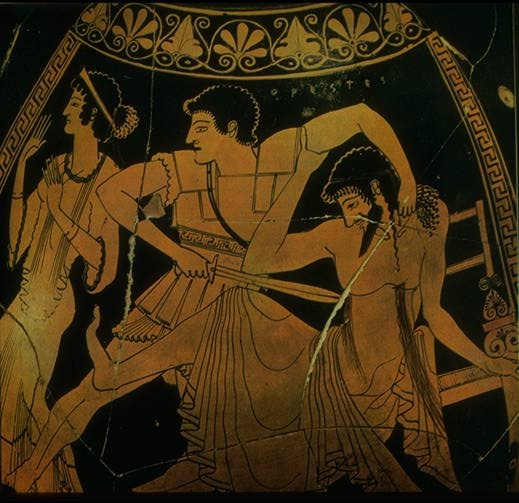
Orestes, as he kills Aegisthus, looks back at Clytemnestra as she flees. Red-figure vase from the 5th century B.C. Museum of Art History in Vienna. Source: ru.wikipedia.org
1a. Same as before, but Orestes brings Clytemnestra to trial, and the court sentences her to death. Where was that court when she was up to her old tricks?..
2. Electra hides her brother in her husband’s house and sends word to her mother that she, Electra, has given birth to a son. Clytemnestra immediately rushes over to see for herself: what a disgrace—the king’s daughter has given birth to a peasant’s child, you little minx, you laughingstock! That’s when Orestes put an end to her with his sword… And then he went to the palace and gave Aegisthus a few more reasons to laugh.
3. Orestes waits for Aegisthus to leave the palace to perform a sacrifice in the meadow. While Aegisthus is busy slaughtering the sacrificial animal, Orestes runs up and… that’s it. That’s the end of Aegisthus. He brings the slain man’s head to Electra as a trophy, and she sends word to her mother at the palace: “Come—things are getting interesting here.” Clytemnestra arrives, and see point 2.
So, both of them died: the echidna mother and her lover. And yet, according to some accounts, they even had children together…
It’s clear that, after all that has happened, Orestes is simply not destined to become king of Mycenae. He is forced to flee, and that’s when new characters enter the scene.
The Arrest of Orest
The Furies. Everyone has heard of the Furies who pursued Orestes for murder. Oh, he was such-and-such—he killed his own mother.
So what if the oracle told him to do that? So what—the Furies serve a different authority; the oracle’s orders don’t apply to them.
Orestes is on the verge of going completely mad from being pursued by the Furies, and Pylades is forced to accompany him so that the fool doesn’t drive himself to madness—which, according to Greek beliefs, is absolutely terrible!
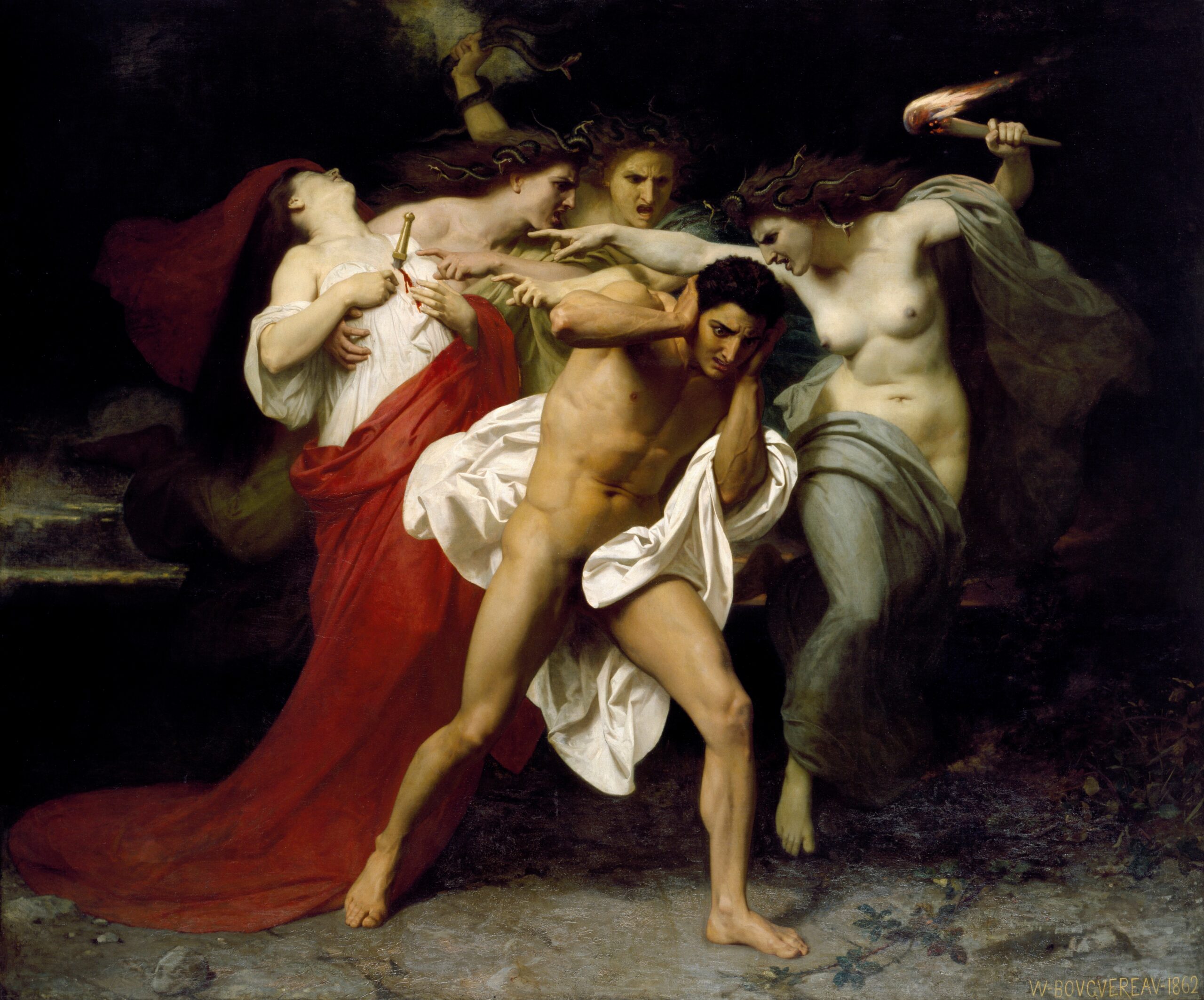
“Orestes, Pursued by the Furies.” William Bouguereau. 1862. Chrysler Museum of Art. Source: ru.wikipedia.org
So, in a dazed state, Orestes wanders into Delphi, and Apollo temporarily lulls the Furies to sleep, allowing Orestes to rest. Apollo then gives him some advice: go to Athens and seek refuge in the temple of Athena. It’s good advice, but he still has to get to Athens! We remember that traveling overland through the Peloponnese wasn’t exactly safe—or easy, for that matter—with mountains all around.
The journey to Athens is a saga in its own right. Although not all sources recount its story, it is worth mentioning. From time to time, Orestes managed to shake off the Furies: in one place he successfully made a sacrifice; in another, he was cleansed of the blood he had spilled; in a third, he tore off one of his own fingers and threw it to the Furies so they would leave him alone for a little while… In short, it was anything but boring.
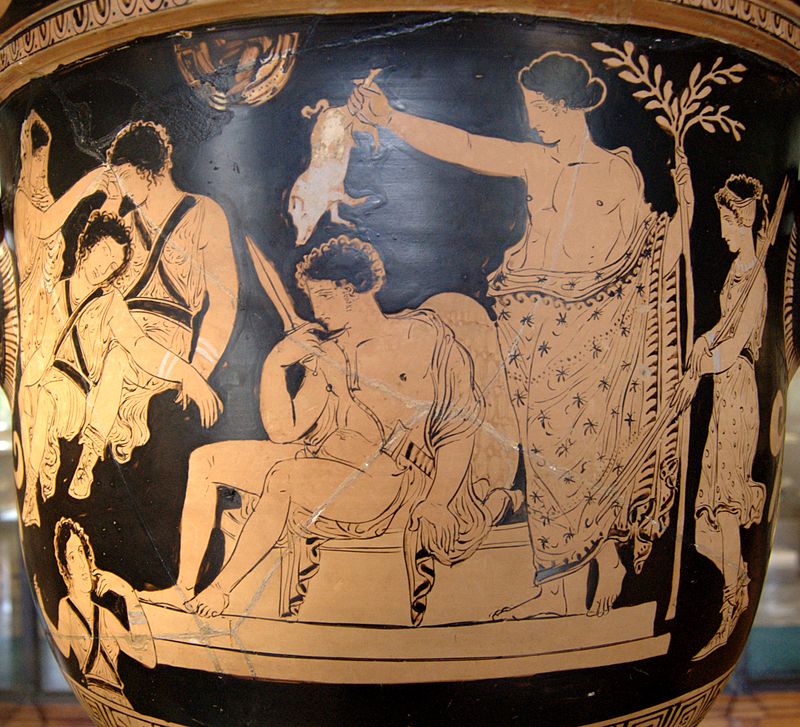
Apollo performs a purification rite over Orestes, slaughtering a sacrificial animal above his head. Red-figure vase, 380–370 B.C. Louvre. Source: ru.wikipedia.org
Finally, he makes it to Athens and asks for protection, embracing the statue of Athena. There, the Athenians take him in—not out of kindness, but simply because they’re afraid of him. But Athena takes matters into her own hands!
As the city’s patroness, she convenes a trial. The prosecutors are… oh, here the accounts differ again. Among them are Tyndareus, the father of the slain Echidna; Clytemnestra’s daughter by Aegisthus; and some other relatives. And the Erinyes themselves, of course. But the defense is represented—applause!—by Apollo himself.
Apollo’s arguments are as simple as three obols: of course, in archaic times, a mother and her family were one’s closest kin, and if, say, Clytemnestra had killed someone else—a stranger—rather than her husband, her son would have had to defend her. But here—forgive my Trojan perspective—Clytemnestra’s own crimes are plain to see, and she plotted against her son. And, let’s be frank, these days—unlike in the past—the father and paternal relatives are now considered closer kin. So revenge for one’s father is legitimate, for the father is the head of the family.
It was a fine speech, but the archaic elements were still strong: the judges’ votes were evenly split. And according to Athenian law, this situation was interpreted in the defendant’s favor. Orestes was acquitted and cleared of all charges, and the Furies backed down (though they promised to return if necessary).
To Tavrida!
Although Orestes was acquitted on all charges, he still did not dare to return to Mycenae. Whether on Apollo’s advice or for some other reason (here again, there are different accounts), he set out with Pylades for Tauris to retrieve the statue of Artemis. If he brought this statue back to Mycenae, he would be recognized as king.
Taurida is the land of the wild Tauri. They are so archaic that they kill all foreigners, yet at the same time they worship the gods—especially Artemis—in a very archaic and fanatical manner. There is a large sanctuary here that is highly revered throughout the region. King Foant orders that these foreigners be captured and sacrificed to the goddess. And it is the high priestess who must carry out this task.
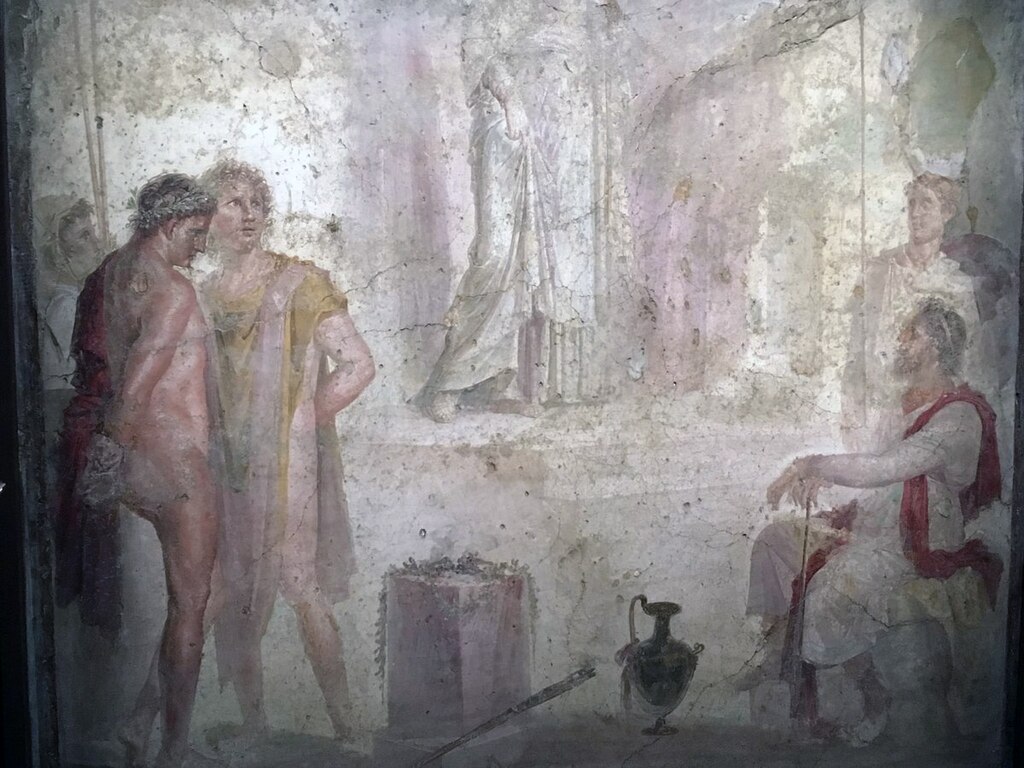
An ancient fresco from Pompeii depicting Orestes, Pylades, and King Phoant. Source: ru.wikipedia.org
The victims are led to the altar, where they are met by… Iphigenia. Surely no one has forgotten that Artemis had transported her to her temple in some sort of comb. Well, those combs are here. Iphigenia and Orestes recognize each other, and it becomes clear that there will be no sacrifice…
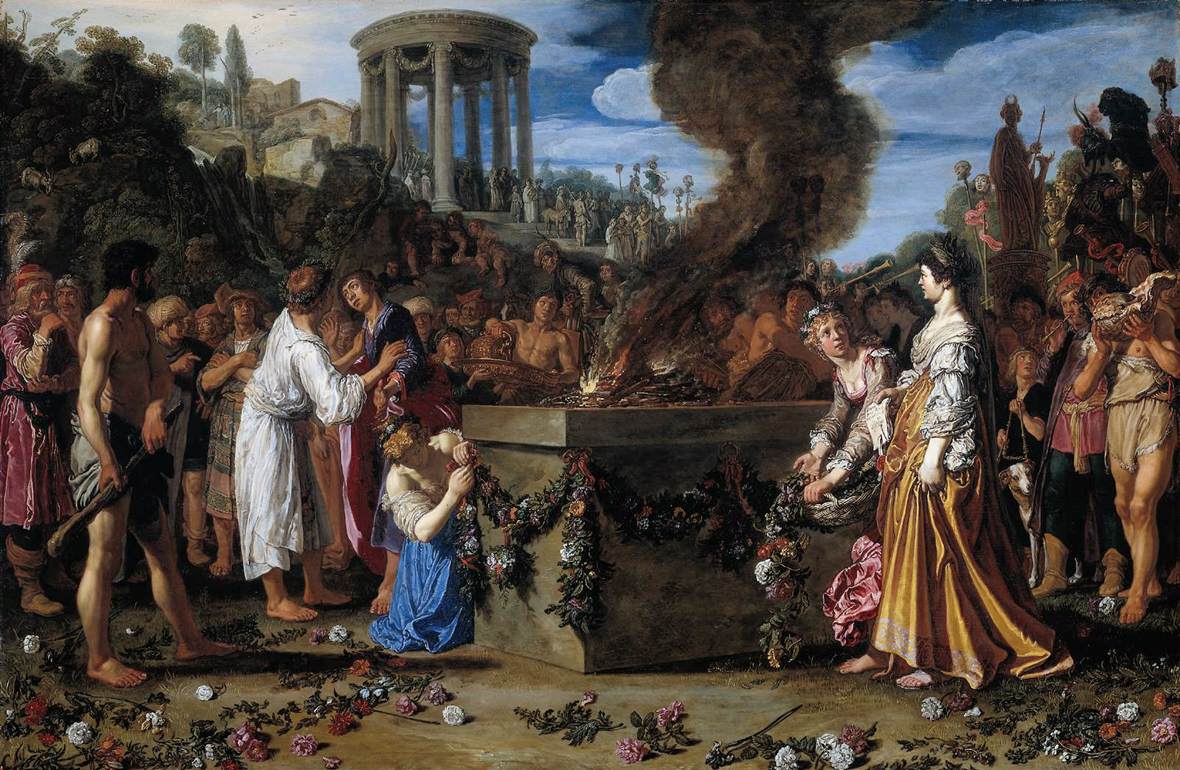
“Orestes and Pylades Are Led to the Altar of Sacrifice.” Pieter Lastman. 1614. Rijksmuseum. Source: ru.wikipedia.org
There are various accounts of how they pulled it off—and even stole the statue. The outcome is the same: the two friends and Iphigenia sail away from Taurida with the statue; Phoant gives chase, and Pylades kills him. The statue was brought to civilized lands—either to Rhodes or to Athens, to the very sanctuary of Brauron.
After all that, Orestes does eventually return to Mycenae. Meanwhile, Aegisthus’s son had taken the throne there… he really shouldn’t have done that! Orestes got married (there are different versions of who he married), and so did Pylades—he took Electra as his wife. One version of the story holds that Orestes quarreled with Neoptolemus over a bride, and that bride was Hermione, the daughter of Menelaus and Helen. If we go by this version, then Orestes killed Neoptolemus and did indeed marry Hermione.
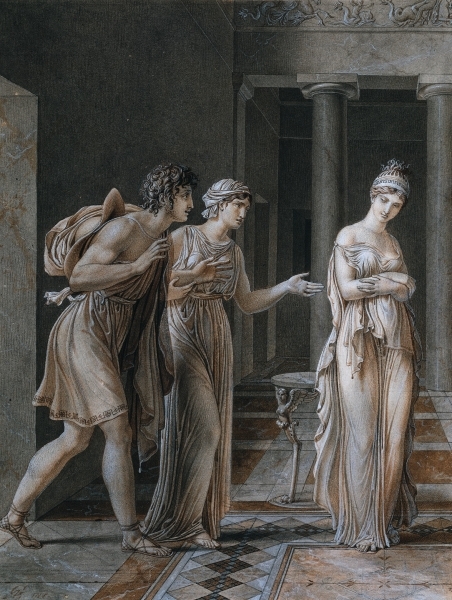
“The Meeting of Orestes and Hermione.” Anne-Louis Girodet-Triozon. c. 1800. Cleveland Museum of Art. Source: ru.wikipedia.org
There are also different versions of how Orestes’s life ended. Either he died while preparing to fulfill the oracle’s prophecy and rebuild Troy, or he left Mycenae to rid it of the plague and died in Arcadia… Take your pick.
One of his sons (according to some accounts) ruled in Mycenae after him.
What is the crux of the problem?
But why didn’t the Furies pursue, say, Clytemnestra herself? Why was Orestes the only one so “lucky”?
Researchers believe that the Furies were pursuing (in this story) the one who shed the blood of a relative. Clytemnestra, of course, killed her husband or helped kill him, but they are not related by blood. They come from different families. Orestes, however, found himself in a situation where any decision would leave him guilty. And he chose to be guilty of taking revenge rather than of failing to avenge the murder.
It is also often said that the final verdict on Orestes—that his act of vengeance for his father was justified—is a consequence of a shift in the importance of kinship ties. The maternal lineage gave way to the paternal, and the interests of the paternal lineage became more important. This is a good explanation, reflecting a certain phase—one that, of course, spanned centuries—of change in archaic society.
That’s what you get for messing with the Erinyes. Listen to the oracle 🙂
источник: https://author.today/post/499873