An article from Alex Raigorodetsky’s “military-exotic” channel on the Blogspot platform.
The name Ivan Pavlovich Bratukhin is far less well-known than those of other helicopter designers. However, it was Bratukhin’s helicopters that provided the practical and scientific foundation whose application accelerated the development of the Mil and Kamov helicopters, making our country a world leader in helicopter engineering. The results of Ivan Pavlovich’s work are significant and diverse. Kamov called Bratukhin’s well-known book *Design of Helicopter Structures* the first work in the world’s literature to systematically organize and scientifically substantiate the methodology for selecting the basic parameters and structural elements of helicopters. He began his work in the “helicopter field” even before World War II and continued after its end, working alongside Yuryev, Kamov, Mil, Kuznetsov, Strizhinsky, and other designers of Soviet helicopters and autogyros. With his participation and later under his leadership, the prototype helicopters “Omega,” “Omega-II,” as well as prototypes of the six-seat B-5 passenger helicopter, its medical variant, the B-9, and the B-10 artillery spotter helicopter. Many projects never made it past the drawing board. The helicopters designed by I.P. Bratukhin were the first Soviet helicopters that actually flew, were easy to control, and were adapted for practical use. But in my opinion, his designs for heavy transport helicopters and “flying cranes” are the most interesting.
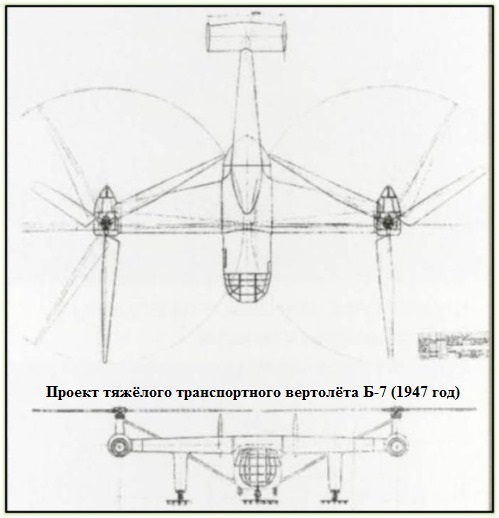
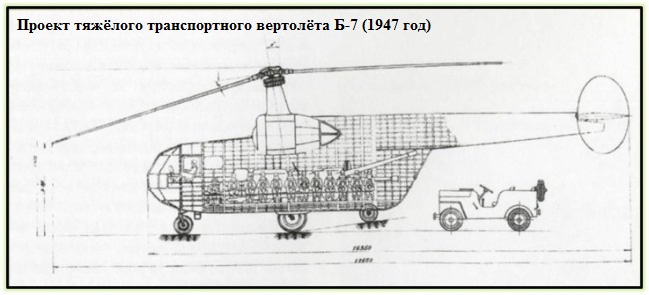
Design specifications: overall length—19.65 m, rotor diameter—16 m, maximum takeoff weight—10 t, powerplant—two ASH-82 engines, each rated at 1,850 l.s., crew—3 people, capacity—30 passengers or 2,000 kg of cargo, estimated speed—225 km/h, service ceiling—5,000 m.
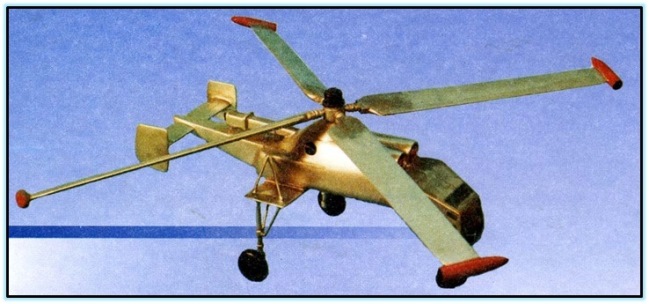
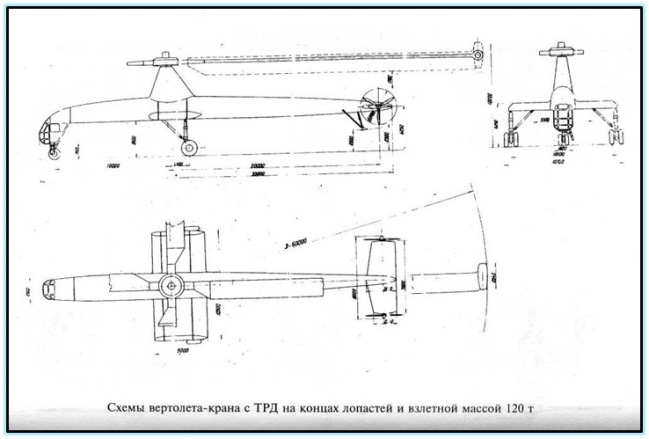
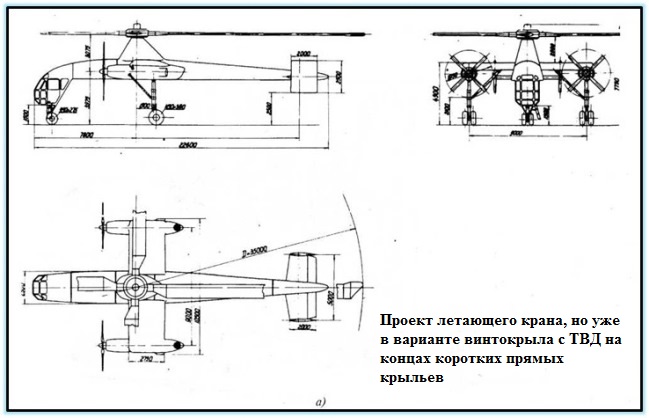
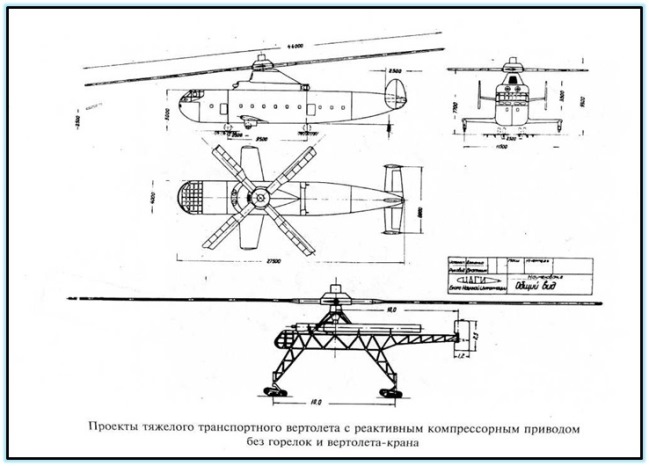
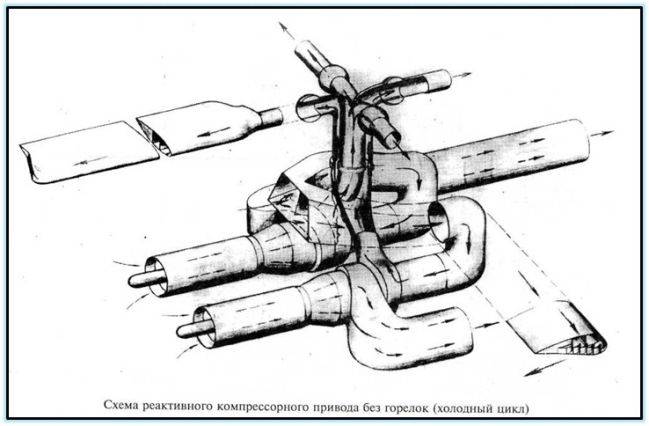
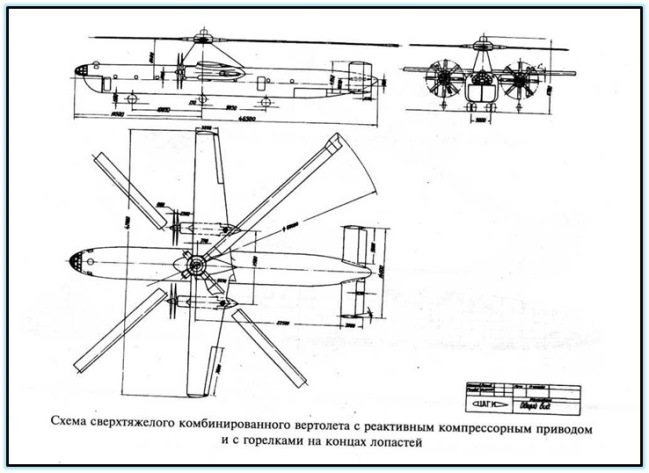
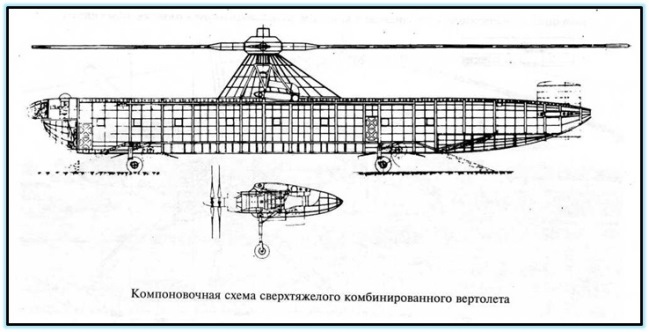
Starting in 1953, Bratukhin led parametric studies at TsAGI on promising super-heavy transport helicopters and “flying cranes” with a lifting capacity of about 60 metric tons, using a jet compressor drive for the main rotor, as well as variants with turbojet engines mounted at the tips of the rotor blades. The results of these studies made it possible to identify the strengths and weaknesses of various jet propulsion methods and, furthermore, to determine the technical level required to develop such heavy transport aircraft.
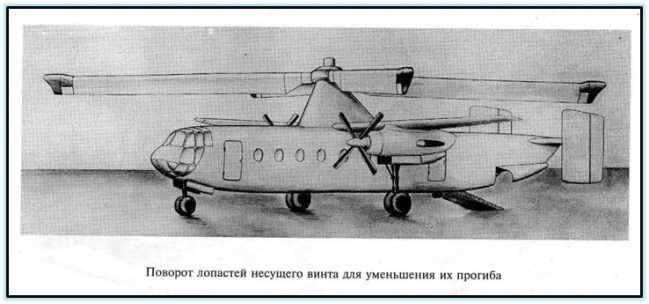
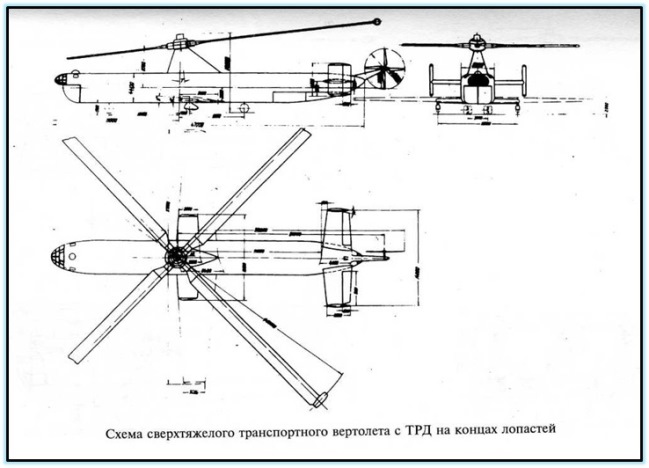
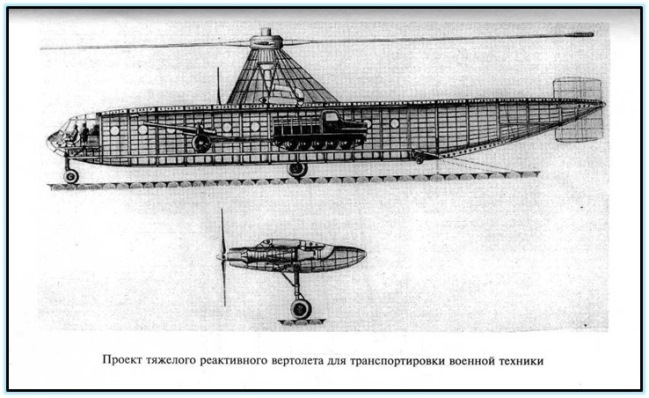
A year later, a design team was formed at MAI to develop a vertical takeoff and landing (VTOL) troop transport aircraft. The work was led by B.N. Yuryev and I.P. Bratukhin. The VTOL aircraft was designed to be powered by four NK-12MV turboprop engines, each with a capacity of 12,000 l.s.; similar engines were used on the Tu-95 strategic bomber. The NK-12MV engines were intended to drive six-meter coaxial propellers.
The layout of the SVVP under development was unique. The aircraft was designed to assume a vertical position during takeoff and landing. The turbojet engines were housed in nacelles at the tips of a cross-shaped wing with a low aspect ratio (which more closely resembled the tail section of a rocket). The aircraft’s fuselage had a rectangular cross-section; its nose housed a two-seat crew cabin, followed by three large cargo compartments. The seats were designed to have locking hinges to ensure the comfort of the crew and paratroopers as the aircraft’s position changed during takeoff and landing.
In 1955–1956, under the direction of I.P. Bratukhin, the BNTU at TsAGI conducted research on other variants of transport VTOL aircraft equipped with propellers. The most thoroughly developed design featured a swiveling wing and coaxial propellers driven by turbojet engines. The power plant consisted of a pair of the same NK-12MB engines. Their power allowed for the transport of cargo with a total mass of up to 5 metric tons at a cruising speed of approximately 700 km/h and a range of at least 1,200 km.
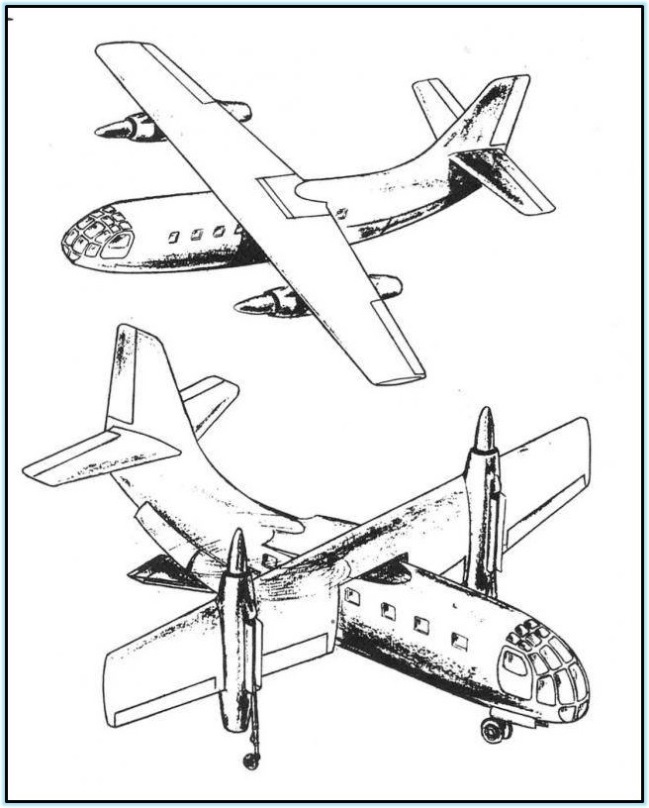
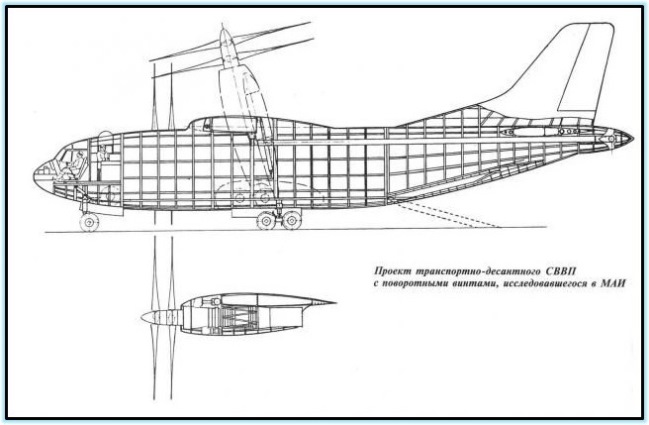
Variants of the SVVP with two, four, and even six coaxial propellers mounted on a swiveling wing were also studied. A design featuring two swiveling wings arranged in tandem was also explored. Later, similar designs were studied in the United States by Hiller and in West Germany by Boelkow (prototypes were built). From 1957 until practically his death in 1985, I.P. Bratukhin served as head of the “Helicopter Structures and Design” department at the Moscow Aviation Institute (MAI).
https://www.secretprojects.co.uk/, https://topwar.ru/
источник: https://military-exotic.blogspot.com/2024/08/1947-1956.html