Winged Ergonomics. The Fairchild XNQ-1 Experimental Trainer Aircraft. United States


An article from more than twenty years ago in the magazine *Le Fana de l’Aviation* (Issue No. 377, April 2001), which I think will be of interest to readers and colleagues.
Contents:
Editor’s Note: The Fairchild T-31 was one of the competitors to the much better-known Beechcraft T-34 Mentor two-seat trainer. Two prototypes were built. The U.S. Navy version, the XNQ-1, has survived to this day and is still flying. The owners of this aircraft guard it jealously and have no intention of parting with it!
Background
In early 1945, the U.S. Armed Forces announced their need for a modern basic flight training aircraft. Three companies responded to the U.S. Armed Forces’ request: Beechcraft Aircraft of Wichita, Kansas; Temco of Dallas, Texas; and Fairchild of Hagerstown, Maryland. Beechcraft modified its Bonanza civilian aircraft into the T-34 Mentor, while Temco redesigned its two-seat Swift sport aircraft into the T-35 Plebe; and Fairchild was the only company that did not modify an existing aircraft; instead, it developed an entirely new aircraft—the Type 92—which the U.S. Air Force designated as the T-31 and the U.S. Navy as the XNQ-1.
The Fairchild 92 was designed by French engineer Armand Thiéblot, to whom Fairchild owed the success of its PT-13, PT-23, and PT-26 training aircraft. This two-seat monoplane, with the student and instructor seats arranged in tandem, featured an all-metal structure and retractable main landing gear; it was the first competitive design proposal submitted to the U.S. military.
Special attention was paid to the cockpit, whose layout marked the first attempt to standardize the equipment across civilian and military versions of the aircraft.

Fairchild paid particular attention to the XNQ-1 cockpit, whose layout represented the first attempt at ergonomic standardization of equipment across civilian and military versions of the aircraft
It was decided that each control should resemble, in both shape and movement, the part of the aircraft it controls; the layout of the controls in the cockpit was to correspond as closely as possible to the part of the aircraft the pilot was controlling, and the controls were to move in the same way as the system being controlled. Thus, when simulating the engine control lever, all controls would be activated when it was moved forward or upward. In addition, to achieve the desired effect, the pilot had to execute each command only once. Furthermore, the controls of the XNQ-1—an aircraft designed to train U.S. Navy pilots— — will be located in the same places as on single-seat carrier-based fighter aircraft in order to simplify and speed up the transition from one type of aircraft to another.
Fairchild built three prototypes: two aircraft for flight testing (the T-31 for the U.S. Air Force and the XNQ-1 for the U.S. Navy) and one aircraft for static testing. Fairchild proposed three Lycoming engines as the powerplant: the 280-horsepower R-680-13 radial engine, the experimental 300-horsepower XR-680-10 radial engine, and the 320-horsepower GSP-580 flat-eight-cylinder geared engine.
The first T-31 prototype took to the air for the first time on October 7, 1946, piloted by Fairchild’s chief test pilot, Richard A. Henson. In 1948, the T-31 prototype was tested with all three proposed engines. The aircraft was later destroyed in an accident during landing.
Saved…
Equipped with a 280-horsepower R-680-13 engine, the XNQ-1 prototype (Aeronautics Administration number [BuAer] 75726) made its first flight on February 10, 1947, from an airfield adjacent to the Fairchild plant in Hagerstown. Subsequently, the aircraft was fitted with a 320-silny GSO-580 engine, the V-angle of its wing cantilevers was increased, and all control surfaces of the tail were enlarged. After further testing, the XNQ-1 prototype was returned to its original configuration.
After the Air Force and Navy aviation branches completed their evaluation program of prototypes from all three aircraft manufacturers, Beechcraft received major orders for both variants of its T-34, equipped with a nose-wheel landing gear. However, in one of its publications, Fairchild claimed that it had won the competition and received an initial order for 100 aircraft. But a revision of the 1949 military budget led to the cancellation of the Fairchild trainer aircraft production program, and Beechcraft was given the green light to begin mass production of its T-34 Mentor.
However, since the U.S. Air Force and the U.S. Navy’s aviation branch continued to show interest in Fairchild’s aircraft, the company received some grants to continue refining its prototypes.
In August 1950, the aircraft were transported to a U.S. Air Force base in Randolph, Texas, for testing. By the end of the year, a joint U.S. Air Force and U.S. Navy re-evaluation program had been completed, and the U.S. Air Force decided in favor of the T-31.
But then, the U.S. Air Force and U.S. Navy aviation commands disagreed on the aircraft’s final configuration, and a lack of funding put an end to Fairchild’s hopes for mass production of its XNQ-1/T-31.

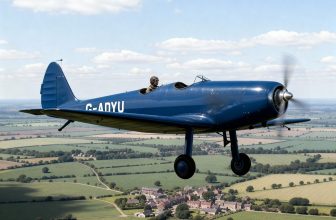
The Fairchild XNQ-1 (T-31 for the U.S. Air Force), equipped with a conventional landing gear, won the basic trainer aircraft competition organized by the U.S. Armed Forces in the late 1940s. However, in the end, the Beechcraft T-34 trainer with a nose landing gear was chosen instead.

The Fairchild XNQ-1 (T-31 for the U.S. Air Force), equipped with a conventional landing gear, won the competition for basic trainer aircraft organized by the U.S. Armed Forces in the late 1940s. However, in the end, the Beechcraft T-34 trainer with a nose landing gear was chosen instead.
Several years later, when competition with Beechcraft and Temco had long been forgotten, the XNQ-1 prototype was transferred to a unit of the Civil Air Patrol, which was based at the now-defunct Beacon Field in Virginia. This saved the aircraft from being lost to history…

A Fairchild XNQ-1 at Beacon Field, Virginia, in the early 1950s. At that time, the aircraft belonged to the Civil Air Patrol
Today, Ann and Don Pellegrino of Rome, Texas, are the proud owners of the XNQ-1 prototype. They first saw this aircraft at a restoration workshop in Waco, Texas, to which the prototype had been transferred by its then-owner, the Aviation Museum in Oklahoma City, Oklahoma. Since the restoration of the XNQ-1 prototype was progressing slowly, the Aviation Museum transferred the aircraft to one of its employees living in Oklahoma. Unfortunately—or fortunately for the Pellegrino couple—this person reneged on his promises, and the Aviation Museum decided to sell the aircraft.

Don and Ann Pellegrino, the proud owners of a Fairchild XNQ-1
Thus, Ann and Don Pellegrino became the owners of the aircraft in September 1982, after having the XNQ-1 prototype transported by road to their estate (which also included a private airfield) in Story City, Iowa.
“The plane hadn’t flown since 1965. When we took it apart, we found numerous nests of rats, snakes, and other pests in the fuselage. Sometimes it took us several days to remove certain parts due to corrosion, but overall, the original Fairchild primer protected the interior of the plane quite well.”
– said Don Pellegrino. A new coating was applied to the undersides of the wing spars, the engine cowling, the center section, and the horizontal surfaces of the tail. A friend who is an engineer and an amateur designer built a new cockpit canopy.
According to Don, the XNQ-1’s design was typical of military aircraft of that era: all-metal, with the exception of the movable surfaces, which were covered with fabric. The exception was the 45°-deflectable flaps, which were covered with metal skin.
The wing spars feature a NACA 2416 airfoil at the wing tips, with a chord length of 2.28 meters, and a NACA 4409 airfoil at the wingtips, with a chord length of 1.19 meters. The wing spars and center section are connected by two stringers. The wing houses four fuel tanks, each with a capacity of 300 liters. The wingspan is 12.61 meters. The ailerons are actuated by a system of cables and pulleys; the flaps are electrically actuated.
The XNQ-1 is 8.28 meters long and 3.67 meters high. The aircraft’s empty weight is 1,327 kg, and its maximum takeoff weight is 1,770 kg. The aircraft is designed for g-loads ranging from +6.7 to –3 g, and its maximum speed is 467 km/h.
Nearly ten years later, after countless evenings and weekends spent restoring the aircraft, the XNQ-1 was once again certified as airworthy. The aircraft was repainted in the same colors it had when it left the factory. Although the XNQ-1 is still equipped with its original 280-l.s. Lycoming R-680-13 engine and a 2.59-meter Hamilton Standard propeller, its instrument panel has been significantly upgraded to enable instrument flight.
In flight
Don and Ann drew lots to decide who would fly first: the Pellegrino couple are pilots, and fate gave Don the chance; he completed the flight without any problems on June 1, 1992.
“As with all radial engines,” Don explains, “you need to spin the propeller before getting into the cockpit. Then you open the fuel and oil supply valves. In the oil supply system, I turned the valve, which, when closed, cuts off power to the starter. I give it a little throttle; the mixture is 1/3 lean, the propeller is set to a high pitch, the battery is turned on (switched to ON), the fuel pump is turned on (switched to ON), the fuel pump is on (switched to ON) until the pressure rises; press the starter and injection buttons, then, after one or two propeller revolutions, set the magneto selector to 1+2.
It takes 30 seconds before the oil pressure gauge needle on the front dashboard begins to move; it takes a few more seconds for the oil pressure gauge needle on the rear dashboard to start moving as well. Immediately after starting the engine, I keep it at low RPM for two minutes to allow the oil pressure to stabilize above 50 pounds (345 kPa) and to let all the engine components “run in.” If the engine is hot or warm, I simply wait until the oil pressure rises above 50 pounds before switching the propeller to a low pitch. While doing so, I keep the engine RPM below 1,000. After five minutes of warm-up, the engine reaches higher RPMs; you can hear this, and the RPMs increase on their own.
The 100-amp electric generator engages at 800–900 RPM; then the red indicator light goes out, and you can turn the inverters and radios ON.
The XNQ-1 is equipped with a tail wheel that rotates 360° and can be locked in place. Taxiing on the ground is performed the same way as on any aircraft with conventional landing gear, except when the turn exceeds 15°. Next, you must unlock the tail wheel by pushing the control stick forward and applying the brake to the right or left. This isn’t very intuitive compared to what’s standard on most conventional-landing-gear aircraft, where simultaneously moving the control stick forward and applying the brakes—with the exception of the T-6—is prohibited. The view over the cowling isn’t all that bad, and zigzagging down the runway is really only necessary when following another aircraft.
For engine tests, the shaft speed is increased to 1,900 revolutions per minute, with the control stick pulled back and the feet on the brakes. Then, depending on the passenger’s weight, the elevator trim is set between 0° and 5° down. I usually use the first flap position for takeoff (the second position is with the flaps fully extended.)”

On the ground, the forward visibility over the hood isn’t all that bad compared to other aircraft with conventional landing gear
When only Don Pellegrino is in the cockpit, the XNQ-1 takes off at a speed of 80 km/h after a 250-meter takeoff run. Its initial rate of climb at a speed of 130 km/h is 300 m/min.
10 years, $10,000
At an inlet pressure of 22 inches and a propeller speed of 1,950 revolutions per minute, the cruising speed is 220 km/h, and the Lycoming engine consumes between 53 and 61 liters of fuel per hour. At maximum load, the XNQ-1 stalls at 74 km/h with flaps extended and at 80 km/h with flaps retracted. Thus, the approach is performed at a speed of 130 km/h, decreasing to 95 km/h during the final approach. The aircraft touches down at a speed of 80 km/h. Typically, the XNQ-1 comes to a stop after a rollout of 300 meters.
“The handling is light and responsive,” Don Pellegrino continues. – “Of course, with a wingspan of more than 12 meters, it doesn’t handle like a Pitts or a Christen Eagle, but the stall—with the flaps extended or retracted—is smooth and flawless.
Without a passenger, achieving a good three-point landing—when the aircraft stalls at a height of 1 centimeter—requires some practice.
With the biplanes mentioned above, I got the impression that my feet had to be glued to the pedals, whereas the XNQ-1 is even less demanding in this regard than our Piper J-3 Cub —I always joke about this with my friends. You might be impressed by the sound of the running engine, but you should understand that flying any other aircraft with a conventional landing gear is more difficult!
Shutting down the engine is the same as with any other radial engine: the propeller is set to a high pitch, spun at 1,000 revolutions per minute, then the engine is cut off, and finally the contacts are opened.
There’s nothing quite like the sounds of a radial engine starting or stopping. Likewise, there’s nothing better than the feeling you get when you’re at 7,500 feet (2,268 m) and look at the wingtips of that enormous wing—it feels like you’re sitting on top of the world.
The nearly ten years it took Ann and me to restore the XNQ-1 is a small price to pay for the pleasure of flying it. I bought this plane for $800 and invested $10,000 in its restoration. I’ve already turned down an offer to sell it for $300,000!
I’m keeping this plane. As of today, the XNO-1 is one of a kind, and flying it is a real pleasure!”

According to Don Pellegrino, during the flight, “when you look at the tips of that enormous wing, you get the feeling that you’re sitting on top of the world.”
Source: Howard Levy; Translated from American English by Xavier Meal, “Fairchild XNQ-1: Ergonomic Training,” *Le Fana de l’Aviation*, April 2001 (377), pp. 75–80
This translation was first published at – https://vk.com/@710541705-krylataya-ergonomika-opytnyi-uchebnyi-samolet-fairchild-xnq