By the end of the war, the enemy sought to compensate for the loss of air superiority by increasing the intensity of anti-aircraft fire. Anti-aircraft artillery fire destroyed the bulk of the Soviet ground-attack aircraft and dive bombers lost during combat operations in 1944–1945.

The threat posed by German rapid-fire anti-aircraft guns to our air force was largely due to their technical sophistication. The design of these small-caliber anti-aircraft guns made it possible to quickly adjust the direction of fire both vertically and horizontally. In most cases, the fire from the anti-aircraft batteries was corrected by the PUAZO, which provided adjustments for the aircraft’s range, speed, and heading.
When used individually, each gun was most often equipped with an optical rangefinder for range correction. German anti-aircraft crews were well-trained, which made their fire accurate and their reaction time short. Often, the Germans were able to fire their first aimed shot as early as 20 seconds after detecting a target. They made adjustments for the aircraft’s changing parameters within 2–3 seconds, using tracer rounds that facilitated these corrections. The probability of hitting a non-maneuvering aircraft with a 20-mm Flak 38 at a distance of 1,000 meters, at a speed of 400 km/h, and with a 20-round burst was approximately 0.01.
The increase in the number of anti-aircraft guns or the use of multi-barrel mounts improved the chances of a hit. The enemy’s anti-aircraft defenses were dense, and the number of guns protecting targets was increasing, so that by early 1945, up to two hundred shells could be fired per second at a ground-attack aircraft operating within the fortified zone.
The increase in fire density led to a rise in the number of aircraft shot down and damaged. In 1943, 1,468 Il-2s were lost to German anti-aircraft artillery fire; in 1944, 1,859; and in the first months of 1945, 1,048 aircraft. This occurred against the backdrop of a decline in losses to enemy fighters. In aerial combat in 1943, 1,090 Il-2s were shot down; in 1944, 882; and in 1945, 369.
Due to the German industrial sector’s inability to sharply increase the production of anti-aircraft systems, aircraft machine guns and cannons began to be converted on a massive scale for use in air defense. Starting in the first half of 1944, systems based on 13–15-mm aircraft machine guns and 20–30-mm cannons played a major role in German air defense.
At the start of the war, 20-mm anti-aircraft guns were widely used: the Flak 28, Flak 30, Flak 38, and Flakvierling 38, as well as numerous 37-mm rapid-fire guns: the Flak 18, Flak 36, Flak 37, Flak 43, and the twin-barreled Flakzwilling 43. There were also 25–40-mm guns captured from other countries.
Despite this, Wehrmacht generals complained of a shortage of anti-aircraft guns to defend against attacks by Soviet ground-attack aircraft. Anti-aircraft artillery was deployed in areas around transportation hubs and warehouses, which compromised the defense of field airfields. Starting in late 1942, the enemy strengthened its defenses by using 20-mm MG-FF turret guns removed from aircraft.
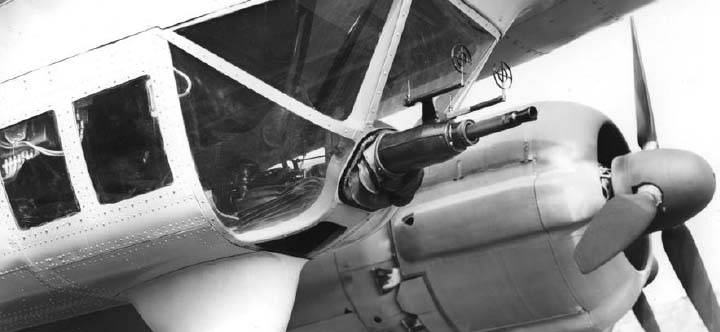
The 20-mm MG-FF cannon in the lower defensive gun position of the FW.200 bomber
In 1936, the German company Ikaria Werke Berlin developed the MG-FF aircraft cannon chambered for 20×80 mm ammunition, based on the Swiss Oerlikon FF 20 mm automatic cannon. The cannon was distinguished by its elongated barrel and modified reloading system. It used 15-round magazines or drums with capacities of 30, 45, and 100 rounds. A 117-gram projectile was fired from the 820-mm-long barrel at an initial velocity of 580 m/s. The gun’s rate of fire was up to 540 rounds per minute; its weight ranged from 26 to 28 kg, and its overall length was 1,340 mm, with a barrel length of 820 mm.
Due to the use of low-power ammunition, the muzzle velocity was modest, and the armor-piercing shells were not very effective. To address this shortcoming, in late 1940, specialists from the Luftwaffe Technical Academy developed a thin-walled high-explosive shell with a high explosive content. This shell was made from special alloy steel using a deep-drawing process and was strengthened by hardening. The charge ratio of the new shell increased from 4% to 20% compared to previous models.
Designated as a “Minengeschoss,” the 20-mm shell contained a mixture of hexogen and aluminum powder, making it twice as powerful as TNT. It was designed for internal explosions within an aircraft, damaging structural elements rather than the skin. A hit by such a shell on the wing root would, in most cases, cause the wing to break off. Minor modifications to the breech allowed the gun to fire these shells, and the upgraded version was designated MG-FF/M. By replacing the breech and spring, many MG-FF cannons were retrofitted at field bases to the MG-FF/M standard. The new rounds improved the gun’s effectiveness against aerial targets, although its effective range did not exceed 500 meters for large, slow-moving aircraft.
However, by the second half of 1941, the MG-FF had become obsolete for modern aerial combat. Its light weight and simple design could not compensate for its shortcomings: low muzzle velocity, low rate of fire, and a bulky magazine. The introduction of the new MG.151/20 cannon, with a more complex but also more effective belt-feed system, led to the gradual phasing out of the MG-FF. Over time, the guns remaining in storage shared the fate of older machine guns and were used on anti-aircraft mounts to defend airfields and small vessels.
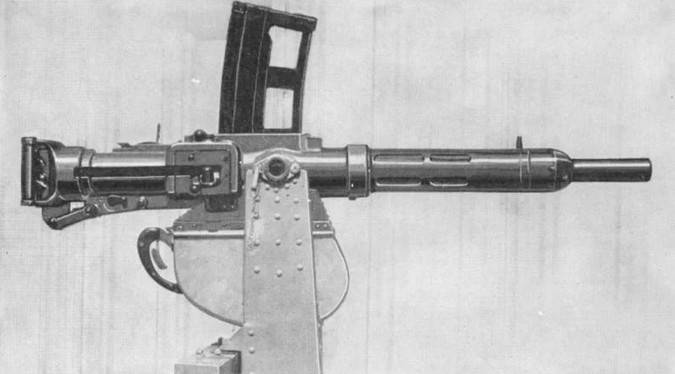
Nevertheless, the MG-FF’s ground-based guns were significantly inferior in range and accuracy to specialized 20-mm anti-aircraft guns, which were originally designed for more powerful ammunition. For example, the maximum effective elevated-angle range of the anti-aircraft version of the MG-FF did not exceed 800 meters.
Around the beginning of 1944, German anti-aircraft units began receiving triple mounts equipped with MG.151/20 aircraft cannons.
The MG.151/20 gun, which operated on the principle of a recoiling movable barrel to which the bolt was attached, was developed by engineers at Mauser Werke based on the 15-mm MG.151/15 aircraft machine gun. With the caliber increased to 20 mm, not only were the barrel and chamber modified, but a more powerful rear recoil spring, a new belt feed mechanism, and a new firing pin were also incorporated.
Several variants of the MG.151/20 were produced: a motorized cannon for firing through the propeller hub, a version with a synchronizer, a wing-mounted version, and a version for use in defensive turrets. The gun weighed 42 kg and had a rate of fire of 750 rounds per minute.

In the non-motorized turret version, the MG.151/20 machine gun was equipped with two trigger handles and a frame sight mounted on a bracket.
Production of the MG.151/20 cannon began in 1940 and continued until the end of the war. This 20-mm cannon was used as the primary armament in various versions of the Bf 109 and Fw 190 fighters, as well as in fighter-bombers, night fighters, and ground-attack aircraft. In addition, it was mounted on bombers in both mechanical and manually operated turrets.
The MG.151/20 fired 20×82 mm rounds. The projectile weighed between 105 and 115 grams. The projectile’s muzzle velocity ranged from 700 to 750 m/s. The ammunition load included not only armor-piercing incendiary and armor-piercing incendiary tracer rounds, but also a high-explosive round containing 25 grams of a hexogen-based explosive.

A belt link with rounds for the 20-mm MG.151/20 cannon
When a 20-mm high-explosive shell struck the armored fuselage of an Il-2, it often caused a hole in it. A hit by such a shell on the fuselage or wing of a Soviet ground-attack aircraft usually destroyed those parts of the airframe, which meant the end of controlled flight.
The ammunition load for the 151/20 anti-aircraft gun originally consisted of a belt containing 20% armor-piercing shells. The remainder consisted of high-explosive, fragmentation-incendiary-tracer, and armor-piercing-incendiary or armor-piercing-tracer shells. However, toward the end of the war, due to a shortage of specialized charges, the proportion of more economical armor-piercing-tracer and armor-piercing shells in the belt increased to 50%. An armor-piercing tracer shell could penetrate 12-mm armor at a distance of 300 meters with a 60° angle of impact.
The German 20-mm MG.151/20 aircraft cannon was highly effective against aerial targets, and the armor of ground-attack aircraft often could not withstand its fire. Combat experience and range tests showed that the Il-2’s armored fuselage often could not withstand hits from 20-mm fragmentation and armor-piercing shells.
A single hit from a 20-mm fragmentation shell on any part of the ground-attack aircraft’s engine was often enough to disable the engine. At times, the holes in the armored fuselage reached up to 150 mm in diameter. The cockpit armor also did not provide sufficient protection against 20-mm shells. On average, it took 6 to 8 20-mm high-explosive fragmentation shells hitting the fuselage to put an Il-2 out of action. The probability of the rudder control cables being severed by shell fragments was very high.
By 1944, there were about 7,000 MG.151/20 cannons and more than 5 million rounds of ammunition for them in storage. The first 20-mm MG.151/20 cannons, adapted for anti-aircraft fire, were turrets removed from damaged bombers. These mounts were used for the air defense of field airfields.
MG.151/20 turret-mounted machine guns were mounted on makeshift supports, such as logs or pipes buried in the ground. Sometimes, a turret-mounted machine gun used for anti-aircraft purposes was equipped with an armored shield. Very soon, factory production of infantry mounts was established; these could be mounted on any sturdy base.
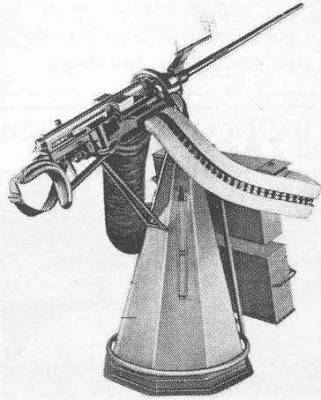
When using cannons in turret mounts to engage aerial targets, no serious difficulties arose; nevertheless, the variants designed for synchronized fire and the wing-mounted versions—which were part of the primary armament of fighters and ground-attack aircraft—required significant modifications when used in anti-aircraft mounts.
The 20-mm aircraft cannons, which were mounted in turrets and used for synchronized fire, were modified at arms factories and large workshops for ground-based use. The main changes involved the reloading mechanisms and the firing mechanism. Electric firing systems and pneumatic reloading mechanisms were replaced with mechanical components, enabling continuous fire when mounted on single-barrel and multi-barrel anti-aircraft systems.
The most well-known anti-aircraft mount equipped with 20-mm MG.151/20 cannons was a triple-barreled mount on a pedestal, known as the 2.0 cm Flakdriling MG 151/20. Mass production of this system began in the spring of 1944; its design and appearance bore a strong resemblance to the anti-aircraft machine gun mount that used 15-mm MG.151/15 machine guns.

A 2.0 cm Flakdriling MG 151/20 anti-aircraft gun at its firing position
Three ammunition boxes were mounted on the swiveling pedestal support below the guns. The front box held a belt with 400 rounds, while the two side boxes each held 250. This method of storing ammunition was due to the fact that loading the front box was more cumbersome than loading the side boxes. The barrels of some of the anti-aircraft mounts were equipped with muzzle brakes, which reduced the muzzle flash that would blind the gunner. The weight of the anti-aircraft mount, including ammunition, exceeded 200 kg.
Aiming the gun mount at the target was not mechanized. The gunner had to exert considerable physical effort to aim the mount at the target. Although the designers tried to balance the guns in the horizontal plane, the angular traverse speed was low, and the inertia during rotation on the turret was very significant. The sighting devices of the 2.0 cm Flakdriling MG 151/20 triple-barreled 20-mm mount were very simple and, in terms of their capabilities, significantly inferior to the 20-mm anti-aircraft guns 2.0 cm Flak 28; the 2.0 cm FlaK 30; the 2.0 cm Flak 38; and the 2.0 cm Flakvierling 38.
Nevertheless, an anti-aircraft gun with a total rate of fire exceeding 2,000 rounds per minute posed a serious threat to low-flying aircraft. A significant advantage of the belt-fed 2.0 cm Flakdriling MG 151/20 guns, compared to the 20-mm quadruple 2.0 cm Flakvierling 38, was the ability to fire long bursts of greater duration. This required only one gunner, whereas operating a magazine-fed 20-mm quadruple anti-aircraft gun required a crew of eight. When the ammunition load included armor-piercing tracer rounds, the gunner of the 2.0 cm Flakvierling MG 151/20 adjusted the lead angle based on the tracers.
It is currently impossible to determine exactly how many anti-aircraft guns were built using MG 151/20 aircraft cannons, but judging by the numerous photographs in which they appear, quite a few of these anti-aircraft guns were produced.
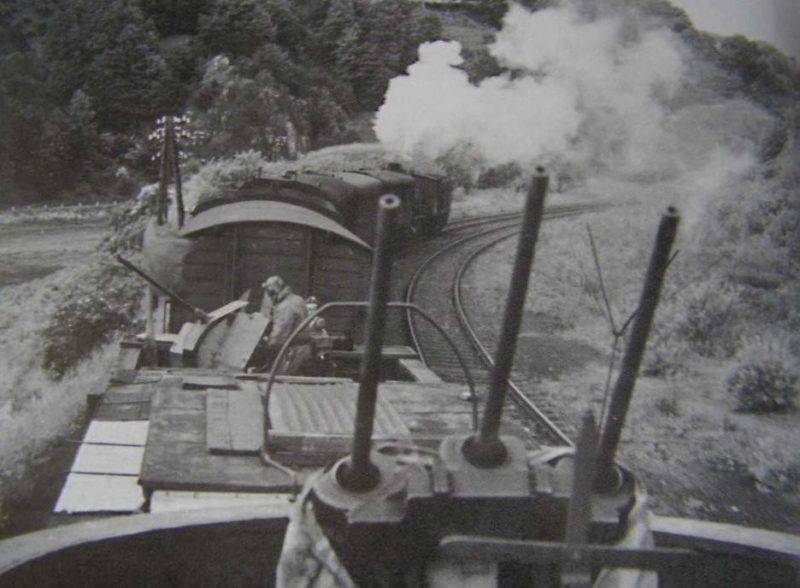
The 2.0 cm Flakdriling MG 151/20 triple-barreled mounts were often installed either as fixed installations for facility-based air defense or mounted on towed four-axle trailers with various levels of armor, road and rail vehicles, including air defense armored trains.
The SdKfz 251 family of half-track armored personnel carriers was most commonly used as an armored chassis to mount the 2.0 cm Flakdriling MG 151/20. Initially, the anti-aircraft guns were mounted on armored personnel carriers with an open rear deck. While this provided the gunner with good visibility, he was protected from bullets and shrapnel only by an armored shield at the front.
Later, the Sd.Kfz.251/21 self-propelled anti-aircraft gun entered production, protected on all sides by 8–14.5 mm of bulletproof armor. The artillery mount itself was housed in an armored box.
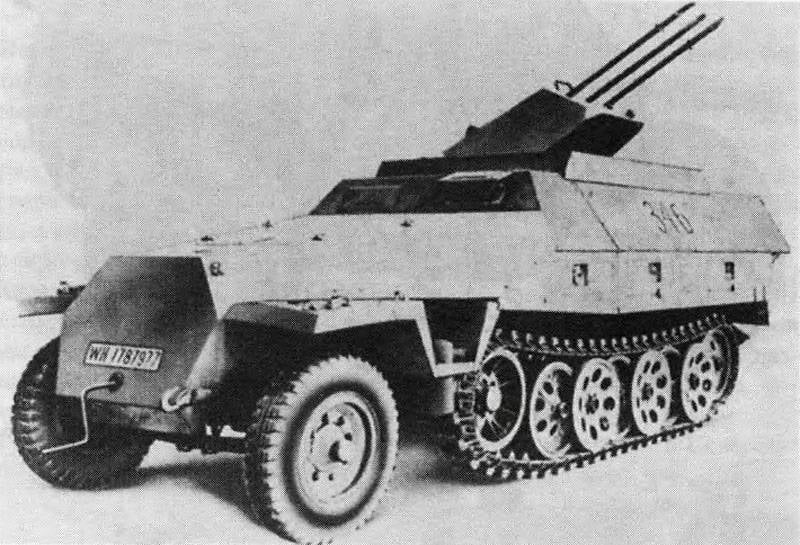
They were capable of firing not only at air targets but also at ground targets. According to American combat reports, the Sd.Kfz.251/21 self-propelled anti-aircraft guns were very frequently used on the Western Front to support ground forces. Based on their overall characteristics, the Sd.Kfz.251/21 self-propelled anti-aircraft guns can be considered among the most successful German models built on a half-track chassis.
This self-propelled anti-aircraft gun, despite its relatively low cost and decent mobility and cross-country capabilities, possessed high firepower and could effectively engage aircraft, as well as strike lightly armored targets and enemy personnel. However, the Germans did not have time to produce many of these self-propelled anti-aircraft guns. From October 1944 through February 1945, German industry managed to produce approximately 150 armored personnel carriers armed with mounted gun turrets. This successful self-propelled anti-aircraft gun appeared too late and had no significant impact on the course of the fighting.
When discussing German anti-aircraft systems based on aircraft cannons, one cannot fail to mention the 30-mm MK.103, which was among the most successful examples of aircraft armament developed by German designers during World War II.
The MK.103 aircraft cannon was designed by Rheinmetall-Borsig AG in 1940. This weapon fired a powerful 30×184 mm round. The MK.103 30-mm cannon weighed 145 kg without ammunition. A box containing a belt for 100 rounds weighed 94 kg. The operating mechanism was of a mixed type: the extraction of the spent cartridge case, the feeding of the next round, and the advancement of the belt were achieved by a short recoil of the barrel, while the recoil of the powder gases was used to cock the breech and clear the barrel bore. The MK 103 gun was fed from a metal loose belt containing 70–125 shells. The rate of fire was up to 420 rounds per minute. The direct-fire range was 800 meters.
The weapon’s design is fairly simple and reliable. According to Soviet experts, the main drawbacks were the high impact loads during automatic firing and excessive recoil, which limited the use of 30-mm cannons on single-engine fighters. In terms of its overall combat performance, the MK.103 occupied an intermediate position between the 23-mm VYA aircraft cannon and the 37-mm NS-37.
A 455-gram armor-piercing projectile with an initial velocity of 760 m/s could penetrate 32-mm armor at a range of 300 m. Subsequently, a sub-caliber armor-piercing tracer round was developed for the 30-mm aircraft cannon, which, at a range of 300 m and when striking at a 60º angle, could penetrate 50-mm armor.

30-mm rounds for the MK.103 aircraft cannon
The most effective rounds for engaging aerial targets were the 330-gram 3-cm M.-Gesch. o. Zerl. high-explosive shell, containing 80 grams of TNT, and the 320-gram 3-cm M.-Gesch. L’spur o. Zerl., loaded with 71 g of phlegmatized hexogen mixed with aluminum powder. By comparison, the Soviet 37-mm fragmentation-tracer shell UOR-167, weighing 0.732 g and included in the ammunition load of the 61-K anti-aircraft machine gun, contained 37 g of TNT. A direct hit by a 30-mm high-explosive shell on any part of the Il-2 ground-attack aircraft resulted in critical damage.
Production of the MK.103 continued from mid-1942 until February 1945, and a significant number of unused 30-mm cannons had accumulated in Luftwaffe warehouses, which led to their use in anti-aircraft mounts.
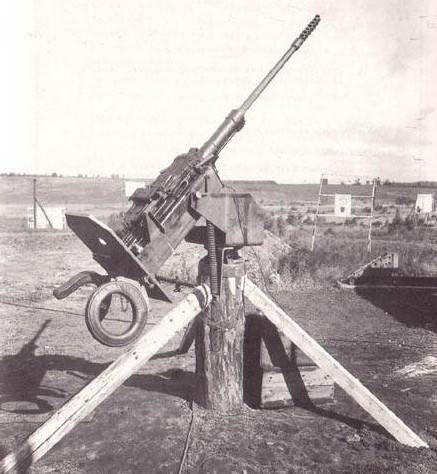
In the initial phase, as was the case with other aircraft machine guns and cannons, the MK.103s were mounted on makeshift anti-aircraft mounts. In the summer of 1943, the first 30-mm cannons were mounted on primitive and rather crudely made turrets. In this way, the Luftwaffe’s ground crew attempted to strengthen the air defense of airfields.
In the summer of 1943, Waffenfabrik Mauser AG created the 3.0 cm Flak 103/38 by mounting an aircraft cannon onto the 20-mm Flak 38 anti-aircraft gun mount. Although this anti-aircraft gun was largely a wartime stopgap measure, it was, on the whole, quite successful.
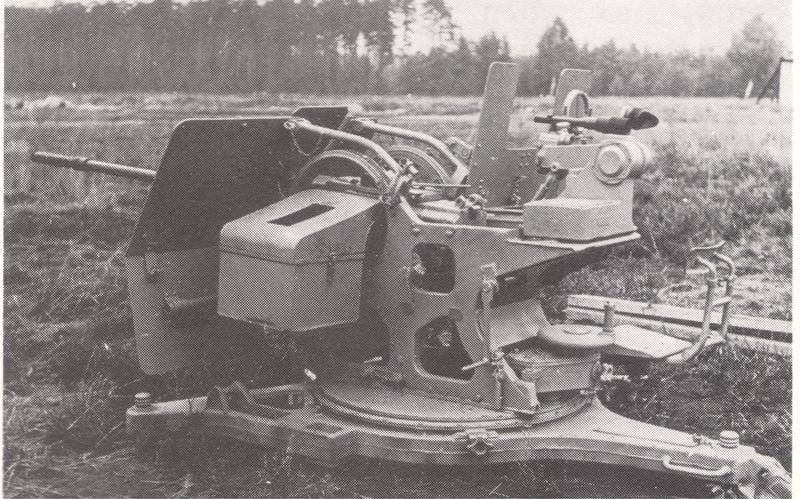
30-mm 3.0 cm Flak 103/38 anti-aircraft gun
Compared to the 20-mm 2.0 cm Flak 38, the new 30-mm Flak 103/38 anti-aircraft gun was approximately 30% heavier. The weight of the 3.0 cm Flak 103/38 in transport configuration was 879 kg; after removing the wheeled undercarriage, it weighed 619 kg. According to expert estimates, the effectiveness of the 30-mm anti-aircraft gun increased by about 1.5 times.
The effective firing range increased by 20%, but the combat rate of fire rose significantly thanks to the use of a belt feed system and a 40-round magazine. At the same time, the destructive power of a 30-mm shell was approximately twice that of a 20-mm shell. Thus, to shoot down an armored attack aircraft or a twin-engine dive bomber, it generally took no more than two or three high-explosive tracer rounds or a single hit from a high-explosive shell. Since the heavier 30-mm shell lost its energy more slowly, the maximum range for firing at aerial targets at an angle was 5,700 m, and the maximum altitude was 4,700 m.
Single-barrel anti-aircraft guns based on the MK.103, mounted on the standard 20-mm 2.0 cm Flak 38 anti-aircraft gun carriage, were used in a towed configuration and mounted on various self-propelled chassis. Very often, the 3.0 cm Flak 103/38 anti-aircraft guns were mounted on Austrian Steyr 2000A trucks.
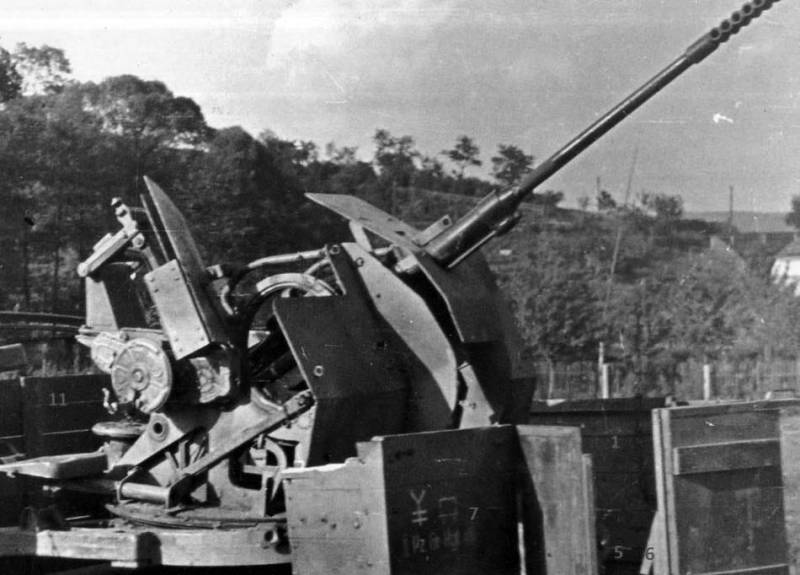
30-mm 3.0 cm Flak 103/38 anti-aircraft gun mounted on a Steyr 2000A truck chassis
To reduce production costs, the cab was designed as an open-top model. To protect against the elements, an awning could be mounted on removable arches over the driver’s station and the cargo bed. Apart from the armored shield, the crew of the improvised self-propelled anti-aircraft gun had no protection from bullets and shrapnel and was vulnerable to them.
30-mm aircraft cannons were also mounted on self-propelled anti-aircraft guns based on the Czech-made Pz. Kpfw. 38(t) light tanks. Externally, this vehicle was almost indistinguishable from the Flakpanzer 38(t) self-propelled anti-aircraft gun equipped with a 20-mm automatic cannon.
In late 1944, the 3.0 cm Flakvierling 103/38 was developed, modeled after the 2.0 cm Flakvierling 38 quadruple 20-mm anti-aircraft gun. Externally, the 30-mm quadruple mount differed from the 20-mm version in that it had longer and thicker barrels equipped with a multi-chamber muzzle brake.
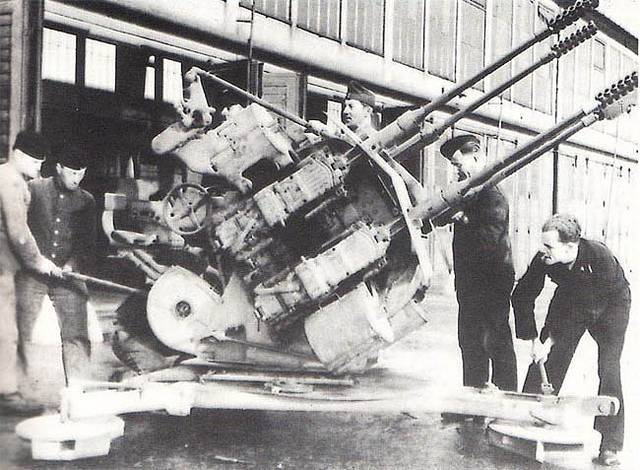
3.0 cm Flakvierling 103/38 Quadruple 30-mm Anti-Aircraft Gun
Compared to the quadruple 2.0 cm Flakvierling 38 mount, the weight of the 3.0 cm Flakvierling 103/38 in combat configuration increased by approximately 300 kg. However, the increase in weight was more than offset by improved combat performance. The total rate of fire was over 1,600 rounds per minute. When using armor-piercing shells, 12 kg of molten metal flew toward the enemy every second.
The Wehrmacht high command had high hopes for the 30-mm quadruple mounts and planned to equip the Flakpanzer IV Wirbelwind self-propelled anti-aircraft vehicles with them.
In terms of firepower, the 3.0 cm Flakvierling 30-mm anti-aircraft gun was unmatched at the time and posed a serious threat to both combat aircraft flying at low altitudes and tanks.
In total, approximately 500 30×184 mm anti-aircraft guns were assembled at German and Czech factories. Germany’s limited resources, the relentless bombing of its defense plants, and the Red Army’s successes prevented the production of a sufficient number of 30-mm anti-aircraft guns to have a significant impact on the course of the war.