Why were 45-mm cannons, despite being obsolete, still being produced right up until the end of the war?

The history of these guns is quite complicated, and it has raised (and perhaps still raises) many questions. During the Soviet era, of course, no inconvenient questions were asked—not even why our 45-mm guns looked so remarkably similar to German 37-mm anti-tank guns. It was originally believed that the Red Army used equipment and weapons designed by Soviet engineers and manufactured by Soviet factories. It was not permitted to think otherwise.

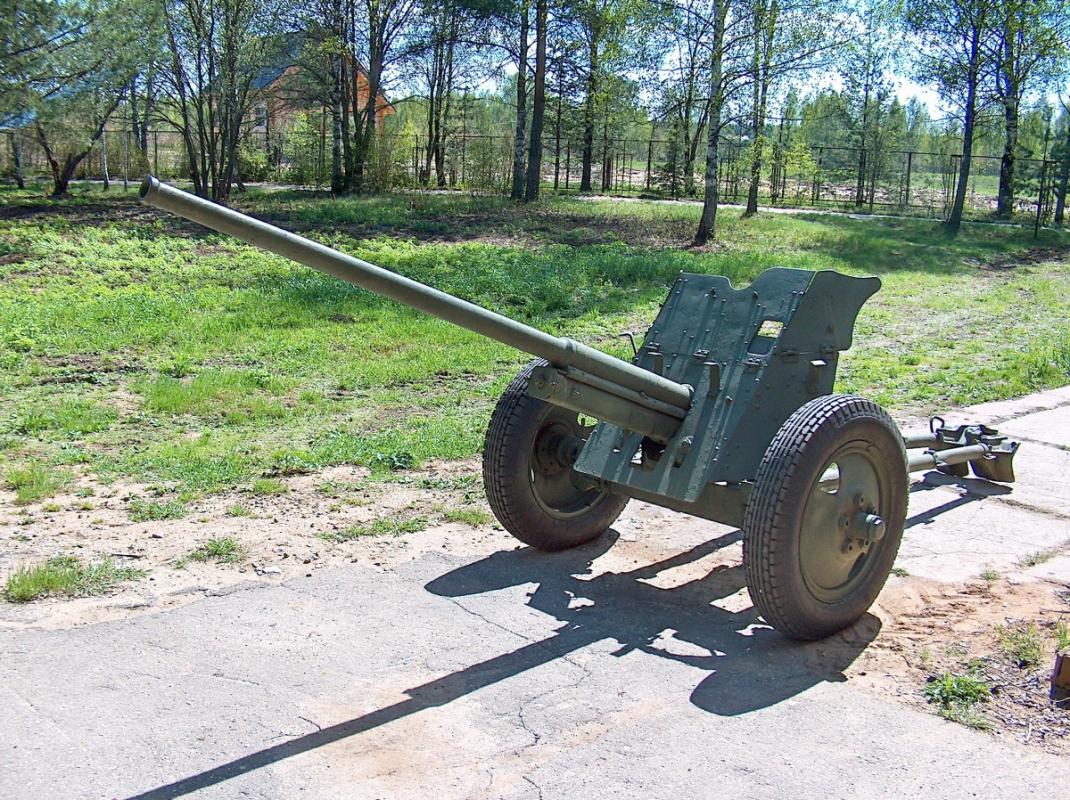
When the Soviet Union ceased to exist, the public was finally told that the 45-mm antitank gun was not entirely the creation of Soviet designers. Instead, it had been created in a makeshift workshop at Plant No. 8, based on a 37-mm gun purchased from Germany, which was adopted as the 37-mm anti-tank gun, Model 1930.
However, in recent years, it has come to light that the 45-mm gun was also designed by German engineers at our request (incidentally, not only at our request—the same gun, but with a 47-mm caliber, was offered to the Netherlands).
In any case, the Red Army first adopted the 45-mm anti-tank gun, Model 1932, and it was later replaced in production by the 45-mm gun, Model 1937.
All Soviet books state that our “45-mm gun” was the most advanced weapon in its class and could penetrate the armor of all contemporary tanks. This is generally true, based on prewar experience and reference data on the tanks of that era. However, just before the war, in late 1940, production of the 45-mm guns was halted. The reason for this was intelligence reports indicating that the Wehrmacht was developing new tanks with frontal armor of 80 mm or more, against which the “45s” would, of course, be useless. It is sometimes claimed that either our intelligence was mistaken or the Germans deceived us, but this is not true. In this particular case, intelligence reported accurately. A whole line of tanks was being developed in Germany, ranging from small vehicles designed to directly support infantry to heavy and super-heavy breakthrough tanks. And their frontal armor was indeed supposed to be between 80 and 120 mm thick. It’s another matter that some of these designs never went into production, and some were produced in small batches only after the war had begun, but overall, there was a very serious reason to focus on developing more powerful anti-tank weapons (and specialized units).
True, before phasing out one type of gun, it would seem logical to first prepare to introduce its replacement, but… that’s a question for the Soviet leadership and production planning. To replace the “45s,” a powerful 57-mm gun was developed, better known in our country by its factory designation, ZiS-2. It was a good gun, but it had a serious flaw—Soviet industry was never able to master its production. The defect rate was astronomical, and as a result, the gun was taken out of production. Later, using Lend-Lease equipment purchased specifically for this purpose, production of the gun was resumed, but again without much success.
Perhaps a much more promising project was the 57-mm antitank gun using the barrel from a 76-mm Czech mountain gun, but this weapon never progressed beyond the conceptual stage. It could have turned out to be something similar to the British 6-pounder antitank gun.
Even more powerful 107-mm guns were being developed. But as a result, the Red Army had nothing but the “40-pya” after the war began.
Furthermore, after the war began, it became clear that the prewar assumptions about the “45s’” inability to fire effectively at German tanks had proven correct. And not against the 80-mm armor they had been promised, but against 30-mm frontal armor.
Soviet sources typically cited reports stating that 45-mm guns effectively destroyed all German light tanks, while medium tanks were hit in the side and rear. And this was presented as a success. In reality, however, the conclusion was the opposite, and these very reports pointed to the ineffectiveness of the “forty-fives.” The very fact that work on a replacement began as early as 1941 speaks volumes.
The new weapon—the 45-mm anti-tank gun, Model 1942—though outwardly almost identical (only the barrel was longer), used different ammunition and was significantly more powerful. However, the new gun did not prove to be a saving grace for tank destroyers, as the realities of the battlefield demanded new, even more powerful guns.
Apart from the “45s,” the Red Army had only the 1942-model 76-mm divisional guns, which bore the brunt of the fight against German tanks starting in 1943. The 85-mm anti-aircraft guns also played a huge role—and not just at the start of the war—becoming the Soviet Union’s most powerful anti-tank weapon (there’s no point in mentioning the 100-mm guns — they appeared too late and in too small numbers to play a significant role).
However, despite all of the above, production of 45-mm guns continued in the USSR in both 1943 and 1944. Moreover, this included not only new ones—the 1942 model—but also older ones—the 1937 model.
This may seem strange, especially since by the end of 1943, the armies of all countries had, if not completely abandoned guns of the same class as our “40-pya,” certainly taken them out of production.
However, I don’t think there’s anything surprising about this. First of all, the Wehrmacht had quite a few light armored vehicles that the “40-50s” could take on.
Second, the 45-mm guns were capable of firing at more than just armored targets. The British, in fact, never developed high-explosive fragmentation rounds for their equivalent 2-pounder anti-tank guns. It is worth noting here that after the Red Army adopted the 37-mm anti-tank gun, the military sought a 45-mm caliber gun precisely because they wanted to increase its high-explosive fragmentation effect. This would allow them to fire on infantry and firing positions—in other words, to have a gun capable of supporting infantry. Of course, a 45-mm caliber is a bit underpowered against infantry, but… it’s much better than 37 mm.
And it must be said that in this second role, the “40-50s” performed exceptionally well. They easily supported the infantry under any conditions. There are plenty of newsreel clips showing a crew rolling out a “40-pytka”—even if most of them are staged. During urban combat, the 45-mm guns were even rolled up to the upper floors, and firing at the enemy in a neighboring building with a cannon is much more effective than with a machine gun.
By the way, the “40-pytka” was also perfect for the partisans—almost all partisan brigades had these guns, and along with 50-mm mortars, they made up virtually the entire arsenal of partisan artillery. As for German tanks, the partisans did encounter them, but only extremely rarely, and even then, these tanks were mostly old, captured ones.
So the “45s” saw plenty of action on the front lines right up until the final days of the war, and that alone is reason enough not to halt their production. However, I don’t think anyone would argue that if the Red Army had had a worthy replacement for the 45-mm guns, the “forty-fives” would have been phased out. But… there was nothing to replace them with. Although it’s often stated that production of the 45-mm guns was halted in 1944 in favor of the more powerful 57-mm guns, production difficulties persisted with the latter, and they never managed to be produced on a sufficiently large scale.
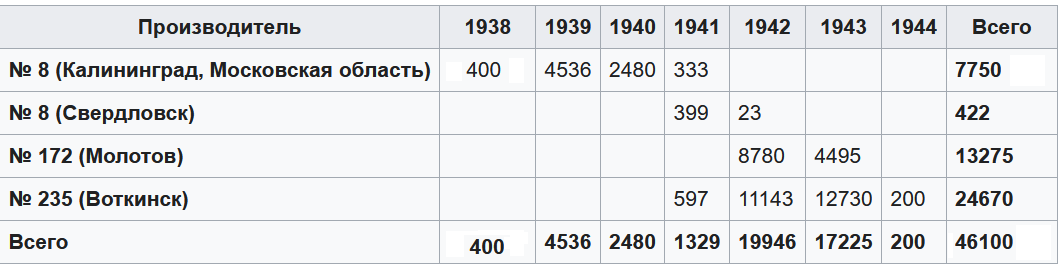
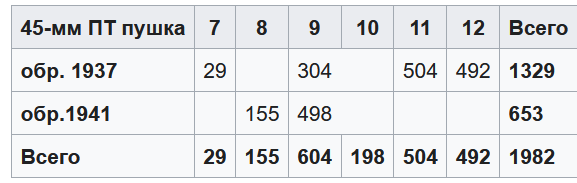
To illustrate this, I think data on artillery production will be useful.
Production of 45-mm Model 1932 anti-tank guns

Production of 45-mm anti-tank guns, Model 1937
Monthly production of 45-mm anti-tank guns, Model 1937, in 1941.
Production of 45-mm anti-tank guns, Model 1942

Source — https://dzen.ru/a/ZrxT6Y2hWXAstqDO