The History of Rus' After Its Adoption of Western Christianity. Part 50. Family Matters

Grand Duke Vladimir Petrovich was born in 1691. His father, the young Emperor Peter I Fyodorovich, wanted to name his son Peter, but the emperor’s mother, the widowed Empress Maria Ivanovna Sheina, insisted on the name Vladimir, which had already become a tradition among the Rurikids.
Although Vladimir had been the heir to the throne from the very beginning, he received little attention. He grew up withdrawn and unsociable, spending much of his time in solitude with his books, and was the complete opposite of his younger brother, Grand Duke Alexander Petrovich, who was known for his lively, energetic disposition and was his father’s favorite, whereas Vladimir was closer to his mother. It is no surprise that when the royal couple left the Grand Palace, Peter I Fyodorovich took his younger son with him to the Mainhertz Palace, and Empress Sophia Christianovna took her older son with her to the Porphyry Palace, which soon became known as the Danish Palace.
Even then, Peter I Fyodorovich was considering changing the law of succession and bequeathing the throne to his younger son, whom he considered more capable. Vladimir was engrossed in chivalric ballads, while Alexander showed a keen interest in military and engineering matters, as well as in politics, and often visited his father when the latter was at war with Romania.
Vladimir was raised by his mother. He spoke Russian and German fluently; he used the latter to communicate with Sophia Christianovna and her court, among whom he grew up. Rumors circulated throughout the capital and all of Russia that the heir to the throne, under his mother’s influence, was showing a tendency toward Protestantism.
The first open conflict between father and son occurred in June 1706. Against the backdrop of the War of the Monsters’ Coalition, Peter I Fyodorovich attempted to place Sophia Christianovna under house arrest, but Vladimir was outraged by his father’s action and rallied the guards of the Danish Palace, despite his mother’s objections and the resistance of the Abyssinian Guard that had arrived on the scene. During a brief skirmish, he was wounded, whereupon the palace guards ceased their resistance, and the empress was ultimately placed under house arrest.
That same year, Grand Duke Alexander Petrovich died of smallpox, much to the great sorrow of Peter I Fedorovich. Now he had only one son left—his unloved firstborn.
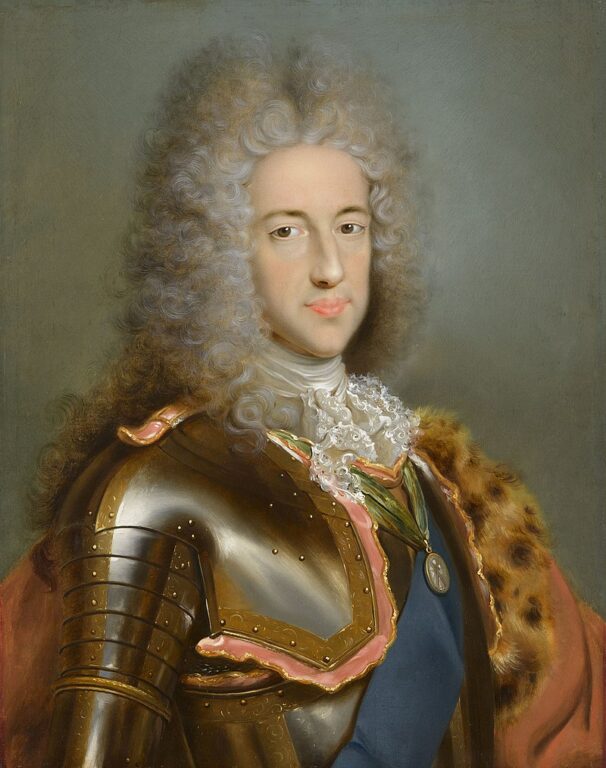 Grand Duke Vladimir Petrovich
The year 1706 was, for the most part, an unfortunate one for Peter I Fyodorovich. In addition to the above, that year saw a large-scale uprising led by Kondraty Bulavin, and in December, the emperor was seriously wounded by an unknown assailant; while he lay wounded, hovering between life and death, a power struggle broke out in the empire, and Vladimir declared himself regent, but few were eager to follow the orders of a teenager, especially while the emperor was still alive. Soon, Peter I Fyodorovich recovered and changed his mind about allowing his son to participate in state affairs.
In 1711, Peter I Fyodorovich married his son to a foreign princess, Charlotte Christine of Brunswick-Wolfenbüttel (Charlotte Ludvigovna), the daughter of Prince Ludwig Rudolf of Blankenburg. It was a political marriage intended to strengthen ties between the two dynasties—Charlotte Ludvigovna’s sister, Elizabeth Christina, was the wife of Emperor Charles VI.
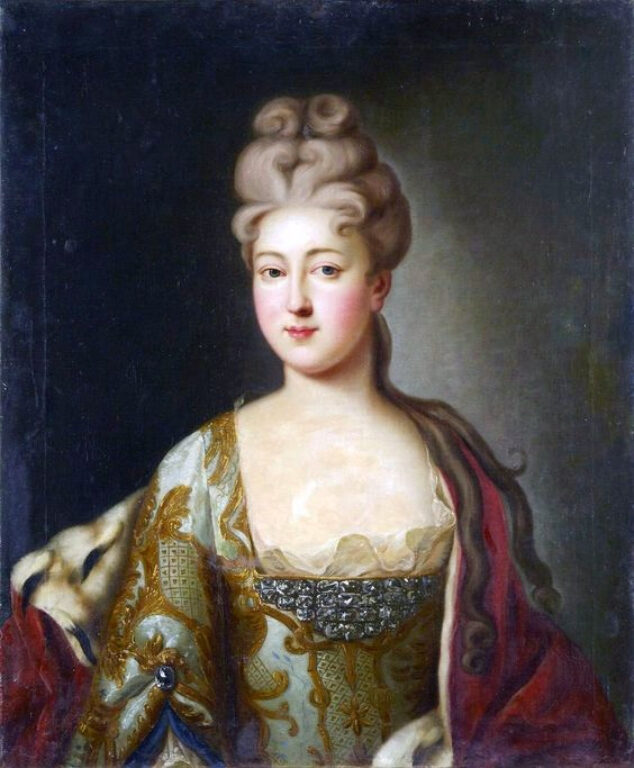 Grand Duchess Charlotte Ludvigovna
The marriage did not last long; in 1712, Vladimir Petrovich and Charlotte Ludvigovna had a son, Peter, and in November of that same year, Charlotte Ludvigovna died of a cold.
In 1715, Empress Sophia Christianovna, who had not lived with her husband for quite some time, decided to leave Russia for good and return to Denmark. Vladimir volunteered to accompany his mother, and although Peter I Fyodorovich understood the situation, he had no apparent reason to forbid it and did not stand in his son’s way.
The emperor’s fears were confirmed—Vladimir, due to deep disagreements with his father, decided not to return. Peter I Fyodorovich summoned his son home, and when the latter ignored him, he excluded him from the line of succession and stripped him of his right to inherit the throne. The following year, the famous “Act on Succession to the Throne” was issued.
Vladimir did not stay long in Denmark; he soon moved to Vienna—a city he had come to like when he and his fiancée, Charlotte Ludvigovna, were guests of Emperor Charles VI, with whom he had a friendly relationship.
Upon learning that Charles VI had taken his son in, Peter I Fyodorovich immediately severed diplomatic relations with Vienna and assumed the title of “Emperor of Rome,” to which he had some claim following the annexation of Constantinople.
However, Vladimir soon left Vienna and traveled to Denmark to be with his mother. The fact was that Hungary’s top officials had devised a plan to use Vladimir as their puppet in an intervention against Rus’ and had proposed him to their king, Geza III. Vladimir feared that the Hungarians would secretly offer Charles VI a large sum to hand him over, and that the cunning Austrian would not turn down the opportunity to make an easy profit, so he hurried to leave.
However, Geza III rejected this plan, considering such an undertaking too dangerous.
Upon returning to Denmark, Vladimir married a wealthy widow, Baroness Anna Bons, and settled with her on a small estate in Jutland. They had four children: Sofia, Andres (Andrei), Jørgen (Yuri), and Alexios (Alexei).
Though he missed his homeland, Vladimir did not long for his father or the imperial court in the least, calling it hypocritical and insincere—a place where no one cared about who he really was, which is why he was forced to constantly put on a facade. Vladimir spoke just as unflatteringly of the Danish and Viennese courts.
I think it’s worth noting that under Peter I Fyodorovich, the imperial court lost its former splendor and grandeur. The emperor lived outside the city, in a small palace, and after the death of the widowed Empress Alexandra Apraksina, the court was left completely bereft.
Vladimir often visited his mother, but Sofia Khristianovna, who always welcomed her son warmly, never once came to his secluded estate, as she did not wish to make such long trips.
After Vladimir Petrovich was removed from power, it was no surprise that the obvious replacement for the prince who had fled was his son, Grand Duke Peter Vladimirovich, whom his grandfather had taken in. For reasons that remain unclear, Peter was not officially named heir to the throne, most likely due to his young age. If Peter I Fyodorovich had died without a will, the younger Peter would have become emperor, and until he came of age, his uncle, Grand Duke Eustafy Fyodorovich, would have served as regent. In turn, Grand Duke Evstafy Fyodorovich began to lay claim to becoming the new heir himself, and his cousin, Grand Duke Ivan Yuryevich, also entered the race for the imperial crown.