You could call it the trendy term “side-well.” To some, the ending of *Become a Shadow for Evil* might seem lackluster (to me too, since the characters did all the most important things a little earlier), and here comes the moment of truth, which slightly contradicts the logic of the previous narrative, but why not take advantage of SAC**?
_____________*
“In anticipation of dazzling happiness”—a line from the movie *The Dawns Here Are Quiet*.
** SAP — Sacred Authorial Arbitrariness.
Two admirals from the same country, even though their countries have different names. And who, by God’s inscrutable ways, met so that… I won’t spoil it.
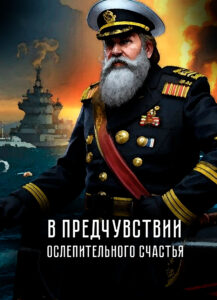
July 28, 1904. The Yellow Sea.
Wittgeft.
“Your Excellency, it seems they’re no longer bothering you even on the *Poltava*”—the orderly Vasilyev had stopped standing at attention before the rear admiral, whom he held in the highest esteem; rather, his posture now simply expressed respect for the utterly exhausted “His Excellency.” The Japanese squadron was falling behind. Wilhelm Karlovich Witgeft, Rear Admiral of His Majesty’s Imperial Fleet. What the hell kind of fleet was that? A ragged bunch of little ships, like sheep, with no other point of reference, stretched out in a timid column in the wake of the flagship, doomed to follow it.
“Well, they gave us a couple of hours, and then we’ll be in deep trouble again—and that’ll definitely be the end of us,” Witgeft mused resignedly. Unaware of the losses inflicted on the Japanese, he knew his own all too well. They were still holding their ground for now, but the range-finding posts were destroyed, the guns knocked out. Coal consumption was running high. Togo will finish them off—no doubt about it. These strange demons who’ve taken it upon themselves to help that dim-witted Japanese admiral. Just look at these macaques—they’ve given themselves titles just like ours, those of enlightened seafarers. Call yourself the viceroy of the illustrious daimyo, or the shogun of all Japan’s seas and their surroundings. But no—just passing by, having bought a few little ships on credit from the sea usurers, they sort of reluctantly noticed, “Hey, we’re not just scraping by on a shoestring here either; we’ve long been members of your maritime club, and we’re sort of the chairmen here, so to speak. Since when did the proud descendants of the samurai wear epaulets? Huh? And you’ve never had daggers or sabers in your lives, clanging away with delight at all sorts of kukumorisas and takanas made of shoddy iron—or whatever it is you have there, God forgive me…
But during the battle, those Roburs with their invisible rattles—as the sharp-eyed messenger assured us—had already flown over the *Tsarevich* three times, taking aim… So I’ll go down to the bottom, I suppose, a complete jerk and a wimp—that’s all we’re destined for.
All right, let’s have lunch, and we’ll see what happens. Maybe we can pull off some more tricks to keep the number of Orthodox Christians down today… No, we’ll hold out until the very end, even though my sour expression this morning is putting all my subordinates in a gloomy mood. We’ll keep playing dumb, trying both not to anger the powerful visitors and not to lose completely.
— I’m watching… I’m watching…
The signalmen are shouting from the right wing of the bridge. Well, it seems Nikolai Mikhailovich trained the crew well, but look at that—something’s got them stumped. Shouldn’t Kedrov, who was sent there, be hanging around? And, at eighteen cable lengths away—if Wilhelm Karlovich has his courses and timing straight in his head—the cruisers under the command of that drunk Reitzenstein should be poking around.
“What are you staring at, country bumpkin?” — yeah, Ensign Ellis was laying into his subordinates. It would have been interesting to listen, but the signalmen’s frantic chatter was drowned out by a strange rumbling. The sound of a mechanism vigorously churning the air—it couldn’t have been anything else.
“Vasily, move to the starboard side! I’ll be right over.”
There was a temptation to order a ten-point turn to starboard so that the source of the sound would come into view of the prearranged scene—the admiral’s chair and Vasily Vasilyev, huddled next to his 47-mm “Gochkins.” But a sailor, like some kind of rattlesnake, had already slithered past the wheelhouse, and after a few heartbeats, he emerged from there with a dazed look in his eyes.
“They’re here, Your Highness! The Roburs, if I may report.”
And without waiting for the ship to make a sharp turn, the source of the sound loomed before the admiral. Of course, the sailors weren’t trained to report flying ships, so they hesitated. The rumbling airship, its deafening roar pounding their ears, was now clearly visible to anyone who could look directly along the battleship’s course. There it was, emerging from behind the wheelhouse… No, it didn’t look like the elegant flying chest that he and Vasilyev had seen in the Port Arthur roadstead during the last attack by the fire ships. Nor did the little craft resemble the “cigar case with wings” that Roshchakovsky had seen. It was a heavy, sturdy machine, resembling a giant coffee grinder. Without the slightest hint of invisibility, transparency, or ethereality.
On board, even to Wilhelm Karlovich’s untrained eye, one could make out rivets and what appeared to be small streaks of rust. The fast-spinning blades of the two propellers beat the resilient air without the slightest regard for the spectators’ eardrums. There was not the slightest doubt that this machine, with a cabin as spacious as a carriage, was real and operated on perfectly understandable principles. It was something like Leonardo’s “helicopter”—perfection itself—our very own Da Vinci. Although the blades, whistling at breakneck speed, could in no way have been made of starched linen, as the genius of the High Renaissance had proposed. Vasilyev’s dandyish, sleek, flat-topped cap was made of linen—and in the very same second, it flew overboard, swept away by a sudden gust of turbulent air.
“I’m receiving signals from the Ratier lamp!” the signalman reported in a trembling voice. “Az, Rtsy, Kher, Izhitsa…”
For crying out loud! They were firing at us from an unidentified aircraft… “Arkhipych, don’t shoot!”
“What do you mean, ‘Archipych the Star’?” Matusevich asked in bewilderment as he rushed out of the conning tower.
“That’s me, Your Highness,” Vasilyev whispered softly, stepping away from his little cannon. And immediately putting on a “clueless” expression, he assumed an extremely preoccupied and focused look, adjusting the sights on his little gun. The unknown vessel briskly cut across the battleship’s course and, with the grace of a harbor tug, swung its bow around, revealing to the spectators a strange flag painted on its hull. Aesthetically, it resembled the St. Andrew’s Flag—the same blue design on a white background. But two strange red squiggles were alarming. It looked like a star and something else odd.
Just as he was thinking about the flag, a door opened in the side of the craft, and a tiny human figure (I’ve never seen anything like this, not even at the Chinizzelli Circus! — Witgeft gasped inwardly) nimbly leaped down, clinging to a very thin but apparently sturdy rope. It was a good hundred fathoms down; the pilot of this flying coffee grinder was clearly afraid of snagging the battleship’s Martian landing pad, and the distance was quite considerable. If she fell, there’d be no bones left to gather. However, the figure—like some sort of little spider, with her legs courtly clasped together—descended confidently until the “Tsarevich’s” bow-mounted twelve-inch turret lay directly beneath her feet.
“Kedrov! Forward!” Vitgeft barked in a manner that was uncharacteristic of him and completely undiplomatic. Oops, I think I got carried away—you can’t talk to Mikhail Alexandrovich like that. Although the lieutenant couldn’t hear him anymore, and having figured out on his own what to do, he clambered up the ladder to the platform in front of the conning tower, with a dashing… but let’s not go into that; let’s leave it at that—he leaped dashingly onto the stack of sailors’ bunks stacked against the port side of the forepeak. In a flash—and there stood his Imperial flag officer… In short, after a few more heartbeats, clanging his dagger against the brackets on the conning tower, he appeared before the stranger, who remained on the armored dome in a politely expectant posture.
Kedrov.
The stranger, clearly a military man, was most likely a sailor—after all, where have you ever seen an infantryman or a cavalryman in a dark blue uniform? Strange, of course, but who knows what goes on in the minds of people flying in these coffee grinders with unfamiliar flags? He was wearing… Imagine that—a tie! Yes, the uniform came with a tie! At least he’s not an admiral—he’s not wearing epaulets.
There, the ensign—a second after appearing on the tower—straightened his jacket and raised his arm in a military salute.
“At ease, Comrade Senior Lieutenant,” the stranger said, waving his right hand in a conciliatory gesture; he clearly knew firsthand what the Drill Regulations entailed. “Rear Admiral Nikolai Mikhailovich Babuev of the Soviet Navy. I’ve come here as part of a cultural exchange.”
— Let me. I… I’m not the oldest.
“You will. You will, my dear Mikhail Alexandrovich. And believe me, you’ll become an admiral—as the so-called rear admiral of some strange country, Nikolai Mikhailovich glanced around in his usual way—just that, you hear?” Stand by Karlych; it’s not easy for him right now. We should have a quiet chat with him, without any outsiders—you know what I mean?
All this familiarity and the absurdity of the situation made the lieutenant’s head spin a little. But tea isn’t a young lady—we have no right to—. Although, where on earth would the rank of senior lieutenant come from in the Russian Imperial Navy? Nonsense. After lieutenant comes lieutenant commander, and we won’t even go any further than that.
“Please follow me,” Kedrov nodded, and led his guest to the bridge. Flag Officer Kedrov sincerely considered composure to be his guiding principle, although today it seemed that principle might be put to the test.
“Thirteen thousand in deadweight, you say,” Nikolai Mikhailovich muttered—not exactly under his breath, but certainly in a very confidential tone. “I’ve got a destroyer that’s just under seven thousand—can you believe it? Well, you’ll see when the time comes.”
Wow. His Excellency had come down from the deck level to greet them and was now standing near the battery of 7.5-centimeter Canné guns by the conning tower. Introducing himself as a vice admiral from some unknown fleet, Babuev shook hands in a friendly yet businesslike manner with Witgeft, who maintained a poker face, and immediately gave Vasilyev a friendly wave:
“I humbly thank you, Vasily Arkhipovich, for not shooting me; I’ve heard a great deal about your integrity.” “Wilhelm Karlovich, we need to talk for an hour or so. Could Mikhail Alexandrovich join us? I’ve been told he’s involved in this matter as well.”
Vasilyev.
If sailor Vasilyev were asked right now whether he was scared or intrigued, he wouldn’t know how to answer. He was incredibly intrigued, but scared as well. It was no joke—the mysterious gentleman in the strange uniform had, as his very first act, expressed his respect for him. And he darted into the saloon along with Their Excellencies and Their Honors. And there he was… Faced with questions from the officers—even the commander of the *Tsarevich* himself, Captain First Rank Ivanov, was pressing him to find out how this Babuev had learned that they shared the same name? Both Nikolai Mikhailoviches… Vasilyev would have felt more at ease if his cap hadn’t flown off in a burst from that crazy coffee grinder. Now he’s in for it…
“Brother, you’re the one in the know here, so go on down,” said Chief of Staff Matusevich, deciding to take charge. “They’ll be making some tea and cookies down there right now; offer them to Wilhelm Karlovich. If they ask for anything else, dash down there right away. And you, Nikolai Mikhailovich, please give the order to serve dinner.”
Instantly, a coordinated movement of officers and enlisted men took shape, a procession through corridors and decks, and within ten minutes the sailor found himself standing in front of the saloon door, holding a samovar, while the boatswain and the steward stood nearby, carrying trays with canapés and crimson-tinted glasses clinking around a bottle of Shustov cognac. What pleased Vasilyev most of all was that he was once again wearing the peaked cap he’d brought down from the quarterdeck in a hurry. Their Excellencies had permitted, as I recall, that we drink without regard for rank, and we’ll probably go…
“That’s the kind of pie it is, Wilhelm Karlovich,” said the strange admiral of a nonexistent fleet, warming a glass in his hand. It was probably not the first glass he’d warmed—it was clear the man was so cozy he couldn’t bring himself to do anything else. “Don’t mind me—I’ve just come out of a battle, so to speak. Although this battle, so to speak, won’t take place for another eighty-six years.”
“May I ask…” Kedrov was about to interject, but Babuev waved him off.
— It’s possible, but a bit pointless. To describe how we fired at the SASHOV mother ship—which was launching airplanes toward us that flying faster than the speed of sound? I did it, Lieutenant. Sorry, I didn’t realize. The rank of “senior lieutenant” won’t be introduced in your service for another two years. I lost half my squadron, but I did it.
“Allow me to congratulate you”—His Excellency’s voice was far from ironic. It was clear that the old man was genuinely happy for his colleague.
— I congratulated myself, too. And then—boom… Night, street, streetlight, pharmacy. Oh, right, you haven’t written that poem yet. Anyway, some guys showed up at my place… They said you know them and call them “croupiers.”
— Let’s just say we suspect they exist.
“What a treat for you, Your Honors!” Babuev exclaimed in admiration. “You’re waging war as if you were at a resort. I don’t even have time to think about the Roburs, let alone whether I’m a horned man.”
— Nevertheless, your awareness…
— Just as we were sending the *Carl Vinson* to the bottom, I rushed over to the secret agent and said, “I found something interesting…” That’s a representative of the Secret Chancellery on the ship.
— Do you perhaps still have the full cast of *La Bayadère* there?
“Thirty-eight thousand metric tons of displacement, just a moment. But just a moment, because the main thing…”—the admiral (if we’re to take this pleasant little fellow with a single shaggy star on his epaulet at his word) deftly poured himself some more cognac. And… Our guy—why hold back? He downed it in one gulp; Their Lordship actually winced. But Their Excellency—as solid as a rock—took a swig for himself, too.
“In short, it turns out I’m an alternate history, you see?” And seeing that I didn’t understand, Nikolai Mikhailovich continued:
— None of that ever happened. Some Roburs flew over to us, about five years “before.” And they messed everything up—who knows what. They rewrote it all, changed it. My war didn’t happen; there was no battle. They didn’t kill Peskarik, and Rumyanov, the dead pilot of the airplane, didn’t fall from a height of eight thousand sazhens into the ocean. There was no Mr. Farnheil, who let the whole world go to hell.
— As we understand it, Makarov didn’t die here either; the *Steregushchy*, which hadn’t surrendered, didn’t sink; and Stepanov, the disgraced commander of the *Yenisei*, didn’t take his own life.
— Well, you guys have a chance here to get the story back on track, but we don’t. It’s all going to fall apart over there. They cut out the entire storyline involving us. To be honest, though, they made me an offer I couldn’t refuse.
Vasilyev seemed to intuitively understand what Their Excellencies and Their Nobility were talking about, but he was daunted by the new horizons that had opened up for him to contemplate. “Never mind them—I’ll shoo them away right now and bring some more pastries from the mess hall, or else they might get bored, and that wouldn’t do. The Japanese will surely be here soon, and the admiral needs a clear head.”
Kedrov.
— Why such a strange method?
— Energy, damn it. For them to bring something here from their own time—that would take an ocean of energy. But for my little ships to get to you, it takes several times less effort—just 85 years. And the bill from the Final Reality Renderer will be much lower, since my “Kirov” was cut up for scrap in 2002. Basically, the savings are obvious. Everything will be taken care of. My “Kirov,” even though it’s worn out and not a single “Granit” is left, still has a couple of “Rastrub” missiles, eight torpedoes, and a hundred of them in half a truckload. Don’t make that face, Lieutenant. Can you imagine the power of the Whitehead mine, which has been perfected over 85 years? Based on the experience of two world wars, no less? Oh, you don’t know what a world war is? Well, thank God for that. Although, it looks like you’ll have to live to see one.
— What will happen after you support us?
— As soon as the croupiers decide that we’ve pulled the blanket far enough over to where it’s supposed to be, we’ll be off the hook.
— Excuse me?
— An honorable discharge to the reserves. Retirement. The Roburs will take us in. Maybe they’ll find a job for some of us—look at my friend Peskarik; he made a career for himself there. He’s the second deputy commissioner now. Or maybe we’ll go fishing and bask in the sun. But that’s not for sure—we still have to win.
Wittgeft.
— Karlych, cut that out. If you rush into a counter-course, Togo will pull away “all at once,” and as soon as your old-timers get into formation two cable lengths further north, he’ll close in again. Does he have a two-knot advantage?
“Around two, actually.” Wilhelm Karlovich, who had been somewhat taken aback at first by the guest’s familiar manner, realized it had been worth it, because the exchange of ideas was proceeding at an almost unimaginable pace.
— So why are you targeting “Fuji”? Once we take him down, Togo will be bummed, of course, but then he’ll run even faster. It’ll just go to your head, that’s all.
— I agree with that, but we need to reduce the Japanese firepower. I’m trying to pin down the “Garibaldians,” but they scatter in all directions like cockroaches every time.
— So, take a three-point turn to the left, and let him go around you. You just have to turn the wheel once, but it’ll take them at least twenty minutes to get their aim right.
“Look, Mikhalych”—Vitgeft FORCED himself to be more direct in the conversation; he had to keep up. “If your self-propelled mines are guided by the wake, then fire from right here…”
“Ah, what a smart dog!” Babuev exclaimed admiringly. “But listen, if anyone misinterprets your signal and charges ahead, they’ll get a good shot across the bow.” I won’t be able to call my torpedo and say “cancel.”
— Here’s what my guys won’t do: they won’t push forward across the flagship’s path. I’ll take the opposite course; you lay a mine. The *Mikasa* won’t adjust its aim for another three minutes, and by then your mine will be in position.
— It’ll be here soon. I’ll fire off a “Rastrub” for a job like this. The fish have a long way to go, but then—boom—something falls from the sky. The fish will start working at night. We’ll show them what a destroyer attack is all about. That’s all. Your “Karlych’s boys” need to scour the sea, search, fire, and report. Otherwise, they won’t understand how it is that no one found anything, yet a couple of Japanese battleships didn’t make it through the night. And in the morning, you’ll go back into battle. You’ll crush whatever’s left.
— We’ll have to hang around near their squadron.
— I’ll send you a couple of cable-launchers with radios; I’ll be coordinating. Kedrov’s a smart guy—he’ll mark everything down. You’ll be able to see them on the map as if they were right there. If you can’t handle it—we’ll take out a couple of destroyers from fifty cable lengths away in total darkness. Our hundred-caliber gun fires a shell per second, even more.
— Where am I going to put them?
— The Kapleits? Give them a cabin, or they can sleep right here in the saloon. And introduce them to the crew in the wardroom—there’s food and all that.
— I’m talking about radio stations.
— Oh, don’t make me laugh. Have you seen a sailor’s bunk? That’s what their stations will be like. We’ll guide you with a directed beam, and the Ka-27RC will be circling overhead. Just make sure… Karlych. Don’t stand by the wheelhouse slits. You guys have such a mess with those slits—a steam locomotive could fly right in there, let alone a piece of shrapnel. If you get killed, the commissar-croupiers won’t have time to pull you out. Who am I going to go fishing with when I get discharged?
Witgeft let out a heavy sigh.
— Zema, what the hell! You’re the one who did this to him, that Jap. He’s completely freaked out right now, about to commit seppuku. A quarter of his guns are knocked out; if it weren’t for the new guns from the Nagls, he’d be meeting Zinovy Petrovich with his ass hanging out. He was already about to give up when the Robury heard about it, and that’s when they went after you and that other guy… This is your victory. Historians—the civilian ones, of course—are berating you for your lack of initiative, but the sailors watch your maneuvers and quietly seethe with envy whenever the Battle of the Yellow Sea is reenacted. You wiped the floor with him! You literally wiped the floor with him, with a weaker squadron and less well-coordinated crews.
When your fight was going on, I was thinking to myself, “If only that fool—pardon me—hadn’t been sitting in his chair, everything would have turned out perfectly.” But here’s the thing: it turns out you, Karlych, are, no matter how you look at it, a hero of the new generation. A heroic deed without glory. I don’t know if I’d have had the guts to do something like that. To do the best I could, but to have people in the know turn up their noses at the mere mention of your name.
Anyway, the helicopter has already taken off. We’ll be in touch soon, and I’ll make sure everything goes smoothly with the *Kirov*. Let’s sync our watches. See you on the fishing trip. And don’t forget—we’re saving these cross-eyed folks and their descendants, both now and in the future.
Vasilyev.
A strange admiral with a fuzzy star on his epaulets, giving a sailor a friendly pat on the shoulder, was clambering up the tower, while that strange coffee grinder was already hovering in the sky. The strange officer who had jumped onto the deck a minute earlier (was there anything not strange today, I wonder?) was already muttering with a detached expression into a black tube—similar to a telephone Vasilyev had once seen—about the Japanese squadron approaching from the starboard side, its course and speed. “That’s the sharp-eyed one,” Vasilyev thought, feeling a pang of jealousy.
“Arkhipych!” Babuev suddenly shouted, having already grabbed the step of the boarding ladder. “Hey, you. Come on in if you need to. I won’t hurt you.” Just don’t go trying to be a hero today, okay? It’s usually the scared ones who try to be heroes—you’re not like that. You live your life as steadily as you breathe; I respect that. Take care. Here’s to our next meeting, as they say.
“In anticipation of dazzling happiness!” Vasilyev exclaimed with understanding, his nerves suddenly on edge at that very moment. He had definitely heard that somewhere; it couldn’t have just popped into his own head. A sense of melancholy that he would most likely never see or find out. Still, he could think about that later; Japanese ships were closing in on their column from the north…