The History of Rus' After Its Adoption of Western Christianity. Part 53. Emperor Eustace I Fedorovich

Grand Duke Eustace Fyodorovich was born in 1667 to Emperor Fyodor II Vladimirovich and Empress Maria Ivanovna Sheina.
He spent his childhood at his father’s court, and after his father’s death, he moved with his family to the village of Bogolyubovo. In 1686, following the assassination of Grand Prince Simeon Fedorovich, the widowed Empress Maria Sheina fled to Izhorsk, under the protection of the powerful Governor-General of Izhorsk, Boyar Prince Afanasy Mikhailovich Mamonov. Grand Prince Ivan Yuryevich soon joined them.
Evstafiy Fyodorovich was not very educated, did not like to read, and wrote with mistakes his entire life, yet he had a working knowledge of French and German. The Grand Duke had an extensive library, though it was little more than a tribute to the fashion of the time; he himself hardly ever used it.
During the Peter Revolt of 1689, he stood by his brother, Grand Prince Peter Fyodorovich, and after the latter’s accession to the throne on September 7, 1689, Eustafy Fyodorovich became a confidant of his mother, who had sidelined her son from the governance of the country. Peter I Fyodorovich attempted to counterbalance her influence by appointing Boyar Grigory Semenovich of Kholm, a prince of a appanage principality, as chancellor and imperial advisor on internal affairs, and Boyar Alexei Semenovich Shein as Imperial Counselor for Military Affairs, soon granting him the rank of field marshal. But Alexei Shein was the nephew of the widowed Empress Maria Sheina, and Grigory Semenovich, a pleasant conversationalist, a gallant gentleman and a handsome man, had completely charmed her, and these two became Maria Sheina’s closest aides.
As for Evstafiy Fyodorovich, he was something of a secretary to his mother; she loved and doted on her son, but treated him with indulgence and did not heed his opinion, so that, no matter how much he might have wanted to, he had no influence whatsoever.
The Dowager Empress Maria Ivanovna Sheina died on August 4, 1694, after which Boyar and Appanage Prince Grigory Kholmsky and Boyar Alexei Shein, who had managed to form an alliance, simply pushed the young Grand Duke to the periphery. However, he did not remain sidelined for long—in 1695, the Governor-General of Izhora, Admiral Boyar Prince Afanasy Mamonov, passed away, and the emperor appointed his younger brother to succeed him. Eustafy Fyodorovich immediately set out for Izhorsk.
However, Evstafiy Fyodorovich soon lost interest in the affairs of his province and began to spend his days in unbridled drunkenness. He had a passion for expensive clothing (apparently inherited from his father) and was drawn to luxury and sybaritism. Grand Duke Evstafiy Fyodorovich headed the Izhora Governorate for nearly twenty-seven years, but it was actually governed by a succession of vice-governors: Ivan Fyodorovich Turgenev, Yakov Nikolayevich Rimsky-Korsakov, Stepan Timofeyevich Klokachev, and Feodosy Feodosyevich Manukov.
Around 1701, Evstafiy Fyodorovich took on a favorite—a young valet named Stepan Petrovich Neledinsky-Meletsky. Evstafiy Fyodorovich was so attached to him that many considered Stepan to be his illegitimate son. Evstafiy Fyodorovich himself had never been married, a fact attributed to his bad temper. And in 1708, he even appointed Stepan as his vice-governor, but Peter I Fyodorovich, who kept a close eye on his relatives, simply would not allow it, and Stepan Klokachev remained vice-governor.
After Grand Duke Vladimir Petrovich had effectively fled abroad, Evstafiy Fyodorovich remained in the capital, and it was he who persuaded his brother to adopt the “Act on Succession to the Throne,” and in doing so, he pursued his own interests, seeking to secure the crown by bypassing the emperor’s grandson, Grand Duke Peter Vladimirovich. Grand Duke Ivan Yuryevich also sought the crown; however, to their great disappointment, Peter I Fyodorovich never considered his brothers as heirs and held them in low esteem, regarding them as idlers and drunkards.
In early 1722, trouble began to mount for Evstafiy Fedorovich; on January 14, he was removed from his post as governor-general and imprisoned in the Oreshek Fortress. As he set out on his Persian campaign, the emperor decided to keep his brother by his side, though effectively under house arrest. Evstafy Fyodorovich spent more than a year under the threat of execution, for he was, in essence, the only one who could prevent Grand Prince Peter Vladimirovich from ascending the throne. Only his brother’s love saved Evstafiy Fyodorovich from certain execution, as his brother never actually gave the order.
When Peter I Fyodorovich unexpectedly fell ill at his camp near Baku after the peace treaty with Persia was concluded, Grand Duke Eustace Fyodorovich regained his freedom. Immediately, with the full loyalty of most of the general staff, he sprang into action, using blackmail to extract a new will from his dying brother—one that favored him— and later, fearing that Peter I Fyodorovich might miraculously recover, he suffocated him with a pillow.
On that same day, October 7, 1723, the death of Emperor Peter I Fedorovich, following a serious illness, was announced. The deceased’s will was then read aloud, and the troops swore allegiance to the new emperor, Eustace I Fedorovich.
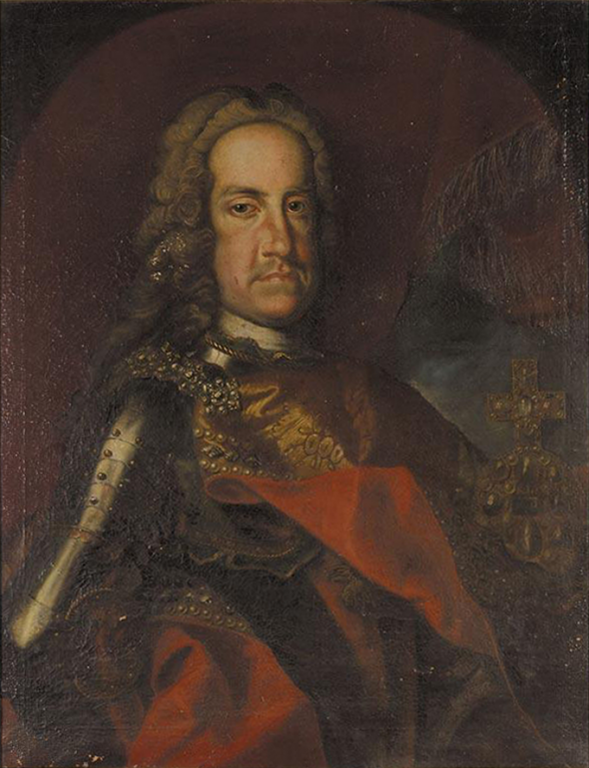 Emperor Eustathius I Fedorovich
However, one problem remained: Alexander Menshik. This nobleman, the late emperor’s most influential favorite, could have rallied the Guard against Eustace I Fedorovich and placed Grand Duke Peter Vladimirovich on the throne; but he had made too many powerful enemies, who were just waiting for the right moment to overthrow him. With the death of Peter I Fyodorovich, they were free to act, and the new emperor acted decisively, aware of the precariousness of his position.
On October 9, 1723, a decree was issued ordering the arrest of the Minister of War, the Governor-General of Vladimir, Field Marshal Duke of Tavricheskiy, Boyar Alexander Danilovich Menshik, and stripping him of all his ranks, offices, titles, and property. On the 16th, he was arrested at his home and taken to the fortress, while his family was exiled to one of their remote villages, with no right to leave.
A vast quantity of gold, silver, precious stones, various coins, and business documents was confiscated from Alexander Menshik, along with all the vast land grants he had received from Peter I Fyodorovich, leaving him with only a few impoverished villages. The case of the former favorite was heard by the Council of Centumvirov, but Eustathius I Fedorovich greatly overestimated him, so, on his secret orders, Alexander Menshik was bayoneted to death in his cell on January 6, 1724, allegedly while attempting to escape. His case was immediately closed.
Upon arrival in the capital, the body of Peter I Fyodorovich was buried with full honors at the Abbey of St. Gabriel, and a general oath of allegiance was sworn to the new emperor, Eustace I Fyodorovich.
In December 1723, a series of personnel changes took place. The Ministry of War was divided into the Army and Navy departments; the former was headed by General Prince Anikita Ivanovich Repnin, who was awarded the rank of field marshal, while the latter was headed by General-Admiral Boyar Fyodor Matveyevich Apraksin, who was succeeded as Governor-General of Greece by Rear Admiral (from 1724, Vice Admiral) Ivan Mikhailovich Golovin. Boyar Prince Mikhail Vladimirovich Dolgorukov became Governor-General of Vladimir, retaining his position as centumvir and being granted the rank of general. On the same day as Prince Anikita Repnin, General Boyar Prince Mikhail Mikhailovich Golitsyn was promoted to field marshal.
On December 31, 1723, Eustathius I Fedorovich unexpectedly appointed a clergyman, Archbishop Fyodor Mikhailovich Yanovsky of Izhora—an old friend of his—as the new Governor-General of Izhora. However, due to the intrigues of another clergyman, Bishop Eleazar Prokopovich of Pskov and head of the Ecclesiastical Chamber, he was removed from the office of Governor-General as early as April 27, 1724, and on May 11, 1724, he was removed from his episcopal see and confined to the Belozersk Monastery. On September 8, 1725, Eleazar Prokopovich succeeded in having him defrocked, and on February 16, 1726, Fyodor Yanovsky died at the Belozersk Monastery as a simple monk.
Eleazar Prokopovich was born on June 18, 1681, into the family of a small-time merchant. The names of his parents have been lost to history, and he himself never used his patronymic. Orphaned at an early age, he was raised by his maternal uncle, Fyodor Prokopovich, who gave him an excellent education. After completing his studies, Eleazar took monastic vows and began teaching himself.
With his profound knowledge and literary talents, he caught the attention of Emperor Peter I Fyodorovich, and in 1711 he became abbot of the Monastery of St. Clement in Kyiv. From 1716, at the emperor’s invitation, he lived in the capital, On May 12, 1718, he was consecrated as Bishop of Pskov, and the following year he was appointed head of the Ecclesiastical Chamber following the death of its first head, Ivan Maksimovich Rimsky-Korsakov, Bishop of Tambov. By that time, he was already an influential figure at court. After the fall of Fyodor Yanovsky, it was Eleazar Prokopovich who succeeded him as Archbishop of Izhora (June 7, 1724), and at the request of Eustathius I Fedorovich, Pope Benedict XIII elevated Eleazar Prokopovich to the rank of cardinal-priest with the title of the Church of Santa Maria-delli-Angeli-e-dei-Martiri at his consistory on December 9, 1726.
In February 1724, Boyar Pyotr Andreevich Tolstoy, head of the Office of Secret and Investigative Affairs, proposed to Evstafy I Fedorovich that he establish a council to assist him in governing the state. The Emperor approved this idea and, on February 11, 1724, signed a decree establishing the Inner Duma, an advisory body to the Emperor of Great Russia, fully subordinate to him; however, the Cabinet of Ministers and the Council of Centumviers were subordinate to the Inner Duma.
The first composition of the Lower House, approved on the same day, included the Minister of the Navy, Admiral General Boyar Fyodor Matveyevich Apraksin, Minister of Foreign Affairs Boyar Gavriil Ivanovich Golovkin, Head of the Office of Secret and Criminal Investigations Boyar Pyotr Andreevich Tolstoy, the head of the Ecclesiastical Chamber, Bishop Eleazar Prokopovich of Pskov; the tutor to Grand Duke Peter Vladimirovich, Okolnichy Andrei Ivanovich Osterman; and the imperial favorite, Boyar Stepan Petrovich Neledinsky-Meletsky.
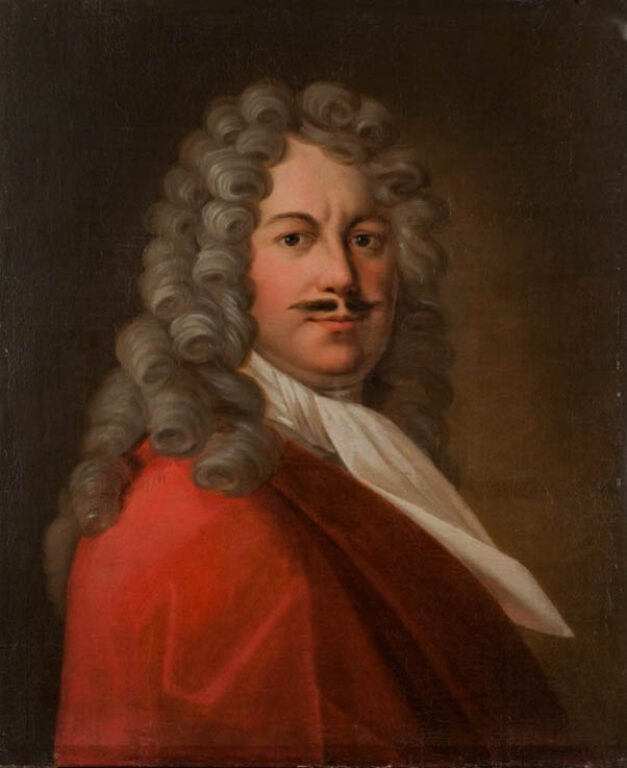 Boyar Stepan Petrovich Neledinsky-Meletsky
On May 28, 1724, a lavish coronation ceremony was held for Eustace I Fedorovich; The ceremony was presided over by Joseph IV Ivanovich Volynsky, Archbishop of Kyiv and Vladimir and Primate of Ruthenia, assisted by Fyodor Pavlovich Pototsky, Archbishop of Gniezno and Primate of Poland. During the ceremony, the emperor solemnly proclaimed Grand Duke Peter Vladimirovich heir to the throne, and Eustace I Fedorovich personally draped a velvet mantle embroidered with golden falcons over his shoulders.
During his reign, Eustace I Fedorovich largely continued his brother’s policies, implementing the plans his brother had not had time to carry out. Thus, as early as January 12, 1724, the office of Prosecutor General of the Council of Centumviroi was established to oversee the legality of government agencies’ activities. Lieutenant Field Marshal Pavel Ivanovich Yaguzhinsky, who had a reputation for incorruptibility, became the first Prosecutor General.
A year later, on January 9, 1725, the Imperial Academy of Sciences was established, modeled after the Paris Academy of Sciences, with the renowned physician Lavrenty Pavlovich Brekhovich serving as its first president. That same year, another university was opened in Irkutsk.
The voivodeships, as administrative-territorial units of Rus’, were established under King Jacob II Vasilyevich in 1547. The voivodeships comprised lands with a predominantly pagan and indigenous population, which were to be Christianized and integrated, and the voivodes possessed broader powers than the governors. The first voivodeships emerged in the lands of the indigenous principalities of Western Siberia, and as Siberia was gradually settled, the number of voivodeships increased.
Over time, their status changed. Thus, in 1626, under King Vladimir VII Alexeyevich, the Pelymsk, Obdorsk, Kazymsk, Belogorodsk, and Bardakovo voivodeships were merged and reorganized into the Ural Governorate. Prussia, which became part of Rus’ following the Second Thirty Years’ War, also held the status of a voivodeship due to its significant Protestant population, but was transformed into a governorship as early as 1655. During the administrative reform of Emperor Vladimir VIII Fedorovich, Prussia was among the governorates that were reorganized into general governatorates, with the Åland District being separated from it to become a separate general governorship, and the capital moved from Mariinsk to Danzig. The Lithuanian General Governorate, with its center in Vilnius, existed for only a short time, from 1710 to 1716, when it was divided into the Vilnius, Kaunas, and Suwałki governorates.
As mentioned in one of the previous chapters, the governors-general differed from the viceroys in that they held civil, military, and judicial authority in their hands, until Emperor Peter I Fyodorovich stripped them of their judicial authority in 1711. During his reign, the Galician, Taurian, Greek, and Lower General-Governorships were established, and the Vladimir and Livonian Viceroyalties were reorganized into them.
Under Evstafiy I Fyodorovich, the last voivodeships were abolished. On December 21, 1724, the Purkhan, Tyrmanovo, Toloban, Irkutsk, Yakutsk, Okhotsk, and Aleut voivodeships were reorganized into the Siberian General-Governorship, with its center in Irkutsk. Prince Alexei Mikhailovich Cherkassky, who had previously served as the Irkutsk voivode, became the first Governor-General of Siberia. Irkutsk itself was one of the largest cities in the empire and a major industrial center.
During the reign of Eustace I Fedorovich, the policies of Peter I Fedorovich continued; by and large, the same people remained in power, and the emperor himself, having delegated the governance of the country to the Inner Council, did not change his lifestyle. His favorite, Stepan Neledinsky-Meletsky, who became a boyar and centumvir in 1724, took no interest in state affairs, preferring to spend his time in revelry, accepting bribes, and stealing—behavior the emperor viewed with indulgence.
On June 8, 1726, Field Marshal Prince Anikita Ivanovich Repnin, the Minister of War, passed away; a few days later, Field Marshal Boyar Prince Mikhail Mikhailovich Golitsyn became the new Minister of War.
In 1726, King Philip I de Courtenay of Great Britain and his son William, Prince of Wales and Brazil, Duke of Cornwall and Braganza, made a ceremonial visit to Russia. He traveled by sea and was personally met in Izhorsk by Emperor Eustace I Fedorovich, who then escorted him to Vladimir-on-Klyazma.
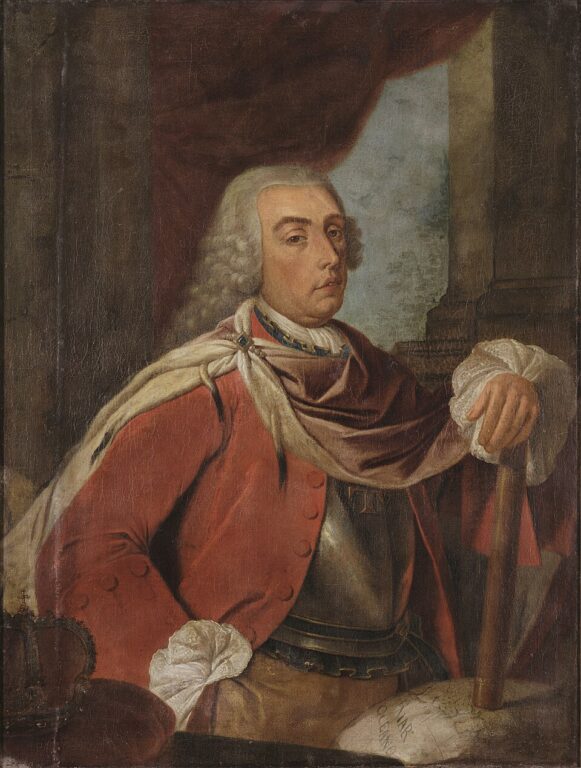 Philip I de Courtenay, King of England, Portugal, and Ireland
The Anglo-Portuguese monarch spent more than half a year in Russia, attending balls and carnivals; in between these events, on August 6, 1726, the parties signed the Treaty of Eternal Friendship, which had been drafted with their active participation. It proclaimed the eternal friendship between the two countries; Great Britain and Russia pledged to assist one another against invaders, established a rule of mutual consultation between the allies’ ambassadors at foreign courts—a novelty in diplomatic practice—undertook not to harbor rebels, and specified the size of auxiliary forces — 20,000 infantry and 10,000 cavalry on each side — established a joint military council during wartime, and stipulated the deployment of their fleets in all allied ports and harbors, should the need arise. In 1727, Scotland acceded to this treaty.
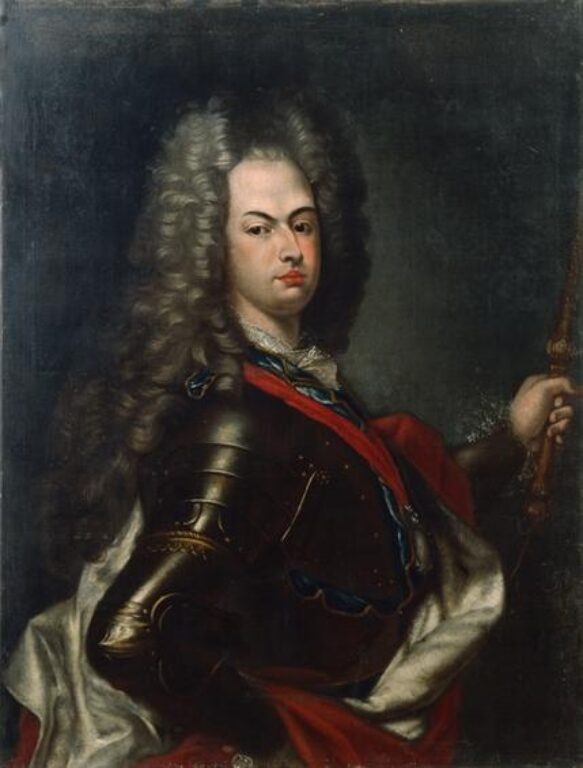 Prince of Wales and Brazil, Duke of Cornwall and Braganza, Wilhelm de Courtenay
As early as 1723, the Shamkhal of Tarku and Wali of Dagestan, Adil-Gerey II had been preparing to attack the Fortress of the Holy Cross and, in order to secure support, began to establish relations with the Egyptian and Safavid courts, while also seeking to win over many local rulers. In June 1723, Emperor Peter I Fyodorovich received a denunciation against the Shamkhal, reporting his secret negotiations for an alliance against Russia with the Kaytag Utsmi Ahmed-khan and the Kyura-Kazikumukh Khan, Cholak Surkhay-khan I, to form an alliance against Russia; however, Peter I Fyodorovich did not have time to respond. Beginning in the spring of 1724, tensions in relations between the Tarkov State and the Russian Empire—to which it was subject—continued to escalate, Adil-Gerey II tried to persuade Vladimir-on-Klyazma to cede Derbent and Baku to him, arguing that this would improve the defense of the empire’s southern borders, but to no avail.
In October 1724, Adil-Gerey II laid siege to the Fortress of the Holy Cross, prompting a swift response from the provincial governor-general, Lieutenant Field Marshal Gavriil Semyonovich Kropotov, who had invaded his territories. Kropotov contented himself with ravaging many of his estates, while the shakh himself withdrew from the fortress and barricaded himself in Tarku, from where he sent envoys to Shahanshah Tahmasp II and to Ibrahim Pasha, the Egyptian governor of Mesopotamia; however, he received no support.
In May 1726, a new campaign was announced against Adil-Gerey II, and Kropotov (who had been awarded the Order of Vitis on January 6, 1726) laid siege to Tarka. Finding no support even among the other Dagestan rulers, the shamkhal—wishing to secure guarantees for his life and the transfer of power in the shamkhalate to his son Khasbulat—sent a negotiator to him, the bishop of Endireyevsk, Aydemir, who promised that if Kropotov lifted the siege of Tarku, Adil-Gerey II would come to him in person and then travel to Vladimir-on-Klyazma for negotiations with Emperor Eustathius I Fedorovich.
After receiving assurances of his personal safety from Kropotov, Adil-Gerey II arrived at Kropotov’s headquarters, where he was unexpectedly taken into custody and imprisoned in the Holy Cross Fortress. His territories were occupied by Russian troops, and Kropotov himself requested in his report that the shamkhal be sent as far away as possible.
His request was granted. At its session on August 15, 1727, the Lower Duma decided to send Adil-Gerey II and 20 of his closest associates to the Kola Fortress, located on the Kola Peninsula, which was quickly carried out. Adil-Gerey II died in Kola in 1731, and the Tarkov Shamkhalate was abolished; its lands were incorporated into the Lower General-Governorship.
Eustathius I Fyodorovich enjoyed robust health, but the balls, carnivals, revelries, and feasts—which followed one after another in an endless succession—undermined his health. In the spring of 1727, the emperor took to his bed, and his condition grew worse with each passing day. Before his death, he spent a long time confessing to a priest. Eustace I Fyodorovich, Emperor of Great Russia, died on May 26, 1727, after a prolonged illness; coincidentally, he was the same age as his brother, whom he had killed—59 years old.