The Pyramids of the Giza Complex and the Significance of Areas Equal to Fibonacci Numbers in Two Systems of Length Measurement

Abstract. Based on the results of selecting mathematical criteria for the arrangement of the pyramids of the Giza complex, a criterion of mathematical equality of the areas of two triangles—formed by the vertices of the pyramids on the Giza Plateau and the vertex of the Great Sphinx monument—has been identified. Calculations in the metric system of the areas of the base and the lateral (visible) surface of the Pyramid of Mykerinus (Menkaure) revealed numerical values that practically coincide with the 21st and 22nd Fibonacci numbers. Calculations of the base area and visible surface area of the Pyramid of Khafre also yielded numbers close to the 24th and 25th Fibonacci numbers.
Keywords: Pyramids of Giza, equality of areas, highly advanced civilization, Fibonacci numbers, metric system.
Introduction. One publication [1] examines the hypothesis that the Giza Pyramid Complex and the Great Sphinx were created by a highly advanced civilization to represent a specific star system and as a means of communication with a planet in that system. A probable “map” of this star system is shown on a scale of 1 meter to 1 million kilometers. The distance from the top of the Great Sphinx to the top of the pyramids was: Khufu ≈ 3.89 AU; Khafre ≈ 4.57 AU; Menkaure ≈ 6.54 AU (figure).
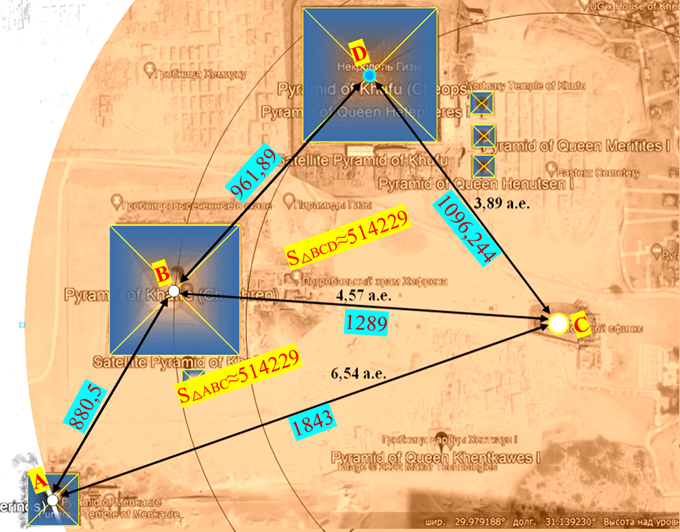
Figure – A schematic representation of the Giza Pyramid Complex and the Great Sphinx, with measurements given in the “Royal Cubit” unit of length, where 1 Royal Cubit = (√5+3)/10
Main Section. Based on the measurements conducted [1], a hypothesis was formulated suggesting that the arrangement of the pyramids in the Giza complex relative to one another may also not be random. While maintaining the required distance in conventional units (c.u.), they could have been arranged in a variety of ways, yet only one of these arrangements was ultimately chosen.
Based on the results of identifying possible mathematical criteria for the arrangement of the pyramids at the Giza complex, a criterion was identified involving the mathematical equality of the areas of two triangles formed by the vertices of the pyramids on the Giza Plateau and the vertex of the “Great Sphinx.” The following two triangles were obtained, with sides of 574; 508.5; 675 meters (S=142134.946) and – 675; 463.4; 965 meters (S=142,151.917). The areas of these triangles in the metric system are approximately equal to 3,772—the 14th Fibonacci number squared [2]. In addition, the areas were also calculated using the “Royal Cubit” unit of length = (√5+3)/10 (figure). The resulting area of the triangles is approximately equal to the 29th Fibonacci number—514,229. The same value for the area—the sum of the areas of the base and the visible surface of the Pyramid of Cheops—was obtained in another study [3]. Moreover, the areas of the base and the visible surface of the Pyramid of Cheops are related as the 27th and 28th Fibonacci numbers—196,418 and 317,811—expressed in units of the square of the Royal Cubit [3].
Calculation, using the metric system, of the areas of the base and lateral (visible) surface of the Mykerin Pyramid (Menkaure) revealed numerical values that practically coincide with the 21st and 22nd Fibonacci numbers—10,946 m² and 17,711 m² (base side length—104.6 m; height—66.5 m). Calculations of the base area and visible surface area of Khafre’s pyramid also yielded numbers close to the 24th and 25th Fibonacci numbers—46,368 m² and 75,025 m² (base side length – 215.3 m; height – 137.5 m).
It is likely that the builders of the Giza Pyramid Complex demonstrated their knowledge of the Fibonacci numbers in two systems of length measurement—the “Royal Cubit” (the area of the base and the visible surface area of the Pyramid of Khufu are equal to the 27th and 28th Fibonacci numbers—as determined in study [3]) and the “meter” (the base area and visible surface area of the Khafre Pyramid are equal to the 24th and 25th Fibonacci numbers, and those of the Menkaure Pyramid are equal to the 21st and 22nd Fibonacci numbers). Thus, we obtain a consecutive sequence of Fibonacci numbers: 21, 22, –, 24, 25, –, 27, 28. Given that the Fibonacci sequence is formed according to the principle “each subsequent number is equal to the sum of the two preceding ones,” when we include the total areas of these three pyramids in this sequence, we obtain a separate segment of the Fibonacci sequence—from the 21st to the 29th number.
Conclusion.
- Based on the results of selecting mathematical criteria for the arrangement of the pyramids at the Giza complex, a criterion was identified involving the mathematical equality of the areas of two triangles formed by the vertices of the pyramids on the Giza Plateau and the vertex of the Great Sphinx monument.
- Calculation, using the metric system, of the areas of the base and lateral (visible) surface of the Mykerin Pyramid (Menkaure) revealed numerical values that practically coincide with the 21st and 22nd Fibonacci numbers—10,946 m² and 17,711 m² (base side length—104.6 m; height—66.5 m). Calculations of the base area and visible surface area of Khafre’s pyramid also yielded numbers close to the 24th and 25th Fibonacci numbers—46,368 m² and 75,025 m² (base side length – 215.3 m; height – 137.5 m).
Bibliography:
- Voron, A.V. The Giza Pyramid Complex as a Kind of “Voyager” // “Academy of Trinitarianism,” Moscow, El No. 77-6567, pub. 28129, Oct. 24, 2022.
- Voron, A.V. The Giza Pyramid Complex and the Mathematical Equality of Areas // “Academy of Trinitarianism,” Moscow, El No. 77-6567, Pub. 29583, July 10, 2025.
- Voron, A.V. Properties of Kepler’s and Fibonacci’s Triangles and Their Connection to the Geometry of the Pyramid of Khufu // “Academy of Trinitarianism,” Moscow, El No. 77-6567, Pub. No. 24320, March 4, 2018.