The Metric System as the Key to Understanding the Symbolic Information of the Giza Pyramid Complex

“…a hypothesis that can not only be taken into account but also discussed must include specific proposals for testing it, along with predictions of possible outcomes.”
“…It is not necessary to seek to overturn a paradigm, but when faced with a fact that contradicts it, you have no right to dismiss it.”
Sergey Viktorovich Saparov (1954–2021)
Abstract. This article attempts to reconstruct, in a logically coherent manner, the symbolic information contained in the Giza Pyramid Complex. First and foremost, the study takes into account the existence of a specific, rational purpose among the representatives of an ancient, highly developed civilization. In this regard, it is hypothesized that the construction of the Giza Pyramid Complex was motivated by the value of information regarding the existence of a planet suitable for life. To interpret the symbols that may point to a specific star system, pyramid-like structures were constructed, and the unit of length “meter” was designated as a symbolic representation of distances. Based on reasonable arguments, the pyramid builders likely used an intelligent method to locate a star system with a habitable planet and provided a means of communication with it. This means of communication was likely based on the principles of radio communication and intended for use within the context of a different—more advanced—technological system. Given the above, the design of the Giza Pyramid Complex was likely also conceived as a significant social catalyst for modern human society.
First Argument. Based on an analysis of the geometry of the “King’s Chamber” in the Pyramid of Cheops [1, 2], the distances of two unique right triangles inscribed within the geometry of this chamber have been interpreted. The first is interpreted as an indication of a unit of length equal to the modern standard unit of length, the “meter” (the lower triangle, Figure 1); the second—as an indication of a length—a derivative of the “meter”—the “royal cubit,” equal to √5+3/10 = 0.523606 … m.
The uniqueness of the triangles shown in Figure 1 is based on the following facts. Among the set of right triangles in which the area and perimeter are equal, there is one that is unique—a right triangle in which the numerical values of the area, the perimeter, and the square of the shorter leg (Figure 1). These properties of a triangle inscribed in a square are evident only when it is represented in the metric system. Finding this equality of values for a right triangle with non-integer sides using a formula is significantly complicated by the fact that the calculation requires the use of a transcendental equation rather than an algebraic one.
Figure 1 also shows another unique right triangle inscribed within the room’s geometry. Its uniqueness lies in the fact that the ratios of its sides correspond to the smallest of the Pythagorean triples among all existing ones. The unit of measurement for this triangle can be expressed as a dimensionless quantity—the square of the golden ratio (Figure 1). These properties of the triangle inscribed in the room are evident only when it is represented in the metric system.
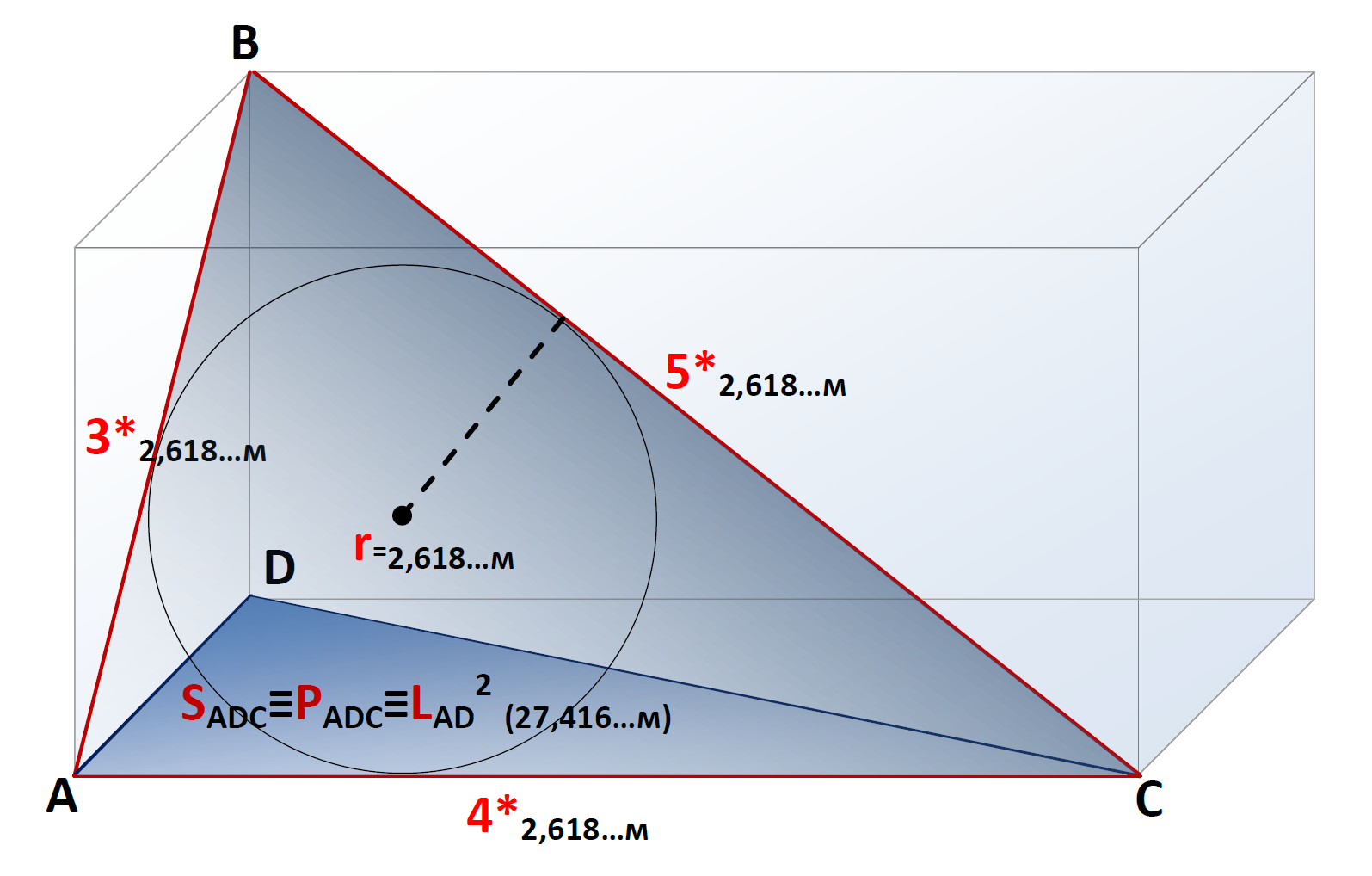
Figure 1 – A schematic representation of the “golden” proportional relationships in the geometry of the Chamber of the King within the Pyramid of Cheops, where: 2.618 … is the square of the “golden ratio” (1.618 … 2), the shorter side (AD) = 2 × 2.618 … (5.236 … m), the height of the figure (DB) = √5 × 2.618 … (5.854 … m) [1, 2]
Second argument. The modern unit of length, the “meter,” due to the high precision with which the speed of light is measured, remains tied to the unit of time—the second—and is equal to 1/299792458 m—the distance light travels in 1 second. Taking the equator as the precise reference point for measuring latitude, we link the latitude of the apex of the Pyramid of Cheops (29.9792458 degrees north latitude) to the speed of light, 299,792,458 m/s (± 1.2 m/s). If we consult the “Google Maps” online application and compare the latitude of the apex of the Pyramid of Cheops with the speed of light, we find that the two values coincide [3] (Figure 2).
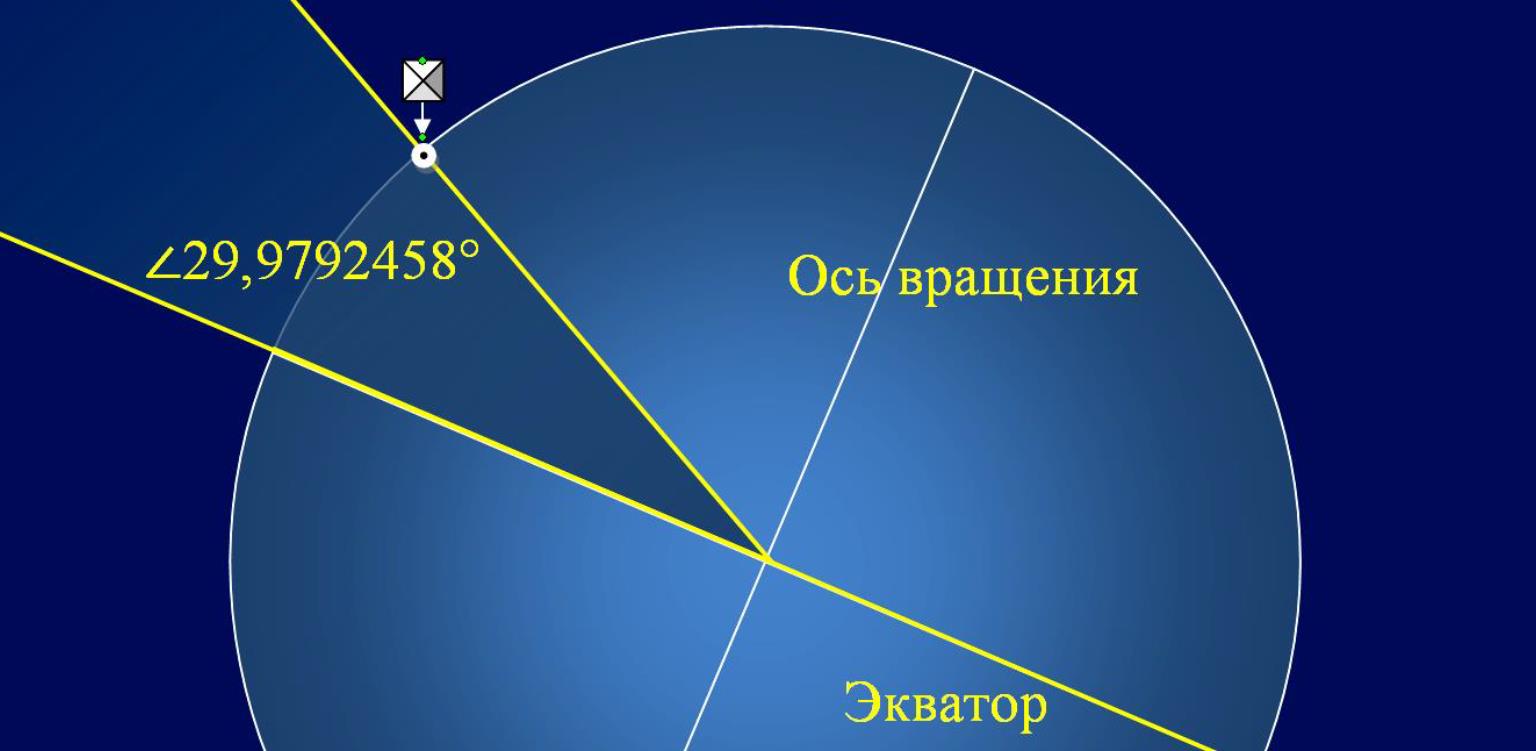
Figure 2 – The angle formed by the projections of a line through the Earth’s equator and a line starting at the midpoint of the planet’s axis of rotation and extending to the apex of the Pyramid of Cheops
Third argument. Calculations using the metric system for the base area and the lateral (visible) surface area of the Mykerin Pyramid (Menkaure) revealed numerical values that practically coincide with the 21st and 22nd Fibonacci numbers—10,946 m² and 17,711 m² (base side length—104.6 m; height—66.5 m) [4]. Calculations of the base area and visible surface area of the Pyramid of Khafre also yielded numbers close to the 24th and 25th Fibonacci numbers—46,368 m² and 75,025 m² (base side length – 215.3 m; height – 137.5 m) [4].
It is likely that the areas of the Giza pyramids were determined by their builders’ knowledge of the Fibonacci numbers in two systems of length—one derived from the “meter” and the other from the “Royal Cubit” (the area of the base—including the casing plus 2 meters—and the visible surface area of the Pyramid of Cheops are equal to the 27th and 28th Fibonacci numbers, respectively; the base side is 443.1907… k.k. or 232.057665… m; the height of the pyramid is 281.87365… k.k. or 147.59… m, as determined in study [5]) and—in the “meter” system (the area of the base and the visible surface of the Pyramid of Khafre correspond to the 24th and 25th Fibonacci numbers, and those of the Pyramid of Menkaure to the 21st and 22nd Fibonacci numbers) [4]. Thus, a consecutive sequence of Fibonacci numbers is obtained: 21, 22, –, 24, 25, –, 27, 28. Given that the Fibonacci sequence is formed according to the principle “each subsequent number is equal to the sum of the two preceding ones,” when we include the total areas of these three pyramids in this sequence, we obtain a separate segment of the Fibonacci sequence—from the 21st to the 29th number.
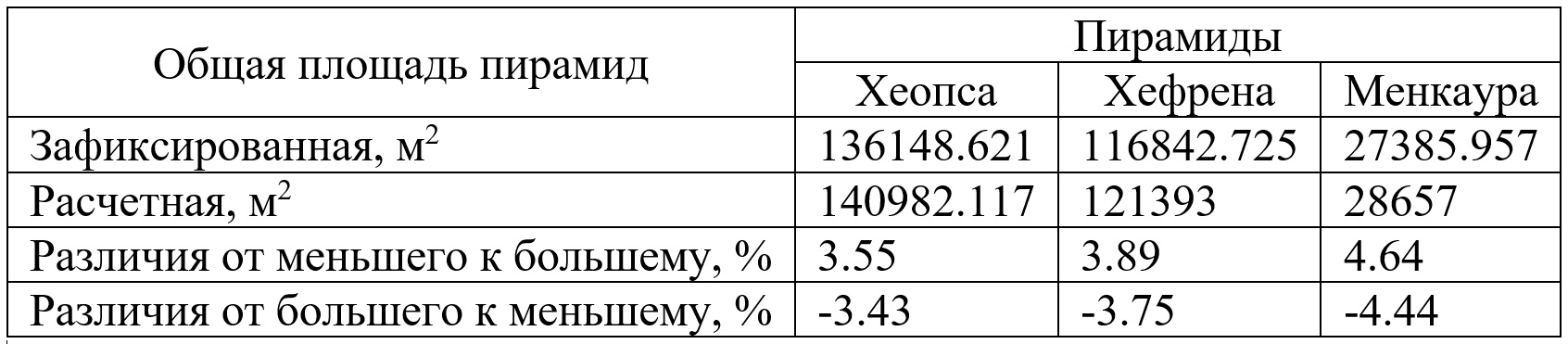
The dimensions of the pyramids recorded today differ slightly from the calculated values, which can be explained by the loss of cladding and structural degradation (Table 1). However, it was found that the total area recorded today differs from the calculated value by no more than 5% (Table 2).
Table 1 – Measured and Calculated Linear Dimensions of the Giza Pyramid Complex:

Table 2 – Recorded and estimated total surface areas of the pyramids at the Giza Complex:
Interpretation of the symbolic information contained in the Giza Pyramid Complex. It is known that the average distance from Earth to the Sun is about 150 million kilometers. This figure constantly fluctuates, sometimes increasing and sometimes decreasing, depending on our planet’s position relative to the path of its orbital motion (since our planet’s orbit is not circular but elliptical). The minimum distance occurs in January (perigee, 147 million kilometers), and the maximum in July (aphelion, 152 million kilometers). The height of the Pyramid of Cheops should be determined based on calculations that take its casing into account, where the length of the base side is calculated in the ancient Egyptian unit of length—the Royal Cubit—and equals √196,418 [5] (196,418 is the 27th Fibonacci number) = 443.1907… royal cubits. 1 Royal cubit = √5+3/10 = 0.523606… m. Accordingly, the height of the structure will be equal to √196,418/2*√1.61803…(√Φ) = 147.59 meters. In this regard, the height of the Pyramid of Cheops can be compared to the minimum distance from Earth to the Sun.
In the study [3], we took the “Great Sphinx” monument as a symbol of a star because of its precise orientation—the sphinx’s head faces east, the direction of the rising of the star “Sun.” If we take this analogy further, the pyramids of the complex can be regarded as symbols of planets, and their smaller structures as their moons. Given that the height of the Pyramid of Cheops can be correlated with the minimum distance from Earth to the Sun, the probable distance from the planets to a certain star has been calculated in the specified conventional units of length — 147.59 meters = 1 AU (Figure 3).
The distance from the top of the “Great Sphinx” monument (Figure 4) to the top of the pyramid was, for:
– Cheops ≈ 574 meters / 147.59 meters ≈ 3.89 conventional units;
– Khafre ≈ 675 meters / 147.59 meters ≈ 4.57 conventional units;
– Menkaura ≈ 965 meters / 147.59 meters ≈ 6.54 conventional units (Figure 3) [3].
Thus, this unique “map” of the Giza pyramid complex can be interpreted as a symbolic representation of a certain star system. In particular, the Pyramid of Cheops can be represented as a planet that both sends and receives signals due to the presence of a large gallery within it. (According to calculations, it is located at a distance of 3.89 AU from the star) (Figure 3).
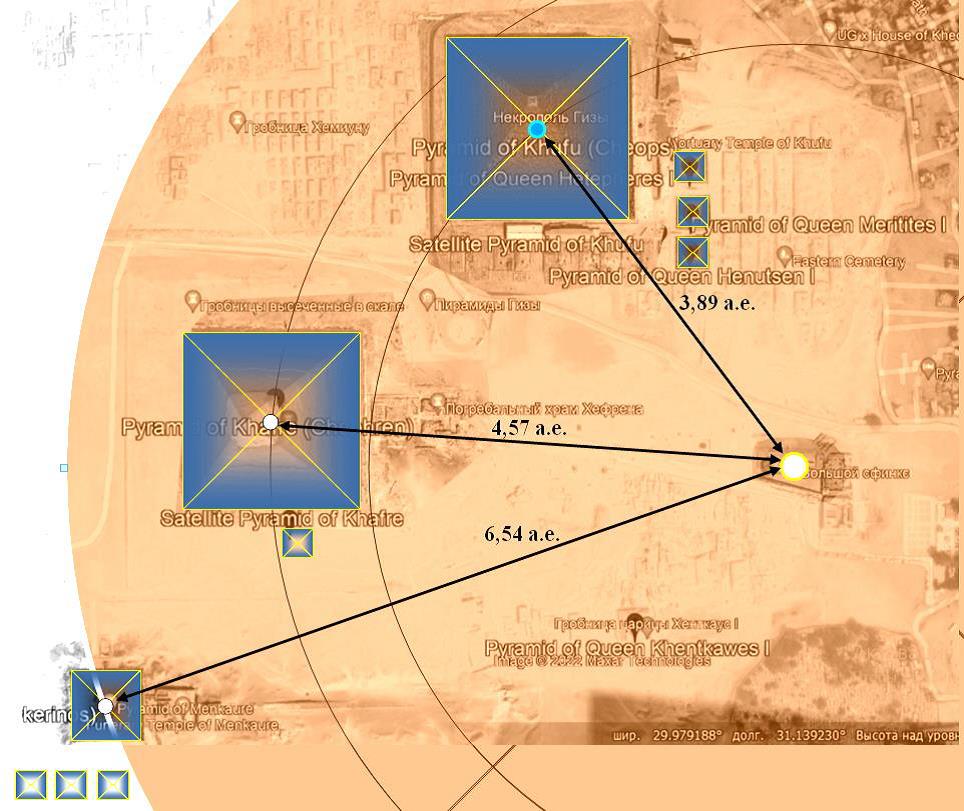
Figure 3 – Schematic representation of the Giza Pyramid Complex and the Great Sphinx monument—top view, where: the symbols for the planets and a star are indicated as circles at the tops of each of the three pyramids—above the head of the Great Sphinx; the distances from the head of the Great Sphinx to the tops of the pyramids are calculated based on a conventional unit of length—147.59 meters = 1 AU—the distance from Earth to the Sun
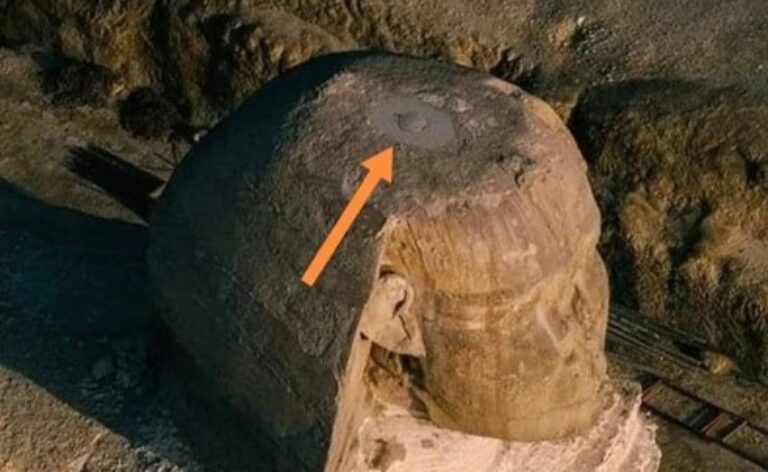
Figure 4 – The top of the “Great Sphinx” monument on the Giza Plateau
It is believed that the Giza Pyramid Complex incorporates a specific orientation method designed to determine the position of a particular star (for the purpose of sending a message). The simplest solution in this regard is to orient the “transmitter gallery” relative to bright stars. In this regard, “air ducts”—channels specially designed for this purpose within the body of the Great Pyramid of Giza—can be used as guides to the stars. An analysis of the possible orientations of these air ducts toward stars with high apparent magnitudes showed that two air ducts on the north side of the pyramid are directed toward the stars Tuban (a white giant in the constellation Draco, apparent magnitude 3.647) and Kochab (the second brightest star in the constellation Ursa Minor after Polaris, apparent magnitude 2.08), and on the southern side—toward the stars Alnitak (a star in the constellation Orion, which is the brightest O-type star, apparent magnitude – 1.7) and Sirius (a star in the constellation Canis Major, the brightest star in the night sky, with an apparent magnitude of 1.46) (Figure 5) [3].
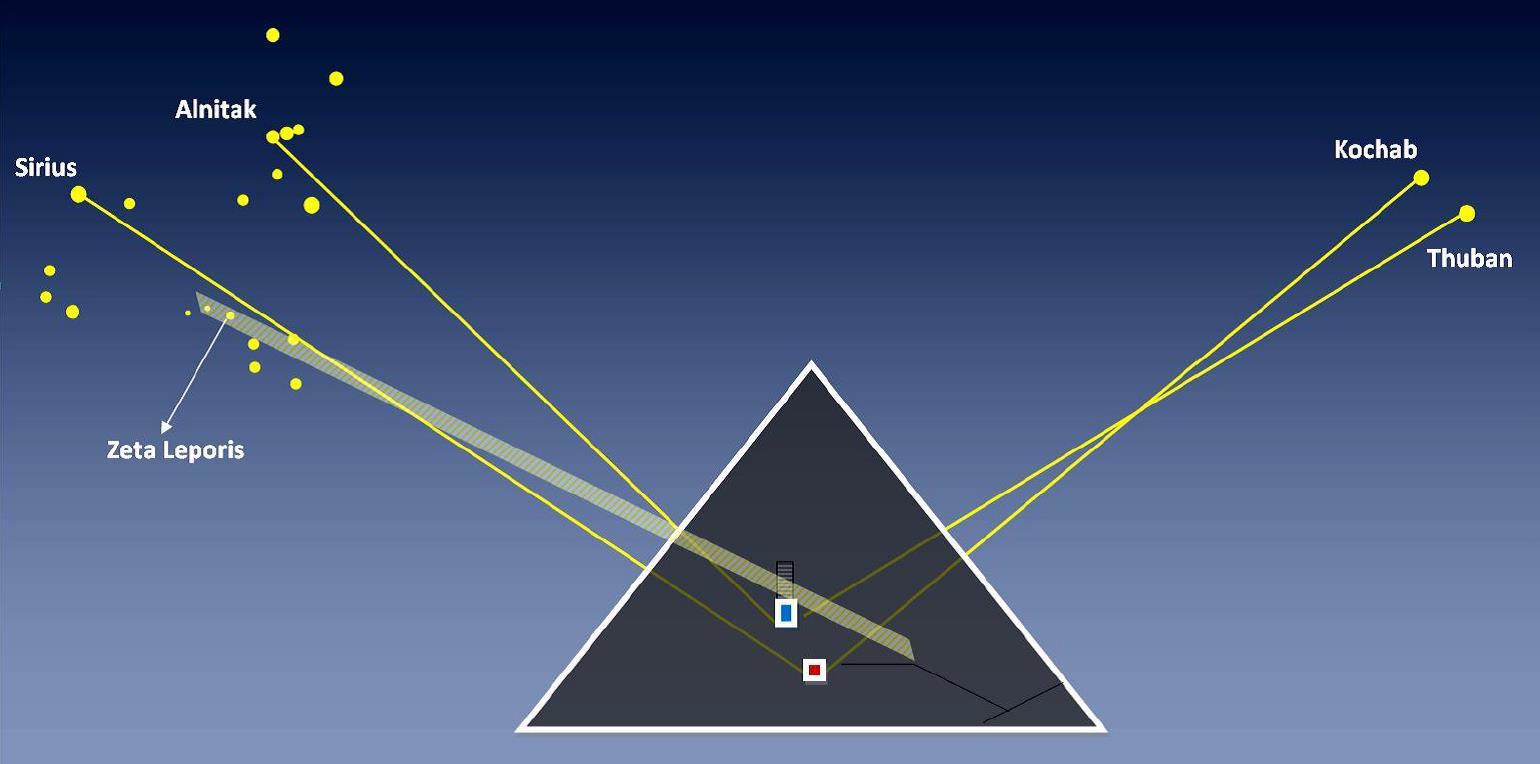
Figure 5 – A schematic diagram showing the orientation of the air ducts and the gallery of the Pyramid of Cheops, where: the star ζ in the constellation Lepus is indicated; the pyramid’s gallery is oriented toward the sector of this constellation relative to the directions of the air ducts pointing toward bright stars
Based on an analysis of the arrangement of stars in the sector of the night sky toward which the Grand Gallery of the Pyramid of Cheops is oriented, the constellation Lepus was identified using the process of elimination. According to Formula 1, the conditions for a planet to be in the habitable zone have been determined: the luminosity of the star for the nearest planet in this system must not exceed 15 times that of the Sun [3].
DAU = √LSTAR/LSUN, where: (1)
DAU – the average radius of the habitable zone in astronomical units;
LSTAR – the bolometric index (luminosity) of a star;
LSUN – a bolometric index (luminous flux) of the Sun.
In this constellation, based on a selection of stars according to their luminosity, the star Zeta Leporis (ζ Leporis, Latin: Zeta Leporis) has been identified. If a planet similar to Earth and suitable for biological life exists in the system of the star ζ Leporis, then it must be located at a distance of 3.9 AU (Figure 6).
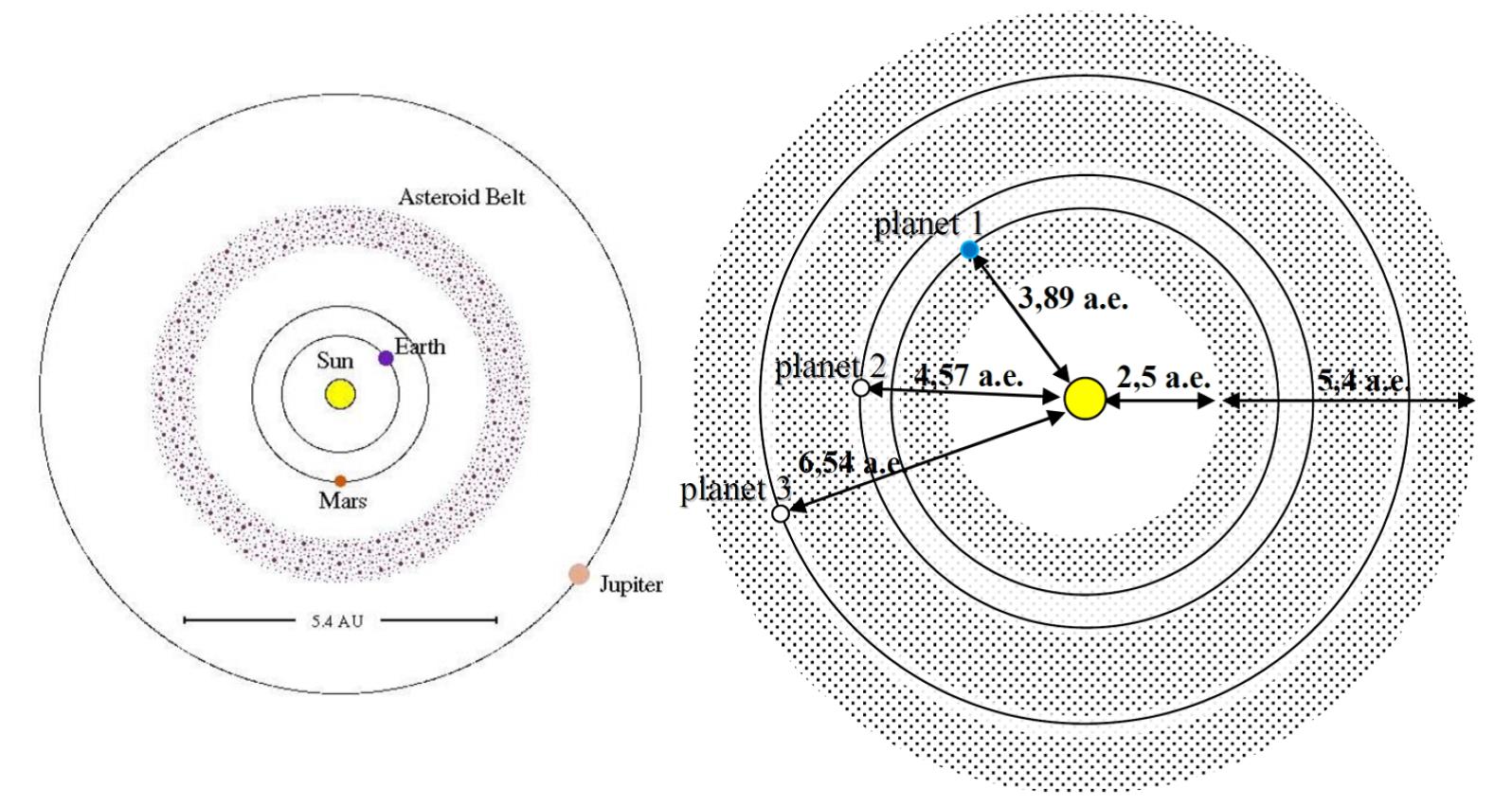
Figure 6 – A schematic representation of the asteroid belt in two model systems—the Solar System (left) and the proposed system of the star Zeta Leporis (right)—where: planet 1, planet 2, planet 3 – are the hypothesized planets of the star Zeta Zaitsa.
The distance from the top of the “Great Sphinx” monument (Figure 4) to the top of the Pyramid of Cheops was 3.89 conventional units, which coincides with the calculated data for the possible habitable zone of the star ζ Lepus [3].
P.S. The calculations presented in this article may contain certain errors. In this article, the author has sought first and foremost to illustrate the logic and the underlying concept behind the pyramid builders’ design from the perspective of common sense and the goal-setting of representatives of an ancient, highly developed civilization. The results of this study may be useful as a working hypothesis that contains “specific proposals for testing it, along with predictions of possible outcomes.”
Bibliography:
- Voron, A.V. The “Royal Cubit” Unit of Length and a Positional Number System with an Irrational Base // “Academy of Trinitarianism,” Moscow, El No. 77-6567, Pub. 25842, Nov. 1, 2019.
- Voron, A.V. The unit of length “meter,” the unit of time “second,” and geometry: the location of the chamber of the King of the Pyramid of Khufu // “Academy of Trinitarianism,” Moscow, El No. 77-6567, Pub. No. 26586, August 3, 2020.
- Voron, A.V. The Giza Pyramid Complex as a Kind of “Voyager” // “Academy of Trinitarianism,” Moscow, El No. 77-6567, pub. 28129, Oct. 24, 2022.
- Voron, A.V. The Pyramids of the Giza Complex and the Significance of Areas Equal to Fibonacci Numbers in Two Systems of Length Measurement // “Academy of Trinitarianism,” Moscow, El No. 77-6567, pub. 29607, July 29, 2025.
- Voron, A.V. Properties of Kepler’s and Fibonacci’s Triangles and Their Connection to the Geometry of the Pyramid of Cheops // “Academy of Trinitarianism,” Moscow, El No. 77-6567, Pub. No. 24320, March 4, 2018.