A Very Strange World War I: Sarmatia and the Spanish Empire against the Central Powers, led by France

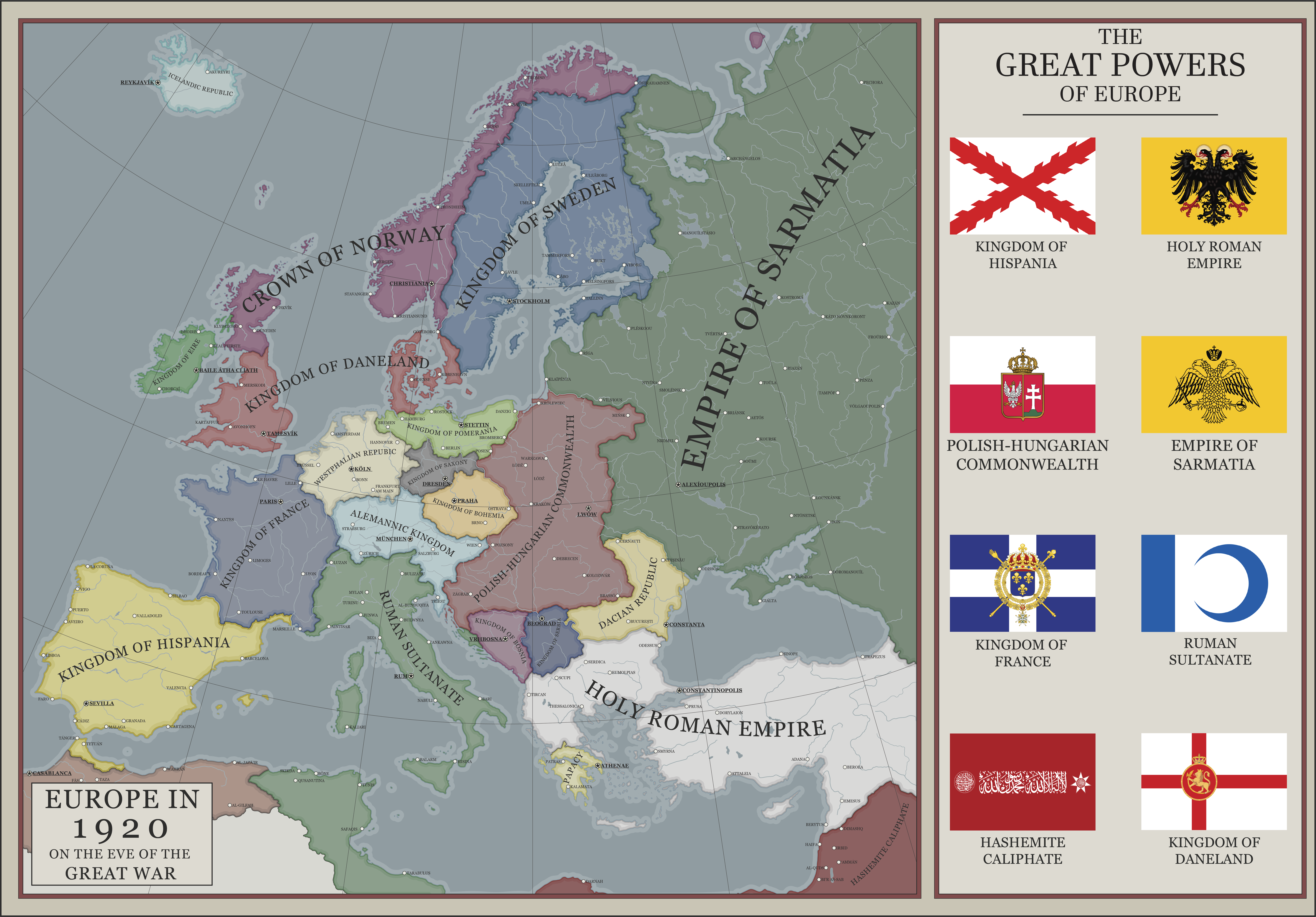
I’d like to share with you a story about a very strange parallel world that’s extremely different from our own. In this world, there is Iberia, where Portugal never gained independence from Castile, the Latin Empire flourished and became something akin to the Holy Roman Empire, Muslim Italy, Danish England, and much, much more, which will be discussed in detail below.
Contents:
Plus Ultra!
The Kingdom of Spain (often referred to as the Spanish Empire due to its vast overseas territories in the West) is, in this world, a leading global power with a massive army, a strong economy, and influence in every corner of the globe. Spain became the first state to unify the Iberian Peninsula since the time of the Visigothic Kingdom in the 8th century, and although events such as the revolt of Alfonso de Portugal in 1128 threatened this, the kingdom persevered and, by 1492, had successfully unified the peninsula by conquering Granada.
However, Spain has one serious weakness: internal problems. Although the army is indeed large, its quality has gradually declined over the centuries, as funding has increasingly been diverted to other needs—such as supporting the royal family and lining the pockets of corrupt officials and politicians. This has sparked strong discontent with the country’s government, and colonial governors, like the revolutionaries, are making plans to establish the system they desire.
Only one question remains: Will Spain be able to weather the approaching storm? Or will the peninsula fall apart for the third and final time?
“Long live Aragon! Death to Spain!” — Aragonese nationalist Rosselló Rabassa, before the assassination of King Diego II of Spain, 1908
Centuries of Humiliation
Ever since not one but two powerful states emerged on France’s southern border, France has been in a state of virtually constant humiliation. If not the Spaniards, then the Saracens; if not the Saracens, then the Spaniards; and if neither, then the Germans, the Danes, or the French themselves. Although the kingdom managed to survive, the monarch became a figurehead, and real power was concentrated in the Estates General.
However, any people can endure only a certain amount of humiliation before they demand change, before retribution for past crimes is finally meted out.
Over the past few decades, the Kingdom of France began to build up its power by equipping its soldiers with the best weapons. They studied their enemies, identified their strengths and weaknesses, and found ways to use this knowledge to their advantage. Napoleon Bonaparte, a native of Corsica who came to France to escape persecution by the island’s Islamic ruler, became the driving force behind the modernization of the French army and its tactics and is widely regarded as the father of the French army. However, his innovations have yet to be fully implemented, and the Kingdom eagerly awaits the opportunity to demonstrate them. Only time will tell how the French will realize their ambitions.
“Death is nothing, but to live defeated and in disgrace is to die every day.” — French General Napoleon Bonaparte, father of the French army
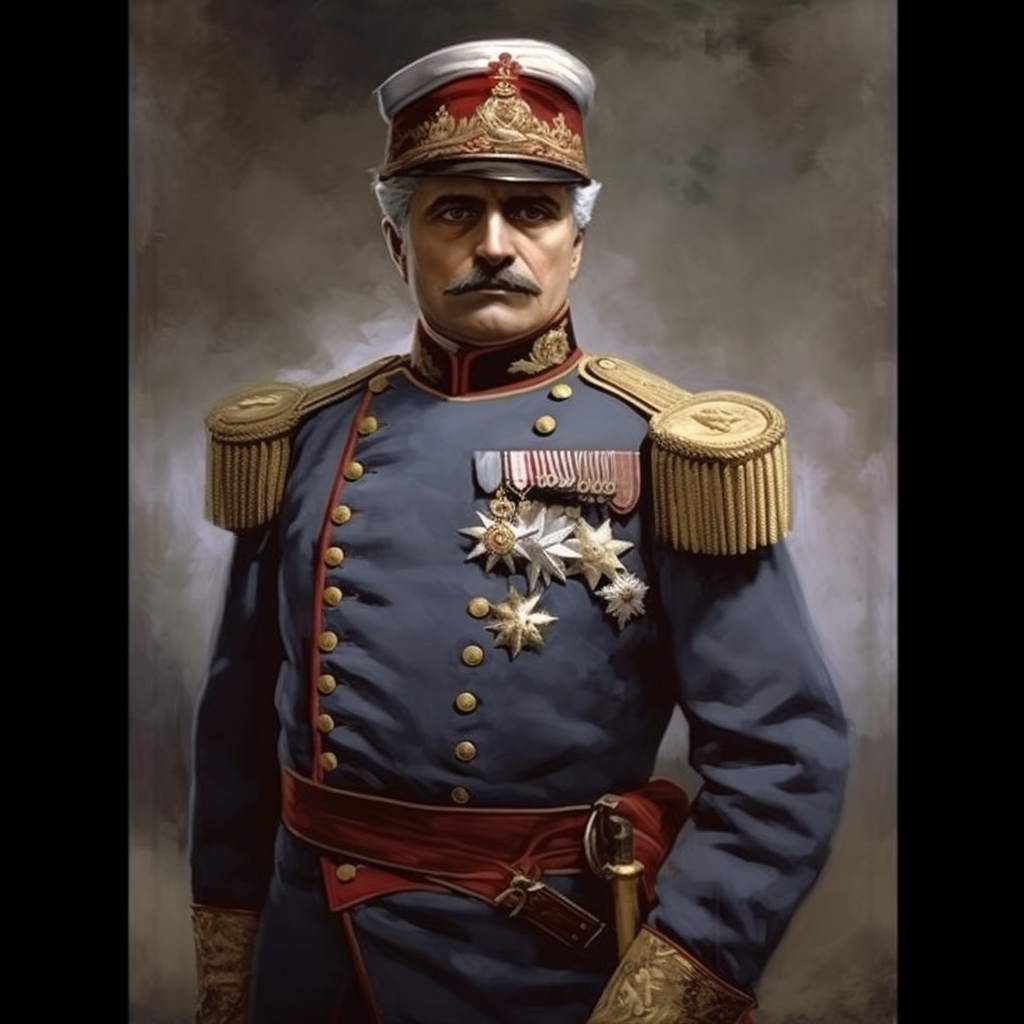
Napoleon Bonaparte of this world
The Holy Roman (Latin) Empire
The Fourth Crusade, which seemed at the time to be a terrible mistake, turned out to be a true blessing for Catholicism. The declining Byzantine Empire, already in decline, was destroyed, and in its place a well-organized Catholic administration was established, which soon asserted its hegemony over Greece and Anatolia, and even reclaimed former Roman territories such as Northern Syria and Mesopotamia. Moreover, when the invading Roman Sultanate was poised to break through the Papal States, the Latin Empire of Constantinople evacuated the pope to Greece. Thus, the Vatican found itself in the Peloponnese. After that, the Kingdom of Constantinople truly became the Holy Roman Empire; however, to avoid confusion, we will refer to it by its traditional name, the Latin Empire.
Over the past few centuries, the Latin Empire has made considerable efforts to “Romanize” the state, renaming cities in the Latin style, making Latin the official language of the empire, and making it mandatory in the education system. Although this has sparked widespread discontent in recent years due to the de facto ethnic cleansing of Greeks and other ethnic groups in the empire, the results cannot be denied: more than 77% of citizens identify as Romans rather than as Greeks, Syrians, Armenians, or others.
The empire remains a powerful force in the world, and if all goes well, the situation is unlikely to change anytime soon.
“The Holy Roman Empire—Holy, Roman, and Empire.” — The French philosopher Voltaire on the Holy Roman Empire
An Empire in Exile
The Fourth Crusade, which seemed at the time to be a terrible mistake, turned out to be an even greater mistake for Orthodoxy. The Great Roman Empire was dismembered and plundered by barbarians from the west, and although for a time it seemed that the Empire of Nicaea might repel the barbarians by conquering Crimea and part of Anatolia, all of this proved futile; in 1261, all Byzantine institutions were driven out of Anatolia, leaving the empire reduced to an insignificant power in the Crimea, which it had previously conquered.
However, the Romans DID NOT GIVE UP! After all, if you can’t reclaim your homeland, you can create a new one!
So, thanks to skillful diplomacy, dynastic marriages, military tactics, and a bit of luck, the former Byzantines managed to conquer the vast lands of Russia. The New Byzantine Empire has absolutely no connection to ancient Sarmatia. It’s just a local fashion trend. In New Byzantium—or Old Russia—they adopted the Sarmatian style of dress and began calling themselves descendants of the Sarmatians. And so, to leave no room for doubt, they named their empire the Sarmatian Empire. However, they, of course, remained Russian, despite the presence of a large number of Greeks—or, more precisely, Romans—among the elite.
At the moment, Sarmatia still wants to reclaim its homeland and drive out the Latin barbarians who proclaim themselves part of the Holy Roman Empire, and, given the looming great war, such an opportunity may soon present itself. All the more so since Theodore’s principality is by no means a small one anymore.
“Our mother is Italy, our father is Sarmatia.” The motto of the Sarmatian Empire
The Buffer Triumvirate
Bosnia, Serbia, and Dacia are often referred to as the “buffer triumvirate” for a very simple reason: they exist solely to keep the great Eastern powers apart. The Latin Empire, the Polish-Hungarian Kingdom, and Sarmatia (Russia). The empires have tacitly agreed to preserve the “independence” of these states. This is particularly important for the Latin Empire and Poland, which share a border with Sarmatia; these countries serve as a guarantee—albeit a tenuous one—that they will not have to fight on two fronts.
As for the states of the Triumvirate, they consider themselves independent. In reality, however, they are merely pieces on a vast chessboard, and puppet governments are often installed there, with monarchs of the same sort ascending to the throne. At present, Dacia remains within Sarmatia’s sphere of influence, while Bosnia and Serbia are firmly in Poland’s orbit. However, even these countries are making plans and plotting behind the scenes, ultimately striving for complete independence, although that day still seems a long way off.
“I’d rather give up all of Siberia than let barbarians control Dacia!” — Sarmatian Emperor Alexei IX, 1844
The Ashes of an Empire
After the pope was exiled to Greece, it became increasingly difficult for the German kings to obtain the title of Holy Roman Emperor, until one fine day they simply… gave up trying, and the title was transferred to the Latin Empire. This significantly weakened imperial power, and by the 17th century, the unified German kingdom had, in effect, ceased to exist, becoming a ceremonial title that eventually fell into disuse. Instead, the German principalities gradually consolidated their power, leading to the emergence of states such as Westphalia, Saxony, Pomerania, and Alemannia.
While the south developed its own Alemannic identity, the north retained a common German culture—albeit, of course, with some regional differences—which gave rise to numerous calls for German unification.
However, the question is: Who will lead such a nation? The kings of Saxony from the Wettin dynasty? The king of Pomerania from the House of Hohenzollern? Or will it be a republic? This is the main obstacle to German unification, and this question will soon have to be answered once and for all…
“Is Germany united? What’s next—some kind of European Union?!” — a French quote of unknown origin
Rusty Sword
The Roman Sultanate was once, perhaps, the greatest Islamic power. At the end of the 14th century, it invaded the Apennine Peninsula, taking advantage of the weakness of other states, and by 1512 had ultimately conquered Rome itself and established the sultanate of the same name in the Eternal City—the successor to the Roman Empire. It even began to expand beyond Italy’s borders, taking advantage of the chaos to invade Germany, the Balkans, and France.
However, just like its ancient predecessor, Rome’s days of glory were long past, The Alemannic Kingdom had created an insurmountable barrier that proved impossible to overcome; the Polish-Lithuanian Commonwealth had conquered most of the Balkans, and internal development had stalled, while other powers were moving forward.
The same can be said of the other two Islamic empires: the Moroccan Sultanate and the Hashemite Caliphate. Although Morocco controls most of Northwest Africa and has colonies in the Western Hemisphere, and the Caliphate controls Iran, Arabia, Egypt, and Nubia, both powers are inferior in strength to the European powers. Although they still possess power, many scholars debate how much of it remains, since even attempts to modernize the flagship of the Islamic world—the Roman Sultanate—have failed. Pervasive corruption and a sluggish bureaucracy prevented this from happening, burying all such attempts.
Nationalism is flourishing in the hills of Tuscany, in German territories, in Venice, and in Genoa; none of these territories has become Arab in the slightest, nor has it become Islamic to any significant degree. The situation is exacerbated by the fact that the Roman administration is becoming increasingly racist and xenophobic, killing its own population solely to maintain order. Preserving the sultanate at this stage is nothing short of a miracle…
“Moreover, I believe that the infidels must be destroyed.” — Quote from Sultan Ismail IV, 1908
East and West
The Polish-Lithuanian Commonwealth was founded in the 15th century, when the Hungarian nobility proclaimed Vladislaus III of Poland king of Hungary. Thanks to his long and prosperous reign and his talented successors, in 1547 the two crowns were officially united into the Polish-Lithuanian Commonwealth, with Lviv as its capital, as a compromise. For two centuries, the Polish-Lithuanian Commonwealth dominated Eastern Europe and served as a transit territory between Eastern and Western Europe.
However, as nationalism grew around the world, Hungarian separatism became increasingly pronounced, as more and more Hungarian citizens became aware of the Polonization of the Pannonian Basin. Fearing that Hungary would soon become merely a part of Poland, radical revolutionaries grew increasingly frenzied and radical, carrying out assassination attempts and blowing up buildings and monuments. And although the suppression of these movements had so far been relatively successful for the Polish-Lithuanian Commonwealth, they had become serious destabilizing factors that might well play a role in a future conflict.
“The Polish-Hungarian state is neither Eastern nor Western; it is the beating heart of Europe.” — Bolesław Jankowski, rector of Lviv University, 1609.
P.S. The author doesn’t say a word about it, but Napoleon from this world is a completely different person. Perhaps he is some sort of reincarnation of the Napoleon from our 19th century.
In this world, World War I will be similar to ours in many ways. The only difference is that the Entente will consist of Spain, Sarmatia (Russia), and Denmark, while the Central Powers will consist of France, a conglomerate of German states, Poland, and the Latin Empire.
In this world, the balance of power is even more even than in our own, so the outcome is far from certain. The author has provided very little information about America—not a single word about the northern part—and this, by all accounts, will be a decisive factor, or more precisely, which side it will take.