The M.37A2 Rhino is a futuristic concept tank that offers a glimpse into the future of armored vehicles

Together with AI, we imagined what the M.37A2 Nosorog concept tank might look like
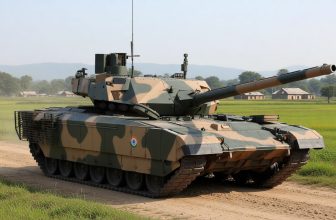
At first glance, the M.37A2 Rhino gives the impression of a vehicle designed not for parades, but for heavy, grueling warfare. This is a tank that makes no attempt at elegance—only functionality, mass, and a sense of power. Its appearance seems to suggest: this is a machine designed for head-on combat, for breaking through enemy lines and holding the front.
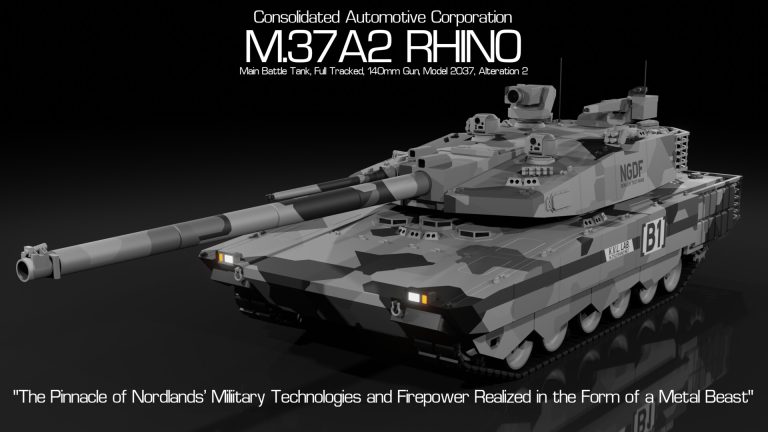
If we were to imagine the Rhino made of metal, it would be a next-generation heavy tank, falling somewhere between classic main battle tanks and next-generation assault platforms.
Contents:
Armor and Protection
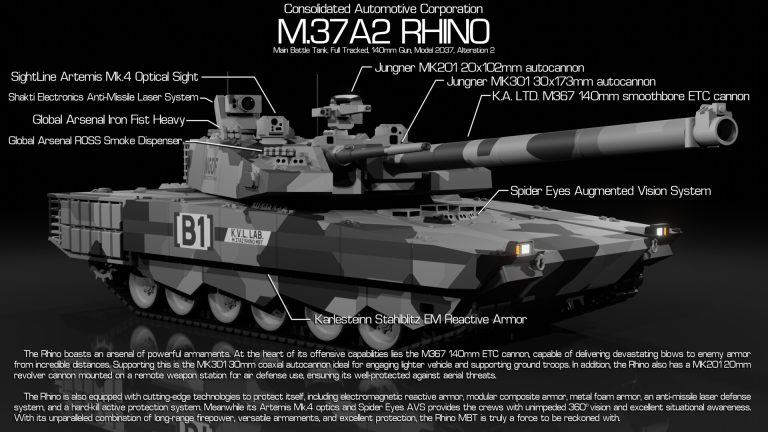
The first thing that catches your eye is the heavy, multi-layered armor. The hull and turret look as if they’re assembled from large armor modules with pronounced angles. In a real vehicle, this would almost certainly indicate composite armor, combining steel, composites, and possibly elements of dynamic or active protection.
One can imagine that Rhino is equipped with:
- built-in active protection modules against anti-tank guided missiles and drones;
- additional side screens that cover vulnerable areas;
- with reinforced frontal armor designed to withstand direct hits.
A tank like this would clearly have been designed with a heavily armed anti-tank battlefield in mind, where threats come not only from the front but also from above.
Tower and Armament
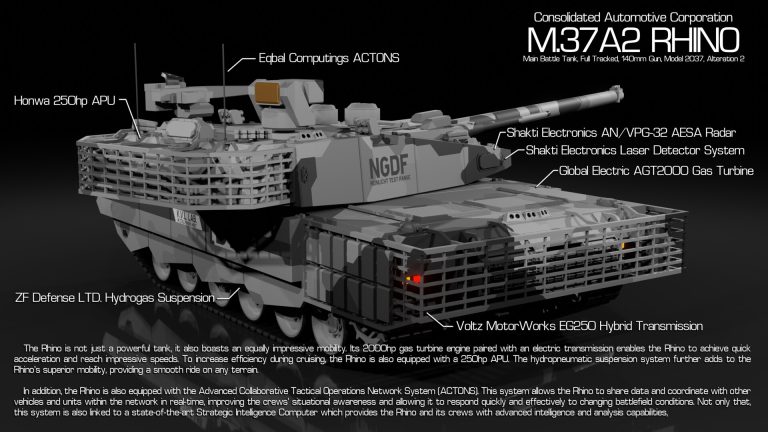
The Rhino’s turret looks massive and solid, suggesting a large-caliber gun—perhaps 130 or even 140 mm, similar to promising European designs. This could be a tank designed to achieve superiority in a firefight, where the first shot decides the outcome of the battle.
In addition to the main gun, it is reasonable to assume that:
- a remotely controlled combat module equipped with a machine gun or an automatic cannon;
- integrated counter-UAV measures;
- modern fire control systems with all-around surveillance and thermal imaging channels.
Rhino is clearly designed to be a machine capable of operating autonomously, with minimal reliance on external guidance.
Crew and Layout
Based on the hull’s proportions, it’s safe to assume that the crew is as well-protected as possible here. In a “futuristic” version, the Rhino could very well be equipped with:
- a reduced crew of two or three people;
- an insulated capsule inside the housing;
- an automatic loading system that completely eliminates human intervention from the ammunition feeding cycle.
This would improve the crew’s survival rate and make it possible to reduce the size of the turret or make it uninhabited.
Mobility and Role on the Battlefield
Despite its imposing appearance, the Rhino is unlikely to be slow. It is most likely a tank with a powerful powerplant—either diesel or hybrid—capable of delivering good performance even with its heavy weight.
In combat, such a vehicle could serve as:
- an assault tank for urban operations;
- an armored “battering ram” for breaching fortified positions;
- the core units of heavy armored groups, around which IFVs, UAVs, and infantry operate.
The Rhino doesn’t look like a “one-size-fits-all” tank. It’s more like a specialized vehicle designed for the toughest sections of the front lines.
A Tank for the Age of Drones
If we were to apply this concept to reality, Rhino would certainly have been designed with a new kind of war in mind—the drone war. This means:
- advanced electronic countermeasures;
- protection of the upper hemisphere;
- integration with its own reconnaissance UAVs;
- the ability to operate within a unified digital combat system.
A tank like this no longer just fires and moves—it becomes part of networked warfare.
Conclusion
The M.37A2 Rhino is a tank design that reflects the fears and expectations of the modern battlefield. It is heavy, well-protected, aggressive, and clearly built for no compromises. If such a vehicle were to exist in reality, it would be a tank for the most challenging missions—where armor, firepower, and psychological pressure are needed, rather than speed and maneuverability.
Based on material from https://www.artstation.com/artwork/OGxDek