Bratukhin's Forgotten Revolutionary Helicopter, the B-11: Why Did It Remain in the Hangar and Never Go into Mass Production?

We’ve already posted an article about this car on our website. However, that was quite a while ago—back in 2021—so I think a more recent piece, with much more extensive illustrations, will be of interest to many people.
The Race for Leadership in Helicopter Manufacturing
In the late 1940s, the Soviet Union found itself technologically behind the West in the field of helicopter manufacturing. The rapid development of foreign designs, coupled with the protracted fine-tuning of the first domestic helicopters, caused concern among the country’s top leadership. In the fall of 1947, Joseph Stalin personally demanded that the aviation industry urgently close this gap.
The response was a resolution of the Council of Ministers of the USSR dated December 12, 1947, “On the Development of a Communications Helicopter for the Armed Forces of the Union of Soviet Socialist Republics.” Three design bureaus—those of A.S. Yakovlev, M.L. Mil, and I.P. Bratukhin—were tasked with developing prototypes of new helicopters. This date would later become the official founding date of the Mil Design Bureau, but for Bratukhin, it marked the beginning of a frantic race against time.
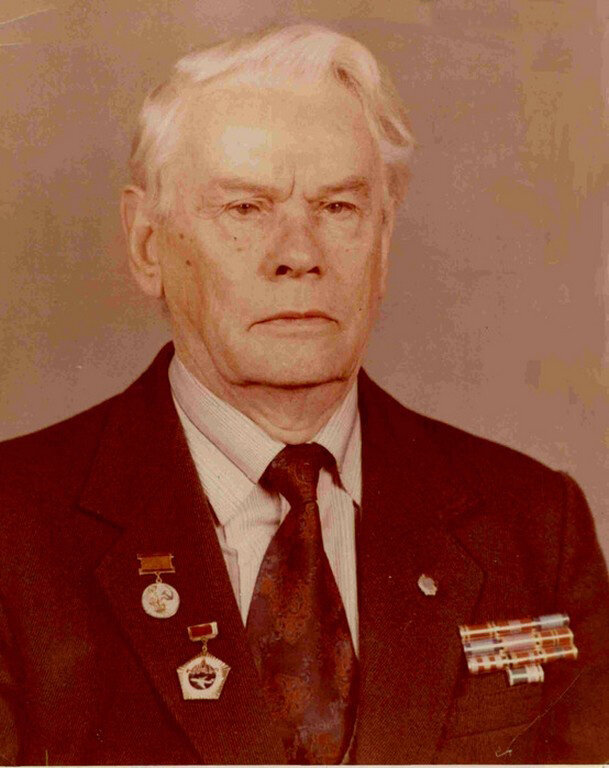
Aviation Designer I. P. Bratukhin
OKB-3, under the leadership of Ivan Pavlovich Bratukhin, was tasked with building a twin-engine tandem helicopter based on the B-5 passenger helicopter, equipped with AI-26GRF engines, capable of reaching speeds of up to 180 km/h, staying airborne for 3 hours, and carrying a crew of three. The aircraft was intended for communications between headquarters, evacuating the wounded, and transporting small cargo. State trials were scheduled for as early as August 1948.
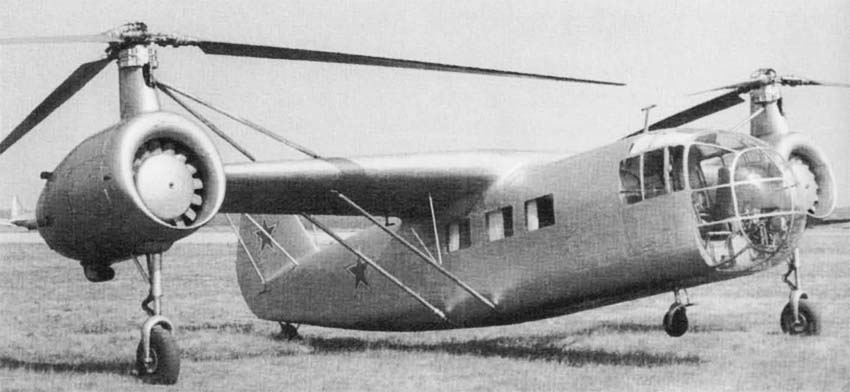
Design: The Final Stage in the Evolution of the Transverse Configuration
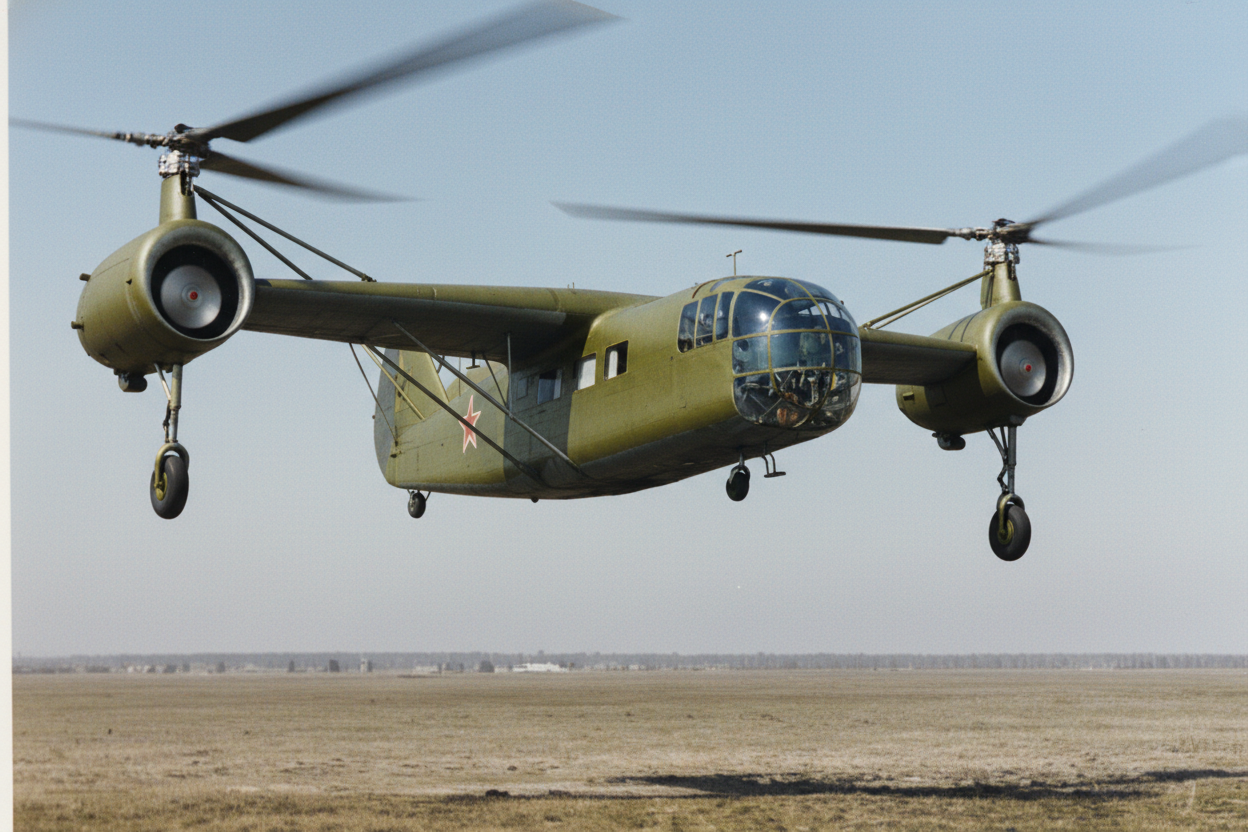
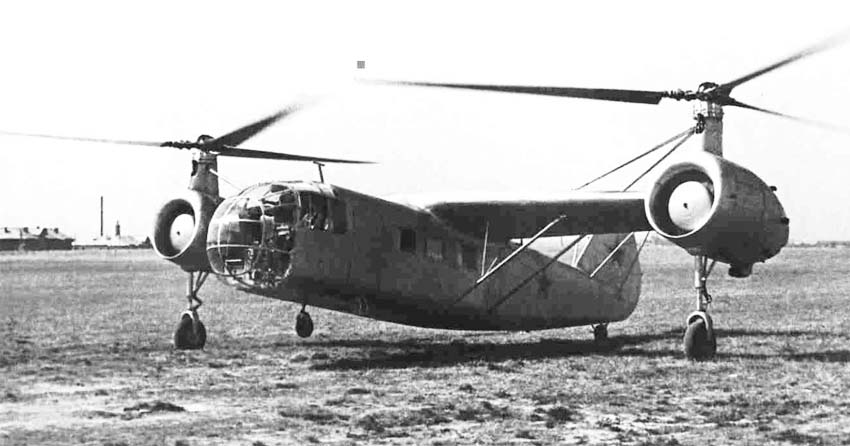
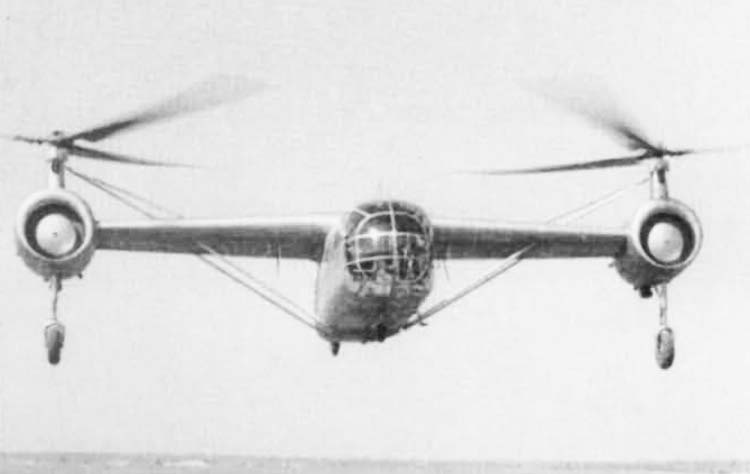
Bratukhin acted decisively. Drawing on the experience gained from the B-5 and B-10, his team had assembled the B-11 by May 1948—ahead of the competition. It was a twin-engine, twin-rotor helicopter with transversely arranged main rotors 10 meters in diameter. The rotor-engine units were housed in engine nacelles connected by a wing, from which the fuselage was suspended.
The design was the logical culmination of a series of vehicles developed by Bratukhin in 1946–1947. It incorporated all the best design features:
- three-bladed propellers, identical to their predecessors;
- the transmission and engine nacelles from the B-10;
- five flexible fuel tanks (560 liters) inside the wing;
- an RSI-6 radio, a radio compass, and a radio altimeter;
- automatic switch to auto-rotation.
The fuselage—an all-metal semi-monocoque—was remarkably well-designed: two doors on the left (passenger and cargo), six windows, an emergency hatch in the cockpit, and comfortable interior trim (walnut wood, soundproofing, curtains, and floor mats). The interior housed:
- pilot and navigator’s cockpit;
- a passenger area with two seats;
- a first-aid station with a stretcher and a space for a medical worker.
The B-11 could be used as a multipurpose aircraft—for everything from transporting people to evacuating the wounded.
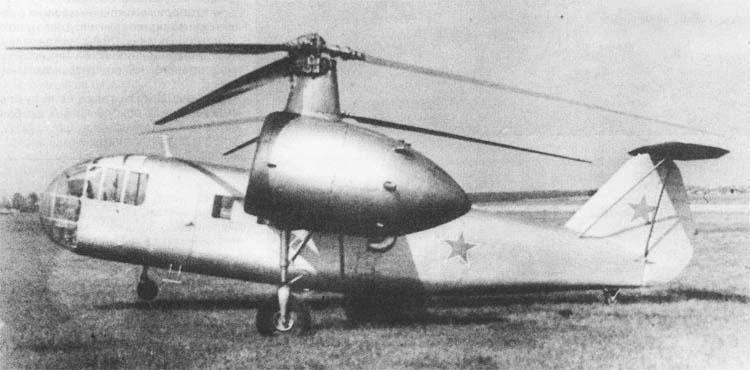
Trials: Success Marred by Problems
The first tethered flight took place on May 13, 1948, and the first free flight on June 18. However, the tests quickly revealed serious flaws:
- At certain operating modes, the wing with a small angle of attack generated negative lift, placing additional stress on the propellers.
- Severe vibrations occurred due to resonance between the oscillations of the units and the loads on the bearing bushings of the drive screws.
- The hydraulic dampers often leaked, which made the control handle shake more.
In August 1948, Bratukhin suspended the tests and sought assistance from TsAGI and TsIAM. Joint research revealed that the landing gear struts, the instrument panel, and the engines were entering resonance. To resolve the issue, special test stands were built, and 100-hour endurance tests were conducted on the transmission and power plant.
But the tragedy of December 13, 1948, marked a turning point. During a test flight of the B-11 backup aircraft, the blade mounting fork failed due to a serious manufacturing defect. Pilot K.I. Ponomarev and flight radio operator I.G. Nilus were killed. After that, complaints poured into the government: “The transverse layout is a dead end,” “Bratukhin can’t handle it.”
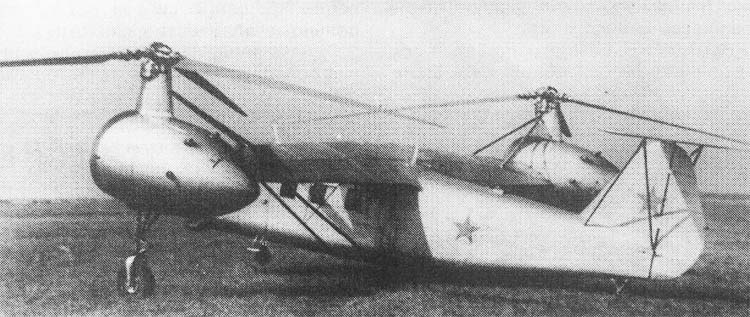
Updates: The car is almost ready
During the winter of 1948–1949, engineers from GSOS No. 3 carried out a major modernization of the first unit:
- The blade roots and keel have been reinforced;
- The engine mounts have been replaced with softer ones;
- the suspension travel has been increased;
- Pressure compensators have been installed in the hydraulic systems;
- A spoiler was added to the trailing edge of the wing (30° angle);
- Dampers and additional struts have been added to the front struts.
G.I. Komarov resumed flight testing. A special commission from TsAGI confirmed:
“Vibration characteristics have improved significantly after fine-tuning… the control knob does not exhibit any issues in any vibration mode… the characteristics are safe for operation.”
The B-11 completed more than 100 flights (total duration: approximately 45 hours), including a route flight from Izmailovo to Serpukhov and back to Izmailovo (220 km in 1 hour and 38 minutes). Based on the results of the factory tests, it was concluded that:
“The B-11 communications helicopter passed its tests satisfactorily… meets tactical and technical requirements… and can be used as a passenger, medical, and cargo helicopter.”
When his fuel reserve was reduced to 1.5 hours, he could take on board:
- 4 passengers,
- 400 kg of cargo,
- or 3 injured + 1 healthcare worker.
Military Failure: Politics Over Technology
In the spring of 1950, the B-11 was transferred to the General Directorate of the Air Force Research Institute for government testing. However, the military, who were skeptical, immediately cited “excessive vibrations” and refused to accept the vehicle.
Repeated objective measurements conducted in collaboration with TsAGI showed that, when the restrictions were observed (maximum speed—155 km/h, altitude—2,500 m), the vibrations remained within acceptable limits. The “shaking” felt by the pilots occurred only under extreme operating conditions—due to flow separation on the blades.
Bratuhin proposed a simple solution:
- increase the chord length of the blades by 15% or
- increase sales by 10%.
That would have completely solved the problem. But the proposal was ignored. By that time, the aviation industry leadership and the military had opted for the single-engine Mi-1 and Yak-100, which were in line with global trends. The side-by-side configuration was considered outdated.
Last Hope: The B-11M Project
Refusing to give up, Bratukhin developed a modernized version of the B-11M in 1949–1950:
- 8 passengers or 6 injured;
- takeoff weight — 5,100 kg;
- load-bearing screws — 14 m;
- new tail feathers;
- automatic speed control;
- Autopilot—a first in Soviet helicopter manufacturing!
He went on to envision the development of tiltrotors (with pusher propellers mounted on engine nacelles) and the transition to gas turbine engines. In his view, the transverse configuration was ideally suited for such designs.
But the bureaucracy had already passed judgment. On December 22, 1950, Aviation Industry Minister Khrunichev and Air Force Commander Zhikharev told Defense Minister Bulginin that “Bratukhin is unable to complete the helicopter’s development.” In the spring of 1951, a commission of scientists deemed the aircraft “unpromising.”
On May 6, 1951, the Council of Ministers of the USSR issued a resolution—all work on the B-11 was halted.
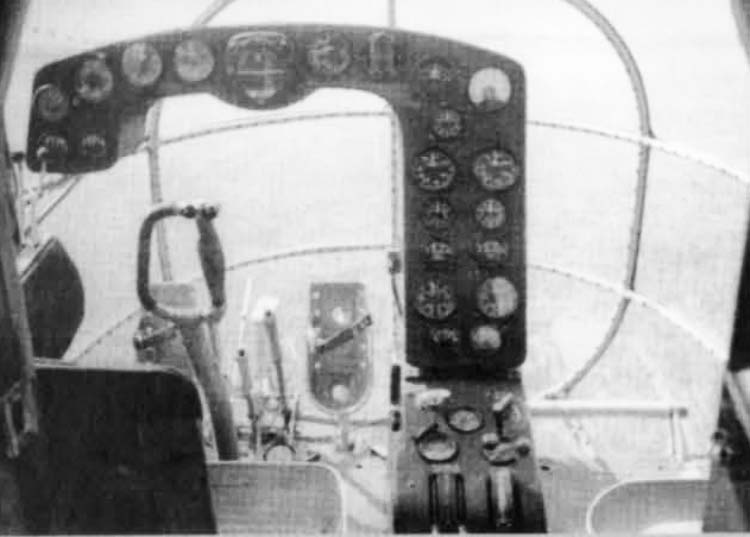
The B-11 Cockpit
Why wasn’t the B-11 put into mass production?
The reasons for the failure are not technical, but systemic:
- The conservatism of military officials and government officials, who preferred “tried-and-true” single-propeller configurations.
- The tragic disaster of 1948, which undermined confidence in the design bureau.
- Political pressure: In the race to meet NATO standards, the USSR chose the path of imitation rather than innovation.
- A lack of support for unconventional solutions, despite their potential.
The B-11 was not just a helicopter—it was a platform for the future: a rotorcraft, a gas turbine engine, an autopilot. But the system didn’t give it a chance.
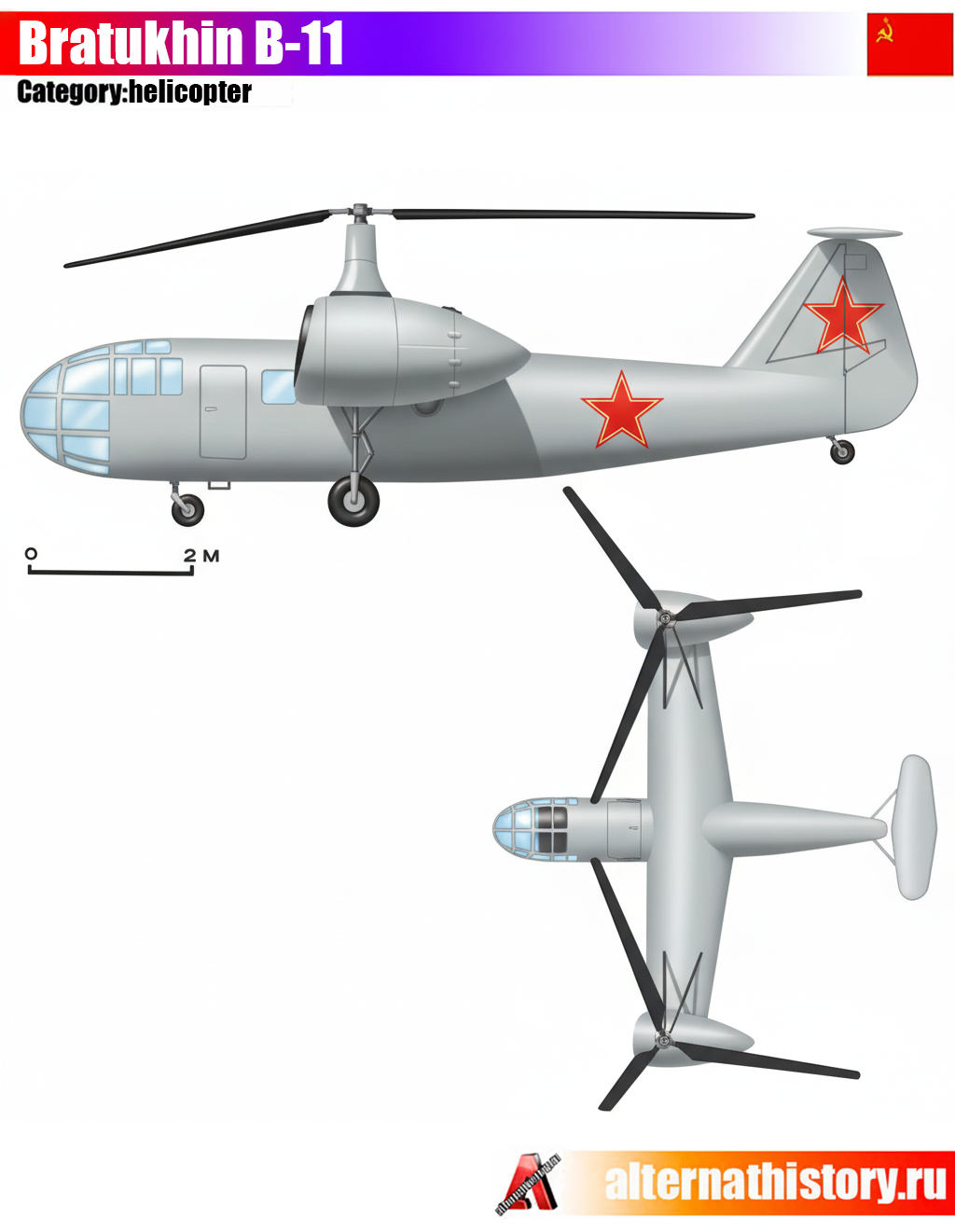
B-11 Flight and Technical Specifications:
- Type — Twin-engine, twin-rotor helicopter with a side-by-side configuration
- The diameter of the main propellers is 10.0 m
- Curb weight — 3,398 kg
- Takeoff weight — 4,150 kg
- Engines — 2 × AI-26GRF (piston)
- Power (takeoff) — 2 × 550 l.s.
- Maximum speed: 155 km/h
- Cruising speed — 124 km/h
- Practical range — 328 km
- Practical ceiling — 2,550 m
- Static ceiling — 1,200 m
- Crew: 2 people
Conclusion
The B-11 is a story about how revolutionary engineering came up against the inertia of the system. It was ready, functional, and versatile. But in an era when “keeping up with the West” was more important than “being ahead of its time,” Bratukhin’s boldness proved out of place.
Today, the B-11 is a forgotten but worthy symbol of the Soviet engineering avant-garde. It is no longer in service—but it has gone down in history as a machine that could have changed the future of helicopter design.
Based on material from — http://xn--80aafy5bs.xn--p1ai/aviamuseum/aviatsiya/sssr/vertolety/vertolety-kb-bratuhina/mnogotselevoj-vertolet-b-11-2/