The Fighter Is More Than Half a Century Old — Yet It Reached a U.S. Base: What Iran’s F-5 Attack Revealed

Imagine a modern American military base in the Middle East. Around it is a network of radars, air-defense systems, airborne early-warning aircraft, fighters, and one of the most sophisticated intelligence architectures in the world. Then Iranian F-5s — aircraft from a family first delivered to Iran in 1965 — approach Camp Buehring in Kuwait at extremely low altitude and reportedly carry out a bombing attack. Former NORAD commander General Glen VanHerck called the incident a wake-up call. And there is a genuinely interesting question here: how could an aircraft based on a design more than six decades old get close enough to threaten a facility defended by 21st-century technology? The answer is far more interesting than simply saying that an old fighter can still be useful.
One important caveat should be made from the outset. Some details of the raid are still based on Iranian accounts and reports that cannot be independently verified in every detail. However, the F-5 attack on Camp Buehring has been discussed by U.S. military sources, and VanHerck emphasized the unusual nature of American forces facing a conventional manned-aircraft attack of this kind.
So rather than counting bombs or debating individual claims, the more interesting question is why such an attack was possible at all.
An American Fighter That Outlived the Shah
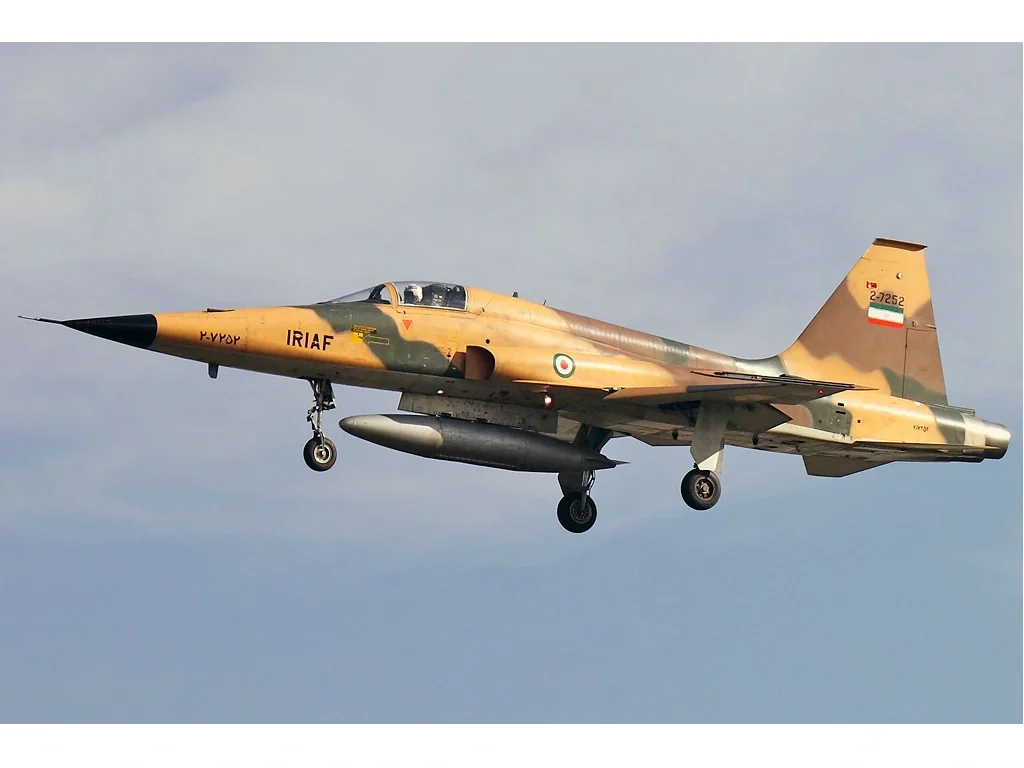
The most ironic part of the story is the aircraft’s origin.
The F-5 is American.
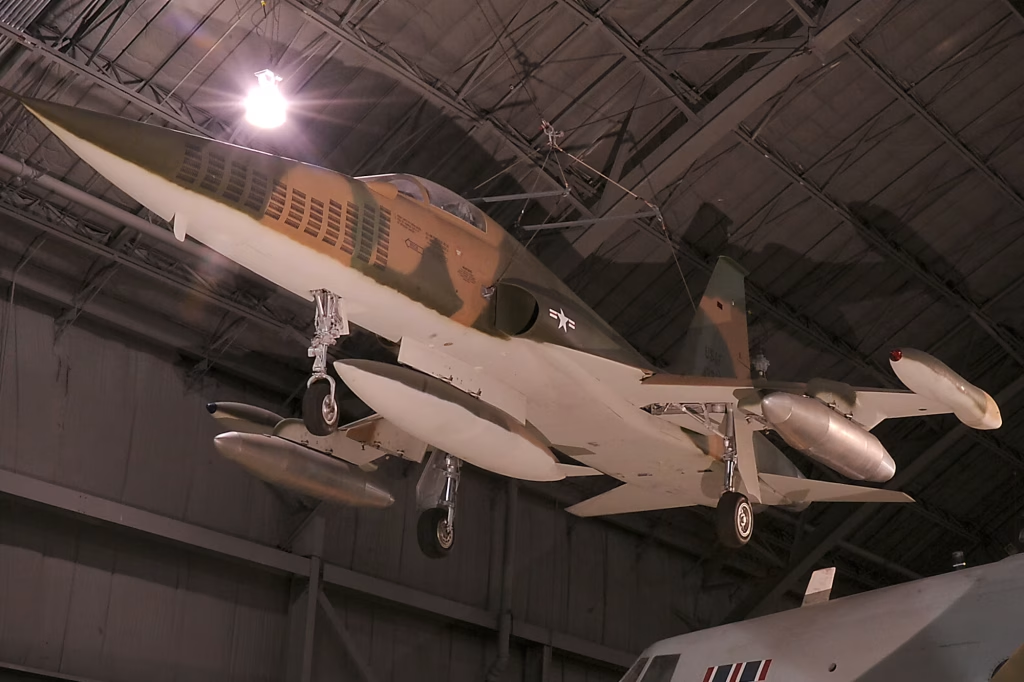
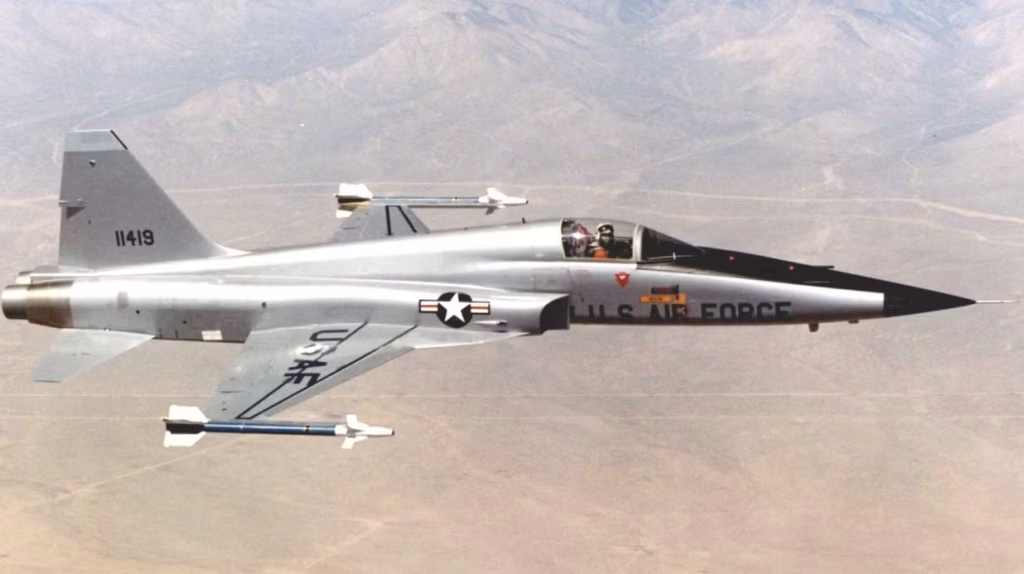
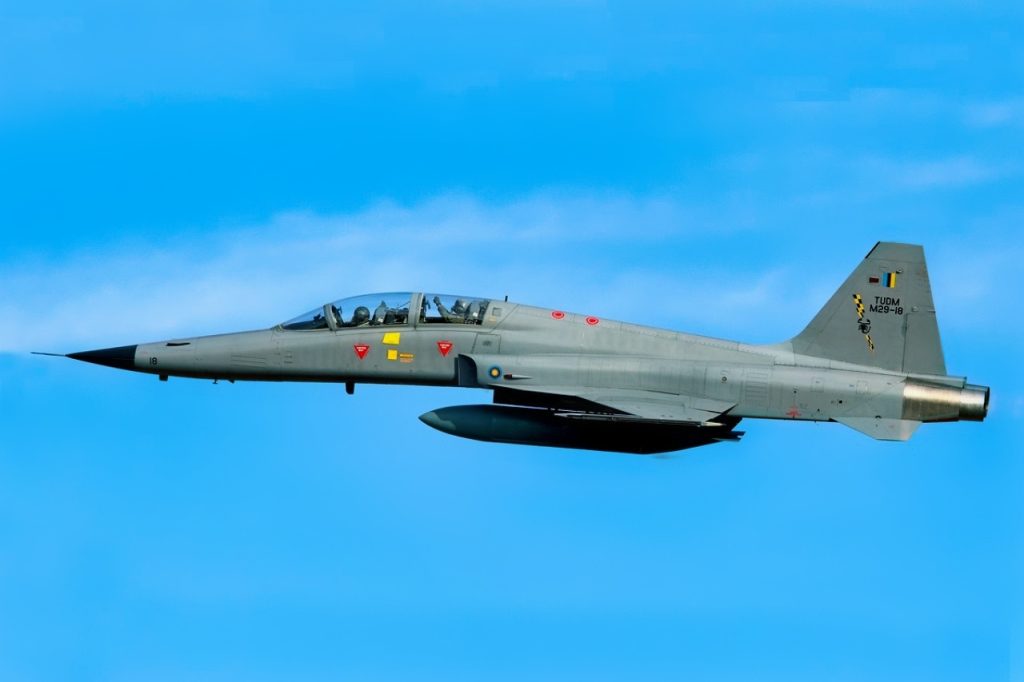
Northrop developed it as a relatively simple, compact, and inexpensive supersonic fighter for U.S. allies. It was not intended to be a heavy and expensive air-superiority machine comparable to the F-4 Phantom II. Instead, it represented a kind of aviation minimalism: a small airframe, two compact General Electric J85 engines, relatively straightforward maintenance, and sufficient performance for a wide range of missions.
Iran became one of the family’s most important customers.
The first 11 F-5As and two two-seat F-5Bs arrived in February 1965. Tehran eventually acquired 104 F-5As and 23 F-5Bs before moving on to the significantly improved F-5E/F Tiger II. Between 1974 and 1976, Iran received a total of 166 F-5E/F aircraft.
By the end of the Shah’s rule, Iran therefore possessed one of the largest F-5 fleets in the world.
After the Islamic Revolution of 1979, relations with the United States collapsed, spare-parts deliveries ended, and Iran’s enormous inventory of American military aircraft suddenly became a logistical nightmare.
One might reasonably have expected the F-5 fleet simply to disappear within a few years.
Instead, the opposite happened.
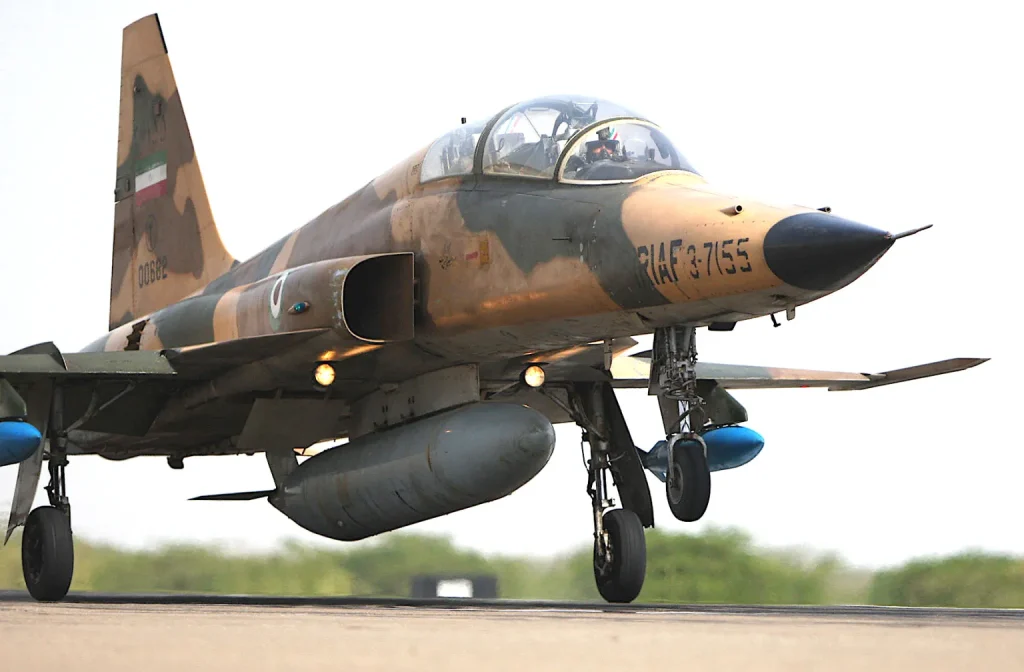
Iran learned to repair the aircraft, restore components, manufacture at least some of the necessary parts, and gradually turned the F-5 into the foundation of its own small combat-aircraft development effort. The Azarakhsh, twin-tailed Saeqeh, and later Kowsar all emerged from this technological lineage. Exactly how much of these aircraft is genuinely indigenous and how much represents heavily modified or reproduced F-5 technology remains debatable, but their ancestry is obvious.
The result is almost a historical joke.
The United States supplied Iran with fighters intended to strengthen an American ally.
Six decades later, descendants of those aircraft were being used to attack an American base.
But Isn’t the F-5 Hopelessly Obsolete?
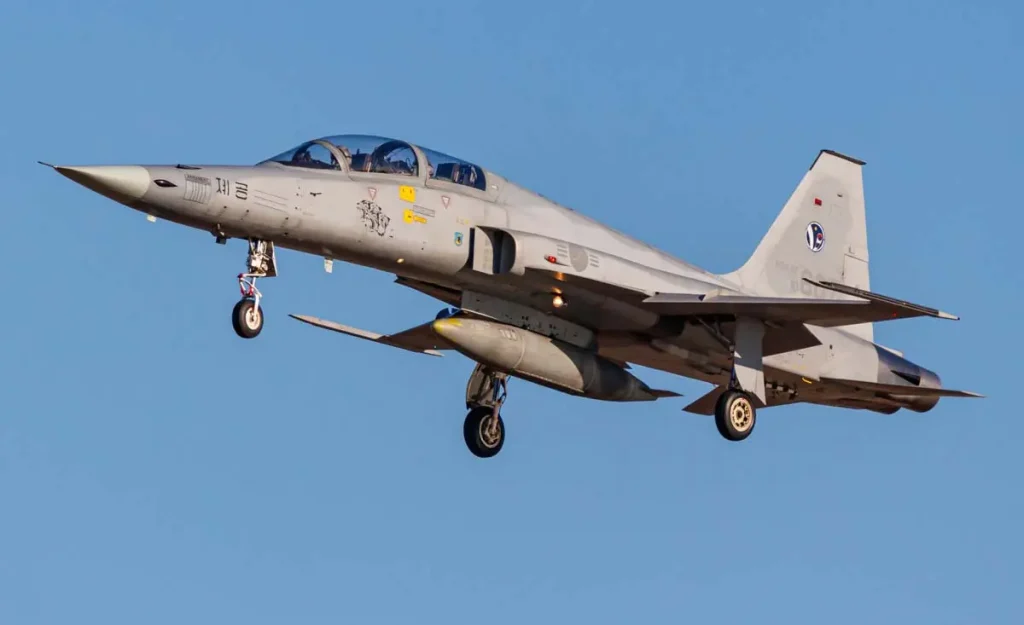
Yes.
Put an F-5E next to a modern F-35 and there is no meaningful technological contest.
The F-5 has no stealth shaping, no modern integrated sensor architecture, and no active electronically scanned array radar. Its original radar systems were extremely modest by modern standards. It lacks the networking, electronic warfare, and beyond-visual-range capabilities associated with current-generation combat aircraft.
But this is where the first misconception appears.
The Iranian F-5s did not need to fight F-35s.
They needed to reach a particular location, drop their bombs, and try to get away.
For that mission, many of the disadvantages of an old fighter suddenly become much less important.
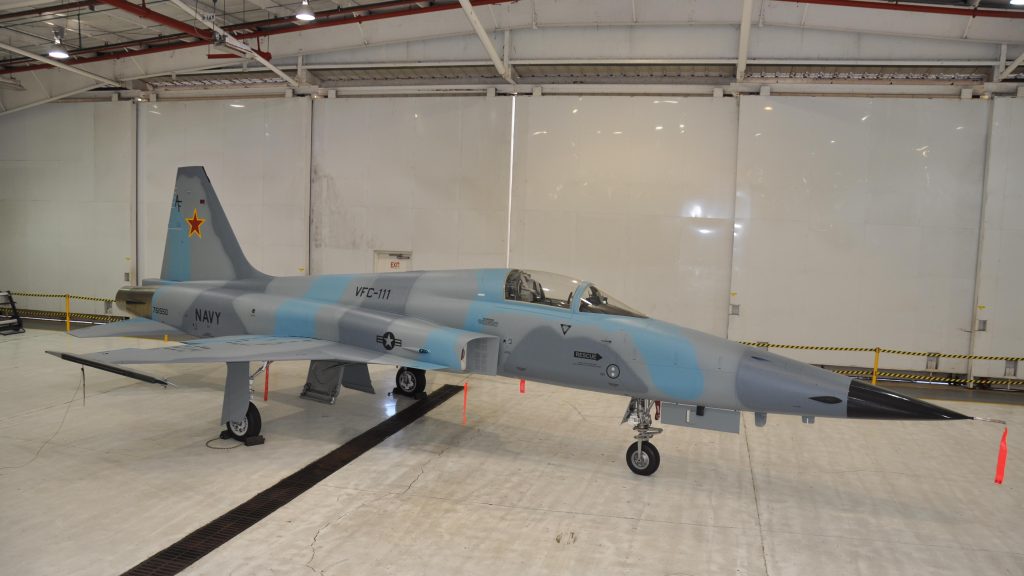
The F-5 was always a small aircraft. The Tiger II is approximately 14.7 meters long with a wingspan of around 8.1 meters. Empty weight is only a little over four metric tons. Two J85 engines give it supersonic performance, while the aircraft’s maneuverability and handling qualities were good enough for the type to spend decades serving as an aggressor aircraft in U.S. training units.
For this story, however, something else matters more.
It can fly very low.
And at low altitude, the laws of physics are exactly the same for an aircraft built in the 1960s as they are for one built in the 2020s.
Radar Cannot See Through the Earth
When people imagine modern air defense, it is easy to picture a powerful radar that sees everything for hundreds of kilometers in every direction.
Reality is less convenient.
The Earth is curved.
For a ground-based radar, that is a fundamental limitation.
An aircraft flying several kilometers above the surface can indeed be detected from very long distances. But as it descends toward the ground, the curvature of the Earth increasingly hides it below the radar horizon. The lower the target flies, the later it becomes visible to a ground-based radar.
Then there are buildings, industrial structures, hills, power lines, and ground clutter.
This is precisely why low-level penetration remained a classic method of evading air defenses throughout the Cold War.
According to accounts attributed to Iranian pilots after the operation, this is exactly what they attempted to exploit. They reportedly maintained radio silence for much of the mission and flew extremely low — in some places allegedly below 50 feet, or roughly 15 meters, above the surface.
Those claims cannot yet be independently confirmed in full, but they make tactical sense.
Fifteen meters in a jet fighter is not merely “low.”
At that altitude, a power line can become almost as serious a threat as a surface-to-air missile.
That also illustrates just how risky such a mission would be.
So Did an Old F-5 Defeat Modern Air Defense?
Not exactly.
And this distinction is important.
The F-5 is not a stealth aircraft. Given favorable detection geometry, a modern radar should have no mysterious difficulty detecting a Tiger II.
The issue is not whether an air-defense system can see an F-5.
The issue is when it sees it.
If an aircraft is detected 200 kilometers away, defenders have time to classify it, establish a track, relay information, scramble fighters, and prepare ground-based interceptors.
If it appears much closer, the equation changes.
The target has to be detected.
Tracked.
Identified.
Classified as friendly or hostile.
Information has to be transmitted.
A decision has to be made.
An interceptor has to be assigned.
A missile has to be launched.
And throughout that entire process, the aircraft continues moving.
This is why modern air defense is built in layers. Ground radars are supplemented by airborne early-warning aircraft, fighters, long- and medium-range surface-to-air missiles, short-range defenses, and additional sensors.
This is where the Camp Buehring incident becomes genuinely uncomfortable.
According to VanHerck, the attack should force U.S. forces to reconsider the threat posed by conventional manned aviation. Over recent decades, the threat environment around American bases in the region has changed dramatically. Enormous attention has been devoted to ballistic missiles, cruise missiles, and, increasingly, drones.
Then, suddenly, a fighter showed up.
A fighter older than many of the people defending the base.
And This Is Where the F-5’s Age Becomes a Strange Advantage
Not technologically.
Economically.
A modern combat aircraft is an extraordinarily expensive asset. Losing one means losing not only the airframe but sophisticated engines, radar, electronic systems, years of pilot training, and one aircraft from what is usually a relatively limited fleet.
Iran’s F-5s occupy a very different position.
Most of these aircraft were paid for decades ago. Iran has been operating and maintaining them for generations, while the design has been absorbed deeply enough into the country’s aerospace industry to produce indigenous derivatives.
That does not make an F-5 expendable. The number of airworthy aircraft is limited, and a trained pilot is far more valuable than an aging airframe.
But the economics remain unusual.
To intercept an old Tiger II, the defender may have to employ modern radars, airborne early-warning aircraft, fighters, and expensive surface-to-air missile systems.
Meanwhile, the F-5 can carry ordinary gravity bombs.
This reflects a very old principle of warfare: force the enemy to spend significantly more resources preventing an attack than you spend conducting it.
Recent attacks on U.S. installations in the region have already demonstrated how difficult it can be to defend large fixed bases against multiple categories of aerial threats.
The F-5 adds another variable to the equation.
Not a new one.
Quite the opposite — a very old one.
The Aircraft That Should Not Have Surprised Anyone
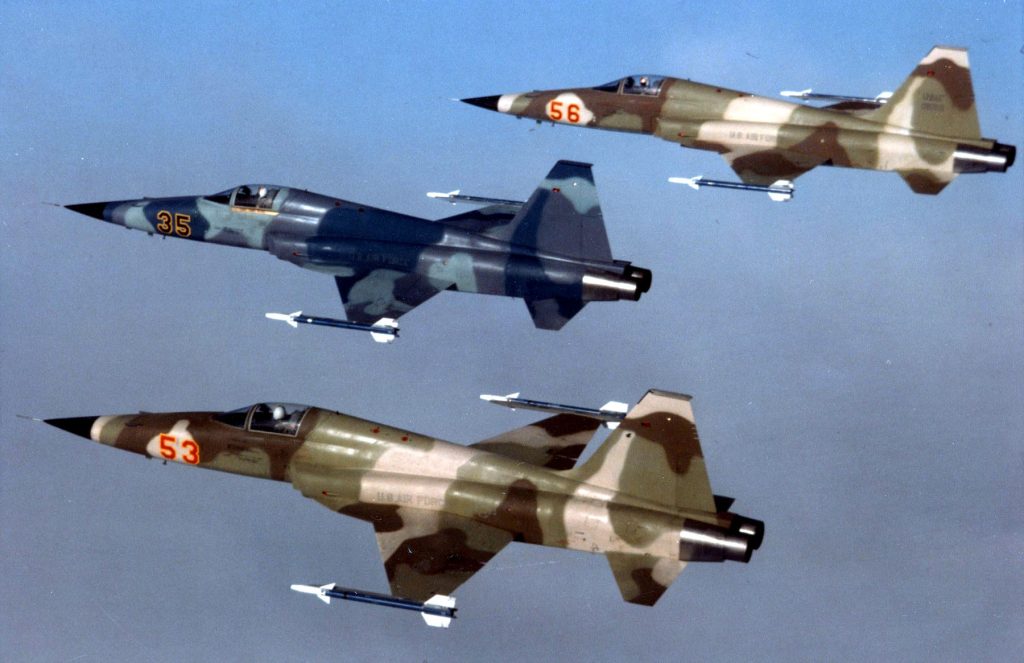
Formation of three aggressor F-5E aircraft of the 527th TFTS, RAF Alconbury, U.K., on Jan. 15, 1983. (U.S. Air Force photo)
This is where the story becomes particularly interesting.
Almost every modern discussion about air warfare revolves around technologies of the future.
Stealth.
Hypersonic weapons.
Artificial intelligence.
Drones.
Network-centric warfare.
Long-range missiles.
Against that background, the F-5 looks like a museum exhibit.
But warfare has never been particularly respectful of the idea that old weapons automatically become useless.
A century-old machine-gun design remains capable of firing bullets. An artillery shell does not stop exploding because the gun that fired it was designed decades ago. And an aircraft does not lose the ability to carry bombs simply because the F-35 exists.
Technological superiority works particularly well when the opponent agrees to fight according to the rules for which that superiority was designed.
Sending F-5s to contest air superiority against modern fighters would make little sense.
But nobody is required to do that.
You can fly at night.
You can stay extremely low.
You can maintain radio silence.
You can choose a route that minimizes exposure to sensors.
You do not have to win the air war.
You only have to reach the target once.
Sometimes the Most Dangerous Characteristic Is Missing From the Specification Sheet
It would therefore be wrong to conclude that a six-decade-old F-5 has somehow become more effective than modern air-defense systems.
It has not.
A modern fighter outperforms it in almost every parameter relevant to air combat. A properly functioning layered air-defense network also possesses the technical means to engage such a target.
But the Camp Buehring attack highlighted a different principle.
A weapon does not have to be modern to represent a modern threat.
Sometimes it only has to be used in a way the opponent was not expecting at that particular place and time.
The F-5 is especially symbolic for that reason. Northrop developed the aircraft family in the late 1950s. The first examples reached Iran in 1965, while the F-5E first flew in 1972. Since then, the world has seen the F-14, F-15, F-16, F/A-18, F-22, and F-35. Fighters learned to detect targets at enormous distances, exchange information in real time, and engage opponents far beyond visual range.
Then, in 2026, the little F-5 was suddenly relevant again.
Not because it somehow became a good modern fighter.
Quite the opposite.
It demonstrated that the age of a weapon becomes much less important when the enemy has stopped expecting the way in which that weapon is being used.
And that is why the former NORAD commander’s description of the incident as a wake-up call may matter more than any performance figure associated with the Tiger II.
The uncomfortable part was not that American air defenses encountered some mysterious weapon of the future.
It was that a weapon from the past managed to become a problem again.