PD-26 vs. PD-35: Who Will Win the Race Among Russian Aircraft Engines—and When Will We See Them in the Sky?

January 2026 marked an important milestone in the history of modern Russian engine manufacturing. While the world watched the fate of the CR929 wide-body airliner project unfold, the country’s most ambitious aviation program underwent a quiet but steady transformation in the design bureaus of Perm. The PD-35 “super engine” ceased to be a standalone project and evolved into a technological platform that gave rise to a new favorite—the PD-26 engine.
2025: From Prototypes to Actual Hardware
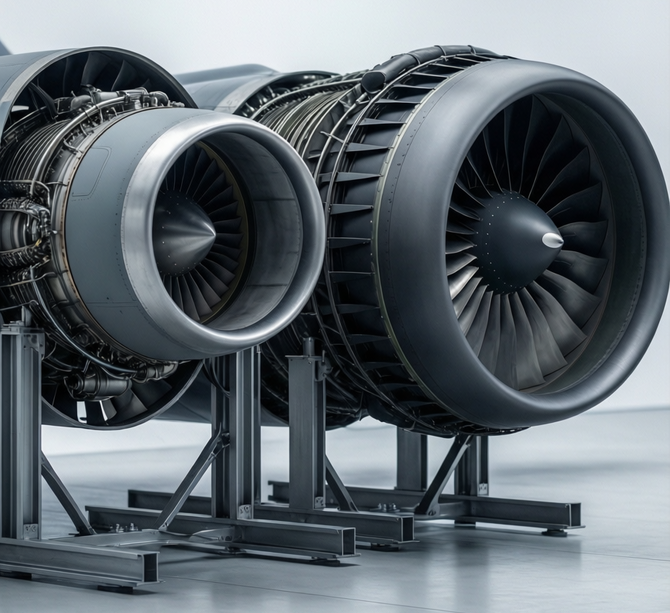
The year 2025 proved to be a turning point for the United Engine Corporation (UEC). While the PD-35 had previously existed mainly as individual components and a gas generator, by the end of last year the program had moved beyond the research and development phase.aviation21
A key milestone was the validation of the gas generator’s performance characteristics—the “heart” of the engine. Tests showed that the selected parameters (exhaust gas temperature before the turbine, compression ratio) are achievable and reliable. This paved the way for the creation of a scalable family of engines.npo-sudmash
At the very beginning of 2026, on January 3, it was announced that a unique technology for manufacturing rotors for the PD-35 had been implemented. UEC began using new machining methods that made the rotors lighter and stronger. For an engine of this size (with a fan diameter of over 3 meters), every kilogram of weight counts, as a heavy engine requires the pylon and wing to be reinforced, which reduces the aircraft’s payload.ixbt
PD-26: The New Favorite
The biggest news at the end of 2025 was the finalization of the design of the PD-26 engine. For a long time, experts had debated whether it would be a “scaled-down” version of the PD-35 or a separate design.
First Deputy Prime Minister Denis Manturov put an end to these disputes by confirming that the PD-26 is based on the PD-35 gas generator. This is a classic example of technology scaling, similar to how Western companies develop engine families (for example, the Rolls-Royce Trent family).npo-sudmash
Why exactly 26 metric tons?
The 26-metric-ton (mt) thrust rating was not chosen at random. It represents the “golden ratio” for the current needs of the Russian aviation industry, filling two strategic niches at once:
-
Super-heavy transport aircraft (“Elephant” / Il-100).
The Russian Ministry of Defense urgently needs to replace its fleet of An-124 “Ruslan” aircraft. The Advanced Transport Aircraft (PTVTS) project, unofficially named “Elephant” or designated Il-100, requires four engines with precisely this thrust. The PD-35, with its thrust of 35–40 metric tons, is overkill for this aircraft, while the PD-14 (14 metric tons) is too weak. -
The Reincarnation of the Il-96.
The modernized Il-96-400M now flies with four PS-90A1 engines. Installing two PD-26 engines instead of four PS-90A1 engines would transform the Il-96 into a full-fledged twin-engine airliner (similar to the Boeing 777 or Airbus A330). This would drastically reduce fuel consumption and maintenance costs, making the aircraft commercially viable.ritm-magazine
A Technological Breakthrough
The development of the PD-35 and PD-26 required the mastery of technologies that had not previously been used in Russia.
-
Composite fan blade.
To reduce weight, fan blades are manufactured from polymer composite materials. In 2024–2025, ODC successfully conducted tests on these blades, including simulations of bird strikes. Previously, such technologies were available only to General Electric and Rolls-Royce.rg -
Additive manufacturing.
Combustion chamber and turbine components are printed on 3D printers using domestically produced metal powders, which speeds up production and allows for the creation of cooling channel geometries that cannot be achieved through casting.
Outlook for 2026–2030
As of now (January 2026), the status of the programs is as follows:
Flight testing of full-scale demonstrators on the Il-76LL flying laboratory is expected to enter its active phase as early as this year.rg
The PD-26 program has now been given high priority, as the army needs military transport aircraft “right here, right now.” If the PD-35 is a ticket to the future of civil aviation, then the PD-26 is a guarantee of the country’s strategic mobility as early as the next decade.vz
Thus, Russia is not merely developing a “large engine,” but is building the capabilities to manufacture any powerplant with a thrust ranging from 20 to 50 metric tons, thereby permanently eliminating the issue of dependence on imports in the wide-body aircraft class.
Source — https://dzen.ru/a/aWR94sNiO0WelIwk