Near Miss: A Cold War-era aircraft from NASA's fleet made an emergency landing without its wheels

On January 27, 2026, at Ellington Field in Houston, Texas, one of NASA’s WB-57F Canberra research aircraft made an emergency landing without extending its landing gear, skidding along the runway on its belly and sending up a plume of smoke and sparks. Video from the scene appeared on social media and in the news, showing the dramatic moment when the fuselage struck the concrete.
NASA confirmed that the incident was caused by a mechanical malfunction that prevented the landing gear from deploying. All crew members and the researcher on board survived and were unharmed. The agency stated that a thorough investigation into the causes of the failure will begin shortly.
How It Happened

The incident occurred around 11:30 a.m. local time. According to eyewitness accounts and recordings, the plane was approaching for landing as usual but was unable to deploy its main and nose landing gear, prompting the pilots to decide to perform a belly landing — that is, with the fuselage making contact with the runway as safely as possible.
The drama of the moment is underscored by a video showing yellow flashes of flame and white smoke emerging from beneath the fuselage’s skin, as the plane slowly skids across the concrete, generating significant friction.
Scene of the Incident and Response by Emergency Services
The incident occurred on Runway 17R-35L at Ellington Airport, which is located southeast of downtown Houston. After the research aircraft landed, the runway was temporarily closed to all flights until rescue and engineering crews completed work to stabilize the aircraft and evacuate the crew.
Firefighters and emergency rescue teams were on the scene and ensured that the two pilots were safely extracted from the cockpit and that medical personnel could assess their condition.
What kind of aircraft is the WB-57F?
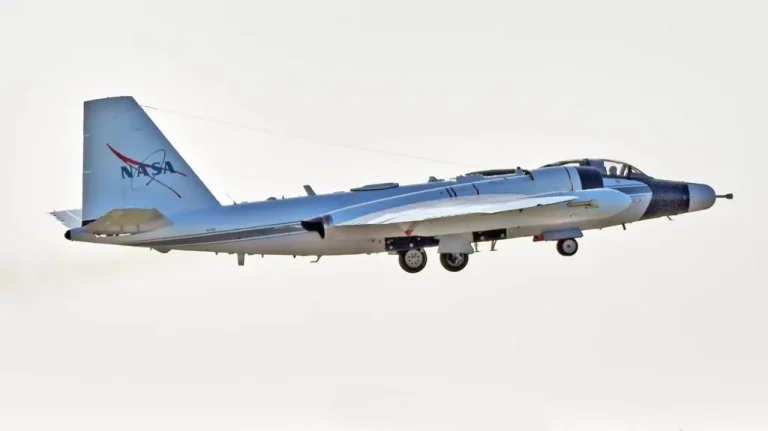
The WB-57F is a high-altitude research jet aircraft operated by NASA for scientific and atmospheric research. It is derived from the Martin B-57 Canberra military aircraft, which was developed in the 1950s as a bomber and reconnaissance aircraft.
WB-57F aircraft are capable of climbing to extremely high altitudes—over 63,000 feet (≈19,200 m)—and, depending on their configuration, carry out long-duration missions involving:
- collecting data on Earth’s atmosphere;
- monitoring of space-related processes;
- filming and monitoring rocket launches;
- scientific testing of onboard instruments.
This model can carry substantial loads of scientific equipment in modular compartments under the fuselage and in additional panels under the wings.
NASA operates a total of three WB-57F aircraft, all of which are based near the Johnson Space Center in Houston.
Why This Incident Is Important
An incident involving a landing without landing gear is a rare occurrence for the modern aircraft fleet, especially for research aircraft, which have been in service for decades and are considered highly reliable.
The WB-57F has been used in scientific and technical missions since the 1970s, and these aircraft remain a valuable asset for research into the upper atmosphere, space phenomena, and even support for certain military operations.
It is not yet clear how the incident will affect the continued operation of the specific aircraft, N927NA: it sustained significant damage, and its repair requires a thorough assessment.
What’s Next
NASA and the U.S. Federal Aviation Administration (FAA) will launch a formal investigation into the incident to determine the exact technical cause of the equipment failure, particularly that of the landing gear retraction mechanism. The analysis will take time and may include an examination of flight data, the condition of components, and interviews with crew members.
The results of the investigation will be included in NASA’s report on the incident, and the agency has promised to provide transparent updates as information becomes available.
Conclusion
The emergency belly landing of a WB-57F aircraft in Houston made headlines in aviation and scientific circles, highlighting just how challenging it is to operate rare and aging research platforms. Despite the visually dramatic nature of the incident, the crew emerged unharmed, and the response by emergency services demonstrated a high level of preparedness for such situations.