Why Does the Bradley Need Its Own Swarm of Ground Drones? The U.S. Army Is Changing the Role of the IFV

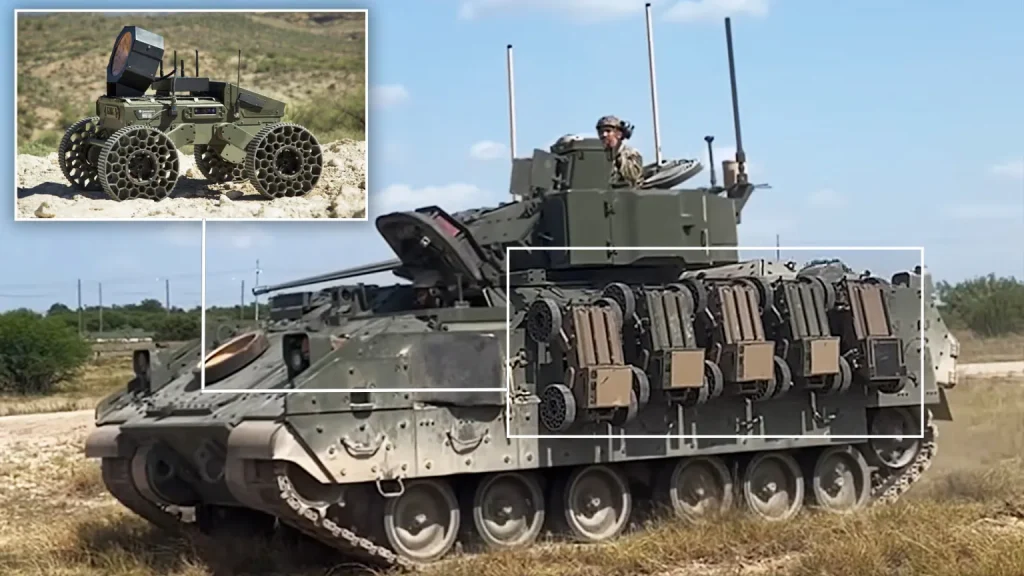
At first glance, the photograph looks almost comical. An American M2A4 Bradley is driving around with five small four-wheeled robots attached to the outside of its hull. This is not some purpose-built robotic carrier of the future or an exhibition concept, but a standard infantry fighting vehicle with several tiny unmanned platforms strapped to its sides. Yet once we look at what those machines actually are, the experiment becomes far more interesting than another attempt to bolt drones onto an existing combat vehicle. What we may be seeing is an early prototype of an entirely new kind of mechanized unit, in which the IFV is no longer merely an infantry transport with its own weapons. It becomes a protected command node capable of carrying a group of autonomous machines to the battlefield, sending them ahead, and using them to scout, disrupt, or even attack the enemy without exposing either the crew or the Bradley itself.
The robots attached to the vehicle are called FireAnts, developed by the American company Swarmbotics AI. They are compact four-wheeled unmanned ground vehicles weighing about 70 pounds, or roughly 32 kilograms. Their most important feature is not their size but their modularity: the same chassis can carry reconnaissance sensors, electronic-warfare equipment, communications gear, relay systems, and other payloads. There is also a considerably more aggressive option. A FireAnt can carry an explosively formed penetrator warhead and effectively become a disposable anti-armor ground drone. But the central idea is not simply to create another small remotely controlled vehicle. FireAnt is being developed for collective operations, allowing several robots to perform a common mission without requiring a human to manually drive every individual machine.
And this raises the central question: why does a Bradley need five small reconnaissance and anti-tank robots when the IFV itself already carries a 25 mm automatic cannon and TOW anti-tank missiles? The answer tells us a great deal about how the role of armored vehicles may change over the coming decades.
The Bradley Can Already Kill Tanks Without Robots
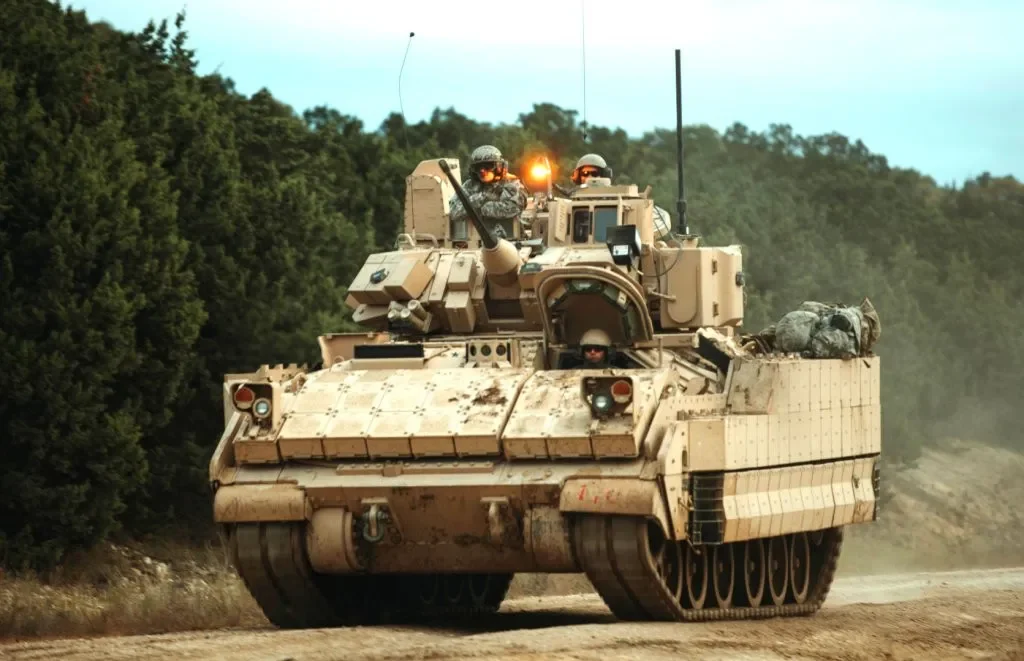
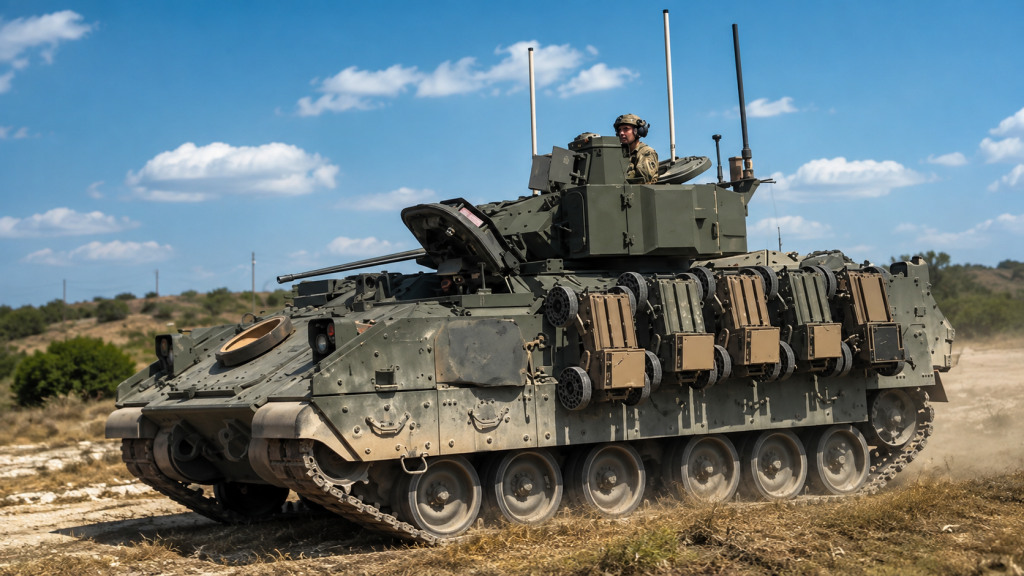
The M2 Bradley has never been merely an armored bus for infantry. Its 25 mm M242 Bushmaster automatic cannon can engage light armored vehicles, firing positions, and numerous other targets, while its twin TOW launcher allows it to attack much heavier armor. So the Bradley does not need a small robot carrying a warhead simply to destroy an enemy tank. The problem lies elsewhere: to use its own weapons, the IFV has to put itself in a position from which those weapons can be employed. Its crew has to detect the target, establish a line of fire, launch a missile or open fire, and in doing so reveal the vehicle’s position. On a modern battlefield, that can mean inviting return fire from artillery, FPV drones, anti-tank missiles, or other weapons.
FireAnt offers a way to break that sequence. The Bradley can remain behind a terrain feature, building, or tree line while small robots move toward suspected enemy positions. One can check the road, another can approach from the left, a third can establish an observation point, a fourth can carry electronic-warfare equipment, and a fifth can serve as a communications relay. If the group detects enemy armor, the coordinates can be transmitted back to the crew. More importantly, if one or more FireAnts carry warheads, reconnaissance could potentially transition almost immediately into an attack. A human authorizes the use of force, but instead of a multi-million-dollar Bradley carrying people moving toward the target, a small unmanned vehicle does.
This is why comparing the FireAnt’s weapon to the Bradley’s cannon or TOW missiles somewhat misses the point. The robot does not replace the Bradley’s organic weapons. It increases the distance between the IFV and the enemy. And distance is gradually becoming another form of protection alongside armor, smoke, explosive reactive armor, and active protection systems.
Losing a FireAnt and Losing a Bradley Are Very Different Things
A modern IFV is an extremely expensive system. There are people inside it, while the vehicle itself combines an engine, transmission, weapons, optics, electronics, communications equipment, armor, and countless other components. Losing a Bradley therefore means not only financial damage but potentially the loss of its crew and infantry squad, as well as a significant reduction in the unit’s combat power. A small robot, by contrast, can be designed from the outset as an attritable system — something whose loss is considered an acceptable part of combat operations. Where soldiers or full-size armored vehicles once had to be risked, it may now be possible to risk a much cheaper unmanned platform first.
A suspicious tree line? Send a robot. A possible minefield? Send a robot. Need to look around the corner of a building? Send a robot. Suspect an ambush? Several robots can approach from different directions. Need to force the enemy to activate communications or open fire and reveal a position? An unmanned platform can do that as well. Even a destroyed FireAnt may have completed its mission if its loss reveals the location of an enemy unit. The Bradley consequently gains another protective layer, but one made not from steel or composites, but from cheap machines, sensors, communications, and distance.
This approach could also change the economics of ground combat. Armies currently have to use expensive platforms for many relatively simple but dangerous missions. If some of those missions can be delegated to cheap robots, expensive armored vehicles can remain outside the immediate engagement zone for longer. In this sense, FireAnt begins to resemble a reconnaissance munition: its value is determined less by whether it comes back than by whether it performs a dangerous task without risking a human being.
But a Real Swarm Begins With Autonomy, Not Numbers
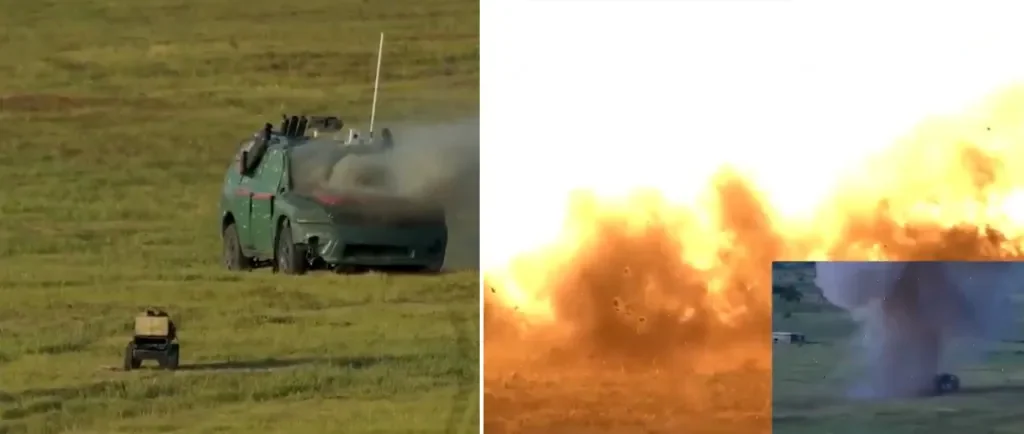
If each of five FireAnts requires its own operator, the concept quickly runs into an obvious limitation. Five robots require five operators, twenty require twenty, and a hundred unmanned vehicles become almost useless without an entire unit of people staring at screens. This is why Swarmbotics AI is emphasizing collective autonomy. The human should not have to control every turn of every wheel. Instead, the operator assigns a mission to the group: reconnoiter an area, check a route, locate armored vehicles, occupy observation points, or establish a relay network. The machines then distribute some of the work among themselves and handle much of the navigation autonomously.
The company has already demonstrated scenarios in which a small unit controlled ten FireAnts. The transition from “one operator, one drone” to “one operator, many machines” is the real dividing line between ordinary remotely controlled vehicles and a genuine swarm. Similar concepts are being developed elsewhere. Britain’s Software Defined Swarms effort, for example, is also aimed at allowing a human to supervise groups of autonomous platforms rather than manually piloting each one.
This is why the word “swarm” matters more than the word “drone.” Remotely operated ground vehicles have existed for decades and are not revolutionary by themselves. Their fundamental problem has always been similar: every platform needs an operator, a reliable communications link, and continuous human attention. As the number of robots increases, so does the demand for operators and radio channels. True collective autonomy is supposed to reverse that equation. Instead of ten separate machines each demanding its own human, there is one system consisting of ten elements. The operator assigns the mission, algorithms distribute roles, the vehicles exchange information, and losing one robot does not necessarily stop the rest of the group.
Now Imagine 50 FireAnts Instead of Five
Five robots on one Bradley are still an experiment, but the concept scales easily. One IFV carries five machines, another carries five more, and a third brings another five. Additional platforms could arrive aboard specialized transports. Suddenly, the mechanized formation is preceded not by a handful of scouts but by an entire unmanned screen. Some machines conduct reconnaissance, others provide communications, others carry electronic-warfare equipment, some inspect routes, while others carry warheads. Physically, they could all use essentially the same basic chassis, differing mainly in payload.
At that point, the most important component of the system is no longer the individual FireAnt. It is the software capable of turning dozens of relatively simple platforms into a coordinated network. One robot does not necessarily need an expensive suite of sensors if the entire group collectively gathers the necessary information. One vehicle detects an obstacle and the others learn about it. Another sees the enemy and that information becomes available across the network. A third loses its direct connection to the Bradley, and its data can potentially be routed through another robot. The value of each individual machine decreases while the value of the network increases.
This is precisely why the U.S. military and defense companies are investing so heavily in collaborative autonomy. The challenge is far more complicated than simply teaching a vehicle to drive toward a set of coordinates, but solving it is essential if robotic systems are ever to be deployed in truly large numbers.
And Then the Bradley Stops Being Just One Vehicle
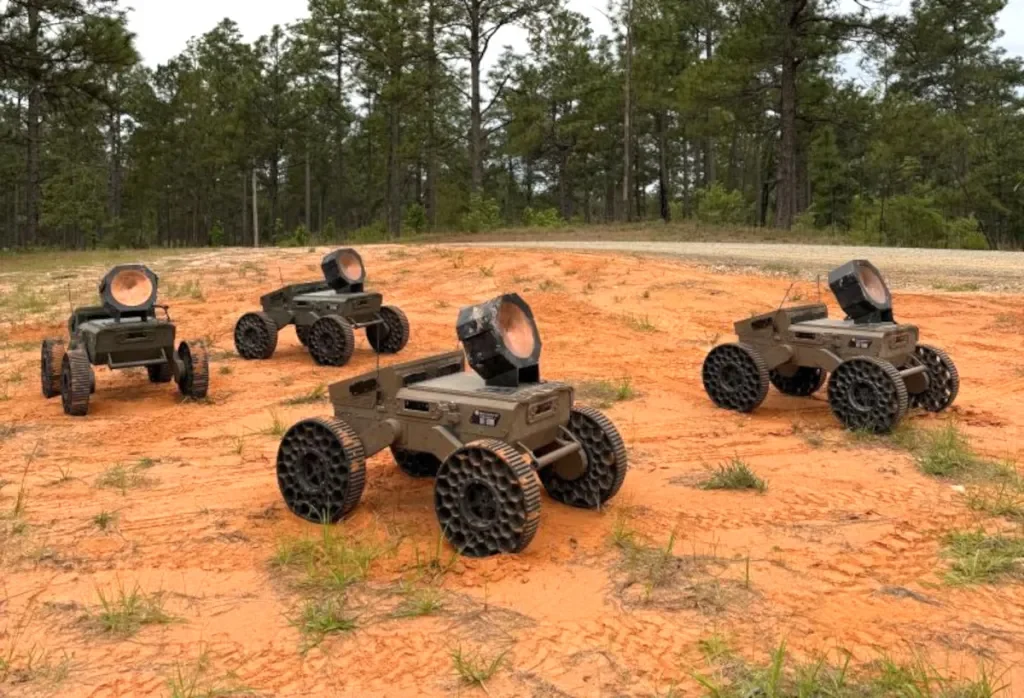
Traditionally, infantry fighting vehicles are compared using familiar characteristics: armor thickness, gun caliber, troop capacity, engine power, protection level, and number of anti-tank missiles. But this kind of warfare introduces an entirely new metric: how many external unmanned systems can an armored vehicle carry, deploy, and control? A Bradley carrying five FireAnts effectively gains five additional observation points, several remote sensors, or potential weapons that can operate hundreds of meters or even kilometers away from the IFV itself.
Physically, the Bradley remains one armored vehicle. Functionally, however, its capabilities begin spreading across an entire area. The crew can see not only through the vehicle’s own sights but through sensors carried by robots. Communications can be extended through a forward relay. An enemy vehicle can be attacked not only by a TOW missile but by a machine approaching from an unexpected direction. The result begins to resemble a distributed combat vehicle, in which the engine, crew, and primary weapons remain inside one protected hull while some sensors and weapons are physically separated from it and move independently around the battlefield.
The Bradley is surprisingly well suited to such a role. Building a dedicated drone carrier seems like an obvious solution, and such vehicles will probably appear, but an existing IFV already has almost all the necessary infrastructure. It is armored, crewed, equipped with substantial electrical power and communications, has internal volume, and can maneuver alongside tanks. It does not have to be introduced into the unit as an entirely new class of vehicle with a separate support structure. At least initially, it may therefore be much easier to add robotic platforms to existing armored vehicles.
The Current FireAnt Installation Still Looks Almost Improvised
The five robots have been mounted on external racks along the Bradley’s sides, in areas normally associated with additional protection. It remains unclear whether future versions will allow FireAnts to be deployed directly from inside the vehicle or whether crew members will have to remove them manually. Additional robots could theoretically be carried inside the troop compartment and unloaded through the rear ramp. The present arrangement looks much more like an experimental installation than a mature production system, but that is entirely normal at this stage: the military first needs to determine whether the concept is useful before engineers design the perfect deployment mechanism.
The idea of using a Bradley as a forward command node for unmanned ground vehicles is not entirely new either. The U.S. Army has previously experimented with using the IFV to control robotic systems. FireAnts have also been demonstrated alongside larger unmanned platforms capable of transporting smaller robots. This creates the possibility of a layered structure: soldiers remain inside a protected armored vehicle, a larger unmanned system moves closer to the danger zone carrying several small robots, and those machines then disperse directly in front of enemy positions.
With each layer, the human moves farther away from the most dangerous point. That may be a much better description of military robotics than the popular idea of “replacing soldiers with robots.” The soldier does not disappear. Humans still make decisions, supervise the system, and remain essential to the unit. What changes is the number of unmanned intermediaries between the soldier and the place where shells are actually exploding.
On the Ground, Everything Is Much Harder Than in the Air
There is, however, a fundamental problem that makes ground swarms considerably harder to implement than aerial ones. A flying quadcopter does not have to cross ditches, fallen trees, curbs, trenches, collapsed walls, or deep mud. Any one of those obstacles can stop a small four-wheeled vehicle. Add snow, sand, tall grass, shell craters, and urban debris, and it becomes clear why autonomous ground navigation is an extremely difficult engineering problem.
It is not enough for a robot to know the coordinates of its target. It must understand how to physically reach it, where it can drive, which obstacle it should go around, which slope is too steep, and when the selected route has become impossible. This is why companies working on military ground autonomy are investing heavily in autonomous off-road navigation. At the same time, the U.S. Army is experimenting with larger autonomous ground platforms capable of carrying cargo, weapons, or smaller drones. FireAnt occupies the opposite end of this emerging ecosystem: small, relatively simple, and potentially expendable.
The second major problem is communications. The modern battlefield is saturated with electronic warfare, and if every robot continuously streams high-resolution video back to an operator, the swarm quickly becomes a massive consumer of radio bandwidth. Autonomy again changes from a useful feature into a necessity. A robot does not need to report every second of its movement. It can receive a mission, navigate most of the route independently, and transmit only when it detects something important or encounters a problem. The less constant communication the system requires, the harder it becomes to paralyze the entire swarm simply by disrupting its data links.
And Finally, Everything Comes Down to Cost
Building a small robot is relatively easy. Building a small, reliable, autonomous, and genuinely inexpensive military robot is much harder. It starts with a simple four-wheeled chassis, but then it needs cameras, thermal imagers, secure communications, navigation equipment, computing hardware, additional sensors, perhaps lidar, electronic-warfare equipment, and enough ruggedization to survive military service. Every new component increases the price, and eventually the “expendable” robot can become so expensive that commanders become reluctant to lose it. At that point, much of the logic behind mass swarming begins to disappear.
One of the most important challenges for programs like FireAnt is therefore keeping the platform cheap enough to remain genuinely expendable. If a FireAnt or a future equivalent costs too much, deploying dozens of them becomes economically questionable. If it is cheap enough, however, the way the military thinks about the robot changes fundamentally. It can begin to be treated almost like a munition — something that does not necessarily have to return after completing its mission.
And this leads to perhaps the strangest part of the entire concept.
The Bradley’s Ammunition Load Could Eventually Include Other Vehicles
We normally think of ammunition as shells, missiles, cartridges, and grenades. But for a future armored vehicle, other vehicles themselves could become part of the combat load. A Bradley reaches its position carrying TOW missiles, hundreds of 25 mm rounds, and five FireAnts. During the engagement, one missile is fired at a tank, several dozen cannon rounds are expended against light vehicles, one robot is lost during reconnaissance, another remains behind as a communications relay, and a third carrying a warhead destroys itself together with an enemy vehicle. After the mission, the Bradley returns to resupply and receives new missiles, ammunition — and new robots.
In such a system, the boundary between vehicle, sensor, and munition begins to blur. The same FireAnt might serve as a scout on one mission, a relay on another, and a disposable weapon with a different payload. For an army, that is potentially an extremely attractive model: instead of several specialized machines, there is one inexpensive platform whose function is determined by its payload and software.
This is why five tiny robots hanging from the sides of a Bradley matter more than the photograph initially suggests. For now, this is still an experiment associated with Pegasus Charge 3, conducted by the U.S. Army’s 1st Cavalry Division. Swarmbotics AI had previously been selected to work on small attritable UGVs capable of collective operations as part of the broader Transformation in Contact initiative, through which the Army is trying to test emerging technologies directly with operational formations rather than waiting years for conventional acquisition programs to run their course.
There is no guarantee that FireAnt itself will become a mass-produced system. Ten years from now, this particular robot may be little more than a historical footnote. But the direction is becoming increasingly clear. For roughly a century, the development of armored vehicles primarily meant improving the vehicle itself: thicker armor, more powerful engines, larger guns, better sights, longer-range missiles. Now another path is emerging. Instead of concentrating every capability inside one increasingly expensive armored hull, the vehicle can surround itself with numerous cheap platforms that watch, listen, relay communications, jam signals, inspect dangerous terrain, and, when necessary, destroy themselves together with the target they have found.
Seen from that perspective, a Bradley carrying five FireAnts no longer looks like an old IFV with a few small robots awkwardly strapped to its sides. It may instead be an early and primitive version of the infantry fighting vehicle of the future — one whose cannon and missiles remain only part of its armament, while another form of ammunition consists of a swarm of robots sent into battle before the humans.