3 Future Technologies to Combat Mines and Drones: Plasan's Smart Armor Instead of Thick Steel

The era when armored vehicles were protected solely by thick steel plates is now firmly a thing of the past. It is impossible to keep increasing their weight indefinitely. Defense contractors have joined the race to develop high-tech survivability systems: now, armor must respond intelligently and precisely to modern threats.
Plasan, an Israeli company and a leader in the production of composite materials, showcased three new developments at the Eurosatory international exhibition back in June 2024. The LAPS, ATHENA, and TAPS systems provide protection against mine blasts, shaped-charge explosions, and drone strikes from above.
Each system addresses a specific challenge that traditional homogeneous or composite armor can no longer handle without significantly increasing the vehicle’s weight.

Protecting the Crew from Mine and Explosive Injuries
The LAPS (Leg Active Protection System) protects the crew’s legs when the armored vehicle hits a mine or a powerful roadside bomb.
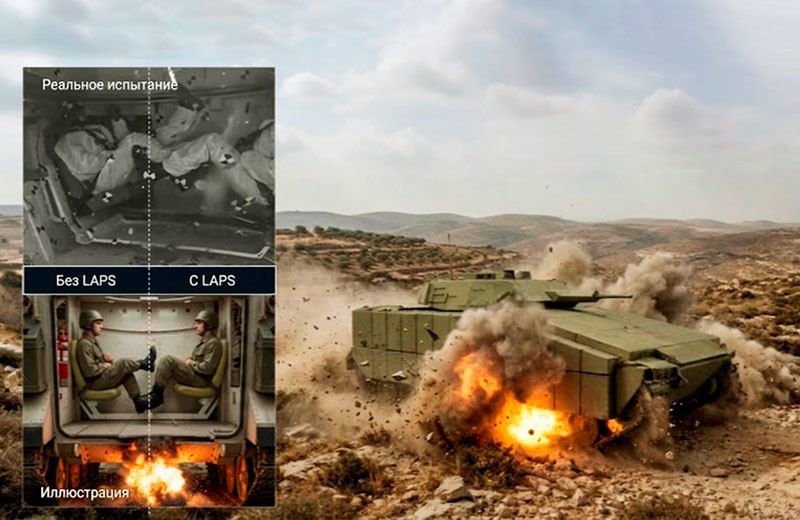
When an explosive device detonates beneath the vehicle, the shock wave hits the floor instantly. Even if the armored hull remains intact, the immense kinetic energy is transmitted upward and can cause serious injuries.
Conventional mine protection merely absorbs and disperses the blast. LAPS works differently: it physically lifts a person’s legs away from the deforming floor.
The system is built into energy-absorbing seats. Ultra-sensitive sensors detect an explosion in milliseconds. Immediately, a pyrotechnic or mechanical mechanism is triggered, causing the footrests to jerk upward along with the soldier’s legs.
All of this happens even before the twisted metal buckles inward into the passenger compartment. It’s a matter of fractions of a second. The pulse passes through the armor in a flash, but the system manages to activate just in time.
This minimizes the risk of compression fractures and amputations. The developers emphasize that LAPS adds almost no weight to the vehicle and takes up very little of the limited interior space. This makes it ideal for light armored vehicles.
Non-explosive reactive armor
ATHENA modules counter one of the main threats to equipment—cumulative ammunition.
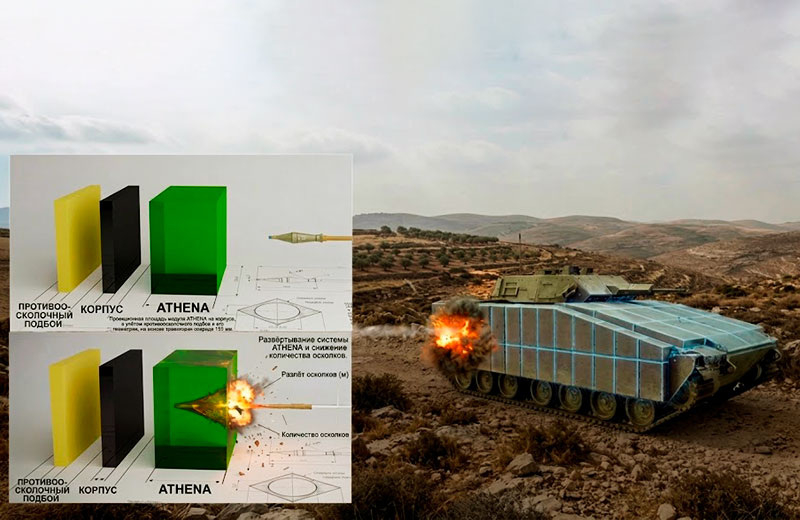
Grenade launchers (RPGs) and guided missiles (ATGMs) penetrate armor not through the force of an explosion. They use a warhead that creates a thin jet of metal, which penetrates steel through immense pressure and kinetic energy.
The military typically relies on dynamic protection modules. When a missile strikes, such a module detonates to meet the impact, and a metal plate disrupts the cumulative jet.
But conventional “reactive armor” has a fatal flaw. A directed blast can seriously injure nearby infantry and destroy the vehicle’s own antennas, optics, and sensors.
The ATHENA system is changing the rules. Instead of an explosion, it relies on a mechanical mechanism—the concept of non-explosive reactive armor. An expandable polymer interliner is concealed inside the modules.
Upon impact, it instantly swells and deforms. The armor array shifts, literally “cutting through” and dispersing the jet of metal. There is no visible explosion.
According to its developers, ATHENA can reliably withstand hits from RPGs, explosive-formed projectiles (EFPs), and a range of kinetic projectiles. Most importantly, it remains completely safe for the troops.
Protecting the Upper Hemisphere from Drones
The TAPS (Top Attack Protection System) protects the most vulnerable area of any armored vehicle—the roof.

Historically, the heaviest armor was installed on the front and sides of tanks and infantry fighting vehicles. The roof sections were always made thin to save weight and maintain maneuverability. Today, this vulnerability has become critical.
The battlefield is dominated by FPV drones, loitering munitions, and missiles that strike while in flight. They hit their targets with precision: narrow hatches, turret roofs, and engine compartment grilles.
TAPS addresses this problem comprehensively. It is an integrated external screen mounted above the vehicle’s roof that replaces makeshift, welded-on “canopies.”
Its mass-produced, well-engineered design is guaranteed to withstand impacts from shrapnel, light kamikaze drones, and shaped-charge warheads flying at a steep dive angle.
Plasan representatives note that the military forces of several countries have already tested the system and approved its purchase, although the details of the contracts have not yet been disclosed.
These three new technologies clearly illustrate the direction in which the defense industry is heading. The blind reliance on heavy, passive armor is being replaced by layered, highly specialized protection tailored to the harsh realities of modern combat.
Source — https://dzen.ru/a/aiMGQ9e1iFa2w0V1