Admiral General. A Stranger Among His Own. Chapter 1.

Foreword
All names are fictional, and any resemblance to real people is purely coincidental 😀.
Dear Reader. This short story—the first chapter of which you are now reading—was written by me, inspired by the book series *General-Admiral R. Zlotnikov*, *The Triumph of the Battleships* by V. Korotin, *The Emperor and Stalin* by S. Vasilyev, *The Odyssey of the Cruiser “Varyag”* by A. Chernov, *The World of Battleships: The Kremlin* by F. Amberskaya, *The World of Admiral Blanc and Comrade Sukhov*, and other authors. I hope this alternative turned out to be exciting. If there are any inconsistencies, please point them out so I can correct them. This work features ships created both by me and by colleagues from the website; I’ll include links to them in the notes and hope they won’t mind their creations being used in this alternate history. Many ideas regarding the fleet are taken from books and articles by Vasilyev, Chernov, and F. Amberskaya. Among them, for example, is the Duncan of the Mtsensk spill. This is, of course, a spoiler, but I’ll mention it anyway. All the Duncans will be captured and used for experiments—there will be a separate chapter on this, but later, because right now I’m working on figuring out what kind of gun mount can be fitted onto the Duncans; one option is the turrets from the Deutschlands, since they fit in terms of diameter; another option is to install a four-gun turret developed by the Metallurgical Plant in the early 20th century, but with 240-mm German guns, albeit slightly modified. Unfortunately, those are the only ones that fit; the 254-mm ones end up being too big, even though the British managed to cram four 356-mm guns into roughly the same dimensions… But more on that later.
Enjoy reading.
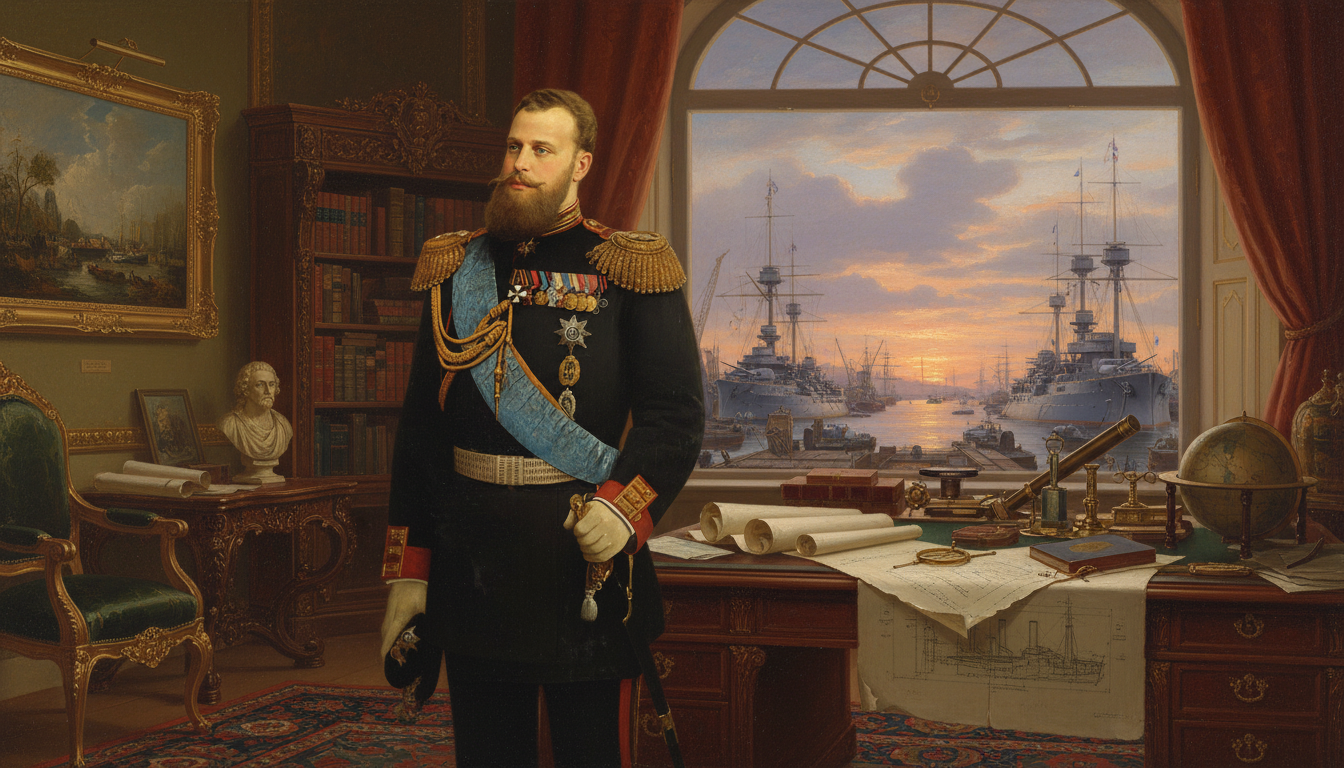
Where in this world did things go differently than in our world? Any naval commander or ruler of a foreign state, if they were to learn a different history of the world, would surely say that it all began on the night of December 31, 1881, to January 1, 1882. And they would certainly say that it all began with the accursed, devilish, and to them all detestable Russian Admiral General Grand Duke Alexei Alexandrovich Romanov, who, after that night, became the man who did so much for the country that many referred to him behind his back as the new Peter I, even though he was not a ruler and, for quite some time—as it seemed from the outside—was far removed from foreign and domestic politics; but in reality, he turned out to be the kind of person who, in another world, would be called “the second coming of Beria or Stolypin,” and some would compare him to Stalin; though compared to the IVS, the Grand Duke pales in comparison, for in that world—for obvious reasons—there was no such civil society, no such industrialization, no such leap forward to eliminate a 50- to 100-year lag, and no such war, after which many would say: “if only there hadn’t been a war,” although, as the history of that world will show, it did, to some extent, bury the country, for its leadership became toothless compared to its founders; but we are not talking now about that world, but about this one, where all events began on a single New Year’s Eve…
The night of December 31, 1881, to January 1, 1882. The General-Admiral’s quarters
The General—Admiral—went to bed peacefully; his mind was occupied with all sorts of things—unfortunately, things that had practically nothing to do with the navy, but rather with how to make a little more money so he could buy some jewelry for the lovely Miss N. And so he fell asleep and immediately woke up in an unfamiliar place; everything around him was unknown to him. It was a room—or rather, a cabin, judging by the fact that the deck was rocking slightly. There were paintings hanging on the wall. One depicted Peter the Great, and next to him was a mustachioed Caucasian man in an unfamiliar uniform, but clearly holding a high rank, similar to that of a marshal or general. Alexei Alexandrovich wasn’t well-versed in land-based insignia and couldn’t determine this with certainty. Another wall was adorned with battle scenes. In one, some strange ships were sailing at full speed under a RED! flag and were clearly towing something—it looked like a heavily damaged ship after a battle—which greatly surprised the Grand Duke. Another painting depicted ships resembling battleships, only larger and equipped with long guns, and these were shown flying the St. Andrew’s flag. The third painting depicted an armored ship being blown up by mines. This surprised him; he stepped closer and read the title of the painting: “The Sinking of the Battleship Petropavlovsk and the Death of Admiral Makarov on March 31, 1904.” Alexei crossed himself and stepped back in horror from the painting, refusing to believe what he saw; he glanced at another one, where the ships were depicted under a red banner, and read: “The Soviet Northern Fleet returns to Murmansk after its triumph over the Grand Fleet at Dogger Bank. The battleship Oktyabrskaya Revolyutsiya tows the captured battleship HMS Hood, 1942.” The Grand Duke was even more shocked by this—after all, where could such a state exist that would be capable of defeating the Grand Fleet?! He decided to walk over to another painting, which read: “The Second Pacific Squadron is heading into its final, disgraceful battle at Tsushima.” Alexei Alexandrovich crossed himself and, not understanding what was happening, sat down in a chair. Where was he? What did all this mean? Why was he here, and what did they want from him? But just then a man entered, wearing a uniform of an unknown design; judging by his epaulets, he was at least a full admiral. From beneath his cap, his hair—scarlet, like blood—was visible. The stranger looked at him; his eyes, blue as a clear sky, gazed at him with contempt and clearly not with the kindest of intentions. Alexei Alexandrovich, stunned and overwhelmed, jumped to his feet at the sight of the newcomer and placed his hand on the hilt of his dagger. The stranger was unflappable; his bearing, direct gaze, and commanding presence revealed him to be an old sea dog, accustomed to giving orders on the bridge rather than sitting in a ministry. But this was not the kind of naval authority to which the Grand Duke was accustomed. The epaulets were wide, the uniform austere to the point of asceticism, and that scarlet hair and piercing blue eyes left no doubt at all—the man before him was no ordinary person, and it wasn’t even certain that he was human at all…
“Who are you? What kind of place is this? Why am I here? What do these blasphemous paintings mean?” Alexei Alexandrovich blurted out, trying to hide the tremor in his voice behind a mask of arrogance.
The stranger slowly took off his cap, placed it on the table, and gave the Admiral General a appraising look, as if he were the commander of a negligent ship’s boy.
“Blasphemous paintings?” the stranger said with distaste. “So, to you, THIS truth is blasphemy?” “That’s not what I expected from a general admiral of the Russian Imperial Navy, whose empire I defend and protect!” — The stranger’s eyes flashed with rage and contempt toward this man. The Grand Duke recoiled from such a gaze.
“Are you a god?” the grand duke asked, his voice filled with disbelief.
«You could put it that way. My name is Akido, god of the universe, god of good and evil, god of order and chaos, god of destruction and creation, ruler of the gods of light and darkness, supreme god, god above all gods, and so on and so forth. The one you call a god is one of my sons, whose task has always been—and always will be—to maintain order and prevent the collapse of the universe,” Akido replied to him.

This is roughly what Akido looks like when he meets the general-admiral
“So I’m dead? And you’re going to judge me?” Alexei Alexandrovich said, his voice filled with sadness and disbelief.
“That’s quite an honor for you. And you’re still alive. I’m here to make you an offer: you must prevent your country’s collapse and save the fleet from disgrace,” Akido explained to him.
“But how am I supposed to do that? I’m not the sovereign—only he can do everything—I’m just a general and an admiral,” the grand duke replied passionately.
Akido smiled.
“Exactly—you’re a general—an admiral—and yet you can’t do anything?” he asked with an Odessa accent. “Start by not spending money on all sorts of whores, but on the navy, on developing industry, on developing your own country, and ultimately on developing your own people. And convince your sovereign of this. I’m willing to help you a little with that—I’ll share with you the most important resource in the entire universe: knowledge! So, are you in?”
Alexei Alexandrovich thought for a while. To give up everything he had. To become an ascetic. To live as the peasants do. To elevate these peasants, these commoners and servants, to give them an education and the opportunity to live and grow. He didn’t know what to say, but he recalled the words of the ship’s chaplain—about the state of the country and what was really happening there. And he made up his mind.
«I agree, but I have a request,» he replied firmly.
Akido looked at him strangely and asked, “What’s your request?”
«I want to meet the people who did this»—his hand pointed to a picture of ships flying scarlet flags
“Hmm… that could work. It would even be interesting to see this scene: the Grand Duke in the company of the son of a Georgian shoemaker (Joseph Stalin), a nobleman and the son of a colonel in the Fortress Engineering Directorate (Lev Galler), a peasant’s son (Nikolai Kuznetsov), the son of a railroad employee (Ivan Yumashev), the son of a Cossack (Arseny Golovko), the son of a civil servant (Vasily Rakov), the son of an artillery officer (Alexei Krylov), and the son of a poor Caucasian peasant (Lavrentiy Beria).”
And with those words, Alexei Alexandrovich vanished into the darkness.

General-Admiral Alexei Alexandrovich Romanov
Three months had passed since that memorable conversation in Gatchina. In court circles, people had already begun to speculate that Grand Duke Alexei Alexandrovich had either fallen ill, taken up mysticism, or completely lost his mind. He had almost stopped attending balls and receptions, had demonstratively broken off his relationship with the coquette N, and had put his famous collections of jewels and works of art—gathered over many years—up for sale through front men in Paris, London, and Amsterdam.

His Imperial Majesty Alexander III
When the emperor was informed of this, Alexander III merely chuckled under his breath and said:
— So be it. It seems my brother has gone to be with the Lord. Or maybe somewhere else…
And the outcome was already beginning to take shape. In late March 1882, a squadron of ships under the command of Rear Admiral Aslanbegov set sail from Kronstadt—officially on a training cruise off the coast of Africa. On board the flagship frigate *General-Admiral* was the Grand Duke himself, and in the holds were dozens of crates containing strange geological equipment, maps, as well as two dozen Cossacks from the Kuban Cossack Army, personally selected by Alexei Alexandrovich according to criteria known only to him.

Rear Admiral Avraamiy Bogdanovich Aslanbegov.
It was a long journey. Through Gibraltar, around Africa, to the port of Lourenço Marques in Portuguese Mozambique. It was there, in the heart of the Boer territories, in the Witwatersrand region, that the Grand Duke intended to accomplish what historians would later call “the General-Admiral’s golden miracle.” The exact coordinates of the gold-bearing veins, the geological cross-sections, the mining methods—he knew all of this so clearly, as if he had personally drawn up the maps of the area. Akido kept his word: knowledge came at just the right moment, as if someone invisible were laying out folders of documents from the future before him.
The Russian ships caused a sensation in Lourenço Marques. The local Portuguese authorities were at a loss, but the Grand Duke conducted himself impeccably: he spoke of a scientific expedition, a friendly visit, and a desire to pay a courtesy call on Transvaal President Paul Kruger. Meanwhile, as the diplomats exchanged pleasantries, the Cossacks and geologists, disguised in civilian clothes, were already moving deeper into the country toward the coveted mountain range.
What they found exceeded even their wildest expectations. Gold was everywhere. Not just placer deposits—but the richest veins, extending to incredible depths, that no one in the world had ever known about.
The Grand Duke traveled to Pretoria in person. President Kruger—a heavyset, bearded, cautious man who distrusted the British and did not fully understand the Russians—received him with caution. But when Alexei Alexandrovich laid a map marked with the designated plots on the table and offered to sell these lands to the Russian Empire—or rather, to a front company registered in the name of a certain private individual— — the sum he offered made Krüger forget his caution.

President Krüger
“Your Excellency,” said the Grand Duke, “these lands are barren for farming. There are no pastures, and there isn’t enough water.” You’re selling me rocks, barren hills, and thorny brush. Yet I’m offering a price for them equivalent to that of a prime plot with diamond mines. I need these lands for hunting. It’s a gesture of friendship between our peoples—nothing more.”
Krüger hesitated, but the jingle of gold coins—the Grand Duke had brought with him a substantial supply of cash from the very jewels that had been sold—sealed the deal. The deal was sealed. A tract of land covering several dozen square miles became the property of the “South African Mining and Industrial Company,” backed personally by a general-admiral of the Russian Imperial Navy.
And construction began.
The city was named Flark. No one knew exactly why—something had flashed through the Grand Duke’s visions, some image from a dream in which stern-faced people in black uniforms were extracting something under harsh conditions, and that place had a similar-sounding name. The city was built according to a single plan: straight streets, sturdy houses for workers, a hospital, a school, a church, two water towers, and a power plant powered by steam engines. It was a closed perimeter. The entry permit system was subject to the strictest controls. Exit was permitted only with special permits issued personally by the head of the city’s Security Service.
Petr Sergeyevich Afanasyev—a man with a remarkable life story—became the head of this department. A former gendarmerie officer who had been exiled from St. Petersburg for excessive zeal in investigating embezzlement within the War Ministry, he had been languishing in retirement in Rostov for several years when a messenger from the Grand Duke came to him. Afanasyev was one of those Russian men who serve the cause, not individuals. Intelligent, meticulous, ruthless toward offenders, yet fair—he was ideally suited for the role he was offered.
“Pyotr Sergeyevich, you’ll be my eyes and ears,” Alexei Alexandrovich told him at their first meeting. “Theft, drunkenness, and leaks—crack down on them mercilessly. But don’t mistreat the people.” The workers must be satisfied with their lives. I’ll pay them well. But anyone who wants to leave must undergo a security check. No one must know what’s being mined here or where it’s going.”
Afanasyev—tall, thin, with the face of an ascetic and the eyes of a workaholic—accepted the appointment without hesitation.
— Your Imperial Highness, I understand everything. The city will be locked down. Not even a mouse will get through.
And sure enough—it didn’t slip through.
Flarc’s security service—whose ranks included Kuban and Don Cossacks, former gendarmes, several detectives dismissed from the police for having an “uncooperative disposition,” and even a dozen and a half Boers—formed a unique organization. The Boer riflemen, who knew the terrain perfectly, became ideal patrolmen and trackers. The Cossacks provided armed cover. The gendarmes handled field operations and record-keeping.
The main task of the “security officers” was not only to prevent escapes and espionage, but also to create an atmosphere that would discourage the town’s residents from wanting to leave. And they succeeded. Wages in Flarke were three times higher than at any other gold mine in the world. Medical care was free. Children attended a Russian-Boer school, where they were taught three languages and the basics of mining. On Sundays, festivities were held, and residents were allowed to bring relatives from neighboring Boer farms. The town quickly became the stuff of legends: it was said that somewhere in the Russian territories flowed a river of milk with banks of jelly, but no one knew its exact location.
The population grew rapidly. Russian peasants, recruited through front organizations in Odessa and Sevastopol, arrived with their entire families—they were transported on ships under the guise of settlers bound for Siberia or the Far East. Cossacks arrived with military certificates, while Boers came in entire farming clans, drawn by rumors of a good life. By 1884, nearly ten thousand people were already living in Flarka.
And gold flowed like a river. By the end of 1882, the first metric tons of the precious metal had already begun their journey to the coast. The Grand Duke personally designed the logistics plan: a narrow-gauge railroad from Witwatersrand to Lourenço Marques was built day and night, with engineers and rails brought in from Russia. At the same time, a pier and warehouses were secretly purchased in the port of Mozambique.
Twice a year, a detachment of ships from the Baltic Fleet would call at Laurens-Markish—for a “training cruise to southern latitudes” and to “practice long-distance voyages.” Heavy crates were loaded into the holds under the strictest guard. The squadron’s officers were convinced they were escorting government cargo destined for Siberian factories. Only a few people knew the truth.
In St. Petersburg, gold was transformed into machine tools, railroad tracks, steam engines, patents, and technology. Front companies—some of which were personally controlled by Afanasyev through trusted intermediaries—bought up factories throughout Europe. Belgian steel mills closing due to the crisis, German machine-building factories, and English locomotive workshops—all of these were dismantled down to the last screw, loaded onto barges, and shipped to Russia.
People moved along with the factories. Engineers, foremen, and skilled workers received offers they couldn’t refuse: triple pay, signing bonuses, a government-provided home, and free education for their children. Germans, Belgians, French, and Czechs moved to Russia with their entire families, settled around the new factories, built churches and cathedrals, and quickly became Russified, integrating into imperial life.
By 1884, the scope of the Grand Duke’s activities had become so evident that it was no longer possible to conceal them from the emperor. Alexander III summoned his brother to give a personal report.
“Alexei,” said the emperor once the office door had closed, “I know what you’ve been up to. Your people certainly do good work, but mine are even better.” I know about the gold in South Africa. About your secret city. About the squadrons that are transporting gold instead of conducting military exercises. You’ve dragged the empire into a risky venture that could lead to war with England. What do you have to say for yourself?”
Alexei Alexandrovich calmly held his brother’s gaze.
— I must say, Your Majesty, that war with England (Alexei Alexandrovich was constantly receiving reports about it) is inevitable anyway. Sooner or later. But it is better to wage it with a domestic industry and gold reserves than with nothing to our name and in debt to those very same Englishmen.
Alexander III was silent for a long time, then suddenly burst out laughing—a deep, booming laugh.
“You’ve really changed, brother. Honestly, you have. Go ahead and tell me everything, step by step. And don’t keep anything from me from now on. We’re in this together. And if we’re going to create a new Peter, let’s do it without pulling any tricks behind my back.”
From that day on, the state’s tacit support became absolute. The moratorium on shipbuilding, declared in 1882, was extended until 1886, but now under the emperor’s personal supervision. Financial flows were streamlined, and front companies were legalized through the State Treasury under the heading “His Majesty’s Special Office for Industrial Development.” The Grand Duke was given carte blanche.
And work really got going.
In Nikolaev, St. Petersburg, Sevastopol, and the Far East, colossal shipbuilding slipways were being constructed simultaneously. In the Donbass, the Urals, and Kuznetsk, new-type blast furnaces and open-hearth furnaces were springing up. In Tula and Izhevsk, arms production facilities were being modernized. Strategic railroads were being built throughout the empire—to ports, to coal and ore deposits, and to future shipbuilding centers.
Alexei Alexandrovich worked like a man possessed. He had forgotten what sleep and rest were. He shuttled between St. Petersburg, Nikolaev, and secret meetings with agents in Europe and Africa. His face had grown gaunt and hard, and his gaze had become piercing and demanding. Instead of his elegant naval uniform, he increasingly wore a simple tunic without medals—he had no time for it, and besides, there was no need to flaunt his insignia in front of engineers and craftsmen.
It was precisely at this time that strange people began to appear in his circle. Some of them were found thanks to clues provided by visions sent by Akido.
In 1883, at one of St. Petersburg’s small shipyards, the Grand Duke personally discovered a young mathematician unknown to anyone—the son of an artillery officer, Alexei Nikolaevich Krylov. The very same man whose image had appeared to him in a dream. The Grand Duke spoke with him at length about ship theory, stability, and hull vibrations—and realized he was in the presence of a genius. Krylov was immediately hired by the Naval Technical Committee and sent for training at the best European laboratories—not as a supplicant, but as an equal.
Alexei Alexandrovich knew that the path he had embarked upon would take decades. But the first step had been taken—on New Year’s Eve, from 1881 to 1882, in his cabin, before the visions of future victories and defeats. And now, feeling behind him the invisible support of the stern god in an admiral’s uniform and a whole host of ghostly comrades-in-arms from a future that had not yet arrived, he was ready to see it through to the end.
The year 1886 lay ahead. The year the moratorium would end. The year when Russia was to lay down, at new shipyards, using its own steel and based on its own blueprints, ships that were destined to change the course of world history.