Memoirs of an Old Knight of Acre. Chapter I. While the Lamp Still Burns

“Human memory is like the flame of an oil lamp. So long as there is oil, it casts its light upon the past. But once the flame dies, even the greatest deeds are turned to dust.”
From the writings of Ansel de Nantes, Acre, c. 1148.
I had put off this day for a long time.
Not because I feared death. A man who has spent most of his life with a sword in his hand eventually ceases to fear his own end. It was something else that troubled me. So long as these memories lived only within my head, they belonged to me alone. The moment I set them down upon parchment, they would belong to those who came after me. Some would believe what I had written, some would doubt it, some would call me a liar, and others merely an old man betrayed by his memory. But that would no longer be my concern. God knows the truth. A man can only try to tell it as honestly as the years allow.
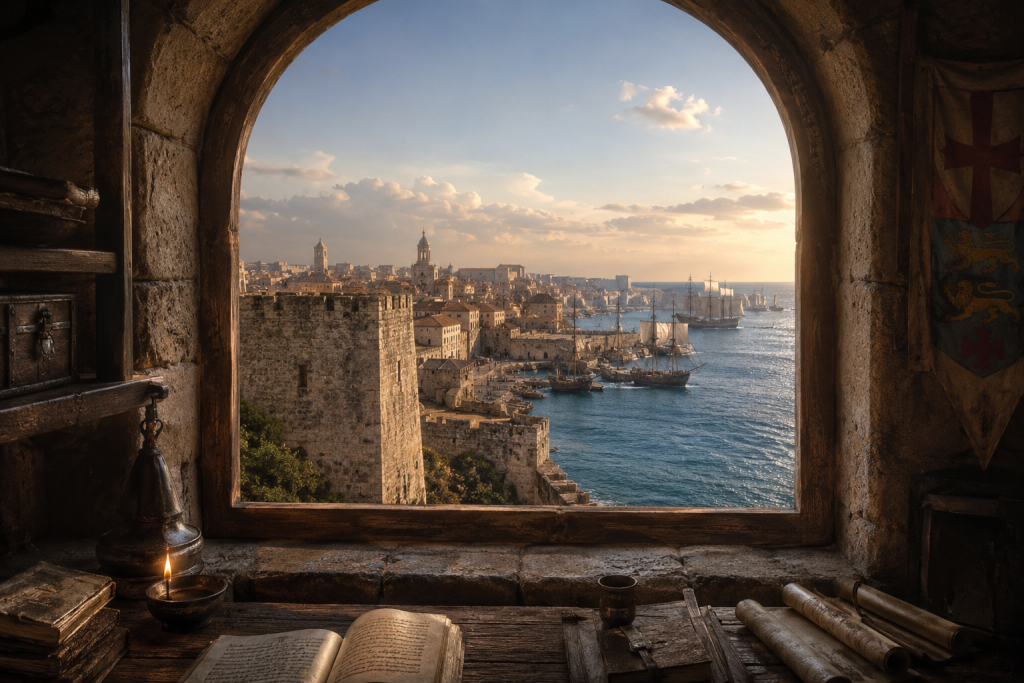
As I write these lines, the evening sun is slowly sinking behind the towers of Acre. From the window of my house I can see a corner of the harbor, where merchant ships rise and fall upon the water. Over the years I have learned to know them by their silhouettes long before I can make out their banners. Genoese galleys sit differently upon the sea than Pisan ones. Venetian merchants are fond of adorning their sterns with carvings, while ships out of Marseille are almost always so heavily laden that one expects the next wave to send them straight to the bottom. When I was young, I thought this harbor had always existed and always would. Only with age does a man begin to understand how fragile even the greatest cities can be. Stone outlives men, but it does not outlive eternity.
The house in which I live stands not far from the northern wall. It was built after Acre had become the chief port of our kingdom. My children grew up here. My wife died here. Friends returning from distant campaigns crossed this threshold more times than I can remember. Now the rooms seem far too large for one old man. In the evenings, when the servants have withdrawn to their quarters and the city gradually falls quiet, I like to sit beside the window and listen to the sea. It sounds exactly as it did half a century ago, when I first saw these shores. Unlike men, the sea does not grow old.
I have often wondered whether these memories ought to be written at all. There are men far more learned than I. Monks are already compiling their chronicles, chancellors preserve the charters of the realm, priests record the deeds of patriarchs, and poets make songs of kings and victories. Yet whenever I have had occasion to read such works, the same thought has always occurred to me: their authors too rarely tell us what things were truly like. They remember dates, but forget faces. They remember how a battle ended, but not how the hands of young squires trembled on the eve of their first fight. They describe coronations, but do not know how many days the soldiers went hungry before those crowns were won.
I have seen too much to allow it all to vanish with me.
My name is Ansel de Nantes. If God permits it, these writings will outlive their author. If not, then such is His will. I was never a king. I founded no order and wore no crown. I spent my youth in the conroi of Prince Robert of Normandy, and my later years in the service of the Kingdom of the Levant, which we built with our own hands. I saw our realm being born. I witnessed its first victories and its first mistakes. And so I believe it my duty to leave behind not a tale of heroes, but a memory of men.
My story began far from this place of sea salt and eastern spices. It began among the rain-soaked meadows and deep oak woods of Normandy, where the wind carries the scent of rain and the winter sky is almost always hidden behind heavy clouds. There stood the small house of my father—a man I could never remember, though his name followed me throughout my life.
His name was Hugues de Nantes.
Our family had never belonged among the great barons. We possessed no scores of castles and could summon no mighty host. Our lands were modest, but for generations the men of our house had served their lords with the sword. Some men inherit their wealth in silver and fields. Others inherit an honorable name.
That was what my father left to me.
Everything I know of Hugues comes from the stories of men who fought beside him. Even after I had grown to manhood, I would sometimes meet old soldiers who had served Duke William himself. The moment they heard my family name, the conversation invariably returned to the same man. They remembered his laughter. They spoke of his extraordinary strength. They told me that in his youth he had been counted among the finest spearmen in the duchy, and that he had taken part in the great crossing of the Channel, when the Normans sailed to conquer England. Some claimed that my father had been among the first to set foot upon the English shore. Others swore they had seen him close beside the duke himself on the day of the great battle. The truth, as so often happens, had long since dissolved into a dozen different stories, and by then no man could have separated it from the fine inventions of old soldiers.
When I was born, England was still an unsettled land. Conquering the country had proved easier than keeping it obedient. Garrisons were forever being sent out to put down fresh rebellions, while the old Saxon houses stubbornly refused to accept the rule of the newcomers. It was during one such campaign that my father was killed. No one ever told me exactly where it happened—beneath the walls of some northern stronghold, in an ambush among the woods, or during the siege of yet another Saxon fortification.
He never came home.
My mother survived him only a short while. They say she waited for her husband for a long time, refusing to believe the news that had been brought to her. Then she fell ill. That winter the cold found its way even through thick stone walls, and the physicians could do nothing against the fever that drained her strength day after day. Within a few months I was an orphan, before I had even learned to speak the names of those I had lost.
Sometimes I think God showed me mercy by leaving me no memory of those days. A man can endure much, but no child should have to remember becoming an orphan.
Had anyone said then that the son of a poor Norman knight would one day see Jerusalem, witness the birth of a new kingdom, and grow old upon the shores of the Eastern Sea, he would have been laughed out of the hall.
But God has a way of leading men down roads they could never have seen before them.
And so my next family was made neither of knights nor of kin.
A monastery became my home.
And for many years, the tolling of its bell became my father’s voice.