What If Sweden Finally Decides to Build a Fifth-Generation Fighter? Meet the SAAB JA-70 GHIDORA

Saab and Sweden itself can be considered something of a unique phenomenon in the modern aerospace industry. Designing and manufacturing advanced combat aircraft has long since become a business reserved for the very rich. Behind the American F-22 and F-35 stands the immense economic, scientific, technological, and industrial power of the United States. China’s J-20 was developed with the backing of one of the world’s largest economies. Even the leading European nations increasingly prefer multinational programs because developing and producing an entirely new generation of combat aircraft independently has become prohibitively expensive.
And then there is Sweden, a country of just over ten million people that stubbornly continues to design its own combat aircraft.
Even more remarkably, those aircraft remain genuinely competitive.
The modern JAS 39E Gripen, with a maximum takeoff weight of around 16.5 tonnes, features ten external hardpoints, an engine producing approximately 98 kN of maximum thrust, an advanced AESA radar, and a sophisticated electronic warfare suite. At the same time, Saab has preserved the qualities that have traditionally been crucial to Swedish combat aviation: relatively straightforward ground servicing and the ability to operate intensively from dispersed airfields. Saab officially states that the Gripen E can be turned around for another combat mission in approximately 15–25 minutes.
And Gripen has long ceased to be an aircraft intended solely for the Swedish Air Force. Different versions of the fighter have been exported around the world, while the Gripen E/F program continues to evolve. In 2025, the Gripen E/F was selected by the Royal Thai Air Force as its future fighter aircraft.
How Sweden manages to preserve an independent combat-aircraft design capability in an era when such programs consume tens of billions of dollars — and why almost nobody else has managed to replicate the Swedish model — is a fascinating subject deserving an article of its own.
Here, however, we are interested in a different question.
What would happen if Stockholm eventually decided that the Gripen was no longer enough and that Sweden needed a true next-generation stealth fighter?
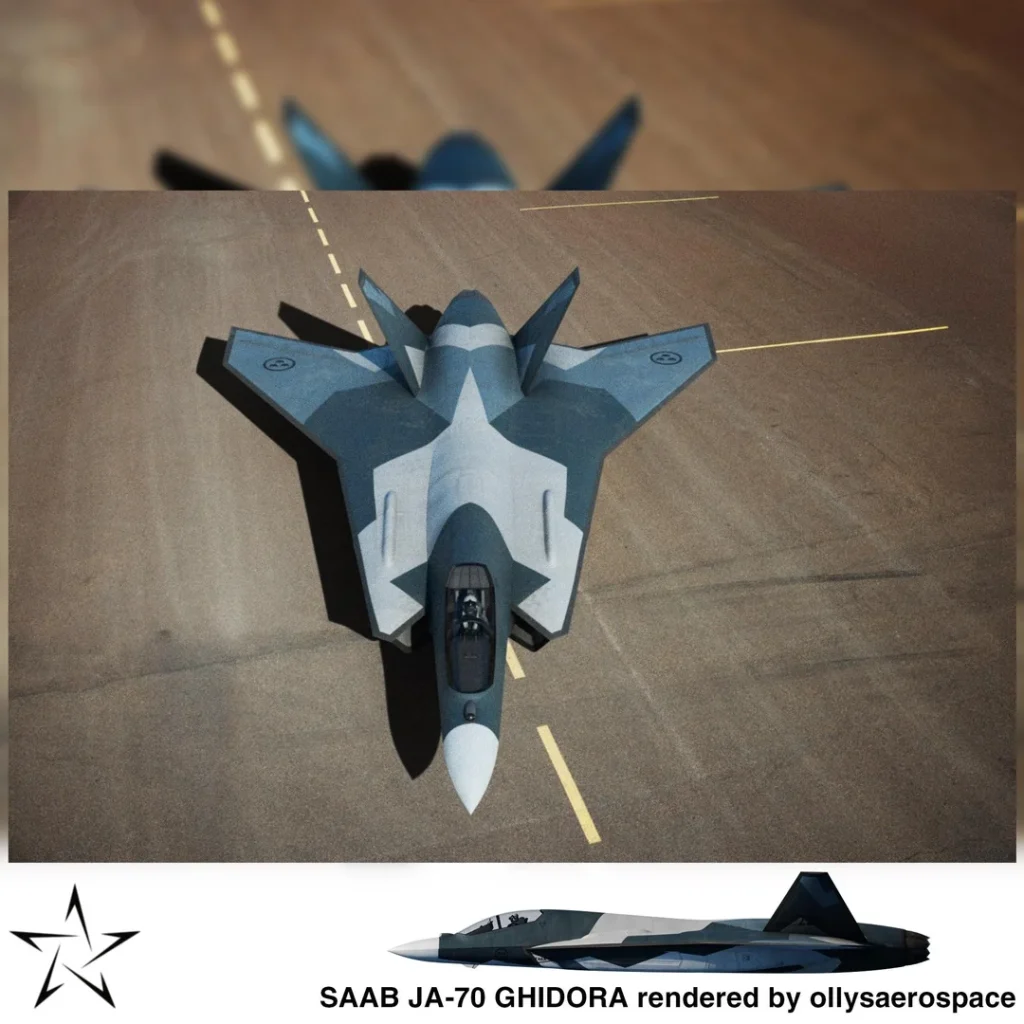
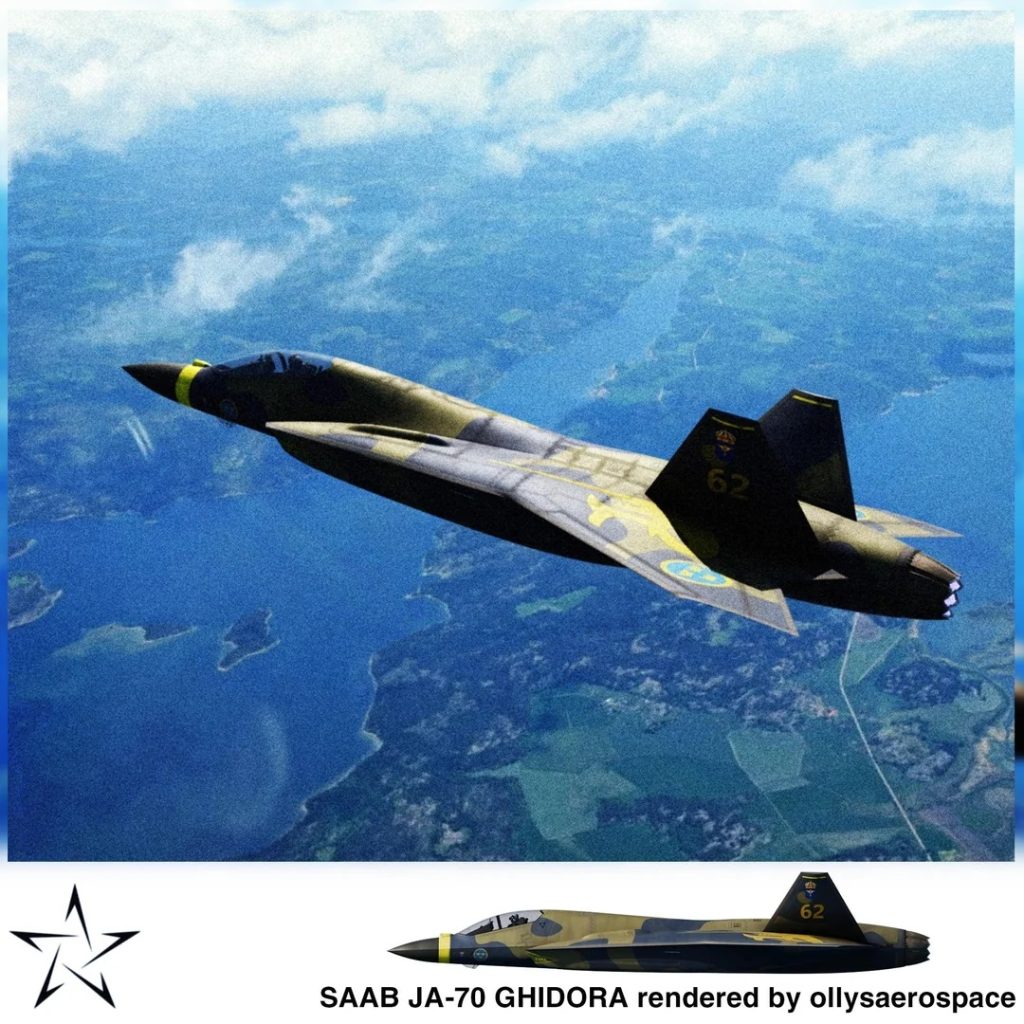
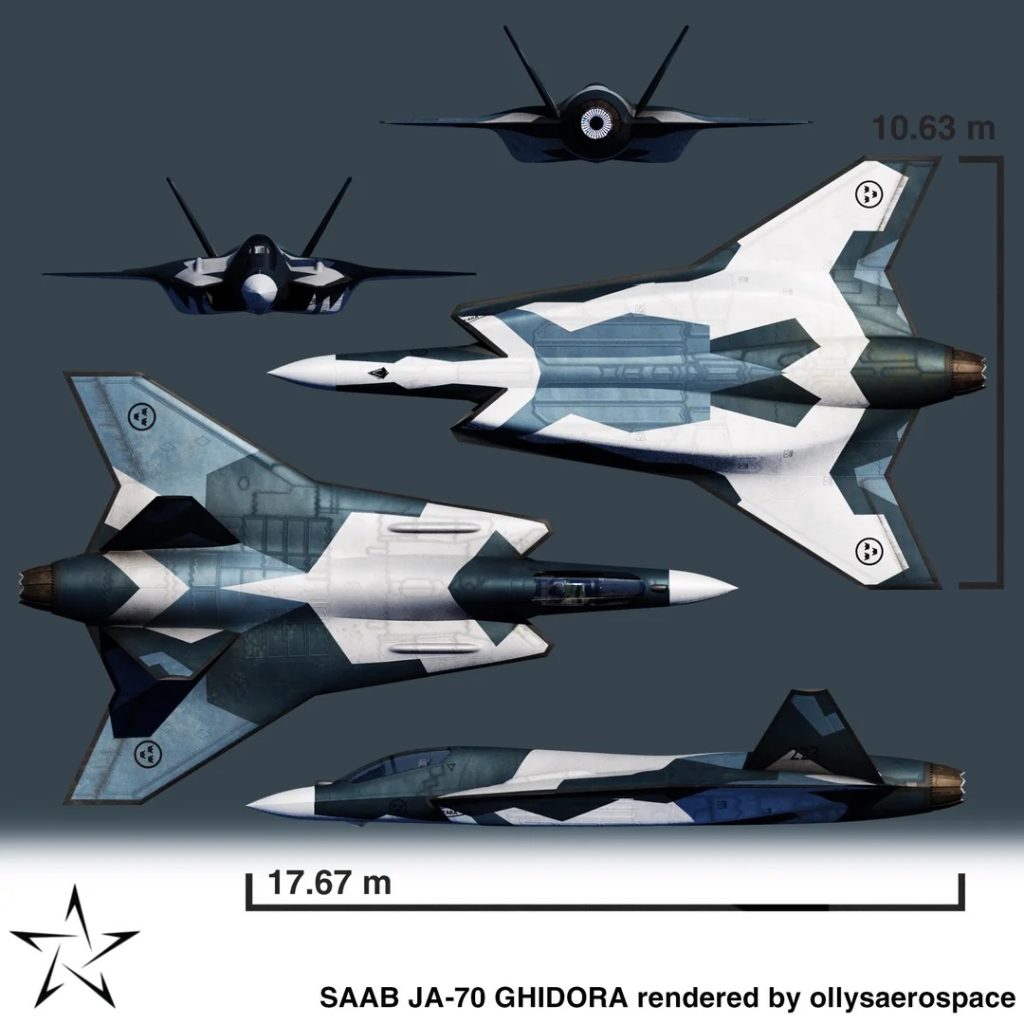
The answer might look something like the SAAB JA-70 Ghidora.
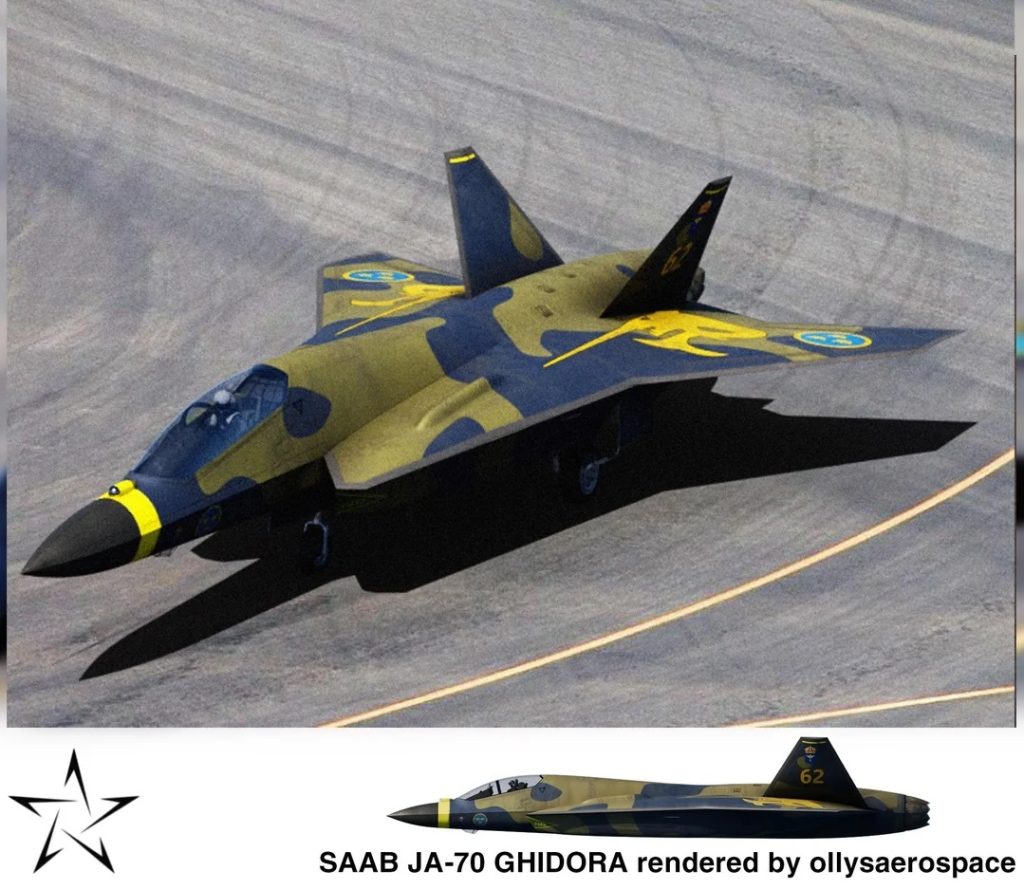
One important clarification must be made immediately: the JA-70 Ghidora is not an official Saab project. It is a fictional aircraft concept created by Reddit user MrGatsby1984 and published in the ImaginaryAviation community. Yet the concept is particularly interesting today because the real Saab has already begun moving in a surprisingly similar direction.
A Swedish Next-Generation Fighter Is No Longer Pure Fantasy
Only a few years ago, talk about a “Swedish fifth-generation fighter” could reasonably have been dismissed as nothing more than an exercise in speculative aircraft design.
That situation has now changed.
In March 2024, Sweden’s Defence Materiel Administration, FMV, awarded contracts to Saab and GKN to conduct studies, develop technologies, and prepare demonstrators for a future combat aviation system. The principal objective of the program is to determine how Sweden should maintain its combat aviation capability beyond 2040.
Importantly, both crewed and uncrewed solutions are being studied.
In October 2025, the program moved into another significant phase. FMV extended Saab’s contract: concept studies and technology development were to continue through the third quarter of 2026, while work on a flying demonstrator was extended through 2027, including initial flight testing. The additional contract was valued at SEK 2.676 billion.
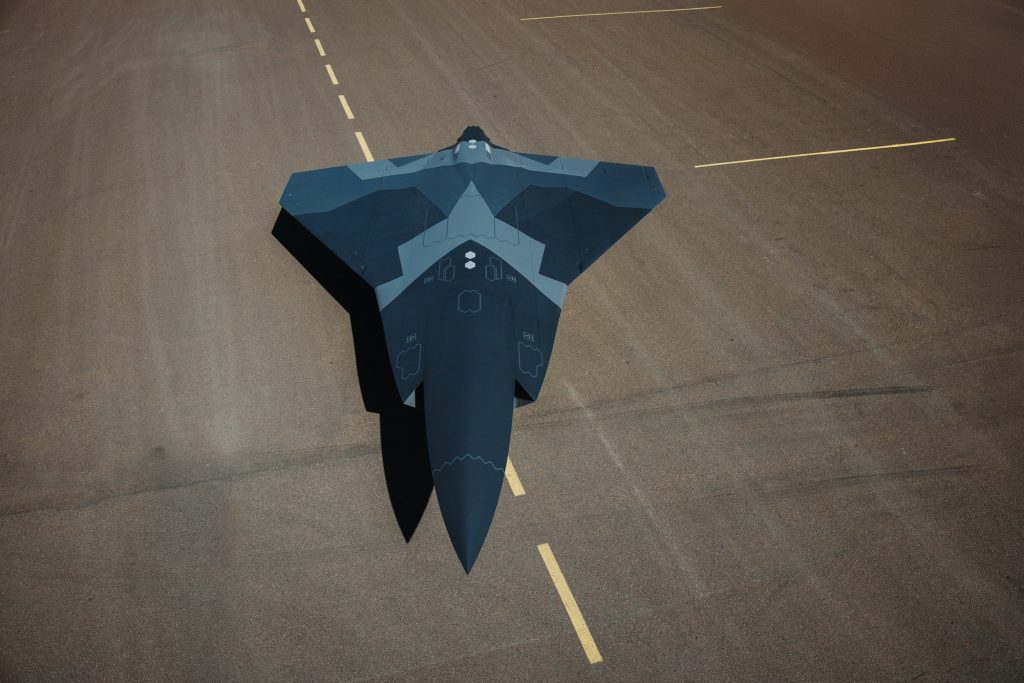
Then, on August 22, 2026, Saab took another intriguing step by unveiling a full-scale mock-up of the A3-001 uncrewed combat aircraft.
It is already a highly suggestive design: a low-observable airframe, a high degree of autonomy, and an intended ability to operate alongside crewed aircraft. Saab has identified electronic warfare, suppression of enemy air defenses, and precision strikes inside heavily defended airspace among the potential missions for this class of aircraft. The company intends to fly fighter-like uncrewed demonstrators before 2030.
This makes the fictional JA-70 considerably more interesting today than it would have been only five years ago.
In our hypothetical timeline, we can imagine that Sweden’s KFS studies and experiments with the A3 family of uncrewed aircraft gradually lead Swedish engineers and military planners to a new conclusion:
Sweden also needs an entirely new crewed combat aircraft.
And that is where the story of the Ghidora begins.
Saab A3-001
The Heir to Two Legendary Saab Fighters
The first thing that stands out when looking at the JA-70 is that it somehow appears both completely unlike a traditional Swedish fighter and unmistakably Swedish at the same time.
The aircraft looks futuristic, yet its ancestry can be recognized almost immediately.
The concept clearly contains echoes of the legendary Saab 35 Draken and its distinctive double-delta wing. The creator of the original design obviously did not simply attempt to produce another generic “Swedish F-35.” Instead, the aircraft looks almost like an attempt to imagine what the Draken might have become had it been designed today under modern low-observability requirements.
Its second ancestor is, naturally, the Gripen.
From the Gripen, however, the future fighter would inherit less of its aerodynamic configuration and more of its fundamental operational philosophy: relatively compact dimensions, a single engine, extensive automation, sophisticated electronics, rapid software upgrades, and — perhaps most importantly — the ability to operate with small ground crews from dispersed bases.
It is precisely this combination of ideas that makes the Ghidora so interesting.
This is not an attempt to build a Swedish equivalent of the heavy F-22.
Instead, it represents a possible Saab answer to a very different question:
What should a stealth fighter look like if it were designed according to Swedish rather than American principles?
Why It Would Still Have Only One Engine
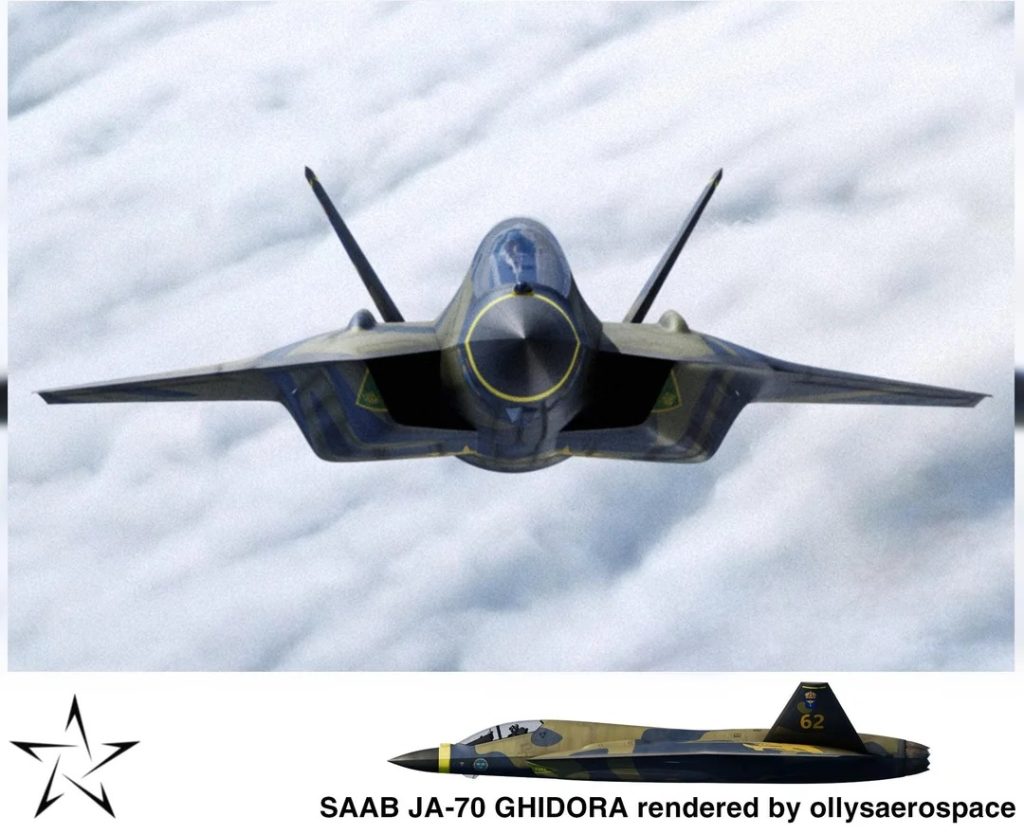
One of the most controversial characteristics of the JA-70 concept is its single engine.
At first glance, this appears to be a major weakness. Commenters discussing the original artwork correctly pointed out that a relatively large stealth fighter would require an exceptionally powerful engine.
For Saab, however, such a decision would actually be entirely logical.
For decades, Sweden has built its modern fighters around a single powerplant. The Viggen used one RM8. The Gripen C/D uses one RM12. The Gripen E uses one RM16, derived from the General Electric F414 family.
The problem is that the roughly 98 kN of maximum thrust available to the Gripen E would no longer be sufficient for a substantially heavier JA-70.
Consequently, if the Ghidora were turned into a real aircraft program, developing or acquiring a new engine would probably become one of the most difficult elements of the entire project.
Sweden would be unlikely to develop such an engine completely independently. A far more plausible scenario would involve GKN Aerospace cooperating with one of the major Western engine manufacturers.
For an aircraft with a maximum takeoff weight of approximately 22–24 tonnes, an engine producing roughly 130–150 kN of afterburning thrust would be desirable. And maximum thrust would not be its only important characteristic. Reduced infrared signature, long service life, and relatively low fuel consumption would be equally important.
Such an engine would allow Saab to preserve one of the Gripen’s most important advantages: relatively straightforward and affordable operation.
Two engines mean two powerplants, two intake systems, greater mass, greater fuel consumption, and higher maintenance costs. For a country that is never likely to procure hundreds of heavy fighters, those considerations matter enormously.
The Ghidora’s single-engine configuration, therefore, should not be seen as an oddity.
On the contrary, it may be one of the most characteristically Swedish features of the entire aircraft.
The Double Delta Returns
The most visually striking feature of the JA-70 is its wing.
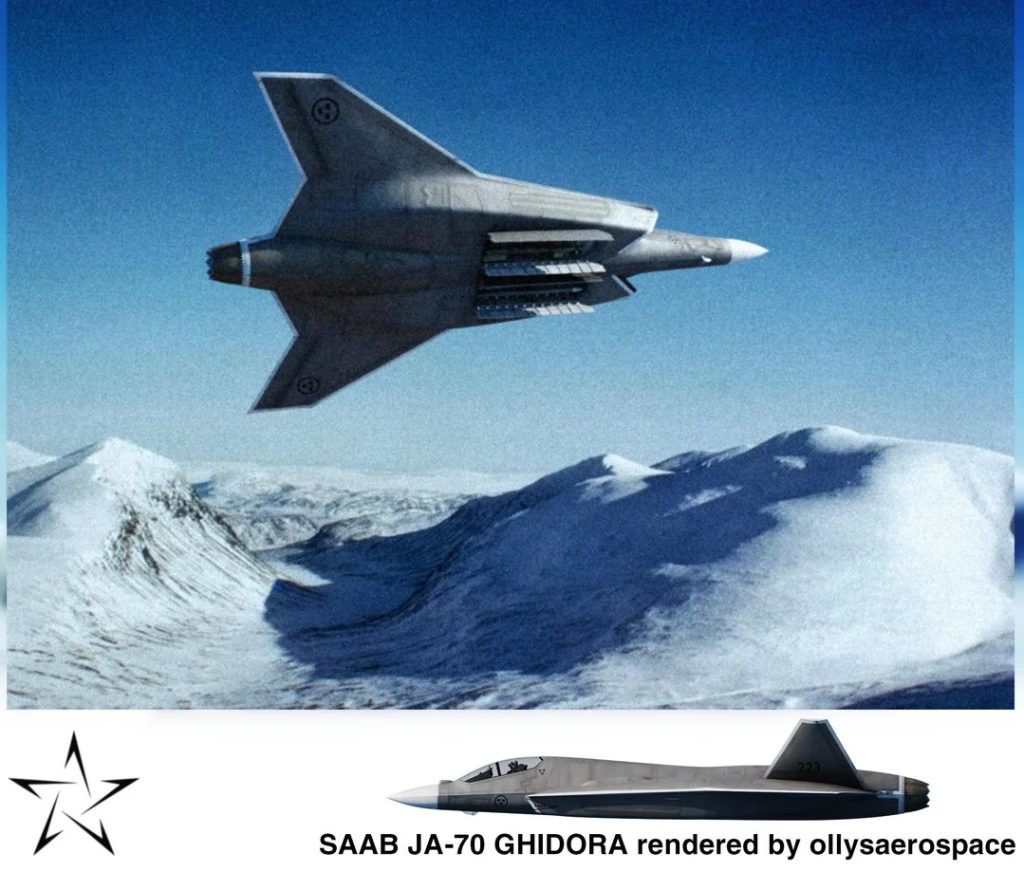
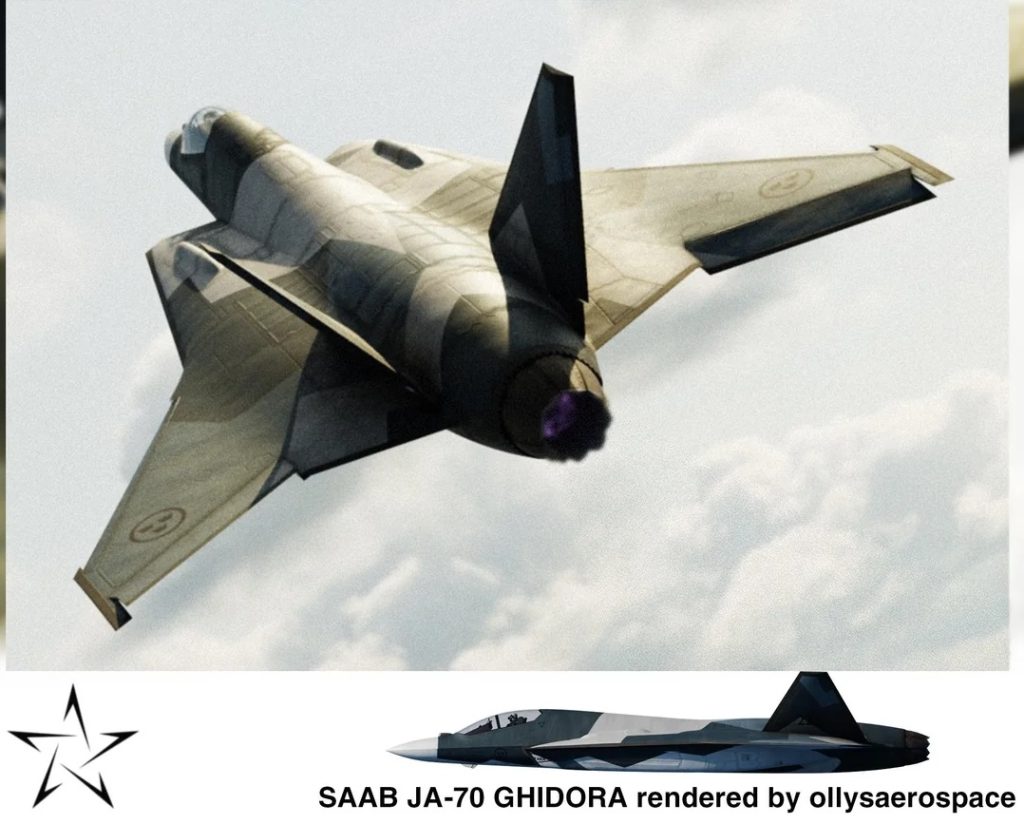
Instead of the Gripen’s familiar canard-delta configuration, the Ghidora uses an enormous integrated lifting surface reminiscent of an evolution of the famous Draken double delta. The aircraft effectively becomes one large triangular lifting body.
Such an arrangement offers several potential advantages.
The large internal volume of the wing and central fuselage provides considerable room for fuel. This is particularly important for a stealth fighter because external fuel tanks significantly compromise low-observable performance.
The same volume also provides room for internal weapons bays.
Finally, eliminating conventional horizontal tail surfaces and forward canards reduces the number of airframe elements capable of producing strong radar reflections.
Naturally, there would be a price to pay.
An aircraft of this type would require an exceptionally sophisticated digital flight-control system. But this is precisely an area in which Saab has enormous experience. Even the Draken demonstrated just how far Swedish engineers were willing to push unconventional aerodynamic concepts, while the Gripen turned digital flight control into one of the fundamental elements of the aircraft.
By the 2040s, artificial intelligence would likely become another part of this equation.
The Ghidora pilot would therefore not so much “fly the aircraft” directly as command the behavior he wanted, while the flight-control system continuously kept an inherently unstable airframe within safe and effective limits.
Stealth — the Swedish Way
Even more interesting is the question of how Saab might approach low observability.
American stealth philosophy has historically involved not only careful airframe shaping but also considerable reliance on specialized materials, coatings, and supporting infrastructure.
That philosophy is poorly suited to Sweden.
Swedish combat aviation has historically been expected to survive attacks against its main airbases.
Even today, the Swedish government continues to invest in improving the Gripen’s ability to operate from a larger number of airfields and temporary road bases.
A JA-70 would therefore have to combine two characteristics that initially appear contradictory: low radar observability and the ability to survive not in a pristine climate-controlled hangar, but at an improvised operating location somewhere beside a Swedish highway.
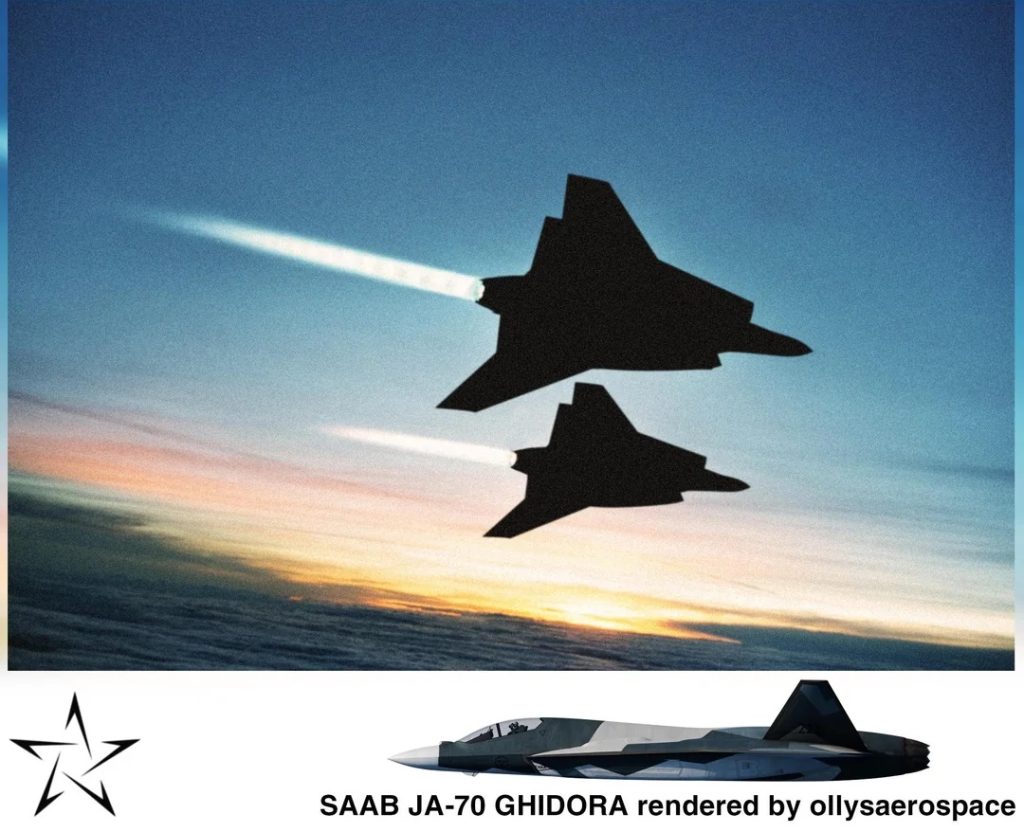
For this reason, it would be logical for Saab to place as much of the Ghidora’s radar-signature reduction as possible into the physical geometry of the aircraft rather than relying excessively on expensive and maintenance-intensive coatings.
Aligned edges, hidden compressor faces, serpentine intake ducts, internal weapons bays, a minimum number of protruding components, and radar-absorbent materials concentrated in the most critical areas could all contribute to an aircraft whose stealth characteristics would remain relatively stable even after several days of intensive dispersed operations.
Naturally, the JA-70 would never become literally invisible.
No aircraft is.
The real objective would be much more practical: dramatically reduce the distance at which an enemy radar can reliably detect, classify, track, and engage the aircraft.
Its Most Important Weapon Would Not Be a Missile
If the Ghidora were to enter service sometime after 2040, its most important weapon might not be a missile at all.
It would be information.
The Gripen E itself was already designed around an advanced sensor suite, modern AESA radar, sophisticated electronic warfare systems, and a new avionics architecture intended to make combat-capability upgrades considerably easier.
The JA-70 would take this philosophy to its logical conclusion.
Its radar would become only one component of a vast distributed sensor network. The aircraft could carry infrared sensors, electronic-support measures, passive detection systems for locating emitting targets, and secure high-bandwidth datalinks.
As a result, the Ghidora could attack an enemy without ever switching on its own radar.
Target coordinates could be provided by another JA-70, a GlobalEye airborne early-warning aircraft, a ground station, a warship, or an uncrewed aircraft.
Instead of forcing the pilot to interpret dozens of separate sensor indications, the aircraft’s computers would automatically combine them into a single integrated representation of the battlespace.
And this brings us to perhaps the most important characteristic of a future Swedish fighter.
One Ghidora Would Actually Mean Several Aircraft
Judging by Saab’s current research, Sweden is already looking at future combat aviation as a true system of systems.
The company officially discusses cooperation between crewed and uncrewed platforms, while the A3-001 unveiled in August 2026 is specifically intended to perform dangerous missions ahead of crewed combat aircraft.
A real JA-70 would therefore almost certainly serve as a command platform for several uncrewed wingmen.
Imagine a typical combat mission.
The Ghidora remains deeper inside the formation, maintaining strict electromagnetic silence. Several dozen — perhaps even a hundred — kilometers ahead fly two or three uncrewed combat aircraft. One conducts electronic intelligence. Another acts as an electronic jammer. A third carries additional missiles.
The enemy detects the drones and activates its radars.
In doing so, it reveals its own position.
The uncrewed aircraft transmit the coordinates to the Ghidora. The fighter’s combat system assigns targets and initiates the attack — although the missile itself does not necessarily have to be launched by the crewed aircraft. It could instead be fired by one of its uncrewed wingmen.
In such a scenario, the JA-70 becomes far more dangerous than its physical dimensions might suggest.
It is effectively a flying command center controlling a small aerial combat group.
And precisely this approach could allow a relatively small country such as Sweden to compensate for its inability to field hundreds of crewed combat aircraft.
What Could Fit Inside the Weapons Bays?
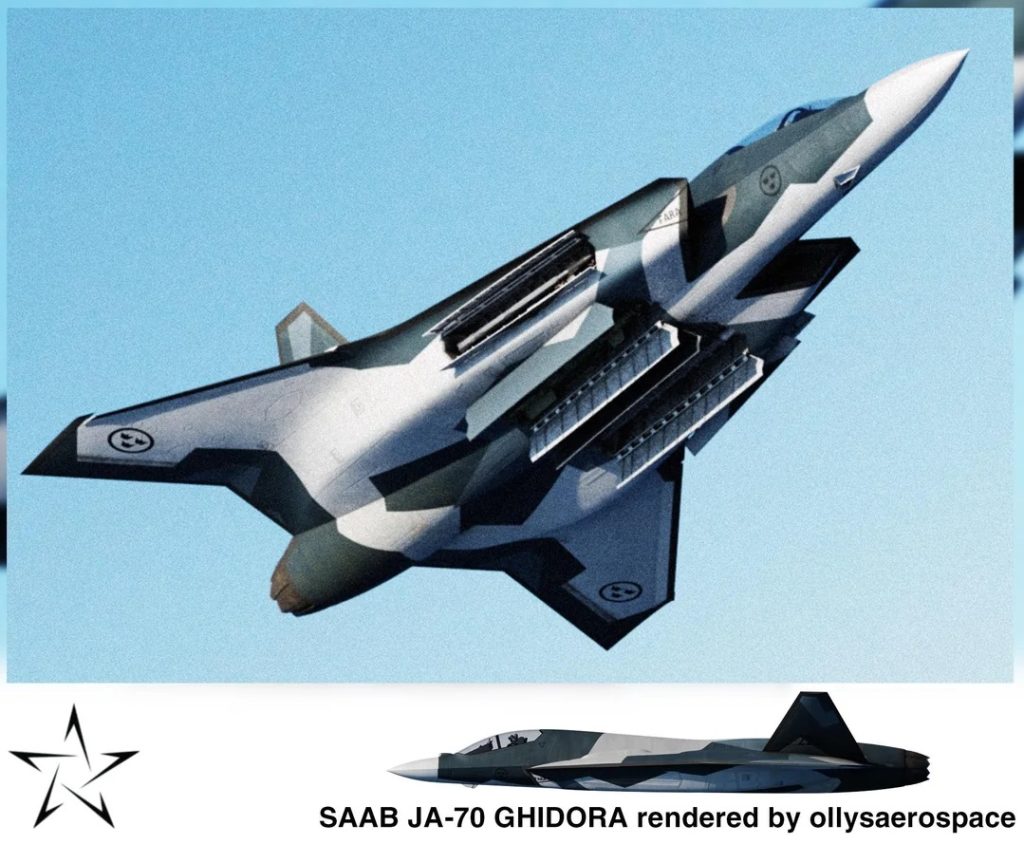
To preserve low observability, the Ghidora’s primary armament would have to be carried internally.
The considerable area and internal volume of its double-delta center section suggest that the aircraft could accommodate a primary central weapons bay and possibly additional smaller side bays for short-range air-to-air missiles.
A typical air-superiority loadout might consist of four to six air-to-air missiles.
A future development or successor to the European Meteor would be an obvious candidate.
For strike missions, the internal bays could accommodate several compact precision-guided weapons, anti-radiation missiles, or future miniature cruise missiles.
However, Saab would almost certainly preserve the pragmatic flexibility already associated with the Gripen.
Stealth is not necessary for every mission.
Once sophisticated enemy air defenses have been suppressed — or when performing routine patrol missions — the JA-70 could carry weapons on external pylons. Radar signature would increase dramatically, but total weapons capacity would rise by several times.
The aircraft would effectively gain a “missile-truck mode.”
The Ghidora could penetrate enemy defenses in a clean, low-observable configuration during the opening phase of a campaign and later return carrying a far heavier external weapons load.
Would It Still Carry a Gun?
For a combat aircraft entering service after 2040, an internal cannon is no longer necessarily an obvious requirement.
Saab might nevertheless decide to keep one.
The Gripen E still carries the 27 mm Mauser BK27. A future Ghidora could therefore receive either a substantially modernized derivative of this weapon or an entirely new lightweight 25–27 mm cannon.
The reason is simple: a Swedish fighter would be expected to remain highly versatile.
Using an expensive guided missile against a slow-moving drone or another inexpensive aerial target would not always make sense. A cannon would also remain a final option during close-range air combat.
For these reasons, Sweden might well decide that the gun still has a place aboard its next-generation fighter.
Estimated Specifications of the SAAB JA-70 Ghidora
Since the aircraft is an artistic concept rather than an official Saab project, the figures below represent an estimate of what the specifications of such an aircraft might plausibly look like if Saab were actually to develop it. They are not official figures.
- Crew: 1
- Length: approximately 17 m
- Wingspan: approximately 12 m
- Wing area: approximately 65–70 m²
- Typical takeoff weight: approximately 18,000 kg
- Maximum takeoff weight: 23,000–24,000 kg
- Powerplant: 1 advanced afterburning turbofan engine
- Maximum afterburning thrust: approximately 140–150 kN
- Maximum speed: approximately Mach 2
- Supercruise speed: approximately Mach 1.2–1.4
- Combat radius: approximately 1,300–1,500 km depending on mission profile
- Service ceiling: approximately 18,000–20,000 m
- Radar: multifunction AESA radar
- Additional sensors: distributed electro-optical system, IRST, electronic-support and signals-intelligence suite
- Armament: internal 25–27 mm cannon, internal weapons bays, additional external hardpoints
- Typical stealth air-to-air loadout: 4–6 air-to-air missiles
- Maximum external weapons payload: approximately 6,000–7,000 kg
- Additional capabilities: control of multiple uncrewed collaborative combat aircraft, networked operations with GlobalEye and ground- and sea-based sensors
Why the JA-70 Might Actually Be a Sixth-Generation Fighter
This creates an interesting terminological paradox.
If an aircraft like this actually entered service after 2040, calling it a fifth-generation fighter might already seem somewhat outdated.
Low observability, internal weapons carriage, supercruise, and extensive sensor fusion fit comfortably within the conventional definition of a fifth-generation combat aircraft.
But control of uncrewed wingmen, extensive use of artificial intelligence, operation as part of a distributed combat network, and the transformation of the aircraft into one element of a much larger combat system are all capabilities now commonly associated with the sixth generation.
A production Ghidora might therefore occupy the boundary between the two generations.
The Swedes, however, would probably not care very much about the label.
Saab has traditionally been more interested in achieving maximum combat effectiveness at an acceptable cost than in attaching an impressive generational number to its aircraft.
Could Sweden Actually Build It?
This is the most important question.
Technically, the answer may well be yes.
Sweden has preserved a complete combat-aircraft design tradition. Saab developed the Gripen E and continues to improve it. The country possesses extensive expertise in radar technology, electronic warfare, aviation software, sensor integration, and weapons integration. GKN Aerospace retains substantial expertise in military aviation propulsion. Finally, the Swedish government is already financing technologies related to a future combat aviation system.
But being technically capable of building an aircraft and being able to make the program economically viable are two very different things.
That is why a real JA-70 would almost certainly not be 100 percent Swedish.
Its engine might be developed together with a foreign partner. Some weapons would be European or American. Certain electronic components would also come from international suppliers. Saab might even seek one or more foreign partners from the beginning, offering industrial participation and local production in exchange for investment and future orders.
The Gripen experience provides a useful precedent.
The two-seat Gripen F, for example, was developed with extensive Brazilian participation and cooperation with Brazilian industry. The first aircraft completed its maiden flight on August 28, 2026.
A similar international industrial model might be precisely what would make a JA-70 program financially possible.
Not a Replacement for Gripen, but Another Layer of the System
There is another important reason why the arrival of the Ghidora would not necessarily mean the immediate retirement of the Gripen.
Sweden is only now introducing the Gripen E into operational service, while its current defense planning calls for maintaining six fighter squadrons. During the 2025–2030 period, three are intended to transition to the Gripen E while another three continue operating the Gripen C/D.
A new aircraft would therefore most logically be introduced gradually.
Initially, a relatively small number of JA-70s could serve as the most expensive and technologically sophisticated component of the Swedish combat-aircraft fleet. They would penetrate the most dangerous areas, coordinate uncrewed aircraft, destroy enemy air defenses, and establish air superiority.
Gripen Es would remain the everyday workhorses: carrying large weapons loads, performing air patrols, and launching stand-off weapons from safer distances.
Meanwhile, A3-type uncrewed aircraft and their successors would take on the highest-risk missions.
The result would be a very Saab-like combat system in which a relatively small number of expensive and highly capable aircraft multiply the effectiveness of a much larger number of cheaper platforms.
Ghidora: A Fantasy That Arrived at Exactly the Right Time
The SAAB JA-70 Ghidora created by MrGatsby1984 is, of course, still the product of an aviation artist’s imagination.
Neither Saab nor FMV has announced the development of an aircraft carrying this designation or name.
But what makes the concept so fascinating is how closely its appearance has coincided with real developments in Sweden.
Sweden really is studying what its combat aviation should look like beyond 2040. Saab really is exploring both crewed and uncrewed solutions. Technology demonstrators are already being funded. The company really is working on low observability, autonomy, and cooperation between different types of airborne platforms.
And in August 2026, Saab publicly revealed the A3-001 — an aircraft that visually demonstrates that the idea of a large Swedish low-observable “flying triangle” may not be nearly as far-fetched as it once appeared.
Perhaps Sweden’s future fighter will look completely different.
Perhaps Stockholm will ultimately decide not to develop another crewed fighter independently at all, instead concentrating on further Gripen upgrades and advanced uncrewed systems.
But if Saab does eventually decide to build a true successor to the Gripen, there is no reason why it should simply become a smaller Swedish F-35.
There is a far more interesting possibility.
A huge double-delta wing recalling the legendary Draken. One enormously powerful engine. Internal weapons bays. Low radar observability. The ability to operate from dispersed bases. Artificial intelligence. Several uncrewed wingmen. And a pilot who no longer commands merely one fighter, but an entire miniature aerial army.
Such an aircraft would certainly deserve the name Ghidora.
And perhaps the most remarkable thing is that, in 2026, the question of such a Swedish fighter no longer has to begin with:
“That will never happen.”
Instead, we can ask something much more interesting:
“What if the Swedes actually decide to do it?”
Sources
- MrGatsby1984, “SAAB JA-70 GHIDORA by me :3,” Reddit / ImaginaryAviation — the original artwork and fictional JA-70 Ghidora concept.
- Saab, “Saab Receives Order for Swedish Future Fighter Concept Studies,” March 22, 2024 — official information on Sweden’s future fighter studies and exploration of crewed and uncrewed concepts.
- FMV, Vägval stridsflyg program — official information concerning technologies and demonstrators for Sweden’s future combat aviation system.
- FMV, next phase of future fighter development — information concerning continued studies, funding, technology development, and preparations for a flying demonstrator.
- Saab, A3-001, August 2026 — official information concerning Saab’s full-scale uncrewed combat aircraft concept.
- Saab, Gripen E-series — official specifications and information concerning the Gripen E/F, its avionics, sensors, and operational concept.
- Government of Sweden, Defence Resolution 2025–2030 — information concerning the future structure of the Swedish Air Force and development of its Gripen fleet.
- Government of Sweden, development of dispersed Gripen operations — information confirming Sweden’s continued investment in distributed and temporary operating bases.