An article by Alexei Tarasov, published in the Cat_Cat community on the social network VKontakte. Publication date: April 25, 2018.
The Grim Reality of German Anti-Tank Capabilities
Germany did not become the country that invented the tank, but it did become a leader in anti-tank warfare. The need to combat enemy combat vehicles arose in the Kaiser’s army long before it had its own “Panzers.”
When it came to the battle between man and tank, the Germans devised and tested virtually everything. For this reason, they can rightly be considered the leading anti-tank power of the 20th century.
Many of their inventions in the fields of weaponry and tactics proved to be extremely successful, and after World War I, other countries quickly began to adopt and develop them. Some survived World War II unchanged, while certain types of weapons and tactics lasted into the 1960s—and even into the present day.
So, what can a single person or a small group of people do to stand up to a tank?
A very deep pit and other types of anti-tank obstacles
Perhaps the most obvious way to deal with them is to dig holes. Grab a shovel and dig a trap for “big game.” However, this method turned out to have more drawbacks than advantages.
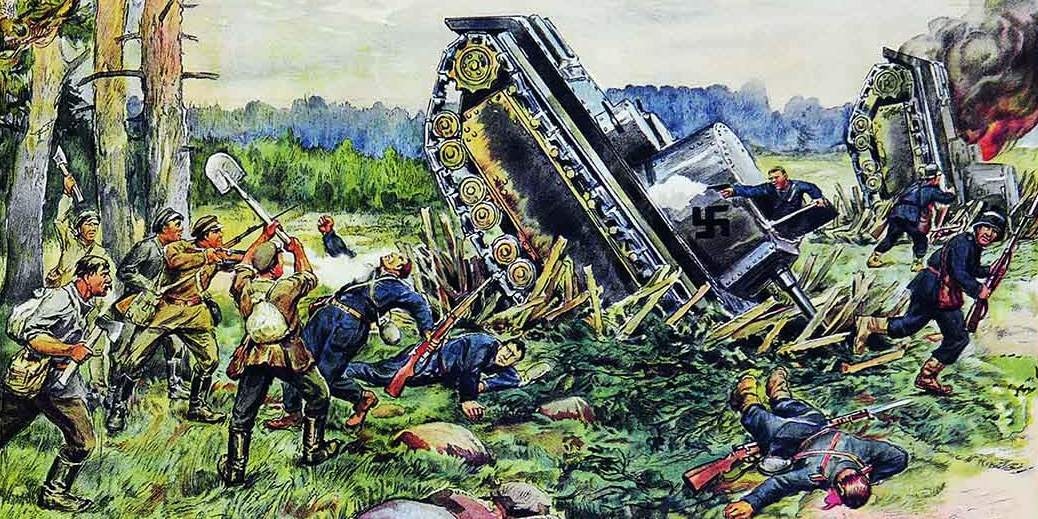
«Hit their weak spots with a shovel…» Soviet propaganda painted a very rosy picture of tanks falling into trap pits.
First, the notorious fog of war (or “fog of uncertainty”—a term referring to the unreliability or lack of data regarding the status of forces and their positions in the theater of operations. — Ed.). You spend hundreds of thousands of man-hours digging anti-tank trenches and traps, while the enemy shows up with his armored vehicles in a completely different location.
Second, engineering obstacles are completely pointless on their own without covering fire. At best, they can slow down the advance of enemy armored units or make their positions more vulnerable.
The shortcomings became apparent almost immediately. For example, during the Saint-Mihiel offensive in September 1918. At that time, the Kaiser’s forces’ anti-tank defenses were based on four components: camouflaged traps, mines, field artillery, and anti-tank rifles. Of the 18 “Schneiders,” 10 “Renaults,” and 30 “Saint-Chamons” that took part in the attack, only one tank fell into a camouflaged trap—and even that one managed to free itself from the pit under its own power.
One of the most sinister anti-tank inventions of World War I was the German Tanksperre (“Tank Barrier.” — Ed.). That war was the heyday of barbed-wire barriers—so the Germans came up with “barbed wire” for tanks.
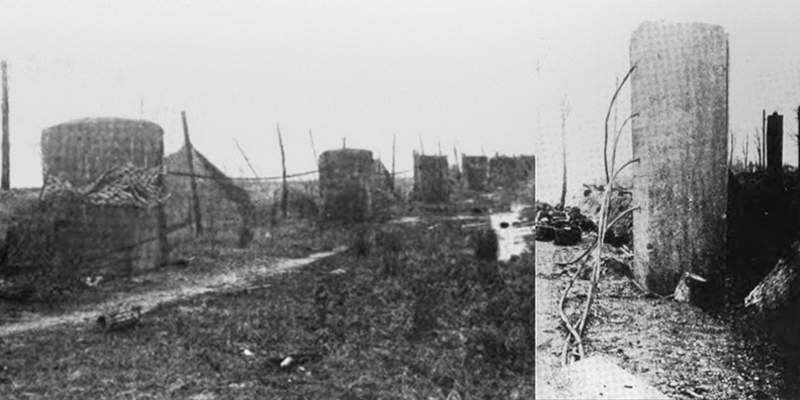
«Tank Barriers»
Powerful steel cables, each with a hook at one end—in case it became necessary to let their own troops through—were attached to the sturdy concrete pillars. Nearby were machine-gun positions that defended the structure against enemy infantry. It was believed that such barriers were capable of stopping even heavy tanks. But, like the “trap pits,” they had no significant effect.
Well, World War II effectively put an end to both passive methods of warfare and “continuous” defensive lines—from the Maginot Line to the Siegfried Line.
Paul D. Harkins—General Patton’s deputy chief of staff—called the Siegfried Line “the greatest monument to human stupidity.” George Smith Patton himself wrote:
“…I no longer have even the slightest doubt about the futility of constructing such structures. On just one section of the road along which the 76th Division successfully advanced, fifteen pillboxes were visible, not counting the dugouts and anti-tank trenches. And yet this division, consisting mainly of inexperienced recruits, overcame all obstacles.”

Some of the posts from the “tank barrier” that have survived to this day
Warning: Mines!
Minefields are a far more effective means of countering tanks. Mines can be carried on one’s person, and they are easier to lay and camouflage. And with the proper skills, an improvised explosive device can be constructed from any type of ammunition. This is exactly what the Japanese did on the islands of Borneo and Bougainville (on these islands, among other places, tanks were used during the Pacific War. — Ed.).
Admittedly, there is a downside: a minefield—just like pits, escarpments, or trenches—cannot be “moved.”
Any barriers must be supplemented with anti-tank weapons. And when it comes to laying mines, clearing mines, or creating effective improvised explosive devices, soldiers must have skills that go beyond simply knowing how to wield a shovel.
The Japanese eventually resorted to making IEDs (improvised explosive devices). And not because they were living the good life, but because their supply system in the Pacific theater of operations had “broken down.” There was simply a shortage of genuine, factory-made mines, as well as anti-tank guns.
Australian military engineer Major Young aptly described the “combination” of minefields and anti-tank artillery: “An anti-tank minefield is a spider’s web; anti-tank artillery is a deadly spider.”
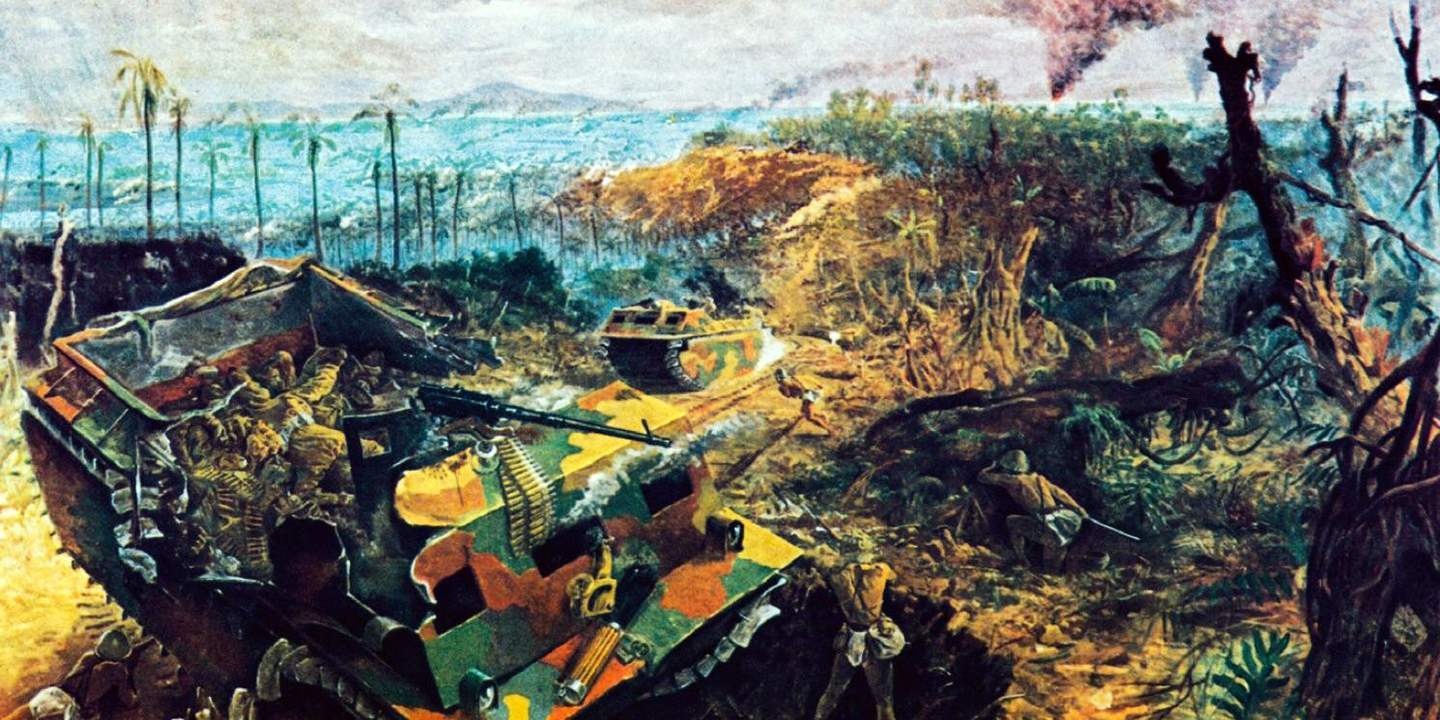
«The American attack is repelled by the brave defenders of Leyte Island.» In the background, a brave defender is seen holding a sword, and another is running toward an LVT with a bag of explosives, 1945. (Author: Yozushiro Terauchi)
But for minefields to be truly effective, you need to know exactly where the tanks will go—or “seed” the area with an incredible number of mines. And that is, perhaps, the biggest drawback of this type of weapon.
During World War II, the Allies considered a density of one mine per yard (0.91 m—Ed.) of the front line to be sufficient, which amounts to approximately one metric ton of Mk 7-type mines for a paltry 70 meters. In the Battle of Kursk, the density of anti-tank minefields reached up to 1,500 mines per kilometer of front line.
So, does that mean a mine can’t be an «individual» anti-tank weapon? Of course it can.
Boards, sticks, and other junk
«T-mines are the primary weapon for a tank-hunting unit. A T-mine is attached to a piece of sheet metal bent forward and upward, which, in turn, is attached to a stick approximately 4 m long.»
It sounds archaic, as if we were talking about a backward African country. But no. The Germans used tactics like these—this is an excerpt from a June 1942 directive on the operations of tank-hunting units.
Anti-tank mines—they were invented during World War I. By the start of World War II, Germany had refined both its munitions and tactics, devising a host of innovative techniques. However, other countries were not far behind.
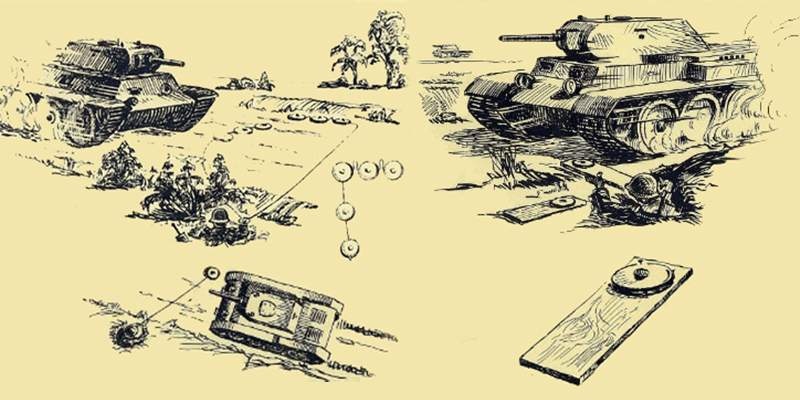
Mines on a String and Mines on a Board
Most of these methods required strict discipline and nerves of steel from the soldiers. But the instructions did not demand the impossible. First, it was recommended to destroy armored vehicles with artillery fire, and only if “it became clear that the fire was ineffective or would not lead to complete success” would tank destroyers equipped with rope-pulled mines enter the fray. Second, the mines were not considered “tank killers.” Their main task was to immobilize or damage the enemy combat vehicle.
Soviet troops also employed the tactic of laying mines in the path of advancing tanks. For example, during the Battle of Kursk, special sapper units were deployed whose task was to lay mines along the routes of enemy combat units as soon as it became clear where exactly the enemy intended to advance.
But what if you don’t have a mine handy?
Grenades and the Predecessors of Indiana Jones
If there are no mines or artillery, you’ll have to use grenades, explosive charges, canisters, and bottles filled with a flammable mixture. Basically, anything flammable or explosive that’s within reach.
The downside of this type of weapon is that it’s used at very close range. Moreover, enemy tank crews may not even give you a chance to throw a grenade at them—they’ll slow down at about 50 meters and calmly wait for their infantry to arrive, or they’ll suppress your resistance with machine guns. But if you’re lucky enough to get right up close to an enemy tank—any means will do.
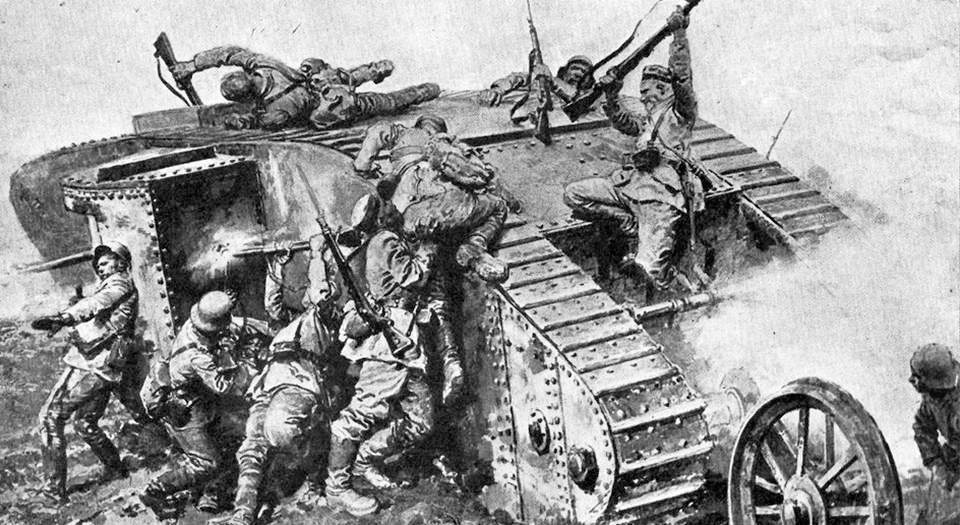
For example, a soldier is tasked with jumping onto a moving tank, breaking the fence over the supply depot with an axe, and throwing a grenade inside.
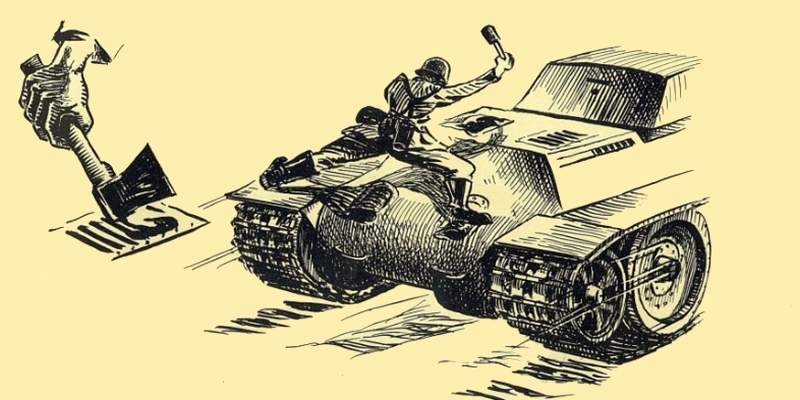
The method described above in a graphical representation
There is a story—one that isn’t backed up by documents, but is all the more beautiful for it. According to this story, German assault troops (Stosstruppen) in World War I were supposedly trained to destroy British “diamond tanks”: a soldier was supposed to let an enemy tank pass or run around behind it, grab onto the track with his hand, and ride it up to the roof. Then they’d toss a bundle of grenades into the open hatch and jump off just in time.
It’s pretty much like in «Indiana Jones,» only without the whip and the hat.

Given how “crazy” the assault troops of the Great War were, this story is quite believable.
Crazy Bernhard and the Flamethrowers
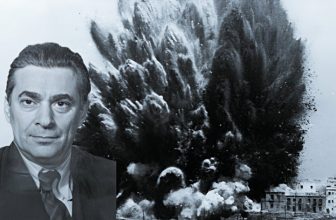
Here, however, is another fact that is fully corroborated. The photo shows tests conducted on February 12, 1918, by Major Bernhard Redemann. The tests revealed that when a Mark IV heavy tank was fired upon with a flamethrower, the oil and fuel residue on the hull would ignite, after which the oxygen would be rapidly “sucked out” of the fighting compartment.
The irony is that before World War I, Bernhard Redemann served as a firefighter in Posen, and during the war he commanded flamethrower units.
During the shelling, he was personally inside the tank, and after the vehicle caught fire and the oxygen began to be drawn out, he was forced to “evacuate in a hurry.”
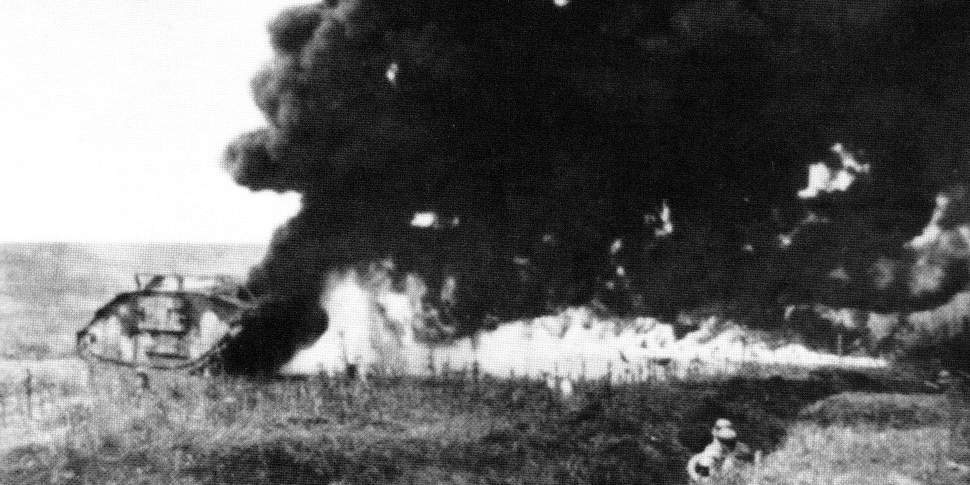
They weren’t testing the flamethrower just for the sake of it—they actually used them against tanks. Conditions made this possible: British and French tanks were slow, so infantrymen were able to keep up with them even despite the flamethrower’s considerable weight (31–24 kg) and the plowed battlefields.
The backpack flamethrower was also used as an anti-tank weapon during World War II—though mainly against immobilized vehicles.
Anti-tank artillery, rifles, grenade launchers, and anti-tank guided missile systems have been deliberately left “behind the scenes.” They are undoubtedly interesting from the perspective of their use and tactics and deserve a separate discussion. More on them next time.
Source: https://warhead.su/2018/04/25/kto-kogo-chelovek-protiv-tanka
Source: https://vk.com/@catx2-who-is-a-person-against-a-tank